Products & Materials : Building Trade Materials News

RCM invests in own transport

RCM have recently purchased their own branded delivery vehicle in order to guarantee a better service to their customers. RCM, the complete though wall solutions provider, have invested in their own company delivery vehicle in order to better meet customer’s requirements. In the past, RCM, part of the Benx group

Read More »

Low Carbon Cement Solution Launched

A new low carbon cement solution has been launched by Aggregate Industries business Lafarge Cement. Lafarge Endure SR is a high performance, low carbon, CEM II blend cement. It blends Portland fly ash (PFA) with clinker, which results in a lower embodied CO2, as well as improved plastic and hardened

Read More »

BASF to Start Sale of 2.7 Billion Euros Construction Chemicals Arm

BASF SE has kicked off a sale process for its construction chemical business, which could fetch about 2.7 billion euros ($3 billion), people with knowledge of the matter said. The German company has started to contact select interested parties, a BASF representative said in response to Bloomberg queries, declining to

Read More »

Södra Wood named Best Timber Brand at BMJ Awards

Leading suppliers, manufacturers and merchants descended upon The Brewery, London earlier this month for one of the most hotly anticipated fixtures on the builder’s merchants’ calendar: the BMJ Industry Awards. Södra Wood had an excellent year, victorious in the Best Timber Brand category after receiving a great response in the

Read More »

Zinsser, Perfecting Paints and Primers for 170 years

Zinsser, the brand famous for solving painting and decorating problems, celebrates 170 years of producing industry leading paints, primers and removal solutions. The Zinsser brand was originally created in 1849, when William Zinsser set up the United States’ first shellac beaching plant on Manhattan’s west side and introduced shellac paint

Read More »

What’s the Difference Between Plastering & Rendering?

For those who sit outside of the plastering trade, a question that gets commonly asked is ‘what is the difference between plastering and rendering?’ While some may just want to seem more in-the-know when they’re talking to the plasterer, others may be struggling to distinguish between what are two very

Read More »

Cavanna Homes Invests in Artisan Bricklayer

Traditional, handcrafted building styles have made way for more cost-effective and less time-consuming modern-day methods as the homebuilding industry works hard to deliver the government’s ambitious target of 300,000 new builds each year. In the Westcountry however, fourth-generation family firm Cavanna Homes is investing in the skills of an artisan

Read More »
Latest Issue
Issue 335 : Dec 2025

Products & Materials : Building Trade Materials News

RCM invests in own transport

RCM have recently purchased their own branded delivery vehicle in order to guarantee a better service to their customers. RCM, the complete though wall solutions provider, have invested in their own company delivery vehicle in order to better meet customer’s requirements. In the past, RCM, part of the Benx group of companies, arranged deliveries of their building boards and facades through large third party hauliers. Whilst still utilising this delivery network, the additional ownership of a 26t rigid vehicle brings with it many advantages. Investing in process improvements that will benefit and support their customers by providing more efficient and cost-effective services has been one of RCM’s main commitments. Some of the obvious benefits will include the ability to exercise greater control over the distribution to better address customer’s requirements. Operating costs will be better managed and there will be clear improvements on driver’s MPG. The number of drops per day can also be better managed, thus ensuring optimization and efficiency on a national scale. RCM will be able to improve their customer service, by reducing the reliance on third party providers.  There will be a guaranteed capacity at all times, with the ability to support RCM’s customers on a postcode/network basis. The latest specification Euro 6 vehicle brings improved fuel consumption and less emissions and therefore is better for the environment. “Delivery of our building boards and façades ranges to high value projects is now even better serviced by the recent investment in the company owned delivery vehicle.  It will allow us to act much quicker and more efficiently to our customer’s needs and requirements.” (Ian Quinton, Managing Director, RCM)

Read More »

Low Carbon Cement Solution Launched

A new low carbon cement solution has been launched by Aggregate Industries business Lafarge Cement. Lafarge Endure SR is a high performance, low carbon, CEM II blend cement. It blends Portland fly ash (PFA) with clinker, which results in a lower embodied CO2, as well as improved plastic and hardened properties when used in concrete. Unlike a CEM I blend, Lafarge Endure SR is suitable for all ground types. Sulphates in the ground can negatively impact CEM I blends. However, Lafarge Endure SR is resistant to sulphates, allowing contractors and suppliers to scope a wider variety of projects including those that may have previously been hindered by ground type. Once hardened, Lafarge Endure SR can be used to DC-4 durability standard and can help increase the life of the structure thanks to its resistance to carbonation and chloride and sulphate attack. This makes it ideal for practically any situation, from producing ready-mixed and precast concrete, to marine, grouting and tunnelling applications. “As its name suggests, Lafarge Endure SR is designed to dramatically increase the longevity of the concrete it forms a part of. It is a great solution for contractors that want to reduce the environmental impact of their build while simultaneously improving its life span,” said Steve Curley, Commercial Director at Aggregate Industries. “In addition to its lower embodied CO2, Lafarge Endure SR uses 10 percent less water than CEM I to reach workable consistency and offers improve pumpability and mixing efficiency. Each of these benefits adds up to a cement that is truly forward-thinking,” he added.

Read More »

BASF to Start Sale of 2.7 Billion Euros Construction Chemicals Arm

BASF SE has kicked off a sale process for its construction chemical business, which could fetch about 2.7 billion euros ($3 billion), people with knowledge of the matter said. The German company has started to contact select interested parties, a BASF representative said in response to Bloomberg queries, declining to comment further. Carlyle Group LP and building-materials maker Standard Industries Inc. are among potential suitors considering offers for the unit, the people said.It could also attract interest from other private equity firms including Bain Capital, Cinven and KKR & Co., according to the people, who asked not to be identified because the information is private. The BASF unit generated earnings before interest, taxes, depreciation and amortization of 245 million euros last year on 2.4 billion euros of sales, the people said. Potential bidders may seek to value the business at around 11 times earnings, according to two of the people. BASF expanded in construction chemicals through its 2006 acquisition of a Degussa AG unit. The German company has struggled with scale as well as the complexity of the market, since local construction techniques can differ even from country to country. Consolidation in the building-materials industry has strengthened the hand of enlarged companies when negotiating with suppliers of grouts, mortars and admixtures, which are added before or after mixing cement to enhance properties like drying times and water content. BASF Chief Executive Officer Martin Brudermueller announced a strategic review of the business in October, and the company has said it aims to reach an agreement by the end of this year. Any transaction would add to the $34 billion in acquisitions of European chemical and industrial companies announced this year, according to data compiled by Bloomberg. CVC Capital Partners agreed in January to sell Parex Group to Sika AG for 2.5 billion Swiss francs ($2.5 billion) including debt, valuing the French producer of construction chemicals at 12.8 times earnings. No final decisions have been made, and there’s no certainty the suitors will proceed to submit offers for the BASF business, the people said. Representatives for Bain, Carlyle, Cinven, KKR and Standard Industries declined to comment.

Read More »

Södra Wood named Best Timber Brand at BMJ Awards

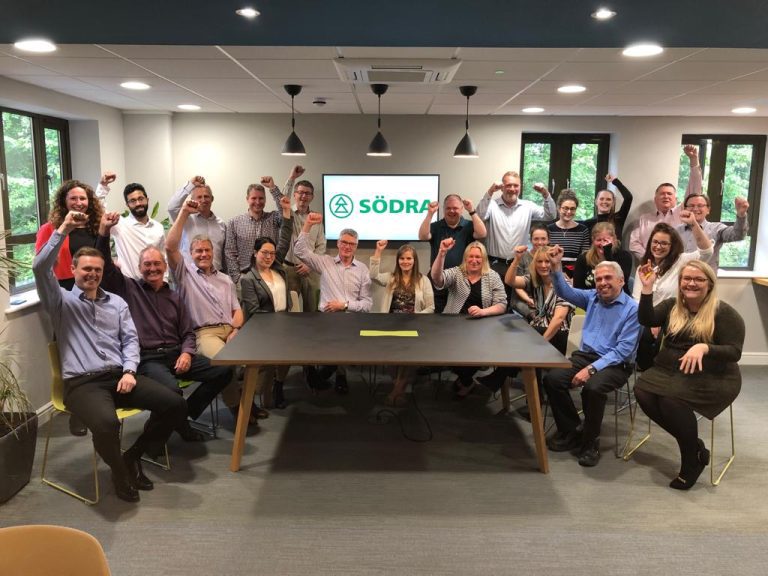
Leading suppliers, manufacturers and merchants descended upon The Brewery, London earlier this month for one of the most hotly anticipated fixtures on the builder’s merchants’ calendar: the BMJ Industry Awards. Södra Wood had an excellent year, victorious in the Best Timber Brand category after receiving a great response in the industry voting stage. On winning the award, Södra Wood UK’s Managing Director, Simon Henry, commented: “To receive such recognition from the industry within only a couple of years of really investing in the UK market is testament to the type of business Södra is: focused on meeting industry needs, delivering sustainable timber supply and generating long-term partnerships with everyone we work with. “This award is fantastic recognition for all of the hard work and dedication of the Södra UK team. I was truly humbled at the ceremony, and I’d just like to again thank all of those who have supported Södra and voted for us. We really value the support.” The award caps off what has been a stellar 18 months for Södra. Last year, Södra celebrated its 80th anniversary and recently announced news of best-ever financial results and plans to expand its production of cross-laminated timber. Simon says this success is due, in part, to Södra’s “long-term approach.” He commented: “As a business, we’re committed to a continued focus on growth, sustainability and innovation. But central to all of that is the long-term relationships we build with the people we work with. It’s why this award is so special, because it’s voted for by those in the industry.” For more information, please visit www.sodra.uk

Read More »

Government to Give £200m to Replace Grenfell-Style Cladding: Is it Enough?

The government has confirmed that it will allocate £200 million to fix private tower blocks that are wrapped in combustible aluminium composite material cladding, the same kind that sent the Grenfell Tower block up in flames back in June 2017, claiming the lives of 72 people. This decision is a response to the anger over freeholders and developers that have refused to fund the costs of replacing the hazardous cladding in their buildings. Whilst many have praised the funding as a “step in the right direction”, there are concerns that the amount is just not enough. Two Years Since Grenfell On 14th June 2017, a fire broke out in the 24-storey Grenfell Tower block of flats in North Kensington, West London. It was the deadliest structural fire in the UK since 1988 and the worst residential fire since World War II. The fire was started by a malfunctioning fridge-freezer on the fourth floor and spread rapidly up the building’s exterior. The devastating spread of the fire that claimed so many lives and injured many more was attributed to the building’s cladding. Grenfell’s exterior cladding was aluminium sandwich plates with polyethylene core and insulation made of PIR (polyisocyanurate) foam plates. According to the police, both of these materials later failed fire safety tests that were conducted after the fire. It was later discovered that the project team for Grenfell chose the cheaper, combustible material despite the nationwide warning that the combustible insulation used should only be used with cladding that does not burn. There are estimated to be 600 high-rise blocks of flats in the UK that have similar cladding to that in Grenfell. In October 2018, the government announced plans to ban flammable cladding on newly built buildings, however, it has been argued that it should be banned in its entirety, also applying to existing buildings. Leaseholders Facing a Crisis Thousands of people across the UK reside in tower blocks that use the same kind of cladding as Grenfell. As a result, residents have been suffering bouts of stress, depression and suicidal feelings; living in unsafe homes is taking a serious toll on people’s mental health. Whilst some landlords have stepped up and vowed to replace their building’s cladding with safer materials, others have refused to pay. Some leaseholders have been forced to start their own 24-hour patrols of their buildings to ensure that fires don’t break out, whilst other’s homes have become unsaleable. For developers refusing to pay for cladding replacement, the costs have been passed onto their leaseholders who have been footed with the bill. This has caused a deadlock between leaseholders who cannot afford to pay, and developers who say they are not obliged to pay under law. Leaseholders are facing bills of tens of thousands each to fix the buildings. In Burton Place in Manchester, the residents were told that they would be facing a bill of £80,000 each for repairs to replace wooden cladding, combustible insulation and missing fire breaks. Of the recent funding announcement, Prime Minister Theresa May said: “It is of paramount importance that everybody is able to feel and be safe in their homes. That is why we asked building owners in the private sector to take action and make sure appropriate safety measures were in place. “And we’ve seen a number of private building owners doing the right thing and taking responsibility, but unfortunately too many are continuing to pass on the costs of removal and replacement to leaseholders.” People fearing another disaster on the scale of Grenfell are looking to their representatives for answers. It is clear that there is mass confusion as to why, after widespread acceptance that fire safety remediation is needed, two years later thousands have been left to live in homes that are unsafe, and so far, very little has been done. The safety threats of living in buildings with unsafe cladding combined with the financial stress of not being able to afford to the costs of replacement is said to be ruining lives. How Far Will £200 Million Go? The £200 million in funding comes after lobbying from leaseholders who said the unsafe cladding in their buildings was making them fear for their lives in their own homes. And after the government’s preferred solution of asking building owners to do the right thing and pay for the work has failed, this funding is a much needed welcome. However, the UK Cladding Action Group that launched a campaign back in March to secure the funding for residential properties have stressed that the money, whilst welcomed, will not cover the costs of removing all the cladding. One of the founders of the group, Rituparna Saha, lives in Northpoint block in Bromley, where leaseholders are facing combined costs of £3.5 million for cladding replacement alone. She claims that news sets up a “cladding lottery”, as the funding will only cover aluminium composite material (ACM) panels which helped spread the fire in Grenfell, but combustible non-ACM cladding would not be covered. Latest figures show that, of the 176 buildings identified as having ACM cladding since the disaster, 166 of those have yet to have had any work started on them. The funds will be made available to remove the cladding from these high-rise buildings across England. Building owners will have three months to claim the funds, with the condition that they take “reasonable steps” to recover the costs from those responsible for the cladding’s presence, citing that the Government has “committed to cover the cost temporarily”. Grenfell United, a group of survivors and the bereaved, have praised the news as offering hope to people who feel at risk at home.   This article was written by Stephen Horin, Managing Director at Bushbury Cladding. Bushbury Cladding are a family run business who have been supplying corrugated steel roofing sheets and wall cladding sheets for many years.

Read More »

Zinsser, Perfecting Paints and Primers for 170 years

Zinsser, the brand famous for solving painting and decorating problems, celebrates 170 years of producing industry leading paints, primers and removal solutions. The Zinsser brand was originally created in 1849, when William Zinsser set up the United States’ first shellac beaching plant on Manhattan’s west side and introduced shellac paint products to the US market. Zinsser now manufactures its range of UK products in County Durham and has remained true to William Zinsser’s principals of quality and innovation by continuously producing world-class, professional quality and fast-drying formulas that make problem solving simple. Whether you’ve got graffiti to cover up, fire damage, or a big issue with mould and mildew, Zinsser products are the muscle you need to wipe out all decorating nightmares in the home or on commercial projects, quickly and for good. The Zinsser range of products include professional coatings for interior and exterior use and each of Zinsser’s paints, primers and removal solutions can be depended upon to do the job right, making the brand a must-have in any decorators van and a top-seller for paint merchants. One of Zinsser’s most popular products which has never been matched or bettered is B-I-N®, the original shellac-base primer-sealer. This “silver bullet” primer, sealer and stain killer offers unparalleled adhesion to glossy surfaces, dries in just 15 minutes and is recoatable in 45 minutes, saving both time and money. B-I-N’s unique formula gives it unsurpassed stain-killing power and covers everything unwanted, from water damage, to fire damage and more. It’s the best primer for sealing interior wood and is the “go to” for spot priming knots or sap streaks inside and out, making it a key staple in any decorators van. A newer customer favourite in the range is Zinsser AllCoat Exterior, available in Matt, Satin and Gloss finishes. This clever paint offers resistance to mould, cracking, blistering and flaking as well as rain and severe weather. Suitable for use with all exterior surfaces, such as wood, metal, masonry, plastic concrete and cladding, it forms a low-maintenance water-shedding coating in one hour and can be painted with a second coat after one hour. This self-priming paint is another superior product that enables jobs to be completed quickly, efficiently and brilliantly. As Zinsser AllCoat Exteriorpaint can be matched to any RAL / BS or NCS colour reference, including designer colours. Alongside an outstanding problem solving product range, Zinsser also ensures decorators and DIYers are armed with the correct knowledge to use products efficiently, ensuring each job is competed correctly. The Zinsser Pocket Guide, which is available as an app and printed book, is packed with expert advice on primers and finishing substrates, with detailed guidance and specialist product recommendations. Zinsser’s UK-based Technical Support team are on hand to answer any questions and offer expert advice. They can quickly tell you which product is best suited to a job, give advice on the best method of application and help establish how much paint is needed. Zinsser’s UK based specification service is also available free of charge, often working with professional specifiers, architects, maintenance managers, FM companies, property owners and professional on-site spray contractors to solve a wide variety of painting problems. The experienced team helps at every stage of a project, from initial survey through to specification and application of coatings, providing on-site advice, training and technical assistance.

Read More »

Use and Applications of Expanded Metal and Wire Mesh for Industry and Architecture

Expanded metal is obtained by cutting and simultaneously ironing the sheet metal. This process creates diamond-shaped openings in the material that allow the free flow of air, fluids or light.  This type of metal is produced from a sheet of any solid metal, including stainless steel, aluminum, galvanized steel, titanium or copper. Expanded Metal, a versatile product Expanded metal includes diamond shaped openings, which distinguish it as a versatile and commonly used product in areas such as platforms, walkways, conveyor belts and railway fences, and others. It can also be retrofitted to existing gratings, floors or diamond sheets and in many areas is a cost-effective solution. Here are four common types of expanded metal.   The most common forms of use of expanded metal for Industry are circles, squares and diamonds, of which diamonds are the most requested forms because of the form’s ability to absorb energy and resist mechanical deformation after installation. Other aspects of construction are represented by the dimensions and angles of the shapes, which also influence the way in which the metal absorbs energy and the point where the energy spreads throughout the expanded metal. Wire cloth can be used in many specific applications and is available in many fabric and material versions. This type of product is an element that allows the use of different types of protection, support and custom applications. The metallic fabric is braided together with a manufacturing process specialized in industrial production factories. Expanded Metal as durable material for construction Expanded metal is commonly used for the construction of fences, walkways and grids, as it is a very robust and durable material. Wire mesh, on the other hand, is lighter and also less expensive. Thanks to the small openings of the material, it is possible to pass through air, water and light, while maintaining a mechanical barrier to larger objects. A further point in favour of using expanded metal, unlike simple metal, is that the exposed edges of expanded metal offer greater adhesion, which has led to its use in walkways or drainage covers. Metal mesh screen is a particularly ductile material for use in many applications. Flexible, individual, resistant and eco-sustainable, the decorative wire mesh is available in different models.   Expanded metal in the Construction Industry Expanded metal is used by the construction industry as metal strips to support elements such as plaster, stucco or adobe in walls and other structures.   Expanded Metal in Modern Architecture In the field of modern architecture, expanded metal or steel mesh are an exposed or screen material that can be transformed into simple or complex decorative forms. Photographic images can be printed on the surface, creating textures or large graphic images that allow light to filter through the external surface of a building.   Wire Mesh for Industry Wire mesh is widespread in the industrial, transport, agricultural, horticultural and food sectors. The characteristic that makes wire mesh such a versatile product is that it can be produced in an unlimited number of specifications. Depending on the manufacturing possibilities, there are almost countless possibilities for combinations of aperture sizes and wire diameters that can be achieved, depending on whether we are talking about woven or welded construction.   Wire Mesh in Modern Architecture Wire mesh has significant benefits for conventional architectural materials leading to greater freedom of modern and flexible design. Its very nature allows it to be used in a very wide range of architectural projects, starting from the interior and ending with the exterior and external applications. You can create impressive visual effects while being strong, durable and flexible.  Whether it is a single part or a combination of parts, the wire mash can be tailored to any architectural project or construction.

Read More »

What’s the Difference Between Plastering & Rendering?

For those who sit outside of the plastering trade, a question that gets commonly asked is ‘what is the difference between plastering and rendering?’ While some may just want to seem more in-the-know when they’re talking to the plasterer, others may be struggling to distinguish between what are two very similar practices. Fundamentally, the two main differences lie in their use and their composition. In terms of practical use, rendering is the coating of external walls, whilst plastering is the coating of interior walls. Whilst both are composed primarily of cement, sand, water and lime gypsum, render features a much heavier composition. Here, we discuss the purposes of both so you can help separate the two once and for all. The Purpose of Rendering Rendering is the process of coating the exterior surfaces of buildings; a process used to waterproof and fireproof the exterior, as well as enhance the aesthetics. Render material is made up of the same ingredients as plaster but features a much heavier cement base, which makes it fit for external purposes. Fine sand and lime gypsum are utilised in the mixture in order to provide a smooth finish. Render represents the final layer on exterior walls, and can be finished as smooth, flat, textured or patterned, depending on the requirements of the client. The Purpose of Plastering Plastering is the process of coating the interior walls and ceilings of a building, so they’re fit for painting or wallpapering. The mixture contains less cement than that of render and utilises less coarse sand, which provides a lighter, smoother finish than its external counterpart. Whilst both are mortar coatings that rest on top of blockwork, plaster is not weather resistant, offering more of a decorative function that is water repellent and easily cleaned. It also holds fireproofing qualities, particularly in older buildings that are constructed from mud or clay. Of course, both share strong similarities. Their makeup includes the same ingredients, and their functional purpose is more or less the same. The important point to distinguish is their differing anti-abrasion properties. For a new house build, it’s essential the exterior is comprehensively rendered to avoid damage and potential collapse from moisture build up. When plastering, make sure to leaves freshly laid plaster for anywhere from a week to a month to dry before beginning painting or wallpapering. Naturally, such jobs are best carried out by a professional, so search for ‘local plasterers near me’ to find a quality, good value tradesmen to do the job for you.

Read More »

Cavanna Homes Invests in Artisan Bricklayer

Traditional, handcrafted building styles have made way for more cost-effective and less time-consuming modern-day methods as the homebuilding industry works hard to deliver the government’s ambitious target of 300,000 new builds each year. In the Westcountry however, fourth-generation family firm Cavanna Homes is investing in the skills of an artisan bricklayer to help define the character of its homes and developments, in turn, helping to keep the ancient craft of stonemasonry alive. Born and bred in the South Hams, Terry Newman currently spends his three-day working week as a subcontractor for West Country Brickworks Ltd on projects for Cavanna Homes, which has its headquarters in Torquay and is in its 96th year. Cavanna Homes incorporates stonemasonry in its developments to reflect a local vernacular and to make a new scheme look more mature so it immediately fits into its existing surroundings. Work incorporating traditional stonemasonry skills is intricate and time consuming: a three-metre stone panel takes around a day to build, while the same sized panel in bricks takes half-a-day, or a couple of hours for concrete blocks, plus wet weather can prolong a job involving stone work because the materials must be kept dry. “Nowadays, time and cost are big factors in the house building industry,” says bricklayer Terry. “So if a developer includes stonemasonry in its schemes, they’re adding time, and time is money! I take my hat off to those firms including stonework at their new developments; it not only adds character and charm to modern buildings but it’s keeping the tradition alive.” Terry trained as a bricklayer at South Devon College in the late 1970s when stonemasonry was included in the course, completing an apprenticeship with a local firm which “happened” to include stonemasonry in its remit. Nowadays, there are no colleges offering stonemasonry courses west of Bath and Weymouth, and you’ll be hard-pressed to find a construction or bricklaying course which offers even a hint of stonemasonry. But Terry has used the skills of his industry’s forefathers ever since his teens. At Cavanna’s Dartington developments, Origins and Yarners Mill, Terry created stone walls and panels to add historic charm to the homes in-keeping with their position in the picturesque Dart Valley, and one of his most recent tasks has been the construction of a 30-metre wall at the entrance of Cavanna @ Wolborough Hill – a collection of 26 luxury-style homes in Newton Abbot – to replace the original wall. Also on his immediate list of pending jobs is replacing the coping (the top of a wall which acts like a lid, keeping the rain out) at Palstone Meadow – Cavanna’s 26-home development in South Brent – and building a wall at Kings Orchard – Cavanna’s emerging 53-home scheme in Stoke Gabriel. Traditionally, stone doesn’t tend to travel very far after it’s excavated, so where the job is determines what type of stone Terry works with. “In Cornwall it’s always shillet which is quarried there and has been used for building for centuries,” he says. “And in South Devon I often work with Stoneycombe, Glendinnings, Yennadon and Mill Hill Quarries stone, excavated on the doorstep.” Type “stonemasonry” into Google and you’ll find numerous glossaries explaining the terminology, which is often linked to the geography as well as the stones themselves. Take the style of the coping at the wall at Cavanna @ Wolborough for example. Bricklayer Terry describes it as “cock and hen” (where vertically placed stones run along the top of a wall). “I don’t know why it’s called cock and hen,” laughs Terry. “That’s what we call it down in the Westcountry.” Elsewhere, it’s known as “buck and doe”. Terry also describes using a method called “snail creep pointing” on the walls at his son’s house in Ivybridge. The effect can be achieved by using the handle of a metal watering can, cut in half. “It looks lovely when it’s finished,” Terry says, offering an insight into the intricacies of his craft, which includes being resourceful. Around a century ago it was typical for stonemasons to wade into rivers to collect stones. In the 90s, at a private residence in the South Hams, Terry found himself thigh-deep in a river which ran through the grounds, collecting stones to make sure the buttress he was building blended with the existing structure. Terry explains that stone can either be left in its natural state, known as rustic stone, or can be cut, so the face of the stone (the part which faces out, forming the side of the wall) has a smoother finish. Terry prefers the former and describes working with “random rubble”, the technical term for a mixture of different sized and shaped stones, which makes his job rather like a giant 3D jigsaw puzzle. Stonemasonry involves a huge variety of different styles and techniques and there is also far more to the pointing (or jointing) work (the joining together of the stones) than merely cementing between bricks. “At Origins I had to keep the jointing quite flush and create an indent of about half-an-inch between the stones,” he explains. “So instead of the surface being flat, the stones protrude a little. Usually the style will be down to the architects who designed the buildings, although often it will be the site manager who decides the finish.” For the wall at Cavanna @ Wolborough, bricklayer Terry said his biggest challenge was finding stones with “good faces”. “With slate or shillet you’ll use a larger quantity of stone but because of their shape it’s almost like stacking them on top of one another, whereas with random rubble a lot goes to waste because you have to have stones with good faces and which sit up well to create a wall with them. Although sometimes they won’t do either!” Although building in stone can be costly and slows down the build process, when completed to a high standard it gives a far higher quality finish.

Read More »

Ibstock Brick Wins Regional Business Award for its Commitment to Sustainability

Ibstock Brick has been announced as a winner in the category of Most Ethical / Sustainable Manufacturer of the Year at the 2019 at the Made in the Midlands Awards. The awards, coordinated by leading business publisher, INSIDER Media, took place in Birmingham on May 2nd 2019. They celebrate excellence and achievement from businesses based in the Midlands region. Ibstock was recognised for its commitment – through its products and processes – to ‘forging a more sustainable future for the company and region’. The judges were impressed by Ibstock’s demonstration of its social and environmental concerns – and the way this has become part of its wider business strategy. As the UK’s leading brick manufacturer, Ibstock Brick is proud to be at forefront of responsible manufacturing – both in the Midlands region and elsewhere in the UK. Sustained investments in energy efficient plant, clean technologies and performance improvements are coupled strong commitment to skills-building and community engagement. The judges cited the company’s unique People First approach to sustainability – commenting that this methodology set Ibstock apart from the other shortlisted businesses. As winner of the Most Ethical / Sustainable Manufacturer of the Year category, the Ibstock team will take part in the INSIDER Media National Finals in June 2020. Commenting on the Made in the Midlands award win, Michael McGowan, said: “This is the latest in a long line of high-profile award wins that recognise the positive impacts we are making in terms of sustainability and we are absolutely delighted to receive it. Our win is very much testament to the hard work of our colleagues across the business. Sustainability is embedded within our business culture and we could not be prouder to lead the way both in the Midlands and further afield.” Ibstock Brick was also shortlisted in the category of Manufacturer of the Year (Over £25M).

Read More »