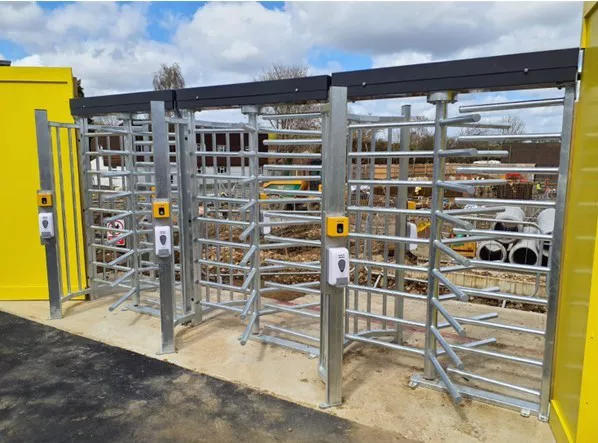
Construction job sites present a unique safety challenge. Equipment moves in and out constantly, crews change shifts, and temporary workers or visitors may arrive throughout the day. When you have strong access controls, these conditions are managed rather than creating opportunities for unauthorized entry, theft, and safety risks. Turnstile security systems solve many of these problems by creating controlled entry points that help ensure only credentialed personnel gain admittance to your industrial site. With the right configuration, automated “cheesegraters” also integrate with connected job site management software, RFID badges, and credential readers to support occupancy monitoring and workforce tracking. These solutions highlight how turnstiles and gates work hard to manage different security applications effortlessly. 1. SecureTurn HT431 — Single Full Height Turnstile The SecureTurn HT431 is a purpose-built full height design for rugged environments. Its floor-to-ceiling design helps create a strong physical barrier that deters unauthorized entry while allowing credentialed workers easy and efficient entry. Constructed with American-made steel, the HT431 handles demanding conditions common to construction job sites. It integrates seamlessly with card readers, biometrics, and proximity scanners, so site managers can control passage through a centralized security system, playing to the market trend where 40% of all new turnstiles are smart tech-enabled. The unit also includes the ARC (Automatic Rotational Control) mechanism, which regulates arm movement throughout the entire rotation. Maintaining a consistent rotation speed helps protect users and reduces equipment wear. It comfortably fitsa 31″ passage width for easy worker entry and is durable, making it well-suited for industrial environments. For long-term industrial projects that require reliable access control, the HT431 delivers a durable and efficient entry solution. 2. SecureTurn HT431T — Tandem Full Height Turnstile Large job sites often need multiple lanes to manage worker influx efficiently. The SecureTurn HT431T addresses this challenge by combining two full height turnstiles into a single welded unit. The tandem configuration improves personnel movement. Not to mention, separate entry and exit lanes help prevent congestion and keep crews moving during peak periods. Each rotor includes the ARC mechanism, providing safe operation and long-term reliability. As with the single unit, it integrates seamlessly with credential readers and access control software, automating entry. For busy construction projects with hundreds of workers entering daily, a tandem configuration often provides the most efficient entry control setup. 3. SecureTurn HT431P — Portable Full Height Turnstile Industrial sites rarely stay static, and entry points change as fencing moves and new phases of work begin. The SecureTurn HT431P portable full height turnstile provides a flexible solution for these changing conditions. This system ships fully preassembled on a forklift-ready steel base. Crews can quickly unload the unit from the truck and position it, allowing security teams to establish access control within minutes. The modular design allows additional lanes to be added or removed as job site needs evolve. Portable solutions like the HT431P offer a practical way to secure temporary job sites without permanent infrastructure. 4. SecureTurn HT80 — Aluminum Full Height Turnstile If your project needs full height security but you want an option that is weather-resistant and easier to handle than a heavier steel unit, the SecureTurn HT80 fits nicely into this roundup. It still gives you the controlled, one-person-at-a-time method that helps reduce unauthorized persons, tailgating, and loose perimeter control on active job sites. This option suits contractors that value durable access control at temporary or semipermanent entry points, where installation logistics must be flexible. It also works well when you want a clean, professional entrance that integrates with credential readers and broader control systems. 5. SecureTurn HT439 — Full Height Turnstile With 40″ Passage Standard turnstiles work well for most workers, but some job sites require wider passageways. The SecureTurn HT439 addresses this need with an almost 40″ passage width that provides enough space for personnel carrying toolboxes, equipment, or materials — no more toolbelts hooking when entering or leaving the worksite. Despite the wider opening, the system maintains the security benefits of a full height turnstile. The design still helps deter unauthorized entry while allowing controlled entry through credential readers. The strong perimeter security and compatibility with access control systems make the HT439 an ideal solution for keeping crews moving efficiently without compromising security at the entrance. 6. SecureTurn HT448 — Full Height Turnstile, Extra Wide Passage Some construction environments demand more space at the access point. Workers may arrive with toolboxes, safety equipment, or large gear that makes standard lane widths restrictive. The SecureTurn HT448 addresses that challenge by providing a wider passage while maintaining the strong floor-to-ceiling coverage that full-height turnstiles are known for. This model helps trade teams maintain strict control without slowing down entry during busy periods. The larger opening allows workers with bulky toolboxes and utility bags to move comfortably while still enforcing one-person-at-a-time entry, which discourages tailgating and unauthorized access. It integrates with credential readers, proximity cards, biometrics, and connected job site software platforms, allowing contractors to link physical access points with workforce credentialing systems, attendance tracking, and broader integrated security programs. 7. SecureTurn HT70 — Revolving Door Turnstile With Glass Panels The SecureTurn HT70 offers a unique solution for these environments. Designed with aluminum framing and revolving glass doors, it has the appearance of a revolving door while delivering the controlled, one-person-at-a-time entry of a full height security turnstile. This design enforces access control at sensitive locations such as planning offices, HR departments, and paypoints on-site while preserving the clean architectural look often expected in office-style environments. It’s frequently used in interior entry points where security systems integrate with card readers, biometrics, or other credentialing systems. Comparative Summary of Hayward Construction Turnstile Solutions Access control brings order to the chaos of a shift change and ensures employees clock in as soon as they arrive on the site. With Hayward Turnstiles, your company is compliant and covered. Now you just have to decide which product works best for securing your construction site. Product Dimensions in Inches Materials Extras Included HT431 Passage width: 31″ Overall width: 62.375″ Hot-dip