

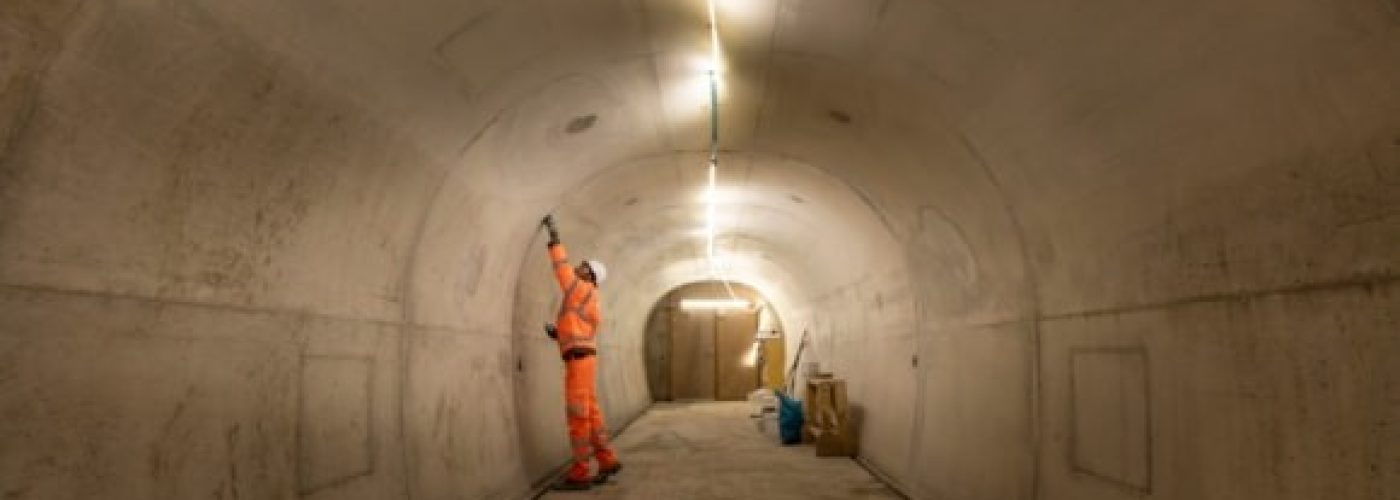


The team building the Northolt Tunnel for HS2 have reached a new milestone, completing the construction of 34 cross passages.
Cross passages connect the northbound and southbound tunnel and are a safety feature which allows passengers to cross to the adjacent tunnel in the event of an emergency.
The Northolt Tunnel is 8.4 miles long, running underground between West Ruislip Victoria Road in Ealing, west London – just outside HS2’s Old Oak Common station. At its deepest point, the tunnel is 35 metres below ground. The tunnel was constructed using four tunnel boring machines (TBMs) and the excavation was finished in June 2025.
Following completion of the cross-passages, engineers will turn to the installation of reinforced concrete secondary collars, which will form the permanent openings for cross passage doors and enable the installation of permanent fire-rated sliding doors.
It is expected that all structural works on the tunnel – the second longest on the 140-mile route between London and the West Midlands – will be completed later this year. The tunnel will then be readied for installation of the rail systems such as tracks and overhead power in the coming years.
Malcolm Codling, Project Client for HS2 Ltd, said:
“The progress made to construct the Northolt Tunnel demonstrates the commitment of our teams to deliver this vital infrastructure efficiently and safely.
“Completing the construction of the cross passages is an important step towards finishing the civil engineering on the tunnel which will allow us to ultimately begin rail systems work including laying track.”
The connections have been made using a spray concrete lining (SCL) mining technique where the team methodically cuts through the ground between the two tunnel bores. The distance between the two tunnel bores ranges from 6metres to 20metres.
The work is carried out using mini-excavators, and every metre of earth cut is supported with sprayed concrete lining while the cross-passage slowly takes shape.
Once the team has completed the lined tunnel, a water-proof membrane is installed followed by a secondary concrete lining.
11 of the cross passages were constructed using a ground freezing technique. This method was adopted due the presence of water bearing soils with a high-water table present in the ground in the western section of the tunnel. The methodology required the team to insert freeze pipes through special tunnel segments to create a 2m thick freeze wall to stabilise the ground before excavation could take place.
HS2’s London Tunnels Contractor is Skanska Costain STRABAG joint venture (SCS JV). They are responsible for the main works civils construction of HS2 between Hillingdon and Camden, bringing the HS2 line into Euston.
Dave Hannon, Tunnels & Routeway Director from SCS JV said:
“The completion of all 34 cross passages along the Northolt Tunnel marks another important step forward for the programme, demonstrating consistent progress across multiple work fronts and the coordinated effort of our teams working deep beneath London.
“With this phase complete, we can progress on the next stage of works on the tunnel, with safety and productivity at the forefront.”
Booth Industries in Bolton are manufacturing the doors for all the tunnels across the HS2 route. With high-speed trains passing within metres of the doors, they will be capable of withstanding constant 14Kpa pressure cycles, along with 2hr Integrity and 2hr Insulation against fire – a world first and setting a new benchmark within the industry. They are being manufactured using majority UK made steel.
While the completion of the cross passages for the Northolt Tunnel demonstrates progress on the HS2 route, there is still a vast amount of work to do across the 140-mile route between London and Birmingham. Mark Wild, HS2 Ltd Chief Executive, is leading a comprehensive reset of the project to ensure the remainder of the route is delivered as efficiently as possible and for the lowest reasonable cost.
Building, Design & Construction Magazine | The Choice of Industry Professionals