BDC News Team

BIM – THE TIP OF THE TECHNOLOGY ICEBERG FOR THE FUTURE

BIM (Building Information Modelling) has been with us for a number of years now. Whilst the benefits this technology brings are easy to see, for some, its adoption has not always been the easiest of things. Innovation can streamline, but there is a learning curve – and also in most

Read More »

Keller warns of post-Brexit dip in UK revenue

The ground engineering specialist is expecting its UK turnover, which makes up 4 per cent of its global revenue, to be “adversely impacted” in Q4 due to a “Brexit-related slowdown”. Keller chief executive Alain Michaelis told Construction News the company had experienced delays on some projects – particularly in London

Read More »

4 Ways RFID is Changing the Building Industry

Radio-frequency identification (RFID) technology has been adopted enthusiastically in many different sectors for its ability to track people and items. For the building industry, too, it has a range of applications which help businesses to better manage their assets, materials, workforce and projects whilst also improving safety and security. What

Read More »

Exxon consortium fined $76bn in Chad

An oil consortium led by ExxonMobil has been fined about $76bn by a court in Chad in a dispute over alleged unpaid royalties, in a sign of a breakdown in the company’s relations with the country. The court in N’Djamena, Chad’s capital, awarded the country’s finance ministry 480bn CFA francs

Read More »

Polyurethane (PU) Market size worth $77.2 billion by 2023

Polyurethane (PU) market size analysis pegs demand at USD 51.5 billion in 2015 and forecasts global industry revenue of over USD 77 billion by 2023.Polyurethane (PU) Market Size By Product, By Application, Industry Analysis Report, Regional Outlook, Biobased PU Application Potential, Price Trends, Competitive Market Share & Forecast, 2016 –

Read More »

Breedon full of Hope as acquisition completes

Breedon has today completed its acquisition of Hope Construction Materials for £336m. Hope Construction Materials was created in 2012 when Indian steel magnate Lakshmi Mittal bought UK assets that competition regulators required Lafarge and Tarmac to sell as a condition of their merger. Under the deal agreed in November 2015,

Read More »

Horizon Nuclear appoints new commercial director

Ivor Sheppard, who has worked in Qatar with CH2M on the country’s World Cup programme and in the United Arab Emirates as bid manager with Emirates Nuclear Energy Corporation, joined Horizon in September. He was also previously a director at Turner & Townsend, covering Heathrow Terminals 5 and 3, the London

Read More »

Welsh Slate helps a landmark gymnasium flex some new muscles

Category: Construction Industry Today | Subscribe to Construction Industry Today Feed Published Mon, Apr 18th 2016 Roof slates from Welsh Slate feature on a refurbished building at the heart of the regeneration of Kings Cross. Posted via Industry Today. Follow us on Twitter @IndustryToday Some 6,400 natural slates from

Read More »

Why fossil fuel plants will be left stranded

Far from having years to work out how to curb the risks of climate change, we face a moment of truth ©Getty Beijing in December: People wear protective masks after pollutant PM 2.5 registered nearly 25 times the acceptable standard set by the World Health Organization Virtually all new fossil

Read More »
Latest Issue
Issue 339 : Apr 2026

BDC News Team

BIM – THE TIP OF THE TECHNOLOGY ICEBERG FOR THE FUTURE

BIM (Building Information Modelling) has been with us for a number of years now. Whilst the benefits this technology brings are easy to see, for some, its adoption has not always been the easiest of things. Innovation can streamline, but there is a learning curve – and also in most cases a cost. BIM is just part of a whole wave of technologies and innovations that look set to change the way we design, construct and operate buildings in the future. Mobile devices and apps are now commonplace on a construction site and in the UK. This is being quickly followed by drones, 3D printing, augmented reality (AR) and virtual reality (VR). With so much technology on the horizon it is an exciting time to be in the construction industry but where does it all fit together and when does technology start to add real value? When the Cabinet Office published the Government Construction Strategy back in May 2011, it was greeted with much enthusiasm. The report announced the Government’s plan which was to have collaborative 3D BIM (with all project and asset information, documentation and data being electronic) on its projects by 2016. It was part of a four year programme with the key objective being reducing capital cost and the carbon emissions from construction and buildings in-use by 20%.  A key part of this ambition was the adoption of information rich BIM technologies, process and collaborative behaviours that would unlock new more efficient ways of working at all stages of the project life-cycle. It is fair to say that BIM has taken longer to integrate than anticipated. It has been widely adopted by the tier one main contractors and leading architects and consultants but it has taken far longer to penetrate deeper into the supply chain. However, it is getting there and Sika have no doubt that in a number of years it will be a default and much more commonplace on schemes, large and small. A recent report, ‘Shaping the Future of Construction – A Breakthrough in Mindset and Technology’ by the Boston Consulting Group on behalf of the WEF (World Economic Forum), found that out of all new technologies, BIM offered the most benefit and likelihood of success.  It is for this reason, that Sika has put BIM as its top technology priority. Sika has been using BIM since 2013. As a global leader, working across a variety of market sectors from construction to automotive (see http://bit.ly/2o8Ca6Z), investing in technology and adding value across our supply chain is an essential part of what we do – everyday. As a global manufacturer, Sika looks at BIM from a global perspective. Driven by a corporate strategy, Sika has set out to create clear guidance and templates and global partnerships, such as having BIMObject.com as the preferred hosting partner. They were selected as the global partner for Sika in BIM because they have the largest user base worldwide and increase the visibility of Sika to the widest range of BIM users. In addition, they are now integrated into the building material search function of the leading BIM software, Autodesk Revit. By centralising information, Sika has begun creating a knowledge centre.  This approach helps with the spreading and sharing of BIM knowhow. It forms a basis for how Sika develops useful BIM object content, standards, templates, internal guidelines and processes for getting in touch with potential customers who have worked with Sika BIM objects. An essential part of this process includes a dedicated BIM team, which includes Sarah Eberhardt, David Vazquez and Alberto Gonzalez. Sarah works in the Corporate Marketing Department at Sika’s Head Office in Zurich, and David and Alberto work for the Corporate Technical Department in Madrid. Each brings their own skill set. For example, David has accumulated more than 20 years’ experience in theoretical and practical applications in the structural refurbishment and strengthening business; Alberto has worked in Spain and the Middle East and has specialised in Revit BIM software having obtained the three (Architecture, MEP and Structure) professional certificates by Autodesk; Sarah has a Master’s degree in Architecture from the University of Cincinnati, Ohio, USA and completed professional level certification training in Autodesk Revit. Whilst working as an architect in Los Angeles she completed an architectural project in Hollywood from design through construction using a 3D BIM workflow, which gave her a holistic perspective into the new age of digital construction and collaboration.  Together the team is working to develop BIM content for architecture, engineering and construction professionals and expand the global Sika strategy in BIM development. For Sika, BIM at a global level is about researching regional and global BIM trends, and following case studies and promoting best practices to share for adaption in other countries. While most BIM developments are occurring at local levels (for example, the UK Government mandate), regional and international efforts are intending to unify BIM efforts, for example the EU BIM Task Group, and ISO BIM standards which are under development. It seems at this time that local BIM mandates are pulling the BIM efforts forward, as in UK (2016), France (2017), Spain (2018) and Germany (2020). A big hurdle to overcome involves languages and translation of BIM standards and objects. Current leading BIM software is lagging in capabilities for automation with regards to data input and language translation capabilities, which is presenting a challenge at this point for Sika as a manufacturer and developer of BIM objects and systems for use across the globe. Another challenge is understanding where each country is on the BIM journey. Knowledge, progress and adoption can greatly differ from one country to another. BIM is at something of a crossroads in the UK. It has been adopted by some but is yet to reach the anticipated momentum, whilst a much higher adoption is being seen in other countries. Sika is committed to BIM. We believe that as a technology fully integrated into the building and construction workflow, it offers the greatest long- term value.


Read More »

Keller warns of post-Brexit dip in UK revenue

The ground engineering specialist is expecting its UK turnover, which makes up 4 per cent of its global revenue, to be “adversely impacted” in Q4 due to a “Brexit-related slowdown”. Keller chief executive Alain Michaelis told Construction News the company had experienced delays on some projects – particularly in London – as investors assessed the impact of the EU referendum vote. “It seems foreign investors are trying to see exactly where their investments lie in the post-Brexit environment until they make any decisions [on whether to move forward],” Mr Michaelis said. However, the CEO was confident the schemes would not be cancelled and said tendering activity in recent weeks had been “ok”. The comments came as Keller posted global operating profit of £30.9m for the six months to 30 June 2016, down 6 per cent on the £35m posted for the same period of 2015. Despite the fall in profit, revenue hit a record £849.7m for the half-year, up 12 per cent on H1 2015’s £755.8m. The fall in profit was largely down to poor performance in the company’s Asia Pacific business, where project delays and “tough market conditions” saw it post losses of £9.6m. Keller’s Europe, Middle East and Africa business performed well, nearly doubling its operating profit to £13.6m in H1 2016 from £7m in H1 2015. Turnover for the division increased to £261.7m for the period, up 24 per cent from £210.3m. The UK market was one of its strongest European markets, with Mr Michaelis saying the firm felt “particularly good” about UK performance in the past 12 months. Keller had a steady order book over the coming months and is targeting work on High Speed 2 and Hinkley, Mr Michaelis said. He said the company was getting ready for the opportunities a new runway in the South-east could provide, adding that it should be “top of the list” when it comes UK infrastructure projects. It was now up to the government to make swift decisions on major infrastructure projects to give the sector greater certainty, he said. “The confidence of the nation is shaky given Brexit, and the industry is not clear on the outcomes of some of these negotiations, so the government should do anything it can to instil confidence through projects within its control.” The chief executive said that while the weakening of the sterling would likely add nearly £40m to Keller’s net debt compared with the end of 2015, it could also have a beneficial effect on Keller’s profit when translated into sterling over the coming years. Mr Michaelis said: “The interesting positive affect of Brexit on us will be in currency: we make the majority of our profit in dollars, so that is a good news item for Keller.”   Source link

Read More »

4 Ways RFID is Changing the Building Industry

Radio-frequency identification (RFID) technology has been adopted enthusiastically in many different sectors for its ability to track people and items. For the building industry, too, it has a range of applications which help businesses to better manage their assets, materials, workforce and projects whilst also improving safety and security. What is RFID technology? RFID is a technology that enables a microchip to interact with a reader using radio waves. The small RFID chips can be embedded into tags or sticky labels and attached to items. When a chip comes within range of a reader, the information stored on it is read and sent to a central IT system, enabling the item to be located and tracked. Crucially, RFID tags and labels, such as those available from Universal Smart Cards, don’t need their own power source as they are activated by the reader, this makes them ideal for low-cost tracking. Chips can also be embedded into smart cards and wristbands enabling members of the workforce to be tracked as they move around construction sites. Here, we’ll look at four ways RFID technology is changing the building industry. Automated timekeeping and payroll One significant benefit of RFID is that it can automatically log the entry and exit of every member of the workforce on the site. Using fixed readers at the entrance totally eradicates the need for any manual recording of arrival and departure such as signing or clocking in. And there is no potential for workers to forget to sign in or out. This process drastically reduces the administrative burden on construction companies as the time each worker spends on site is automatically recorded. The data collected by the system can also be used to automate payroll reducing costs even more. By placing readers at other points around the site, employers can get further insights into working patterns, tracking the movement of workers and the time they spend in various places on the job site. This can be used to help find more efficient ways of working and to increase productivity. Asset management Building companies have a vast array of expensive equipment that they need to manage. From vehicles to hand tools, it is important to know where these items are on a construction site and who has been using them. By scanning items in and out of storage areas, it is possible to track when they were used, how long for and when they were returned. If RFID access control is used to authorise entry into the storage area, the system also logs the identity of the person who takes the equipment. Using fixed readers on the entrance to the storage area means the worker and the item are logged on the IT system as leaving at the same time. With fixed readers in situ around the site or by using handheld readers, it is also possible to locate any items which go missing. However, if workers know that they have been logged using the item, they are more likely to look after it responsibly and take it back when finished. Materials management A problem for many building companies is having to pay workers to do nothing because it has run out of materials. Not only does this reduce the profitability of each job, it also delays schedules which could be a major issue if another contractor coming on board has to wait for the work to be finished. This can result in contractual problems, fines and reputational damage. RFID can provide a workable solution for these types of problems as it enables companies to keep track of the materials that are in stock. Simply attaching an RFID sticker to items enables them to be scanned, letting site managers know how much of each item is on the site. As supplies begin to get low, orders can be placed with suppliers before materials run out and workers are left at a standstill. Making sites safer Ensuring compliance with health and safety regulations is paramount on any building site. RFID technology can enhance safety for workers, especially in areas where there are potential hazards, as tags embedded in their ID smart cards can be used to trigger safety alarms when they get near. Depending on the nature of the site, this can be sound alarms, flashing lights or both. At the same time, access control systems can be programmed to restrict access to authorised users only. This can be done on an individual basis. This means entry to potentially hazardous areas of the site can be restricted to specific people. If someone without authorisation enters, an alert can be sent immediately to the site manager. Wrapping up RFID tags and sensors provide building companies with more effective ways to manage their assets and materials, improve health and safety, track worker activity and reduce administrative burdens. In doing so, they improve the efficiency of the company, helping it to reduce costs and losses whilst providing insights that can make it even more productive.

Read More »

Cheaper batteries could see electric cars bought by the masses

21st November 2015 One of the big obstacles to the uptake of electric vehicles by the masses is the cost of batteries. They need to be big enough to store enough energy for hundreds of miles of driving between charges, yet light enough to not be a drain on the cars carrying them.   “For an electric car, the cost of a battery is crudely the same as the cost of the rest. That is quite the wrong proportion for it to take off. So people are desperate to find ways to supply cheaper batteries,” says Chris Wright, chairman of Faradion, the technology company researching low-cost energy storage solutions. In an interview with the Guardian, Wright explains that the motor industry needs to find a way to produce batteries that doesn’t rely on lithium, the base element of rechargeable batteries. His company’s answer is sodium – far cheaper to source and with similar energy-storing properties. It means electric vehicles could soon be a more viable option for many, including commuters and drivers who have just passed their test who are looking for an easy-to-use and affordable vehicle to put their skills to use with. “We set out to make sodium materials that worked in a simple electrochemical [battery] cell that behaved as well as if not better than some of the lithium systems,” Wright says in the interview. “We were able to produce material which outperformed lithium-ion phosphate, which has until recently been the workhorse in automotive batteries.” Although the sale of electric vehicles has risen sharply over the last year, traditionally-aspirated vehicle sales still far outweigh them. But as the cost of producing electric vehicles’ power plant drops, those savings will be passed onto the marketplace. Range anxiety – the fear of running out of power and being stranded in the middle of nowhere – is receding. Now motorists are realising how much cheaper it could be to run an electric vehicle, not to mention how much greener it is. Charging a car for a 250-mile journey could cost as little as £5. Bjӧrn Nykvist and Måns Nilsson, Swedish scientists at the Stockholm Environment Institute, predict a ‘potential paradigm shit in vehicle technology’ if the price of powering electric vehicles continues to fall at the same rate. A report on TechnologyReview.com highlights that the pair’s analysis suggests that battery pack prices are falling by about 8 per cent every year. That decline in cost could be accelerated if large-scale electric vehicle manufacturers such as Toyota, Tesla and Nissan follow through with their plans to ramp up battery pack production in the near future. In the same article, Luis Munuera, an International Energy Agency analyst, advised a note of caution with Nykvist and Nilsson’s research. The cost reductions predicted should be ‘taken with care’ he wrote in an email to TechnologyReview.com. This is because battery costs from different sources may not be directly comparable, and it is unclear exactly how far into the future such price predicting is accurate to. But he does admit: “We have seen events moving quicker than expected in lithium-ion battery technology.” Source link

Read More »

Exxon consortium fined $76bn in Chad

An oil consortium led by ExxonMobil has been fined about $76bn by a court in Chad in a dispute over alleged unpaid royalties, in a sign of a breakdown in the company’s relations with the country. The court in N’Djamena, Chad’s capital, awarded the country’s finance ministry 480bn CFA francs ($816m) in royalties, and levied a record additional penalty of about $75bn. The fine is larger than the total cost to BP of the Deepwater Horizon disaster, which has reached about $62bn. It is also almost seven times Chad’s 2015 gross domestic product of $10.9bn. Exxon said it disagreed with the court’s ruling and was “evaluating next steps”. It said that the dispute was over “commitments made by the government to the consortium, not the government’s ability to impose taxes”. Exxon added that it was vital for all sides to “abide by applicable law in order to achieve the desired long-term benefits envisioned when projects begin”. In Chad there was scepticism that the fine could be collected. The mood in N’Djamena has been tense at a time of increasing financial pressure on the government following the drop in oil prices since 2014. Civil servants’ salaries and student grants have not been paid since August or earlier, provoking strikes including essential health services and schools. In parts of the capital, youths have been throwing stones at cars this week. Chad produced 120,000 barrels of oil per day last year, according to the US Energy Information Administration. Exxon’s Chad/Cameroon project includes wells in Chad and a pipeline to take the oil from the landlocked central African country to a terminal on the Atlantic coast of Cameroon. The company said last year that since it came into production in 2003, it had contributed $12bn in revenues for Chad. Leading a consortium that included Chevron and Malaysia’s Petronas, Exxon supervised construction of the 650-mile pipeline starting in 2000. Chevron sold its 25 per cent stake to the government of Chad for $1.3bn in 2014, but Petronas remains an investor. The World Bank funded the Chadian and Cameroonian governments’ share in the development. Its involvement was condemned by human rights and environmental groups and local communities, which tried to halt the deal. Related article Financial watchdog investigates reserves and accounting for climate change After construction was finished and oil was flowing, Idriss Déby, Chad’s president, reneged on the terms of the deal, which included a law pledging 80 per cent of oil revenues for social spending. Despite its oil income, the central African country remains one of the world’s poorest. Like its neighbour, Nigeria, Chad is in economic crisis because of collapsed oil revenues amid the running costs of waging war against Boko Haram. Students have been striking this year over lost scholarships and other budget cuts. From 2000 to 2009, Chad boosted its military spending by more than 600 per cent, as the government fought internal battles and in Sudan’s war in the neighbouring Darfur region. Mr Déby came to power in a coup in 1990 and has weathered several military attempts to oust him. He won a fifth term in multi-party elections earlier this year. He is currently president of the African Union, and Chad’s army — one of the most capable in Africa — is playing a key role in the regional fight against both the Boko Haram insurgency and al-Qaeda-linked militants. Sample the FT’s top stories for a week You select the topic, we deliver the news. Source link

Read More »

Polyurethane (PU) Market size worth $77.2 billion by 2023

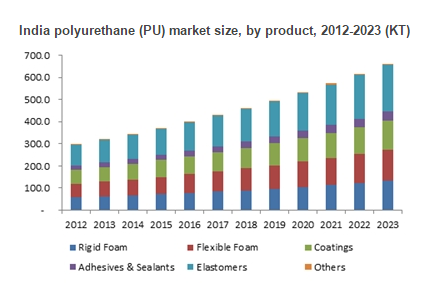
Polyurethane (PU) market size analysis pegs demand at USD 51.5 billion in 2015 and forecasts global industry revenue of over USD 77 billion by 2023.Polyurethane (PU) Market Size By Product, By Application, Industry Analysis Report, Regional Outlook, Biobased PU Application Potential, Price Trends, Competitive Market Share & Forecast, 2016 – 2023 Polyurethane (PU) Market size is expected to reach USD 77.27 billion by 2023; according to the latest research report published by Global Market Insights, Inc. Increasing energy conservation importance owing to rising costs and growing concerns regarding GHG emissions have been major factors driving global polyurethane market size. Government support to boost infrastructure in India, Brazil, and Mexico should promote PU market growth in construction application.             APAC, driven by India & China PU market size, dominated the regional industry demand and may generate over USD 33.5 billion revenue by 2023. Electronics & appliances application in APAC may observe highest gains over the forecast timeframe. Increasing importance for encapsulation of electronic components such as circuits and sensors is a major factor driving PU demand in electronics & appliances segment. Request For Sample Report@https://www.gminsights.com/request-sample/detail/387  Flexible polyurethane foam market size was dominant and industry expects gains at 4.7% CAGR by 2023. Increasing disposable income and changing lifestyle in BRICS nations has led to furniture industry growth and accounts to increasing flexible foam application in mattresses and automotive seating. The automotive industry has been experiencing a significant change over the years and has observed a trend towards automobile weight reduction in order to improve fuel efficiency and curb emissions. Polyurethane, along with other plastics, is a vital part of the new trend as it is capable of providing substantial weight reduction. Moreover, rubber components are increasingly being replaced by polymers in automobile applications which may provide boost to thermoplastic elastomers market size, including thermoplastic polyurethanes. Strong application outlook in automobiles such as seating, engine encapsulation, exterior panels, instrument panels, and cables & wires as an alternative to metals should drive PU market size. Tight supply and correction in crude oil index may hamper availability of key raw materials, MDI & TDI. This factor may affect PU market price trend over the forecast timeframe and hamper manufacturer profitability index. Inquire for Buying industry Analysis Report@https://www.gminsights.com/inquiry-before-buying/387 Key insights from the report include: North America, with construction industry somewhat rebounding in the U.S., may observe below average growth rates. Rigid foam was majorly used product in the U.S. in 2015.  U.S. polyurethane rigid foams market size is set to grow at 4.9% CAGR in revenue terms. They are used as insulation purpose to increase buildings energy efficiency and decrease thermal energy losses.  Europe, driven by Germany, UK and Italy PU market share, is poised to exceed USD 21 billion revenue by 2023. Increasing thermal insulation application post EU legislations regarding energy efficiency of households may drive product demand in construction industry.  Germany automotive application is set to grow at 3.7% CAGR by 2023. Presence of large scale automobile manufacturers may favor product demand. China footwear application may witness average gains at 5.4% CAGR and surpass USD 1.2 billion revenue by 2023.  Growing demand for sports shoes and hiking boots with excellent grip may drive footwear application demand. Presence of footwear companies in the region along with increasing outsourced footwear production in countries such as Vietnam, Thailand, Bangladesh and Indonesia should drive PU market size.  Global PU market share is highly consolidated and is dominated by MNCs having presence across the value chain.  Covestro (formely Bayer MaterialScience), BASF, Huntsman Corporation and Dow are among notable industry players. Other participants include British Vita Unlimited, Foamex Innovations, Mitsui Chemicals, Nippon, Recticel and Woodbridge Foam Corp. Source link

Read More »

Breedon full of Hope as acquisition completes

Breedon has today completed its acquisition of Hope Construction Materials for £336m. Hope Construction Materials was created in 2012 when Indian steel magnate Lakshmi Mittal bought UK assets that competition regulators required Lafarge and Tarmac to sell as a condition of their merger. Under the deal agreed in November 2015, Breedon pay £202m in cash to Cortolina Investments, a Mittal family vehicle, and handed £134m in shares to Abicad Holding, an associate company of the vendor. Hope’s chairman, Amit Bhatia, Lakshmi Mittal’s London-born 36-year-old son-in-law, has joined the Breedon board of directors as a non-executive director. He is the only member of Hope’s management board to be retained by Breedon. Breedon has also changed its full company name, from Breedon Aggregates Ltd to Breedon Group plc. At this stage it appears that Hope will be retained as a brand name for Breedon’s cement products. Although the name is still new to the industry, under Indian ownership there has been heavy investment in brand promotion to create a clear identity. Hope was named after the Derbyshire village that was, and remains, the company’s main cement source.         This article was published on 1 Aug 2016 (last updated on 1 Aug 2016). Source link

Read More »

Horizon Nuclear appoints new commercial director

Ivor Sheppard, who has worked in Qatar with CH2M on the country’s World Cup programme and in the United Arab Emirates as bid manager with Emirates Nuclear Energy Corporation, joined Horizon in September. He was also previously a director at Turner & Townsend, covering Heathrow Terminals 5 and 3, the London 2012 Olympics, and the Shard, according to his LinkedIn profile. Programme director Carl Devlin confirmed Mr Sheppard’s appointment at the CN Summit 2016, where he outlined Horizon’s plan for delivering Wylfa Newydd, a £10bn new nuclear project in North Wales. The delivery team for the project was confirmed in May, with engineers Bechtel and Japanese energy specialists JGC and Hitachi forming a consortium with client Menter Newydd. Mr Devlin said the scheme will bring £20bn of investment into the UK, 60 per cent of which “can be delivered by UK businesses”. He described the project as “a very, very complex jigsaw that we need to put together”, and said “at least 95 per cent” of the design will be completed before construction of the scheme begins. “People can be too keen to get started and it’s a mistake that costs you,” he said. The project’s timeline points to a final investment decision in 2019 with major earthworks getting underway in the same year, and the first nuclear concrete being poured on site in 2020. However, in July this year, the Welsh affairs committee said the project should be built only “if the strike price is below that agreed for Hinkley Point C and competitive with renewable sources”. Horizon is yet to decide a strike price with the government for the Wylfa Newydd project. However, Mr Devlin said the project’s focus would be “all about predictability” in terms of cost, particularly during the construction phase. He added that the firm would be “structuring EPC contracts that are incentivised to perform,” and that contracts would be “incentivised around the same objectives all from tier two supply chain downwards”. “We’ve built this plant four times before and we need to keep as true to our references points as we can to keep costs at an acceptable level,” he said. Source link

Read More »

Welsh Slate helps a landmark gymnasium flex some new muscles

Category: Construction Industry Today | Subscribe to Construction Industry Today Feed Published Mon, Apr 18th 2016 Roof slates from Welsh Slate feature on a refurbished building at the heart of the regeneration of Kings Cross. Posted via Industry Today. Follow us on Twitter @IndustryToday Some 6,400 natural slates from Welsh Slate have helped restore to its former glory the roof of the first purpose-built gym in England, albeit now as a designer restaurant. More than 600m2 of Welsh Slate’s 500mm x 300mm Penrhyn Heather Blue County-grade slates have been used on the main and clerestory roofs and flank roofs of the dormer windows of the Grade ll listed German Gymnasium – a landmark in the King’s Cross regeneration masterplan. They were specified by architects Allies and Morrison to return the roof to its former appearance after the original Welsh Slate roof (which is an important early example of the use of laminated timber to enable broad spans) was removed and the building was left with only a bituminous felt covering across the structure. They also match the slate roofs of the adjacent St Pancras Station and Great Northern Hotels. The new roof over trusses up to 20m wide was installed over four winter/spring months by Attleys Roofing who were reliant on multiple, small deliveries due to the tight site, lack of storage and range of materials required to bring the roof up to today’s standards – insulation, vapour control layer, counter battens, felt, battens and Welsh slates. After a 17-month rebuild the renovated building was officially opened to the public by restaurant group D&D London in November (2015). Originally designed by Edward Gruning and built in the 1860s, the German Gymnasium was influential in the development of athletics in Britain. The building cost £6,000 and was funded solely by the German community in London with the intention of promoting strength-based gymnastics for men and women. The National Olympian Association held the indoor events of the first Olympic Games there in 1866 and they continued there annually until the White City games in 1908. After the First World War the building was taken over by the Great Northern Railway and converted to offices, being sub-divided into cellular offices, with first floor, staircase and internal partitions inserted to divide up the overall single volume. It remained in the ownership of the railway operators under various acronyms until it was drawn into the overall masterplan for the redevelopment of King’s Cross. The earlier demolition of the buildings around it and the emerging context have allowed the public realm surrounding it to become a more dynamic space, the building becoming both a way-finding landmark and a destination in its own right. Allies and Morrison were commissioned by developer Argent to restore and repair the fabric of the building to a shell and core finish to enable subsequent fit out by one of three shortlisted restaurant operators. Conran and Partners established the restaurant concept design and completed the fit-out which includes a new steel mezzanine and staircases. Andrew Rixson of Allies and Morrison said: “The design of the roof is complicated by the increased depth of the new roof build-up in that the additional thickness of the roof sets the new slate tiles above the level of the brickwork details of the existing gable parapets. “To resolve this, our design approach separates the slates from the brickwork by introducing hidden gutters, valleys and leadwork detailing around the perimeters of the roof. These details are adapted into various different forms due to the variety of conditions found within the existing roof and the deformation of the timber roof structure over time but reconcile the precisely constructed new roof elements with the unevenness of the Victorian brickwork.” He added: “Welsh Slate provided technical advice throughout the design phase through telephone consultation and product literature. The slates could be used in a consistent tile size with even colour and their fixings hidden by the overlapping of each tile. We were also able to resolve design problems using the integrated and unobtrusive service penetrations, which are pleasing architecturally and from a conservation perspective, by avoiding the need for a proprietary vent pipe protruding above the pitch of the roof.” Tina Attley of Attleys Roofing said: “The Welsh Slate has provided the aesthetics required by the client and the architect and at the same time has kept it in keeping with the area. Everyone is really pleased with the roof.” ENDS   Source link

Read More »

Why fossil fuel plants will be left stranded

Far from having years to work out how to curb the risks of climate change, we face a moment of truth ©Getty Beijing in December: People wear protective masks after pollutant PM 2.5 registered nearly 25 times the acceptable standard set by the World Health Organization Virtually all new fossil fuel-burning power-generation capacity will end up “stranded”. This is the argument of a paper by academics at Oxford university. We have grown used to the idea that it will be impossible to burn a large portion of estimated reserves of fossil fuels if the likely rise in global mean temperatures is to be kept below 2 degrees centigrade. But fuels are not the only assets that might be stranded. A similar logic can be applied to parts of the capital stock. February was the warmest month on record. The current El Niño — the warming of the global climate triggered by the Pacific Ocean — has boosted temperatures, just as it did in 1997-98. The recent supposed pause in rising temperature was relative to the sudden jump at that time. A comparison between 1998 and today shows that temperature continues to climb, together with atmospheric stocks of carbon dioxide. This reminds us of the realities of climate change. More On this topic Martin Wolf Moreover, two forms of inertia govern climate policy. First, infrastructure in power generation, which generates a quarter of all anthropogenic emissions, is extremely long-lived. In the EU, 29 per cent of thermal power plants is more than 30 years old and 61 per cent is more than 20 years old. Second, carbon dioxide remains in the atmosphere for centuries. Thus it is necessary to think not of annual flows but of cumulative emissions or of a global carbon budget. The Oxford paper assumes (optimistically) that emissions from all other sectors proceed in accordance with the emissions pathway judged by the Intergovernmental Panel on Climate Change to give a 50 per cent chance of keeping the temperature increase below 2 degrees. It assumes, as well, that new generating plants are operated to the end of their normal economic lives. Under those assumptions, capital stock created after 2017 would break the global carbon budget. Yet, in the past decade alone, the emissions implied by the investment in power generation have been rising at 4 per cent a year. To shift suddenly to zero emissions would appear inconceivable. Accelerated declines in emissions from other activities would alleviate the pressing nature of this dilemma, but only modestly. Worse, the dependence of transport fossil fuels is likely to be harder to reduce sharply than that of power generation. Indeed, decarbonisation of power generation will have to make a vital contribution to decarbonisation of transport through growth in use of electric vehicles. Within power generation itself, there are four options. The first would be a more or less immediate shift to zero-emissions technologies. The second would be retrofitting of conventional capacity with carbon capture and storage. The third would be to replace new capital stock with zero-emissions capacity early in its life. The last would be early introduction of technologies to remove atmospheric stocks of carbon. Production costs of zero-carbon energy, including renewables, biomass, hydroelectricity and nuclear power, are falling rapidly. Challenges remain, notably grid integration and storage. The question is by now more when than whether. It is not going to be next year — not even if assisted by an accelerating rise in energy efficiency. Again, some form of carbon capture and storage seems a vital part of any solution. But these technologies remain largely untried and expensive. That is one reason why a rapid shift in investment patterns appears crucial. The option of proceeding with investment in a conventional plant only to then scrap it early would be wasteful and ineffective. Cutting the average life of generating plants by a decade would delay the “commitment year” — the point of no return — to no later than 2023. This leaves us with little time to transform the world’s investment path. It would seem wiser to install zero-emissions capacity faster now instead. That is likely to be particularly beneficial because the costs are falling with cumulative production. In the last resort, carbon removal or other forms of geoengineering might be employed. Yet all such technologies create technical, and even geopolitical, risks. If, for example, a country unilaterally intervened directly in the climate, the consequences for global relations would be unsettling or catastrophic. Far from having years to work out how to curb the risks of climate change, we face an imminent moment of truth. This also raises urgent policy questions. If carbon pricing were to deliver the desired shifts in investment, it would require credible commitment over the long term. But commitments for the long term can barely be credible. A novel approach would be imposition of cumulative emissions caps. Alas, their credibility would be low even if they could be agreed at all. An alternative might be licensing of new and existing power plants, to force shifts in technology and accelerate closure of capacity. But such licensing would again have to be imposed quickly: otherwise, a race to build soon-to-be grandfathered conventional capacity would ensue. It would also be possible either to subsidise or to tax specific technologies. But this has already proved vulnerable to capture by existing or newly created vested interests. Finally, it is possible — indeed, desirable — to invest in research and development. It is a long-time scandal how little is invested in such R&D relative to subsidies to fossil fuels by governments. After last year’s Paris climate conference, the world congratulated itself on having agreed a new process, even though real action was postponed. Yet, given the longevity of a large part of the capital stock, the time for decisive change is right now, not decades in future. But the world is not really serious about climate, is it? It prefers fiddling while the planet burns. martin.wolf@ft.com Copyright The Financial Times Limited 2016.

Read More »