bdc magazine

ISG Announces Strategic Investment in ESS

ISG has acquired a majority shareholding in ESS Group – the modern methods of construction (MMC) specialist headquartered in Dublin and Manchester. The investment underpins ESS Group’s ambitious growth strategy, and further enhances ISG’s leadership role transforming the construction industry through smart innovation and pioneering delivery approaches and methodologies. Founded

Read More »

Johnson Controls advances data centre sustainability through industry-first Data Centre Solutions hyperscale platform

The Data Centre Solutions platform delivers innovative, energy-efficient and water-saving cooling solutions that help hyperscale cloud providers meet sustainability targets With Silent-Aire solutions, Johnson Controls is a leader in providing hyperscale data centres with mission-critical, custom cooling equipment and modular data centre technologies Leveraging OpenBlue smart buildings technology and services,

Read More »

Leading Fit-Out Contractor celebrates 125th Anniversary

One of the UK’s leading joinery and interior fit-out contractors is celebrating a major milestone this spring. EE Smith Contracts in central Leicester reaches its 125th birthday – and is marking the occasion with numerous celebrations and team building events. The company goes into its 125th year of trading with

Read More »

StO ACOUSTIC CEILING SYSTEM BRINGS CALM TO REFURBISHED MUSEUM

An acoustic ceiling system provided by Sto has created a quiet and calm environment for a museum in Hampshire. The StoSilent Distance system has been installed in Petersfield Museum, which has been created by the conversion and refurbishment of Victorian premises that previously housed a police station and court house.

Read More »

Success on Site at ‘Hortonwood 7’ Industrial for Morris Property

Leading Shropshire building contractor, Morris Property, has completed two more industrial units at Hortonwood 7 on the popular Telford industrial estate. The two new steel framed buildings have created 635 m² of warehouse storage and office space for their client, Swancote Energy. The units are clad and roofed using composite

Read More »

Whitecode Consulting aids the ‘electric car revolution’

As part of the Government’s plan to cut carbon emissions and hit its net zero climate targets, it has produced a new mandatory Building Regulation that sets out a new requirement to install electric vehicle (EV) charging points or cable routes to new or existing buildings that is due for

Read More »
Latest Issue
Issue 335 : Dec 2025

bdc magazine

Award winning student part of rising number of women changing the construction narrative at Coventry University

Award-winning student Madeleine Clarke is part of a rising number of women pursuing a construction career at Coventry University and is hoping her achievement will inspire more young girls to consider a career in the industry. Third year Architectural Technology BSc student Madeleine won the West Midlands’ crown at The Association of Women in Property 2021 Student of the Year Awards, an event that aims to increase and support the 15% of women who make up the construction and property workforce. Coventry University is helping to address that figure, with women making up a quarter of the students studying built environment courses at the university. Madeleine, who was 23 when she decided to pursue her dream, is keen to increase exposure of careers in construction to young women. She said: “The only careers that were pitched to me at school were nursing or teaching. I was only exposed to a career in architecture when I completed a career quiz online. When I go to these Women in Property events it is great because the room is filled with women in the industry. “I just want to encourage more women and girls to look into a career in property or construction because exposure is important, and I want to show people through this award that you can change your path and do something different.” Sabine Coady Schäbitz, Curriculum Lead for Built Environment at Coventry University, says the university wants to drive change in the industry. She said: “We are proud of Madeline and are actively encouraging women to enrol on our professional courses in the Built Environment. In the last five years the percentage of women studying with us rose from 17.3% to 26.4%. “We are working closely with industry and the professional bodies to further increase equality, diversity and inclusion in the creation and management of the Built Environment.” Find out how Coventry University can help you follow in Madeleine’s footsteps.

Read More »

ISG Announces Strategic Investment in ESS

ISG has acquired a majority shareholding in ESS Group – the modern methods of construction (MMC) specialist headquartered in Dublin and Manchester. The investment underpins ESS Group’s ambitious growth strategy, and further enhances ISG’s leadership role transforming the construction industry through smart innovation and pioneering delivery approaches and methodologies. Founded in 1989, the ESS Group employs more than 280 staff based in four offices and three manufacturing facilities across the UK and Ireland. The Group, which includes the ESS Modular and Spatial Initiative brands, specialises in delivering MMC solutions for clients in the public sector, healthcare and commercial markets. The financial strength and backing of the ISG business will enable the independently operating ESS Group to support its ambitious growth plans across the UK and Ireland, with a core focus on generating increasing opportunity across current and target public sector frameworks. The acquisition brings additional MMC capability and expertise to the wider ISG business, while maintaining the firm’s agile and responsive approach to client-led demand for innovative construction solutions. Paul Tierney, CEO at ESS said: “The ISG investment is a pivotal moment for the ESS Group, giving us a solid financial platform for our continued growth plans. We passionately believe in a better way and have been working for the last 30 years to bring our high-quality offering to clients. We are looking forward to what we are sure will be an exciting time for the industry as we see MMC continue to transform customer outcomes and expectations in the drive towards a net zero future.” Matt Blowers, CEO of ISG, commented: “Greater integration and collaboration are two ways that our industry can accelerate its performance to meet the growing demand for net zero construction solutions. The ESS Group brings a wealth of expertise, talent and innovation into ISG and enables us to collectively fast-track our journey developing and implementing leading-edge built solutions that are rooted in operational performance and the highest sustainable and ethical outcomes.”

Read More »

Local planning authority projects explore how best to digitise planning process

Esri UK today announced the winners of a competition to find local planning authorities with innovative ideas, for how best to use geospatial technology to help modernise the planning process. Attracting almost 50 entries, the three winning councils were Nottingham City, Dacorum Borough Council and South Ayrshire who will work with Esri UK to make their pilot projects a reality, receiving free consultancy and access to GIS (Geographic Information Systems) software from the company. The competition revealed several common planning challenges faced by local authorities, being addressed by the pilots, including the improvement of community engagement, how to maximise the use of 3D visualisations and how to manage developer contributions more efficiently. Esri UK is also creating a Customer Advisory Board to help grow best practice use of GIS within planning. “As the government looks to reform the planning system with an increased use of digital technologies, we wanted to find innovative solutions to planning challenges and collaborate with authorities to bring them to life,” explained Stephen Croney, Head of Sector for Land, Property and Planning, Esri UK. “By combining each council’s domain expertise with our team of geospatial experts, the pilot projects will explore new and efficient approaches to problems all designed to help make the planning process easier for everyone.” Nottingham City Council’s project will examine how geospatial technology can help increase the use of 3D visualisations within planning, both internally and with the public. Dacorum Borough Council’s pilot will be using GIS systems to better manage the use and communication of developer contributions secured through Planning Obligations, while South Ayrshire Council’s objective is to create an innovative community consultation platform, with interactive methods of engagement to improve community involvement in Local Development Plans. “Geospatial technologies can help shape the future of the planning process by delivering significant cost and time savings,” said Croney. “Spatial data provides the common language to join different data together and make it meaningful. Helping to understand the spatial nature of our environment so that we can better determine its future, means that more sustainable communities are created and helps with the Levelling Up agenda too.” The Customer Advisory Board will provide a forum for local planning authorities to discuss best practice and share common problems and goals. Croney continued: “It became clear that finding new ways of applying GIS in planning opened the minds of councils entering the competition as to what problems could be solved. The advisory board will help Planning teams learn from each other, make better use of their investment in GIS and shape the future of digital transformation within planning.” Geospatial technology and data have an important role to play in digital planning reform, as outlined in the Planning for the Future white paper, published by the Ministry of Housing, Communities and Local Government in 2020. The use of mapping and associated analytical tools was also one of the recommendations in the report A Digital Future for Planning: Spatial Planning Reimagined, released in February 2022, by the Independent Digital Task Force for Planning. Selected from almost 50 entries, the winning applications are: Dacorum Borough Council Dacorum Borough Council wants to translate existing text and spreadsheets by using digital mapping to better manage and communicate infrastructure and developer contributions, secured through Planning Obligations. “The objective is to use digital mapping to help with not only the decision making around the planning of new infrastructure and make the whole process more transparent but also to support community engagement,” commented Councillor Alan Anderson, Portfolio Holder, Planning and Infrastructure at Dacorum Borough Council. “Our current system outputs are text and spreadsheet based – we believe that by providing this information in a spatial way it will provide a powerful asset which can be used by Council officers and others for planning, decision making and monitoring and also by the public to enhance understanding and engagement in infrastructure funding and planning.” Nottingham City Council Nottingham City Council’s proposition will explore how geospatial technology can help increase the use of 3D visualisations within the planning environment, internally and with the public. “If 3D assessments are conducted in a GIS environment, planning teams will be able to conduct an assessment of various constraints on a site, at the same time as a visual assessment of the impact of the site. This will enable better and quicker business decisions and greatly contribute to modernising the planning processes as per the Government White Paper,” explained Mick Dunn, GIS Service Manager, Nottingham City Council. “GIS will bring other capabilities to the process too, from in-depth flooding analysis to view analysis, which we would like to be able to share easily with interested parties. We feel this could be pushed even further, perhaps being able to provide VR (virtual reality) consultation on sites.” South Ayrshire Council South Ayrshire Council’s project will examine how an innovative community consultation platform with interactive methods of engagement can help further improve community involvement in Local Development Plans – the Proposed South Ayrshire LDP2 in the first instance. “The objective is to create a space to keep our community engaged and informed to strengthen our relationship with our stakeholders, in order to reach better planning outcomes,” said Gordon Wilson, Planning Technician at South Ayrshire Council. “Effective public engagement can lead to better plans, better decisions and more satisfactory outcomes and it can help to avoid delays in the planning process too. Our vision is to build on the work already done by South Ayrshire in creating its LDP2, developing new apps and information to create a Local Plan community engagement and consultation Hub, which will be more accessible, as the majority of people are now online.”

Read More »

8 Reasons To Get Commercial Insurance For Your Business In 2022

Managing a business, whatever the scale or size, requires dedication, time, and money. Most of the time, you need to create effective strategies and methods to keep your head above water and stay ahead of the competition. No matter your short or long-term goals, you want your business to be successful at all costs. As most entrepreneurs are aware, a business may face a lot of risks. In some cases, risks are hard to avoid; some are unprecedented or simply unanticipated. To prevent your business from getting hurt, it’s a sound investment to have commercial insurance coverage. This gives you peace of mind that doesn’t equate to any monetary value. If you’re still on the fence about whether to opt for commercial insurance or not, check out more reasons below why they’re needed for your operations: Legally Required Depending On Your State  Most states require businesses of all sizes to have insurance coverage. If you don’t carry the necessary coverage, you may be subject to fines and penalties. And besides, it could cost your business a lot more than the sum total of your insurance premiums if something unexpected happens, like an accident or a catastrophe.  On the other hand, even if you live in a state that doesn’t require it, it’s still best to get commercial insurance to avoid unnecessary expenses later on. This coverage can help you if a customer decides to sue you due to dissatisfaction or unsettled conflict. Some insurance policies also cover fire incidents to help cover the cost of damage to property. The insurance industry evolves with time, so you can access the best coverage for your needs.  Helps Your Business Run Smoothly  An accident or disaster can happen anytime. If and when it does happen, your business may lose a hefty sum of money if it doesn’t have insurance coverage. Business owners can use insurance to protect themselves against loss of income when faced with a major disaster.  Your business won’t be bankrupt since you’ll continue to have funds to restart operations. As a result, it’ll help you run your business smoothly even after a fire or disaster.  Depending on your policy, your insurance may cover your operational costs like rent and utilities. You’re definitely getting more of your money’s worth considering the monthly insurance premium you’re paying. Protects Your Employees  One of the most critical priorities for small business owners is employee satisfaction. Having liability insurance for your employees is a wise decision. Additionally, they’ll feel more secure and protected in case something unexpected happens, like a job-related injury or illness.  Also, this helps to attract high-quality candidates and prospects. Employees who are well-experienced in your industry will prefer to work with you because you cover insurance for all employees. If you add health or dental insurance, they’ll feel more attracted to work for you. As a result, your team will grow, and your employees may be motivated to work harder.  Protects Your Sensitive Data  New technology is constantly emerging, and state-of-the-art tools will make your business run more efficiently and quickly. Unfortunately, these technological innovations give rise to threats of cyberattacks and exploitation of these changes. Therefore, any business that relies on tech tools and software should get commercial insurance coverage. Keep your insurance policy up to date with privacy breach coverage. If personal information is lost, stolen, or accidentally shared, you’re protected against liabilities.  Protects Your Business From Disaster Or Theft  A business without insurance may not be able to afford repairs or replacements in the aftermath of a natural disaster. But with adequate insurance coverage, your business will be able to recover faster from losses due to a catastrophe or theft.  Therefore, small companies without the capital to completely replace damaged or destroyed assets should consider getting insurance.  Improves Your Brand Credibility  Many businesses go for commercial insurance to improve their brand credibility, and it’s enough reason. After all, so many new companies are sprouting here and there, finding it easy to stay ahead of you. Therefore, you must act smart in establishing your company’s credibility. Fortunately, commercial insurance can do that.  You can show prospective customers and clients that you’re a trustworthy business by having insurance. The work you do for them comes with a compensation plan if something goes wrong. Many customers would want to go for a licensed and insured business, and if that’s what you offer, you’ll be assured that you can continue your business for a long time. Helps With Lawsuits  In the event of a lawsuit, you could quickly lose your business if you don’t have liability insurance. In addition, even if you win the case, you’ll still have to pay costly legal fees. Commercial insurance can help you in such a messy situation.   Whether you’re being sued by an ex-employee or by a client, lawsuits can be expensive, and it’ll all come directly from your company’s account. Your business might not have enough funds to deal with a lawsuit, so it’s better to think ahead and plan for this possibility.  Effective Backup Plan  A successful business should always be prepared with a contingency plan. Having insurance is your plan B when you can’t operate and generate revenues due to accidents or disasters. You can also choose optional coverage to guarantee that payroll will be met during a specific period.  Insurance can help cover lost income and day-to-day operating expenses. Your insurance provider can compensate for the interruptions. Since disasters happen more and more, it’s best to include insurance in your business continuity plan.  Nobody knows what the future brings, so it always pays to be ready for anything. So, be prepared for disasters, accidents, or even theft by getting commercial insurance.   Conclusion  Business insurance allows small business owners to focus on what they do best without worrying about issues that may arise. Nothing beats the feeling of security and having peace of mind when things go wrong.  Commercial insurance coverage will allow you to get back on your feet after your

Read More »

Johnson Controls advances data centre sustainability through industry-first Data Centre Solutions hyperscale platform

The Data Centre Solutions platform delivers innovative, energy-efficient and water-saving cooling solutions that help hyperscale cloud providers meet sustainability targets With Silent-Aire solutions, Johnson Controls is a leader in providing hyperscale data centres with mission-critical, custom cooling equipment and modular data centre technologies Leveraging OpenBlue smart buildings technology and services, this platform delivers greater energy efficiency and leadership in sustainability Johnson Controls, the global leader for smart, healthy and sustainable buildings, has leveraged its Silent-Aire solutions to offer the industry’s first hyperscale data centre platform focused on helping cloud providers meet ambitious sustainability targets. The Johnson Controls Data Centre Solutions platform delivers innovative solutions that conserve water and reduce energy consumption, including air-cooled chillers, liquid cooling, combination air handler units, future-ready refrigerants and prefabricated modular data centres. “Through its Data Centre Solutions platform, Johnson Controls is offering something unique and valuable to global hyperscale companies,” said Lindsey Leckelt, vice president of Data Centre Solutions at Johnson Controls. “Johnson Controls is the first to provide innovative digital technologies combined with standard and bespoke cooling equipment and modular data centre solutions that optimise energy consumption and water usage. We have the experience and capability to deliver these solutions as global integrated programs at-scale to our hyperscale partners.” Reaching Ambitious Energy and Water Targets Mission critical data centre operations typically require significant amounts of water and energy for cooling, and hyperscale server rack power density is expected to double as soon as 2023. Many cloud providers are prioritising investments that improve their environmental sustainability and making climate pledges specific to decarbonisation. A 2021 survey conducted by Forrester Consulting commissioned by and developed in collaboration with Johnson Controls, “The Race to Decarbonisation: A Spotlight on Data Centers”, found that nearly half of the data centre decision-makers surveyed have indicated that they plan to reduce energy consumption across their portfolio by at least 50% by an average reported target date of 2024. The Silent-Aire and Johnson Controls team is uniquely positioned to support data centre leaders in meeting these goals by designing and deploying cooling solutions that minimise environmental impact while maximising efficiency and productivity. Redefining Hyperscale Data Centre Sustainability Johnson Controls with its Silent-Aire solutions has been focused on innovative, effective ways to support hyperscale customers as they respond to these challenges. Through Silent-Aire, Johnson Controls is a leading provider to hyperscale companies. With its hyperscale leadership and its global sustainability services, world-class engineering and advanced research and development, Johnson Controls is set to support one of the fastest growing segments of the technology industry as it takes on and solves environmental challenges. “We’re thinking beyond singular projects; we’re investing in ongoing partnerships,” said Maik Bohlmann, vice president and general manager, Data Centre Solutions, Johnson Controls. “We’re carefully listening to our customers, and we’re best positioned to support them as they redefine data centres and their energy profiles. From innovative technologies to continuous support through the lifecycle of their progress, it’s as much a revolution in our approach as it is an evolution of design for the data centres.” The Data Centre Solutions platform is backed by Johnson Controls own commitment to sustainability. To date, Johnson Controls has reduced its energy and greenhouse gas intensity by 70% since 2002. Johnson Controls is honoured to be recognised as AAA MSCI rated, among the “Top 100 Most Sustainable Companies” by Corporate Knights and first in its industry segment. The company’s OpenBlue suite of connected solutions empowers customers to drive environmental, social and governance (ESG) goals by enabling significant energy savings and corresponding drop in carbon emissions. To learn more about how to win the race to decarbonisation and how companies are pursuing their sustainability goals, read the study here.

Read More »

CONCERN OVER DROPS IN AFFORDABLE HOUSING DELIVERY AS SCOTLAND FACES 100,000 HOMES SHORTFALL

Trade body Homes for Scotland (HFS) has expressed its concern at latest Scottish Government housing statistics which show marked drops in housing association completions and approvals. HFS Director of Policy Fionna Kell said: “Whilst overall levels of housing delivery are up on last year’s figures, it is extremely concerning to see that housing association completions have dropped by 17 per cent (620 homes) and quite staggering that approvals have fallen by 54 per cent (3090 homes). “Unfortunately, this chimes with what our members have been telling us.  Highlighting the interconnectedness of the whole housing system, rising costs have hit those delivering homes to both the public and private sectors extremely hard. Grant funding levels must be reviewed, as a matter of urgency, to reflect these exceptional circumstances and arrest this decline otherwise we will see ever decreasing numbers of affordable homes coming through the pipeline.” Kell’s comments follow a recent HFS report highlighting that Scotland’s cumulative housing shortfall since the global financial crisis is now approaching 100,000 homes.

Read More »

Leading Fit-Out Contractor celebrates 125th Anniversary

One of the UK’s leading joinery and interior fit-out contractors is celebrating a major milestone this spring. EE Smith Contracts in central Leicester reaches its 125th birthday – and is marking the occasion with numerous celebrations and team building events. The company goes into its 125th year of trading with its largest ever order book, totalling an impressive £115 million, which will lead to record annual revenues of £60 million this year and £70 million next year. To support the ongoing business growth and with eyes on the future, they continue to expand their award-winning apprenticeship scheme. This year, the business is increasing its number of employees more than ever before across its factory and site operations with 40 apprentices currently earning while learning across various departments in London and Leicester. The business was founded back in 1897 by Edward Elijah Smith who supplied and repaired gas stoves and chandeliers from Canning Street, Leicester. In 1937, he employed 14-year-old apprentice Basil Richardson who, after serving in the Second World War, returned to find Mr Smith in poor health, leaving Basil as the managing director and foreman at just 22! Basil put the company back on the road to prosperity, and later taught his eldest sons, Rodney and Nigel, who worked their way up through the business to take over in 1989. Under their guidance, EE Smith Contracts continued to thrive when the company expanded and developed into the super prime residential and five-star hotel market before a management buy-out in 2016, including Basil’s youngest son John Richardson. Rodney Richardson said there are not many companies in its sector that have been in existence for as long as EE Smith Contracts and with such a wide breadth of experience. “We have always delivered to a very high quality, with a real customer focus and I think that has been vital to our success and longevity,” he said. This trade-based, directly employed but customer centric approach to the joinery and interior-fit out sector led the company to undertake some of the most iconic projects across London such as the Savoy Hotel, Battersea Power Station, the Houses of Parliament, One Hyde Park Penthouses and The Corinthia Hotel. Further testament to the excellence EE Smith has continued to offer over the decades is the 40-year continuing relationship with the Edwardian hotel group, culminating in the recent fit out of The Londoner Hotel in Leicester Square which is the largest in the company’s history and included a full fit out of 355 bedrooms and bathrooms and all of the public area spaces. Neil Bottrill, managing director at EE Smith Contracts, said that the 125-year milestone was an incredible achievement and was a testament to the hard work and skill base throughout the company and the loyalty of the staff who give the business, despite its size, a real family feel. “Our current portfolio of projects is amongst the best in the UK fit-out and joinery markets and we have every reason to believe that further exciting times are ahead for the business,” he said. “We are growing year-on-year and we currently have 40 apprentices, doubling last year’s apprentice joiner workforce. We hope they will rise through the ranks and be an asset to the company as we teach them the skills we have always relied on for EE Smith Contracts to prosper. “Despite our evolution over the years our core values established by Edward Elijah Smith in 1897 are the same, as we strive to deliver the highest quality product and service whilst operating as a close-knit community, with our incredible people at the forefront of our success. “We will continue using the latest cutting-edge technology and seamlessly merging this with our unparalleled craftsmanship to continue setting the standard in our industry. Here’s to the next 125 years!”

Read More »

StO ACOUSTIC CEILING SYSTEM BRINGS CALM TO REFURBISHED MUSEUM

An acoustic ceiling system provided by Sto has created a quiet and calm environment for a museum in Hampshire. The StoSilent Distance system has been installed in Petersfield Museum, which has been created by the conversion and refurbishment of Victorian premises that previously housed a police station and court house. “The StoSilent Distance system is well-suited to this type of refurbishment project,” comments Sto’s acoustics project manager, James Gosling. “It delivers outstanding acoustic performance, but also offers tremendous flexibility as it can be used to create large seamless ceilings, sharp joints and creases, or curved ceilings and vaults. This gives architects and designers great freedom while still allowing them to accommodate the existing structures found on a refurbishment project such as this.” The Sto system was specified for the building by Hampshire County Council Property Services, as part of a project to create a series of new, welcoming spaces at the museum. “This is just the latest in a long line of projects where our StoSilent acoustic solutions have been installed in museums,” adds James.  “A room’s acoustic performance can influence our sense of well-being, and if that performance is poor, noise from speech, movement and everyday activity can create an unpleasant environment where sounds are unclear, communication is difficult, and concentration is impossible. The need for acoustically absorptive measures is therefore clear and the StoSilent Distance system can provide both outstanding acoustic performance and the sort of unobtrusive visual presence which is essential for this type of building.” Installed on this project by specialist applicators The Broadsword Group, the StoSilent Distance system can function as a suspended ceiling, or as a wall-covering over a cavity. It features a metal profile sub-construction fitted with acoustic panels, which are manufactured from expanded glass granulate, making them lightweight and easy to handle, and allowing them to be adjusted to suit any room shape and create a smooth, seamless surface. Different system variants are offered to suit different types of application. The boards were finished with StoSilent Décor M, a spray-applied acoustic plaster which can be tinted to match an extensive range of shades from the StoColor system. This solvent and plasticiser-free plaster creates a classic fine-stipple finish which is ideally suited to a museum environment. It is also Natureplus approved and easy to refurbish. The construction work formed part of the museum’s £3.75m ‘Pathways into the Past’ expansion and refurbishment project. This has seen the museum’s buildings and exhibition spaces undergo a complete transformation, along with the creation of an exciting new outdoor courtyard space.

Read More »

Success on Site at ‘Hortonwood 7’ Industrial for Morris Property

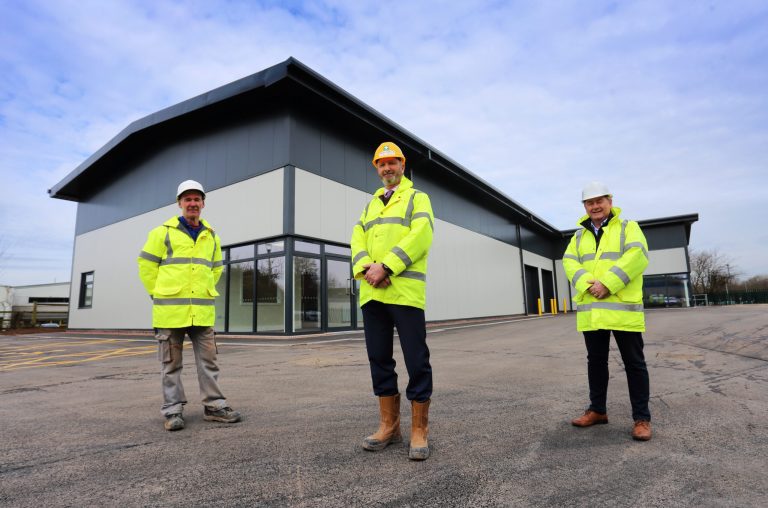
Leading Shropshire building contractor, Morris Property, has completed two more industrial units at Hortonwood 7 on the popular Telford industrial estate. The two new steel framed buildings have created 635 m² of warehouse storage and office space for their client, Swancote Energy. The units are clad and roofed using composite cladding panels and include both pedestrian and roller shutter doors for easy access together with glazed areas to enhance the working environment. Externally there is a tarmac car park and delivery yard, landscaping and new drainage. Swancote Energy, which produces renewable energy from a combination of commercial food waste and purpose grown energy crops, commissioned Morris Property to build the unit due to an increase in demand for its services. The company has invested around £700,000 in the new premises. The Morris Property team are working on a growing number of commercial, residential and education sites in Telford, employing a range of sub-contractors and trades from the local area. Steve Flavell, Construction Manager, said: “We feel privileged to be working in Telford and securing ongoing contracts with both the public and private sector. We wish Swancote Energy all the best in their new premises.” Morris Property is part of a fifth-generation family business group which has been building, restoring and leasing property for over 150 years.

Read More »

Whitecode Consulting aids the ‘electric car revolution’

As part of the Government’s plan to cut carbon emissions and hit its net zero climate targets, it has produced a new mandatory Building Regulation that sets out a new requirement to install electric vehicle (EV) charging points or cable routes to new or existing buildings that is due for implementation in June this year. Approved Document S: Infrastructure for the charging of electric vehicles, applies to new residential and non-residential buildings; buildings undergoing a material change of use to dwellings; residential and non-residential buildings undergoing major renovation; and mixed-use buildings that are either new, or undergoing major renovation. The approved document does not apply to work subject to a building notice, full plans application or initial notice submitted before 15 June 2022, provided the work is started on site before 15 June 2023. The new regulations include specific criteria for each type of building that a developer needs to consider on a new or existing site, as Jamie Mitchell, Associate Electrical Engineer at Whitecode Consulting, explains: “A new housing scheme that requires 100 new car chargers can result in large infrastructure upgrade costs if the existing network is unable to deliver the required power. The new regulations include an average connection cost* cap of £3600 (excluding VAT) per electric charge point. “If the developer can prove that the connection costs exceed £3600 per electric charge point, they will only be required to install the maximum number of charge points until this cost is reached. The developer is then required to install cable routes only** which can be accessed in the future when the infrastructure is upgraded.” To show that the connection cost is greater than £3600 at least two formal quotes must be given to the building control body during the notice/plans stage of a project. At least one quote should be from a distribution network operator. The quote must clearly show the maximum number of EV charge points that can be installed before the extra grid connections costs exceed £3600 per charge point per dwelling. Whitecode Consulting offers a full utility service which includes applications to energy providers. As technical engineers with a team of expert statisticians on hand that are experienced in negotiating with energy suppliers and providing the required technical guidance if a load is going to exceed its cap. As a specialist consultancy, Whitecode provides its clients with three quotations for every project, so it is already exceeding the standards asked for by the regulators in this instance. The engineers at Whitecode have also developed schemes with Dynamic Load Management Systems that can measure the real time power usage of EV chargers on site and can use the capacity of other loads on an installation when they are not in use. This allows for the total capacity on a site to be maximised to provide EV chargers with the total amount of power possible without compromising power quality throughout the site. These will no doubt become more widely implemented as more large-scale car charger installations are required in the future. With the Government planning on banning the sale of new petrol and diesel cars from 2030 there is a real possibility that there will not be enough charger points to meet demand. If the regulations do not go far enough to entice the construction and utilities industries to upgrade infrastructure and provide EV charging points, the move to electric could stall altogether. In a mixed-use development the problem could be exacerbated if service vehicles that may need charging more regularly are competing with residents for access to chargers. Figures published just last month (January 2022) by the Society of Motor Manufacturers and Traders (SMMT), showed that in 2021 plug-in vehicles accounted for a record one in six registrations, while battery electric cars alone rose to one-in-nine, with more registered last year than 2016-2020 combined. The ratio of vehicle charge points to electric vehicles needs to also grow to match this trend. It comes as no surprise that Shell has opened its first electric vehicle charging hub in Fulham, London. It is the first time the company has converted an existing fuel station into one catering solely for electric vehicles. These charging stations will become more common in the future if people are unable to charge their vehicles at home. The new regulation also differentiates between covered and uncovered car parks. There is not as much provision required for covered car parks. Mitchell believes that this is down to the costs associated with upgrading the infrastructure in the future in covered car parks compared to open car parks where the process would be simpler. For new residential buildings, if all car parking spaces sit within a covered section (this excludes garages and car ports), cable routes for chargers must be installed in all spaces if there are 10 or more spaces, or installed in the total amount of spaces per dwelling if there are less than 10 spaces, or all spaces if there are fewer spaces than dwellings. In new buildings other than residential or mixed-use buildings where all parking spaces are within a covered car park, the requirement to install an electric vehicle charge point does not apply. However, cable routes must still be provided for a minimum of one in five parking spaces. “We have worked on a number of large developments over the last few years that have underground basement car parks with a significant amount of car chargers. It’s clear this section of the regulations does not specifically cater to this type of development. This could result in an increased demand for housing with EV chargers in town and city centres.” Mitchell reasons. The Prime Minister Boris Johnson, when announcing the new laws, said the force driving change would not be government or business, but young people who can see the consequences of climate change and will demand better. Mitchell doesn’t believe it is that simple. He said: “Although this new regulation is a significant improvement on the allocation of EV chargers,

Read More »