
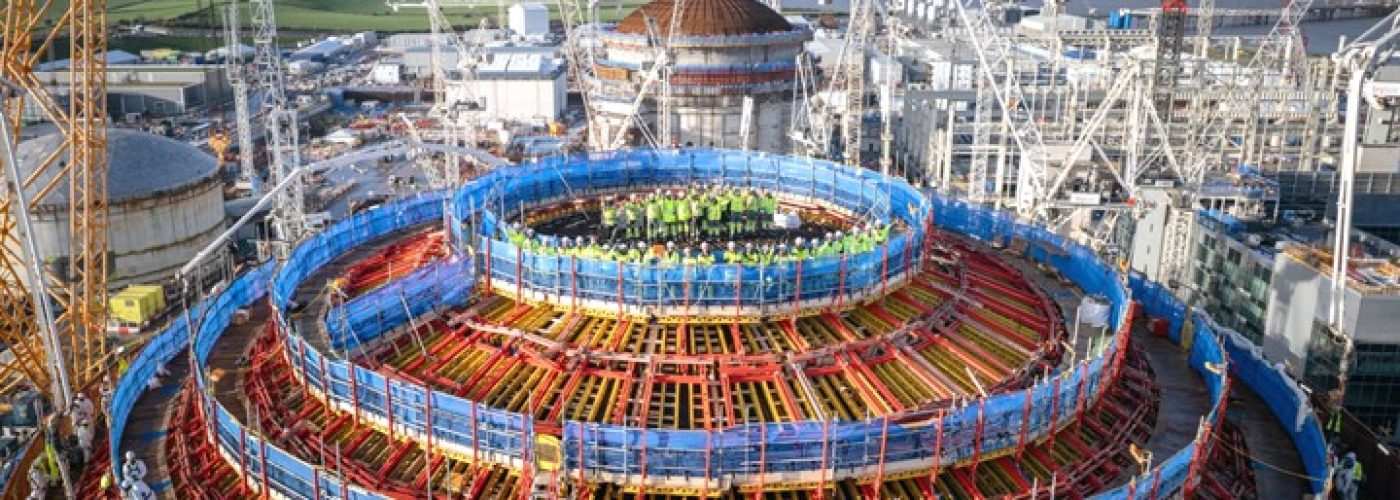


- PERI UK has been playing a central role in the Hinkley Point C project in Somerset, UK.
- Among the most technically demanding phases of the development to date has been the formation of the reactor domes, structures that push the boundaries of formwork design, coordination, and load management.
- PERI UK engineers developed a unique, non-standard solution that incorporated SCS Starter Brace with 550 Strongbacks and load-bearing SB platforms suspended horizontally around the perimeter of the reactor building.
PERI UK has revealed the engineering behind one of the Hinkley Point C project’s most demanding phases: the formation of the geometrically complex reactor domes.
Faced with the challenge of pouring concrete for structures that curve in multiple directions – without the ability to use traditional through-ties – PERI UK engineers developed a bespoke, non-standard solution. The system allowed for the successful completion of the Unit 1 inner dome in late 2025 and has significantly accelerated works on the Unit 2 outer dome, where the entire platform solution was installed in under 14 days.
“Because of this project’s uniqueness, the design solution had to be created from scratch,” explains Gabriel Constantin, major projects lead at PERI UK Infrastructure. “From the onset and throughout the development of the solution, we calculated where the challenges may arise later. These initial stages were marked by, and successful because of, close collaboration and support which continued throughout implementation.”
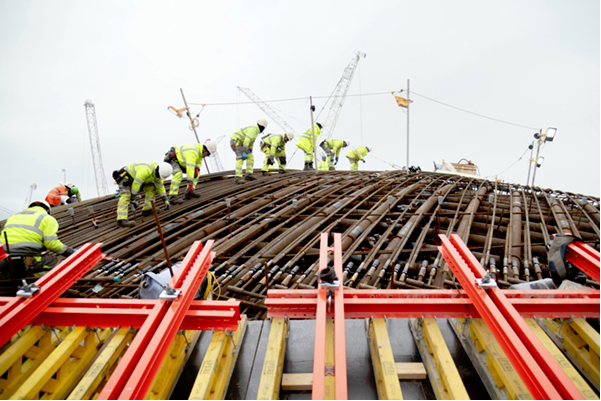
Curves in multiple directions PERI UK VARIO formwork was selected for its adaptability, with 199 bespoke panels fabricated specifically for the dome works. Earlier transition sections from the vertical reactor walls up to level 13 incorporated RUNDFLEX circular wall formwork panels before progressing fully into the dome curvature.
Building without ties
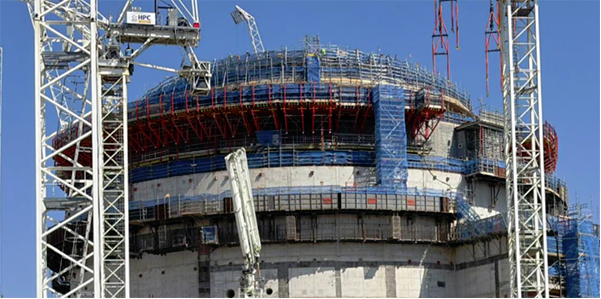
The challenge extended well beyond geometry. The formwork had to operate approximately 45 m above ground level and support significant construction loads without relying on conventional tie systems. The reactor structure did not allow implementation of traditional through-ties, due to the interior airtight 6mm steel shell.
To overcome this, PERI UK engineers developed, from scratch, a unique, non-standard solution that combined several systems. The design incorporated SCS Starter Brace with 550 Strongbacks and load-bearing SB platforms suspended horizontally around the perimeter of the reactor building combined with a single special component – 45-degree anchor adapters – for transferring the concrete loads back into the structure in the absence of ties.
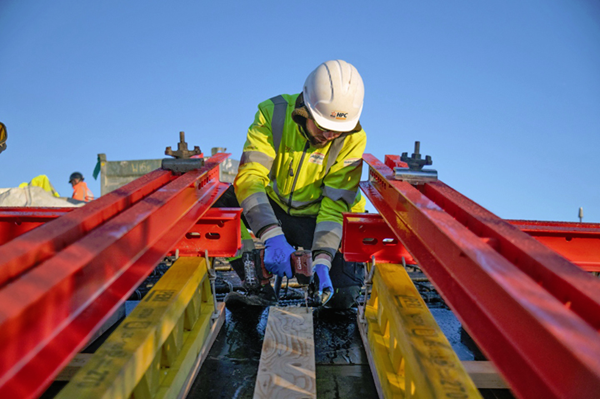
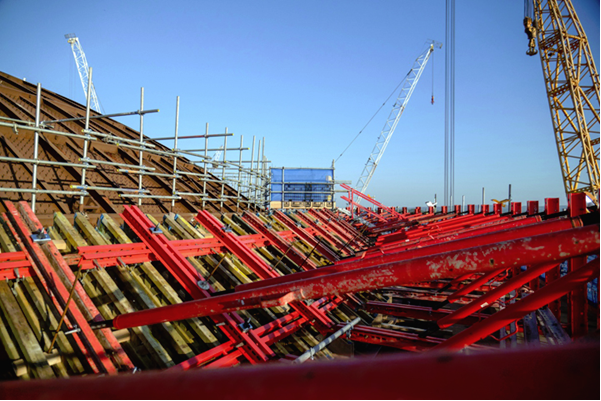
While SB platforms are typically used vertically for single-sided wall construction, at Hinkley Point C they were reconfigured to create platforms approximately 5 m wide to facilitate the curved concrete pour, around 5 m in height, with the special design of the platforms able to support the complex formwork, fresh concrete pressure, and heavy equipment and live loads of the operatives on site.
Designing the solution digitally
From an engineering perspective, the design required extensive modelling. Initial proposals began as 2D engineering drawings before progressing into 3D CAD and digital models to better visualise the interaction between the formwork, platforms, reinforcement, and surrounding structures. In addition, the PERI digital system was able to quickly produce kit lists for procurement on site.
Because the configuration fell outside standard system parameters, the PERI UK engineering team developed a full structural model to verify loads, connections, and anchor forces. Load paths were carefully designed so that forces transferred through steel RCS rails rather than through the timber deck, ensuring the system could safely resist the pressure of large concrete pours.
Learning, adapting, and accelerating
The dense reinforcement within the reactor walls presented further constraints. Anchor positions had to be carefully coordinated around tightly spaced rebar grids and embedded components. During construction, slight deviations in anchor positioning required sections of the system to be redesigned on site.
To avoid any issues when the formwork installation was mirrored on the reactor dome for Unit 2, the PERI UK engineering team supported the site team with precise anchor placement and simplifying platform installation.
“PERI’s digital engineering approach not only played a key role in planning and risk reduction, particularly through rapid generation of procurement-ready kit lists, but it enabled the effective transfer of lessons learned from Unit 1 to Unit 2, directly supporting our target of achieving a 20% improvement in both time and cost,” explains a project engineer involved in the delivery of the reactor building.
Prefabrication also played a key role in efficiencies and speed of the installation. Many elements were assembled before delivery, reducing work at height and allowing platforms to be installed rapidly once on site.
Throughout the project, close collaboration between PERI UK engineers and the construction team at Hinkley Point C ensured challenges could be addressed quickly.
“We believe early involvement of the supply chain will be vital in meeting future UK energy and infrastructure demands,” says the project engineer. “Refining and building on proven methods from the outset, projects can achieve substantial improvements in both cost efficiency and delivery timelines.
“Working alongside a highly experienced reactor construction team, PERI UK’s solutions are a clear benchmark. It makes complete sense to integrate these systems into future nuclear projects from the earliest planning stages.”
The result has seen unique formwork solution that demonstrates the adaptability of PERI UK systems when applied through detailed engineering and strong project integration, on a scheme that is critical to the UK’s future infrastructure.
Learn more about PERI UK products
Building, Design & Construction Magazine | The Choice of Industry Professionals