

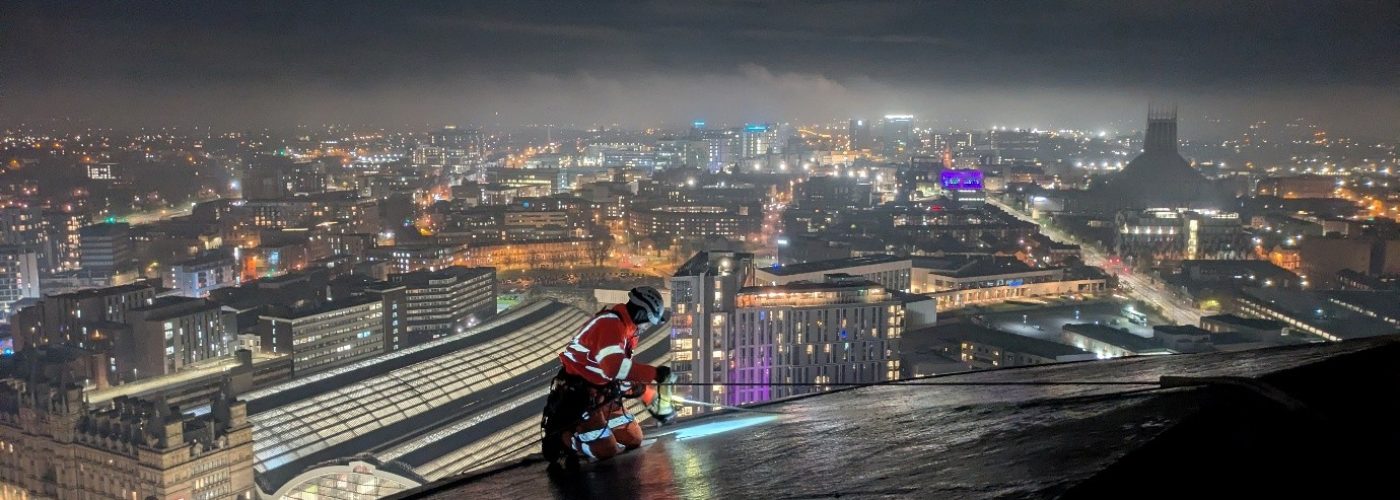


Technicians suspended nearly 140 metres in the air carried out tests on the concrete and steel of St Johns Beacon in Liverpool using specialist rope access techniques.
RSK Group company CAN Structures was contracted to carry out a defect survey and concrete testing of the iconic Grade II listed communications tower following previous inspections in 2011 and 2015. Work was carried out on the 138-metre-high St Johns Beacon, originally built in 1969, through the night over the course of nine days so that the streets below could be closed during the works.
CAN Project Manager Louis Thomas said: “We carried out acoustic hammer tests – tap tests – on the entire concrete façade of the tower. Defects were recorded and depth of carbonation and covermeter tests were taken. The steelwork at the top of the tower and the windows to the ‘doughnut’ also received a full visual inspection.
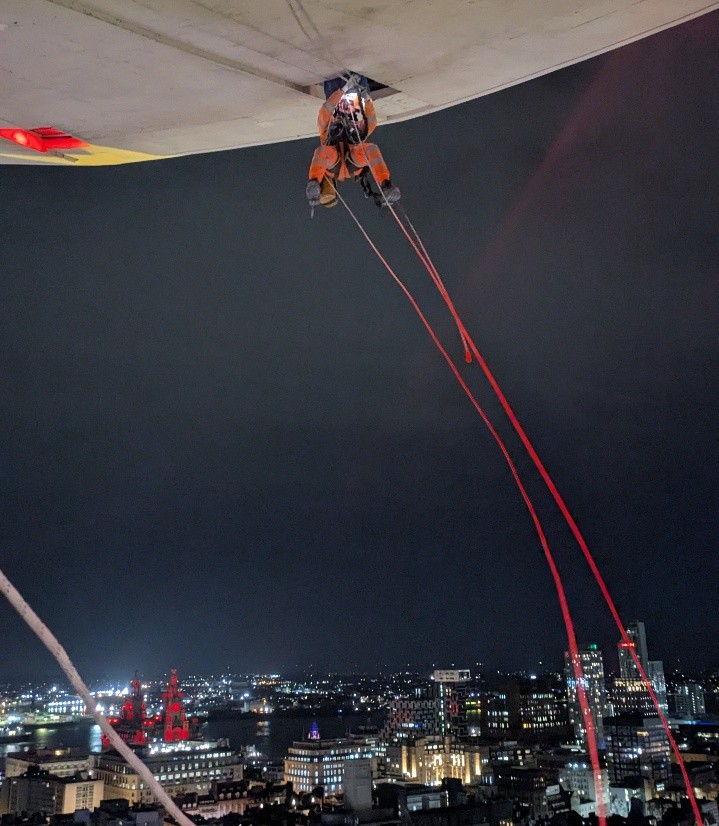
“Access to the underside of the ‘doughnut’ proved particularly challenging. Initial access was gained through lighting openings on the underside of the tower, and we then put up rigging between the adjacent openings. The staging platform we call ‘CAN-Span’ was then winched up from ground level to enable technicians to get within touching distance of the underside of the tower to carry out their inspections.”
Louis explained that, for safety, a considerable cordon was necessary. Several roads, footpaths and pedestrian areas within an extended footprint of the tower were closed by Liverpool City Council.
Munroe K Asset Management manages the building. Director Roger Fulford said: “The Beacon tower is iconic in Liverpool and, like all buildings, needs to be inspected and maintained. For most buildings, the view while doing so is significantly less dramatic. The information gathered during this inspection will be used to assess maintenance schedules and inform us of the condition of the structure so that it can be future-proofed, ensuring it remains an integral part of the city’s skyline for many years to come.”

St Johns Beacon is a notable feature of the city’s skyline and a popular destination for tourists, with the building’s first floor giving visitors 360° panoramic views of the city. It was refurbished between 1999 and 2000 and has been used as a revolving restaurant, a communications tower, offices and a tourist site.
Building, Design & Construction Magazine | The Choice of Industry Professionals