


Timber’s Repositioning in Modern Architectural Language
Timber has undergone a significant repositioning within contemporary architecture. Once perceived primarily as a low-rise or residential material, performance-enhanced timber systems are now integrated into mixed-use developments, civic buildings, cultural institutions and high-spec residential schemes.
Two modification strategies in particular have accelerated this shift:
- Thermal modification (heat treatment)
- Controlled surface carbonisation (charred finishes)
Both approaches extend timber’s performance capabilities while preserving its natural material identity. In architectural contexts increasingly driven by sustainability, façade longevity and material authenticity, enhanced timber systems now serve both structural and visual objectives.
A technical reference to heat-treated timber cladding explains how elevated heat processing alters the cellular structure of softwood to improve dimensional stability and moisture resistance without chemical preservatives.
This evolution allows architects to specify timber not merely as an aesthetic veneer, but as a durable façade solution within performance-driven envelope assemblies.
Thermal Modification: Structural Enhancement Through Heat
Thermal modification involves heating timber to temperatures typically between 160°C and 220°C in a controlled, oxygen-restricted environment. The process changes the molecular composition of hemicellulose within the timber, reducing hygroscopic behaviour and lowering equilibrium moisture content.
In façade applications, this results in measurable improvements:
- Up to 40–50% reduction in moisture absorption
- Reduced tangential and radial movement
- Improved dimensional stability
- Lower resin bleed in modified pine
- Enhanced resistance to fungal decay
For contemporary architectural façades, where crisp shadow lines and consistent board alignment define the visual language, reduced movement is critical.
Large elevations amplify even minor dimensional shifts. Stable boards maintain joint consistency, protect fixing integrity and reduce façade distortion over time.
When integrated into ventilated rainscreen assemblies, thermally modified timber benefits from airflow behind cladding boards, accelerating drying cycles and reinforcing long-term stability.
Charred Timber: Carbonisation as Material Expression and Protection
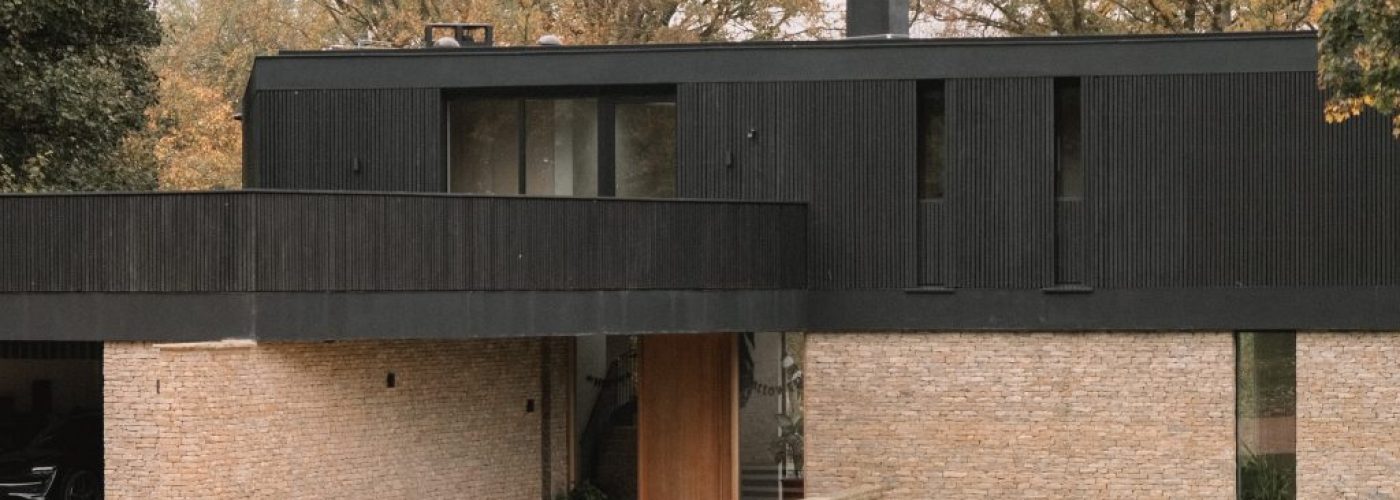
Charred timber, often linked to traditional Japanese techniques, utilises controlled surface carbonisation to create a protective outer layer. The char layer modifies the timber’s interaction with UV exposure, moisture and biological agents.
Architecturally, charred timber provides:
- Deep tonal contrast
- Surface texture and tactility
- Visual depth under varying light conditions
- Distinct material identity within urban contexts
Technically, controlled carbonisation contributes to:
- Increased surface hardness
- Improved UV resistance
- Slower weathering progression
- Reduced initial moisture penetration
A design-led overview of burnt timber cladding finishes demonstrates how carbonised façades can be integrated into contemporary architectural compositions while retaining durability characteristics.
It is important to note that carbonisation is a surface modification. Regulatory compliance for reaction-to-fire performance remains dependent on full system testing and classification under BS EN 13501-1.
Regulatory Integration: Reaction-to-Fire and Envelope Strategy
Modern architectural specification cannot ignore regulatory frameworks. Under UK Building Regulations, reaction-to-fire performance is assessed according to Euroclass ratings defined within BS EN 13501-1.
Reaction-to-fire measures how a material contributes to fire growth. It differs from fire resistance, which measures structural integrity over time under fire exposure.
When specifying timber façades, architects must consider:
- Required Euroclass rating based on building height
- Insulation combustibility
- Cavity barrier detailing
- Substrate compatibility
- Ventilation strategy
Timber can form part of compliant assemblies when combined with appropriate fire-retardant treatments and tested configurations.
Critically, compliance is assembly-based rather than material-only. The interaction between cladding, insulation and cavity detailing determines system classification.
This integrated perspective enables architects to reconcile material warmth with regulatory responsibility.
Material Performance Within Ventilated Rainscreen Systems
Contemporary timber façades are commonly installed within ventilated rainscreen assemblies. This configuration:
- Allows water drainage
- Promotes airflow behind cladding boards
- Reduces moisture dwell time
- Enhances long-term dimensional stability
Thermally modified timber’s reduced moisture uptake complements the rainscreen principle. Lower hygroscopic behaviour minimises swelling and shrinkage cycles, protecting shadow gaps and fixing points.
Charred finishes provide additional surface resilience in exposed elevations, particularly in high-UV or coastal environments.
In multi-storey or civic buildings, façade maintenance can disrupt occupancy and increase operational cost. Performance-enhanced timber reduces distortion-related interventions and extends maintenance intervals.
Lifecycle Modelling and Long-Term Asset Performance
Architectural design increasingly incorporates whole-life cost evaluation. Façade materials must deliver predictable performance across 25–40 year horizons.
Untreated softwood cladding may require:
- Frequent repainting
- Alignment corrections
- Surface remediation
Thermal modification and carbonisation extend maintenance cycles and reduce dimensional instability.
Lifecycle advantages include:
- Reduced repainting frequency
- Lower distortion-related repairs
- Stable façade alignment
- Enhanced resilience to environmental exposure
For institutional and commercial projects, predictable façade performance strengthens asset management planning and protects capital value.
Comparative Performance Overview
| Performance Factor | Untreated Softwood | Heat-Treated Timber | Charred Finish |
|---|---|---|---|
| Moisture Absorption | High | Significantly Reduced | Reduced at surface |
| Dimensional Stability | Moderate | Improved | Dependent on substrate |
| UV Resistance | Moderate | Improved | Enhanced |
| Durability Classification | Lower | Often Class 2 | Enhanced surface resilience |
| Maintenance Interval | Shorter | Extended | Extended |
| Visual Uniformity | Variable | Stable | Stable with controlled weathering |
This comparison clarifies why architects increasingly specify modified timber systems in projects where façade precision and longevity are central to design intent.
Sustainability and Carbon Narrative
Timber’s environmental positioning remains one of its strongest architectural advantages. As a renewable resource, timber stores carbon during growth and generally exhibits lower embodied carbon compared to aluminium composite or fibre cement cladding.
Thermal modification improves durability without chemical preservatives. Carbonisation relies on surface transformation rather than applied coatings.
For projects pursuing sustainability certifications or ESG reporting metrics, performance-enhanced timber supports:
- Reduced chemical intervention
- Extended service life
- Material transparency
- Carbon-conscious specification
Architectural adoption is therefore driven not only by aesthetics but by measurable environmental performance.
Architectural Expression and Material Authenticity
Beyond performance, enhanced timber systems provide architects with expressive potential.
Thermally modified timber retains natural grain patterns while offering improved colour stability and consistency.
Charred finishes introduce:
- Strong linear definition
- Contrast between light and shadow
- Monolithic façade character
- Urban adaptability
In contemporary architectural language, material authenticity often replaces synthetic uniformity. Performance-enhanced timber aligns with this philosophy, enabling natural materials to operate within highly technical building envelopes.
Key Technical Insights for Architectural Specifiers
- Thermal modification reduces moisture uptake by up to 50%.
- Dimensional stability protects façade alignment.
- Charred finishes enhance UV resistance and surface durability.
- Reaction-to-fire compliance is system-based.
- Fire-retardant treatments must be certified for external exposure.
- Ventilated rainscreen detailing is essential.
- Service life commonly exceeds 25 years with correct installation.
- Whole-life cost modelling favours stability-driven materials.
These technical realities underpin timber’s expanded role in contemporary architecture.
Frequently Asked Questions
Can heat-treated timber be used in multi-storey buildings?
Yes, when incorporated within compliant wall assemblies and supported by appropriate fire strategy documentation.
Does charring improve reaction-to-fire classification?
Surface carbonisation alters combustion behaviour but does not replace formal classification testing under BS EN 13501-1.
Is thermally modified timber more sustainable than treated softwood?
Thermal modification enhances durability without chemical preservatives, supporting environmentally responsible specification.
How long can performance-enhanced timber last externally?
With correct detailing and maintenance, service life expectations commonly exceed 25 years in above-ground façade applications.
Performance-enhanced timber systems have redefined the architectural role of wood in commercial and civic design. Through thermal modification and controlled carbonisation, timber now delivers measurable dimensional stability, regulatory compatibility and lifecycle predictability alongside aesthetic distinction. As contemporary architecture increasingly prioritises material authenticity and environmental responsibility, enhanced timber façades occupy a technically credible and visually compelling position within modern envelope design.