

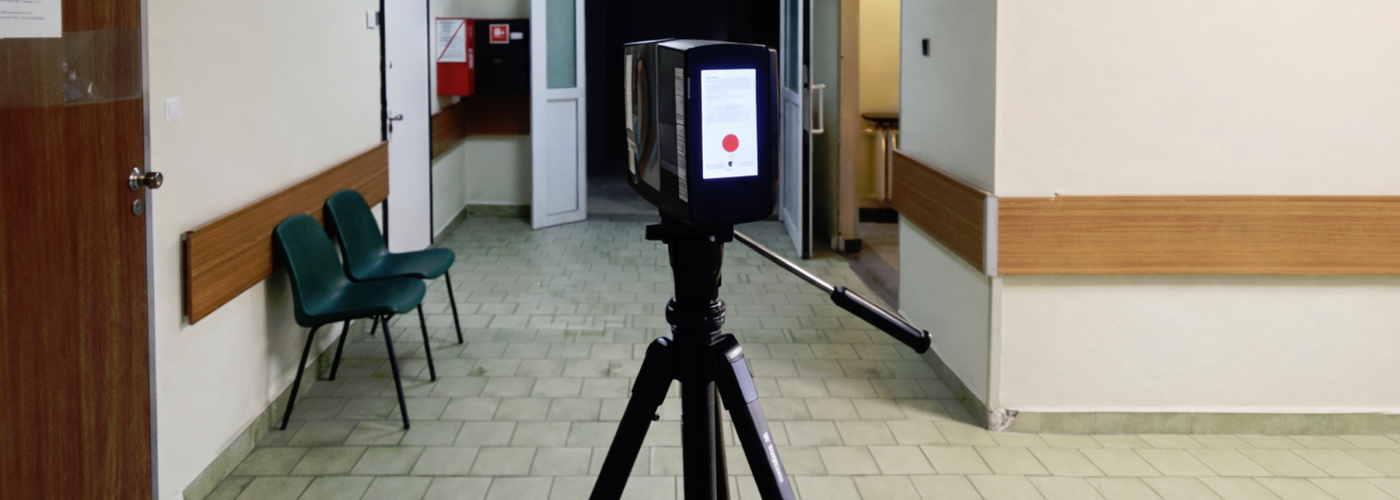


Renovation projects are inherently more complex than new builds. Unlike greenfield construction, refurbishment requires working within the constraints of existing structures, undocumented modifications, and ageing mechanical systems. When original drawings no longer reflect actual site conditions, the risk profile of the entire project changes.
Across commercial, educational and mixed-use developments, inaccurate existing-condition data remains one of the leading causes of budget overruns, coordination failures and on-site delays.
The Hidden Cost of Inaccurate Existing Conditions
Many renovation schemes begin with legacy drawings that may be decades old. Over time, buildings undergo structural reinforcements, plant upgrades, rerouted services and internal reconfigurations. These changes are not always properly recorded.
The consequences typically emerge during construction:
- Structural elements discovered in unexpected locations
- MEP systems clashing with new installations
- Ceiling voids lacking sufficient clearance
- Facade misalignments affecting prefabrication
- Rework caused by dimensional discrepancies
Each of these issues carries direct financial impact — additional labour, material waste, programme delays and contractual disputes.
For developers and main contractors, the problem is rarely poor design intent. It is uncertainty at the data level.
As-Built Data as a Risk-Control Mechanism
Accurate as-built documentation transforms renovation from assumption-driven planning to evidence-based execution. When field conditions are captured precisely and translated into structured digital datasets, project teams gain clarity before construction begins.
High-resolution 3D laser scanning allows for:
- Millimetre-level dimensional verification
- Comprehensive documentation of structural geometry
- Precise mapping of mechanical and electrical routing
- Early identification of spatial conflicts
This approach enables design coordination to occur in a controlled digital environment rather than on-site under time pressure.
In complex refurbishment schemes, professional as-built drawings services and construction documentation in the USA provide the geometric certainty required to reduce exposure to downstream construction risk.
Improving Coordination Across Disciplines
Renovation projects often involve multiple stakeholders — architects, structural engineers, MEP consultants, contractors and specialist subcontractors. Without reliable existing-condition data, coordination becomes reactive rather than proactive.
Verified as-built datasets support:
- Clash detection before installation
- Validation of structural load paths
- Assessment of ceiling congestion
- Alignment of prefabricated components
- More accurate tender documentation
When spatial uncertainty is reduced at the outset, coordination meetings focus on optimisation rather than problem-solving.
Programme and Cost Predictability
One of the most significant advantages of accurate existing-condition documentation is improved predictability.
Unexpected site conditions frequently trigger variation orders and programme extensions. By identifying geometric inconsistencies early, teams can adjust designs prior to procurement and installation.
This leads to:
- Reduced contingency utilisation
- Fewer mid-project design revisions
- Improved contractor confidence
- More stable scheduling
For developers operating within fixed funding structures, this predictability directly influences financial performance.
Supporting Digital Construction Workflows
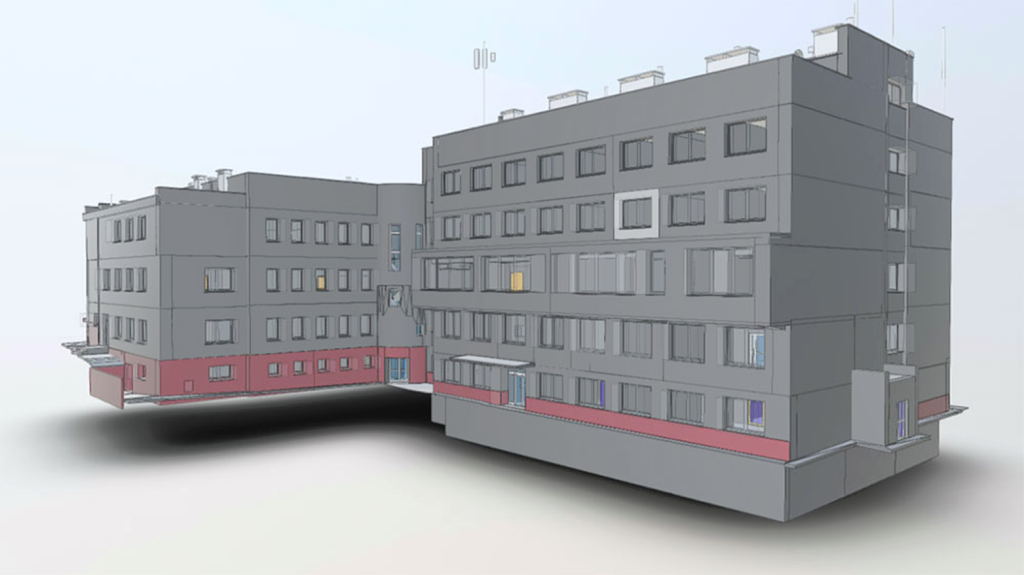
Modern construction increasingly relies on digital coordination environments. BIM-based workflows, off-site fabrication and modular integration all depend on dimensional accuracy.
If base geometry is flawed, digital coordination models cannot deliver their intended value.
Accurate as-built data supports:
- Reliable BIM integration
- Fabrication-ready detailing
- Tolerance management in retrofit environments
- Long-term asset management documentation
As refurbishment activity continues to grow across the built environment, the integration of scanning and structured documentation is becoming a foundational step rather than an optional enhancement.
From Risk Exposure to Controlled Delivery
Renovation will always carry a higher risk profile than new construction. However, the magnitude of that risk depends on the quality of information available at the start of the project.
When existing conditions are verified through precise measurement and structured documentation, uncertainty shifts from the construction phase to the planning phase — where it can be managed more effectively.
For contractors and developers seeking to minimise financial exposure and protect programme integrity, investing in accurate as-built data is no longer a technical preference. It is a strategic risk-management decision.