

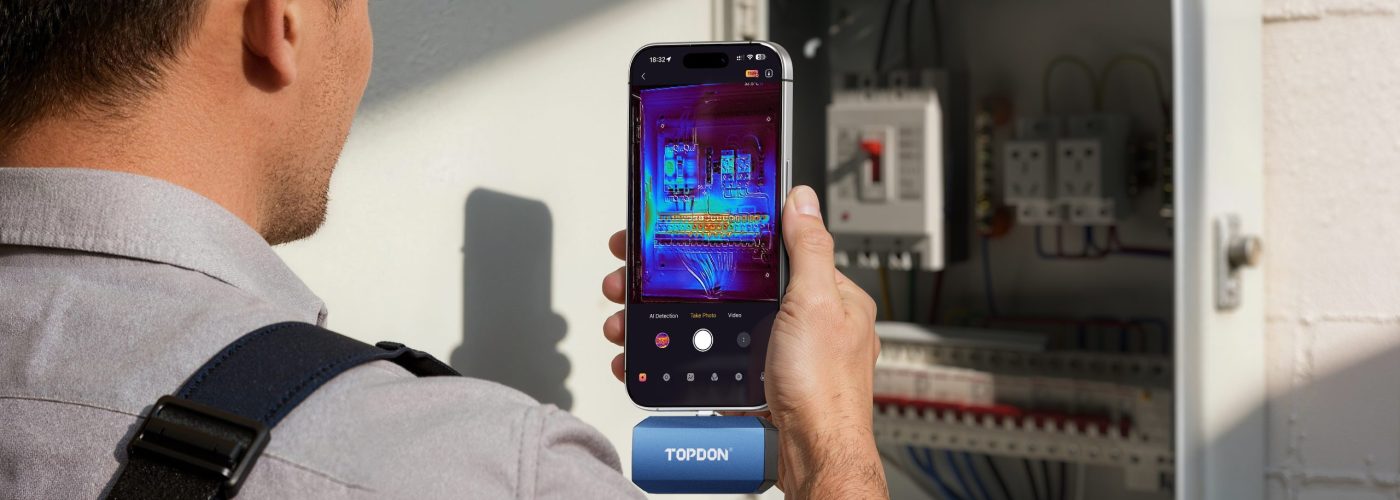


Global thermal imaging manufacturer TOPDON has launched the TC001 Max, a dual-lens smartphone-connected thermal camera aimed at HVAC engineers, electrical contractors and building services technicians. The camera combines an infrared sensor with a built-in visible light camera, fusing the two images together to give engineers precise, on-screen fault location across heating, ventilation, air conditioning refrigeration systems and electrical wiring.
Fault-finding is the most time-intensive part of any HVAC call-out, and the most commercially sensitive. Whether it’s a refrigerant leak that has partially migrated, an underperforming heat exchanger, a poorly balanced duct system or a faulty contactor running hot inside a panel, the challenge is always the same: identifying the precise source quickly, without unnecessary dismantling, and with enough evidence to justify the repair to the customer.
Traditional fault-finding methods like feeling pipework by hand, checking pressures at service ports, or isolating circuits one by one, are slow, often inconclusive, and leave the engineer with limited visual evidence to share with the customer or building manager. An experienced engineer working through an intermittent fault on a multi-zone system can lose an hour to tracing work that a thermal scan would resolve in minutes.
The TC001 Max solves this by rendering heat distribution across any system as a live visual image, without contact. Blocked heat exchangers, poorly insulated pipework, overheating electrical contactors and air infiltration points in building fabric all produce distinct thermal signatures that become immediately visible on screen. Until recently, equipment capable of this level of sensitivity in a field environment cost several thousand pounds and was largely confined to specialist thermographic survey contractors.
TOPDON has deliberately priced the TC001 Max to make thermal imaging a practical day-to-day tool rather than a specialist hire item. It connects directly to iOS, Android or Windows devices, using the engineer’s existing smartphone or tablet as its display, interface and storage platform. This removes the need for a dedicated screen and battery pack, which account for a significant portion of the cost of conventional handheld thermal cameras.
The camera’s 256 × 192 infrared sensor is upscaled to 512 × 384 pixels through TOPDON’s TISR processing, giving resolution sufficient to distinguish temperature variation across individual components rather than broad surface areas. Thermal sensitivity of ≤40mK (NETD) means the camera picks up the small differentials that matter in HVAC and electrical diagnosis – a slightly cool section of refrigerant pipework, a marginally warm return air grille, or early-stage bearing heat in fan motor assemblies. A 25Hz refresh rate keeps the image fluid during live scanning.
The key differentiator is the TC001 Max’s dual-lens design. Unlike single-sensor thermal cameras that produce a thermal-only image, the TC001 Max pairs its infrared sensor with a built-in visible light camera and electronically fuses the two into a single blended image. Five selectable fusion modes let the engineer dial between full thermal and full visible, with blended options in between, so component outlines remain sharp and identifiable even when scanning a densely packed plant room or electrical panel. In practice, this means an engineer can see exactly which valve body, terminal block or pipe joint is the source of a thermal anomaly. For building envelope surveys, where identifying the precise location of insulation voids or air infiltration paths is critical to a useful report, the fused image is particularly valuable.
“HVAC engineers are under constant pressure to diagnose faster and document better,” said Oscar Diaz, CEO of TOPDON Europe. “The TC001 Max gives them a tool that does both. The fused imaging puts the fault location in the image itself, which speeds up the diagnosis and gives the engineer something concrete to show the customer.”
The TC001 Max works with TOPDON’s TopInfrared (Mobile) and TopView (PC) applications across iOS, Android, and Windows, supporting thermal image capture, spot and area temperature measurement, isotherm analysis, and structured PDF report creation – including client-ready reports with annotated images and temperature readings suitable for handover to building managers or FM teams. When used alongside TOPDON’s TopFix AI, thermal findings can be cross-referenced against fault data to accelerate diagnosis and inform repair recommendations.
Building, Design & Construction Magazine | The Choice of Industry Professionals