

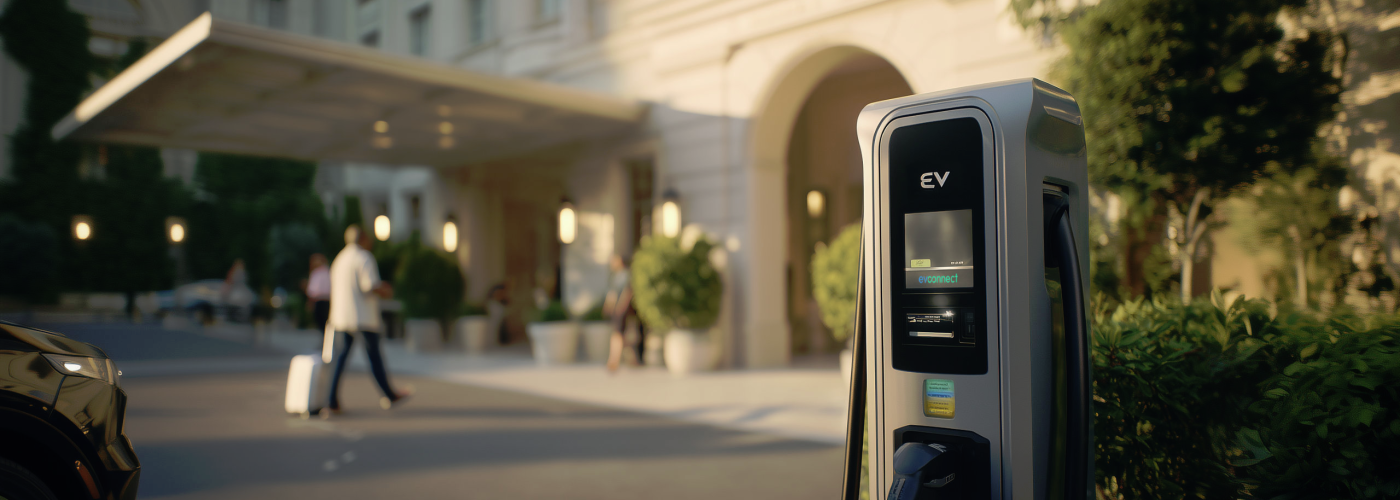


Walk onto the site of a next-generation leisure resort taking shape on the edge of a British city, and the guiding idea becomes clear almost immediately: nothing here is designed to stand alone. The car park talks to the building management system. The lighting responds to footfall. The charging bays know when a guest is due to arrive. Developers are no longer treating entertainment, mobility and digital connectivity as separate procurement lines. They are weaving them into a single connected fabric, built for an adult audience that expects its leisure to be as seamless as everything else in its life.
That expectation extends well beyond the physical building, reaching into the on-demand entertainment that fills a connected guest’s evening. This is precisely where independent reviewing comes in, and a ranking of the top online casinos for UK players in 2026 illustrates the standard of transparency such guests now expect. The page sets out comparison tables covering bonuses, wagering requirements, withdrawal times, payment methods and game studios, allowing adult visitors to weigh their options before committing. Published as part of Gambling Insider, an independent iGaming title covering news, reviews and guides across multiple markets, it reflects the same instinct that shapes connected leisure: today’s adult visitor compares, scrutinises and favours convenience, whether choosing a charging bay or an evening’s entertainment. For resort operators trying to understand the leisure habits of that connected guest, this kind of structured, side-by-side reviewing is a telling signal of how thoroughly people research where they spend their time.
The Single Connected Fabric
The defining principle of these schemes is integration. A decade ago, a leisure resort might have bolted on a row of charging points as an afterthought, wired separately and barely monitored. The connected approach treats them as data nodes. Internet of Things sensors track utilisation, energy draw and dwell time, feeding a central dashboard that also governs heating, ventilation, occupancy and even queue management at the venue’s bars and gaming floors.
The technical case for that integration is well documented. Research into connected vehicle charging sets out how connected sensors and real-time data exchange can balance loads, prevent grid strain and let operators manage demand dynamically. For a resort drawing hundreds of vehicles on a busy weekend, that intelligence is the difference between a smooth arrival and a frustrating bottleneck. The chargers stop being passive hardware and become part of the same nervous system that runs the rest of the destination.
Designing for the Digitally Engaged Adult
The guest these resorts are built for is comfortable with technology and impatient with friction. They book through an app, expect their charging session to start with a tap, and assume the venue knows roughly when they will walk through the door. They graze across entertainment formats in a single evening, moving from a live music set to a cocktail bar to a few minutes of digital play on a phone while waiting for a table.
That behaviour shapes the brief handed to architects and project managers. Spaces must accommodate people who never fully disconnect. Robust connectivity, generous power provision and quiet corners with strong signal are now as fundamental as the lighting scheme. The connected fabric runs right through to the guest’s pocket, and the developments that succeed are those that treat that continuity as a feature rather than an inconvenience.
EV Charging as a Destination Driver
Charging infrastructure has quietly become a reason to visit rather than a mere amenity. A 40-minute charge is 40 minutes of dwell time, and a well-designed resort turns that window into revenue across food, retail and entertainment. The link between mobility and tourism is increasingly studied; analysis of electric vehicle tourism patterns in the United States found that the availability and visibility of charging directly influences where drivers choose to stop and how long they linger.
UK developers are reading the same signals. A resort that publishes real-time bay availability, integrates payment into its own app and offers covered, well-lit charging close to the entrance is removing exactly the kind of anxiety that keeps electric drivers cautious. The single connected fabric makes this possible, because the charging data and the guest app are speaking the same language from the outset.
Building the Infrastructure to Carry It
None of this works without serious groundwork, and that is where the construction and procurement community earns its keep. Provisioning enough power capacity, future-proofing cable routes and specifying the network backbone for thousands of connected sensors are decisions made at the earliest design stage, long before a single charger is mounted. Underestimate demand, and a flagship resort risks looking dated within a few seasons.
Strategic studies underline how much planning this demands. A review of regional charging infrastructure needs in New Hampshire mapped where investment had to land to avoid coverage gaps and stranded assets. The lesson translates directly to a leisure scheme: capacity must be designed for the destination it will become, not the one it is on opening day. That means oversizing the electrical intake, laying spare ducting and choosing systems that can scale as both vehicles and visitor numbers grow.
A Blueprint for Connected Leisure
The single connected fabric, then, is more than an architectural flourish. It is the organising idea that ties charging, sensors, energy management and guest experience into one coherent product. For the construction and development professionals shaping these destinations, the challenge is to build something that feels effortless to a sophisticated adult audience while concealing genuinely complex engineering beneath the surface. Get that balance right, and the next generation of leisure resorts will not simply house entertainment — they will anticipate it, charge for it cleanly, and keep the connected guest coming back.