BDC News Team
Equans to transform Winsford brownfield site into 99 net zero homes

Equans to transform Winsford brownfield site into 99 net zero homes

Energy and regeneration specialist, Equans, has been appointed by Cheshire West and Chester Council to transform a brownfield site in Winsford into 99 net zero carbon family homes. Equans has been granted planning consent to demolish and redevelop a former highways depot on Clough Lane, into a mixed-tenure development, where

Read More »
EDF improves collaboration at Hinkley Point C with GIS portal

EDF improves collaboration at Hinkley Point C with GIS portal

GIS from Esri UK helps coordinate 8,000 workers on 450-acre site  EDF has used enterprise GIS from Esri UK to create a geospatial portal for Hinkley Point C (HPC) nuclear power station, one of Europe’s largest and most complex construction projects. Supporting better collaboration and enabling new digital workflows, the

Read More »
RENDALL & RITTNER PROMOTES NEW DIVISIONAL DIRECTOR

Rendall & Rittner promotes new divisional director

Leading property management agent Rendall & Rittner has recently promoted Martin Hellenas to Divisional Director of one of its London divisions. Most recently, Martin has worked as an Area Director at Rendall & Rittner, with a portfolio of developments across London. In his new role, Martin will focus on the

Read More »
Drum Property Group Appoints New Construction Director

Drum Property Group Appoints New Construction Director

Ian Gracie Promoted to Key Position with Award Winning Developer  Drum Property Group has announced the promotion of Ian Gracie to the role of Construction Director. Gracie has been with Drum since 2019, leading and coordinating large design and construction teams across the company’s extensive portfolio, and has nearly 20 years’ experience

Read More »
World’s first zero-emissions cement industrial trial launches in UK

World’s first zero-emissions cement industrial trial launches in UK

Scientists and industry unite to decarbonise construction supply chain and tackle global climate emergency   Cement 2 Zero (C2Z), a UK-based demonstrator project to trial the world’s first zero-emissions cement on an industrial scale, was officially launched this week having successfully conducted the first in a series of pilot-scale melts. The

Read More »
Temporary Works Challenge on Tideway’s South East London Site

Temporary Works Challenge on Tideway’s South East London Site

Vinci Construction Grands Projects and Bachy Soletanche JV, the Costain, demanded mining support to install an air treatment unit (ATU) at Tideway’s Deptford Church Street site in Lewisham. The ATU will control and treat air exhausted from London’s 25km long “super sewer” tunnel. The Costain has installed the ATU alongside

Read More »

HS2’s plans for Balsall Common Viaduct capture local feedback

HS2’s plans for the Balsall Common Viaduct in Warwickshire, recently submitted to Solihull Council, incorporate local feedback focussing on environmental sustainability, landscape integration, visual connectivity and public access. HS2’s main works contractor, Balfour Beatty VINCI (BBV), supported by a Design Joint Venture of Mott MacDonald and Systra together with architects

Read More »
Latest Issue
Issue 339 : Apr 2026

BDC News Team

Equans to transform Winsford brownfield site into 99 net zero homes

Equans to transform Winsford brownfield site into 99 net zero homes

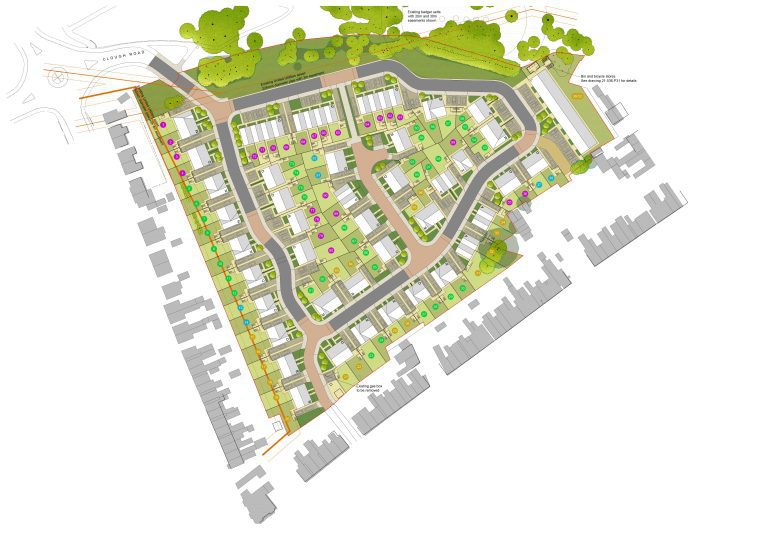
Energy and regeneration specialist, Equans, has been appointed by Cheshire West and Chester Council to transform a brownfield site in Winsford into 99 net zero carbon family homes. Equans has been granted planning consent to demolish and redevelop a former highways depot on Clough Lane, into a mixed-tenure development, where homes will be delivered with high environmental credentials and designed to meet net zero carbon status. Recognising both the climate emergency and cost of living crisis, the development will also provide in-use zero-carbon housing to future homes standard. This means that the new homes will not be connected to the gas network and will instead be equipped with energy-efficient insulation and heated by a low-carbon heating source such as an air source heat pump together with solar PV panels. A new pedestrian and cycle access onto Weaver Street will also enhance the connectivity and legibility of the development, encouraging sustainable travel. This builds on Equans’ presence in the area, with the developer already working on two low-carbon housing developments in Winsford. One of these – Wharton Green – is seeing 138 two, three and four-bedroom homes, constructed along with improvements to local highway infrastructure and a community open space. Five of these homes are set to be zero-carbon, a pilot which Equans will roll out across all 99 homes on the Phoenix scheme. Steven Gregory, Regional Director at Equans, said: “We’re delighted that planning permission has been awarded for this exciting scheme as it’s our first 100% in-use zero carbon homes project.  It’s a pleasure to see our good work continue in Winsford and surrounding areas and to also support the Council in meeting their sustainability targets. “All stakeholders have worked collaboratively and enthusiastically to move this scheme on and I can’t wait for it to get underway.” The scheme will be undertaken with Equans as the lead contractor, in partnership with Cheshire West and Chester Council, and Torus. Demolition will start on 6th March this year, and the build is anticipated to complete in May 2025. Building, Design & Construction Magazine | The Choice of Industry Professionals

Read More »
RTPI calls for consistency in leadership to deliver Government’s planning reform and housebuilding priorities

RTPI calls for consistency in leadership to deliver Government’s planning reform and housebuilding priorities

The Royal Town Planning Institute (RTPI) will be writing to the Minister of State for Housing and Planning Rachel Maclean MP, highlighting the need to deliver Government’s planning reform and housebuilding priorities. Victoria Hills, Chief Executive of the RTPI, said: “We look forward to working with the Minister, as we did with her predecessors to continue building a stronger planning system for the future. “The RTPI has worked tirelessly to help shape planning reform to benefit local communities and unlock economic, environmental and societal opportunities. The Housing Minister has been an important ally in achieving those goals. “However, like many others, we are concerned that the high turnover of Ministers in such a fundamentally important role, to deliver the homes the nation so desperately needs, risks undermining the urgency of the situation, and does not tally with the recognition by the Government in its Levelling Up White Paper for a strong planning system. “Now, more than ever, we need consistency in our leadership as we progress through the National Planning Policy Framework consultations and edge closer to the Levelling U and Regeneration Bill receiving Royal Asset. We hope that Rachel Maclean MP brings the strong leadership and consistency to the position and as ever, offer our assistance in helping to inform decision-making.  “We believe that, by working together with the Housing Minister, we can continue to build a strong planning system for communities and businesses to thrive throughout the country, whilst delivering on the Government’s ambitions for achieving net zero.” Building, Design & Construction Magazine | The Choice of Industry Professionals

Read More »
EDF improves collaboration at Hinkley Point C with GIS portal

EDF improves collaboration at Hinkley Point C with GIS portal

GIS from Esri UK helps coordinate 8,000 workers on 450-acre site  EDF has used enterprise GIS from Esri UK to create a geospatial portal for Hinkley Point C (HPC) nuclear power station, one of Europe’s largest and most complex construction projects. Supporting better collaboration and enabling new digital workflows, the portal is sharing a single view of the entire project, helping employees and contractors work seamlessly and improve safety and productivity. Recently opened-up to include Tier 1 contractors when construction of the nuclear reactors started, the portal now has over 1,500 users. Currently one of Europe’s largest construction projects with 8,000 workers on the 450-acre site, Hinkley Point C is the UK’s first new nuclear power station built since Sizewell B in 1995. The nationally significant infrastructure will provide around 7% of the UK’s electricity, power around 6 million homes and contribute to the UK Government’s Net Zero target. Central source of data Delivering clarity of information, the GIS portal is a central source of all spatial data, maps, apps and dashboards, combining multiple sources of information and making them accessible to everyone on site. An interactive primary site map contains over 100 different data layers, from BIM models and CAD data including Revit models, to construction operations, temporary works, utilities, logistics and emergency preparedness. “The scale of the project presents a complex logistical challenge,” said Jon Dolphin, Construction Project Manager and GIS Lead at HPC. “Clarity of construction data is critical and the GIS portal provides a single view of this, which drives collaboration as people can see where things are happening and when. Every employee or contractor is making decisions based on the same data. The confidence this generates makes decision-making faster and strengthens the ability of teams to work more efficiently. As a result, we’ve seen improvements in quality, safety and productivity.” Starting life as a proof of concept three years ago, the GIS portal first became an enterprise roll-out in Spring 2021 and has grown since then. “Small pilots showed what was possible, helping a wider audience understand the benefits of using GIS on a megaproject,” explained Dolphin. “Users now browse the spatial data, explore applications and enable new digital workflows relevant to them. The number of portal users is growing daily as more people become aware of what GIS has to offer and more use cases emerge.” Digitising workflows Esri GIS has enhanced HPC’s ability to collect data out in the field, replacing manual methods using paper checklists, clipboards and spreadsheets. One example is emergency planning data, used to provide assurance for regulatory purposes, which is now collected on tablets and appears in real-time in the GIS portal. Managers view and report on it using dashboards, helping to make more informed decisions. Temporary Works teams use similar new digital workflows, for planning and inspecting hundreds of simultaneous works, including excavations, earth works, scaffolding, ramps or form work for reinforced concrete pours. Adding the spatial context means contractor activities do not clash while physical surveys now take a fraction of the time. Using GIS apps and integrated dashboards for data input and reporting, eliminates the need to transfer information into a report when staff return to the desktop. Mobile GIS Another example of mobile GIS in action is an app created to improve the management of generator permit requests. HPC needed to monitor emissions as the site grew and wanted a detailed understanding of generator use. Now contractors have the ability to use a new mobile app instead of a spreadsheet, to click on a location and request a generator which is submitted into a workflow for approval. A dashboard displays the data so electrical and environmental teams can optimise the use of generators and reduce emissions across the site. “The new digital approach has replaced the previous spreadsheet-based system, which lacked auditability and had no spatial context,” said Dolphin. The portal will see another increase in usage when the MEH phase (Mechanical, Electrical and HVAC) ramps up in 2023, to manage permitting and controlling what is being built on site. This phase will see contractors work together on the complex installation of cabling, pipework and equipment for the power station’s 2,500 rooms. Future plans include using GIS to track and optimise the use of plant around the site to reduce emissions and make transport services more intelligent, by tracking the site’s buses and other vehicles. “Having one GIS portal for our construction data is immensely powerful for breaking down communication barriers, getting everyone on the same page and improving collaboration,” concluded Dolphin. “The use of Esri GIS at Hinkley Point C was a cultural shift for many people but new digital approaches soon become indispensable when working on such complex engineering projects.”

Read More »
Balfour Beatty launches Right to Respect – the equivalent of Zero Harm for inclusive behaviour

Balfour Beatty launches Right to Respect – the equivalent of Zero Harm for inclusive behaviour

Paul Raby, Balfour Beatty Group HR Director and Executive Committee member, explores Right to Respect and what it means to Balfour Beatty and the wider construction and infrastructure industry Ours is an industry plagued by historical misconceptions; long heralded as typically male dominated, steeped in the imagery of spades in the ground and hard, manual labour. But while a large proportion of our workforce is out on site achieving incredible feats of engineering and construction every day, the construction and infrastructure is progressively diverse and increasingly modern. This isn’t just in the people that choose to work with us, but in the wide range of technical skills and digital capability that we need to drive forward the plethora of mega projects that we are set to deliver. And as our sector evolves, it is imperative that our culture changes too. At Balfour Beatty, we recognise the impact that words and behaviours can have on others – both positive and negative. That is why when we launched our cultural framework, ‘Value Everyone’ was introduced as one of the five behaviours to which we hold ourselves accountable. We want to make sure that everyone feels completely comfortable at work. We’ve come a long way from some of the outdated attitudes many of us once knew, not just in our industry but in wider society, and so much the better. But in this fast-paced world we all need a bit of help to understand where the new lines are. No one wants to work in a sterile environment. We want to encourage our people to communicate, collaborate and enjoy being in the workplace. However, everyone has different tolerances and opinions on what is or isn’t acceptable and sometimes, actions – either by accident or deliberately – can make others feel awkward, excluded, or overlooked. In response, we’re taking action to help develop a shared understanding of where the boundaries are, and how to challenge unacceptable behaviour when we see it – with the launch of Right to Respect – a new approach to driving positive behaviours across our business and the wider construction and infrastructure industry. Successfully piloted with 1,000 of our employees last year, Right to Respect is the first step in a long journey ahead. We know that we have a way to go but we are confident that it will help us, and our supply chain partners, truly ‘Value Everyone’ through a combination of awareness sessions, toolbox talks and visible communications. It will allow us to recognise how the consequences of our words and actions can affect others and also empower us to deal with situations when the arise, effectively and confidently. It is our equivalent to Zero Harm for inclusive behaviour and will be launched in phases across our UK operations this year. It reflects who we are now and who we want to be. We believe that over time and with the support of every colleague across Balfour Beatty, Right to Respect will have the ability to change the perceptions that have loomed over our industry for far too long and bring fresh, new ways of thinking. It will encourage a more collaborative working environment built on respect – and will enable our industry to continue to evolve for the future. Read on our website here.  Building, Design & Construction Magazine | The Choice of Industry Professionals

Read More »
RENDALL & RITTNER PROMOTES NEW DIVISIONAL DIRECTOR

Rendall & Rittner promotes new divisional director

Leading property management agent Rendall & Rittner has recently promoted Martin Hellenas to Divisional Director of one of its London divisions. Most recently, Martin has worked as an Area Director at Rendall & Rittner, with a portfolio of developments across London. In his new role, Martin will focus on the strategic management of the division. As a Divisional Director, he will continue to develop relationships with leaseholders and residents, whilst working alongside internal departments. With plans to hire a new Area Director, Martin will work collaboratively to continue to build upon Rendall & Rittner’s success and to further develop the company’s portfolio. After joining the Erinaceous Group (later part of RMG) as a Property Manager in 2008, Martin has worked his way up in the industry. Following 6 years and a promotion to Senior Property Manager, he took on a new role at Premier Estates as it set up its London office, where he worked as an Associate Director. Since joining Rendall & Rittner in 2019, Martin has been an Area Director supporting a portfolio of London developments for clients, residents and leaseholders. Martin comments: “I joined Rendall & Rittner having previously met Matt Rittner and Richard Daver at networking events. Since joining, I have had the opportunity to develop myself and to work with amazing people. The senior management team at Rendall & Rittner is incredible and I am able to learn new things from them. The company culture here makes Rendall & Rittner a great place to work and I am excited to see where the company goes next.” Richard Daver, Group CEO at Rendall & Rittner said: “Since joining Rendall & Rittner, Martin has proven his commitment to delivering exceptional customer service and has gone above and beyond to resolve issues. Martin’s promotion to Divisional Director reflects this and I look forward to seeing how he continues to support our London portfolio in this new role.” For further information please visit: www.rendallandrittner.co.uk Building, Design & Construction Magazine | The Choice of Industry Professionals

Read More »
Drum Property Group Appoints New Construction Director

Drum Property Group Appoints New Construction Director

Ian Gracie Promoted to Key Position with Award Winning Developer  Drum Property Group has announced the promotion of Ian Gracie to the role of Construction Director. Gracie has been with Drum since 2019, leading and coordinating large design and construction teams across the company’s extensive portfolio, and has nearly 20 years’ experience working across the residential, commercial, leisure, retail and public sectors.   He takes over the role of Construction Director from Gordon Milne, who has moved to the newly created role of Technical Director for the Group. Welcoming Gracie’s promotion, Graeme Bone, Group Managing Director of Drum said: “Since joining Drum, Ian has proven himself a vital member of the team through the management and delivery of key projects during a uniquely challenging period for the industry.  Ian’s promotion is a natural next step in his development and very well deserved – his track record and experience working within Drum will bring further depth to our senior management team.  Commenting on Gordon Milne’s new position within the company, Mr Bone added: “Gordon’s new role also allows us to retain a highly experienced director within the business, providing technical and management oversight across all projects and maintaining consistency of delivery as we transition into our next cycle of development and expand our portfolio throughout the UK.”  Speaking of his promotion, Ian Gracie said: “Drum has always maintained a strong track record of growth and expansion, and I am pleased to now lead the talented delivery team for such an ambitious and dynamic developer. We have some significant projects to both complete, and in the pipeline, and I look forward to working closely with Graeme and the rest of the team at what is an exciting period of opportunity for the firm.”  Building, Design & Construction Magazine | The Choice of Industry Professionals

Read More »
Planning Approval Granted for Ingram Street Development in Glasgow’s Merchant City 

Planning Approval Granted for Ingram Street Development in Glasgow’s Merchant City 

Artisan Real Estate to Deliver Sustainable Homes and Commercial Spaces, With Landscaped Roof Terraces and Courtyard  Proposals for a landscaped and carbon friendly mixed-use development at the heart of Glasgow’s Merchant City have been given the go-ahead by Glasgow City Council, subject to agreement of a ‘Section 75’ legal agreement. Artisan Real Estate’s plans for the site at 65-97 Ingram Street, currently being used as a temporary car park, include 109 sustainable apartments and ground floor commercial space, housed in buildings varying in height from four to seven storeys.  Central to the development’s design is a publicly accessible landscaped garden courtyard filled with trees, flower boxes, raised beds for growing vegetables and seating areas. A series of landscaped private rooftop gardens and terraces will further help in creating a ‘green oasis’ for Glasgow’s city centre, significantly enhancing the local area’s biodiversity.   Designed by Scottish architects AMA Studio, the apartments will include a range of one, two and three bedroomed properties offering the latest in low carbon, fossil-fuel free living – including energy-efficient air source heat pump technology and high levels of insulation helping to keep energy costs down. The ground floor commercial space will accommodate up to four separate units ranging in size from 1750 to 2750 sq. ft. and suitable for a range of uses including leisure, office, retail or restaurants/cafés.  Welcoming the planning approval, David Westwater, Artisan’s Regional Director for Scotland, said: “We are now looking forward to our vision for this brownfield site in the heart of the city centre becoming a reality. We have set out an innovative design to attract people back into the Merchant City – creating an attractive and accessible space to live, visit, work and enjoy. As well as building sustainable and energy efficient new homes, we are also creating a variety of green, open spaces which will provide a rich, natural experience for both residents and visitors alike, with interlinked pathways and accessible seating areas.”  Mr Westwater said that more than 1200 people viewed the proposals during a three-month consultation programme held in 2022. He added: “We received some valuable feedback during the consultation. Incorporating the garden terraces and courtyard shows how natural landscaping can feature in even the most urban of settings, providing a genuinely different living experience to encourage people back in to the city centre. We look forward to working closely with the local community and other stakeholders to make the most of this accessible, public courtyard space.”   Supporting the city’s net zero ambitions, no car parking spaces are proposed although residents will be provided with secure bike spaces and access to the city car club.  For more information on Artisan Real Estate’s plans for 65-97 Ingram Street, visit the consultation website at: www.65-97ingramstreet.co.uk  For more information about Artisan Real Estate, visit: www.artisanrealestate.co.uk  Building, Design & Construction Magazine | The Choice of Industry Professionals

Read More »
World’s first zero-emissions cement industrial trial launches in UK

World’s first zero-emissions cement industrial trial launches in UK

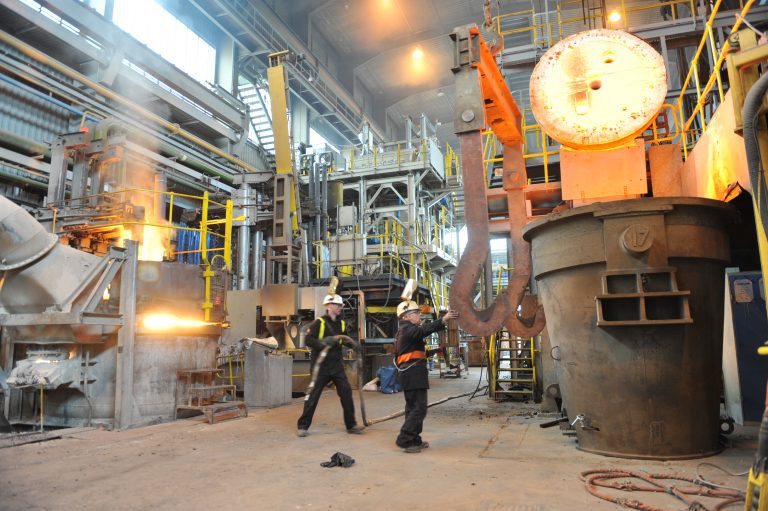
Scientists and industry unite to decarbonise construction supply chain and tackle global climate emergency   Cement 2 Zero (C2Z), a UK-based demonstrator project to trial the world’s first zero-emissions cement on an industrial scale, was officially launched this week having successfully conducted the first in a series of pilot-scale melts. The innovative project, which secured £6.5million of Government funding from UKRI as part of the Transforming Foundation Industries Challenge, aims to further advance the construction, cement and steel sectors’ decarbonisation journey to net zero industries of the future, to help meet the UK Government’s commitment of achieving Net Zero by 2050.  Led by the Materials Processing Institute, supported by the University of Cambridge (UoC), and in collaboration with key players in the supply chain, Cement 2 Zero is the first collaborative trial of its kind, to address the global construction industry’s biggest challenge of decarbonisation, in response to the climate emergency. Concrete is the most widely used material on earth, after water, and it is fundamental to our way of life, our economy and shaping our world. However, the chemical and thermal combustion processes involved in the production of cement are a significant source of carbon dioxide (CO2) emissions – with more than four billion tonnes of cement produced each year, accounting for around seven per cent of global CO2 emissions, according to the Global Cement and Concrete Association (GCCA). In the UK, concrete and cement account for 1.5 per cent of UK carbon dioxide emissions* The Cement 2 Zero project will investigate both the technical and commercial aspects of upscaling Cambridge Electric Cement (CEC) production to produce 20 tonnes of the world’s first zero emissions cement.  The first phase of trial melts is being carried out by the Materials Processing Institute, initially in a 250kg induction furnace, before being scaled up to 6T in an Electric Arc Furnace (EAF). Once the process has been substantially trialled, developed and de-risked effectively, industrial scale melts will follow in CELSA’s EAF in Cardiff. The two-year industrial trial will test each stage of the production process and brings together the expertise of the Materials Processing Institute, the University of Cambridge and key supply chain partners – Atkins, Balfour Beatty, CELSA, Day Aggregates and Tarmac – before using the innovative product in a live UK construction project.  If successful, it could not only further advance the cement, steel and construction industries, but influence how we recycle, construct and maintain our built environment and transport infrastructure, shaping the future of towns and cities, whilst simultaneously boosting economic development, and most importantly, reducing CO2 emissions to help tackle global warming.  Chris McDonald, Chief Executive Officer of the Materials Processing Institute, said: “Cement 2 Zero has the potential to make a significant contribution to achieving a zero-carbon society, secure and increase jobs in the UK cement and steel sectors and challenge conventional production processes, creating high-value materials from demolition waste.” Dr Philippa Horton, University of Cambridge, who created the project consortium, said: “If Cambridge Electric Cement lives up to the promise it has shown in early laboratory trials, when combined with other innovative technologies, it could be a pivotal point in the journey to a zero-emissions society. The Cement 2 Zero project is an invaluable opportunity to collaborate across the entire construction supply chain, to expand CEC from the laboratory to its first commercial application.” This major break-through is a result of Dr Cyrille Dunant and his research team at the University of Cambridge. They invented a new process which brings together two critical industries and construction materials – cement and steel – by combining the production processes, transforming a by-product of steel recycling into a valuable material, in one zero emission process.  Dr Dunant, said: “We take the built environment around us for granted, new homes, schools, hospitals, workplaces, roads and railways, as well as infrastructure that provides us with clean water, sanitation and energy all require cement which is an essential building material. It’s estimated that annual production equates to more than 500kg of concrete per person on the planet per year, and it is not currently possible to produce the material without creating CO2 emissions. “This breakthrough offers a positive move in cement production and will support the industry response to the UK’s legally binding commitment to bring all greenhouse gas emissions to net zero by 2050. “ The science behind this breakthrough Known as Cambridge Electric Cement (CEC), three researchers at the University of Cambridge, Dr Cyrille Dunant, Professor Julian Allwood and Dr Philippa Horton, invented a process that converts construction and demolition waste to cement over molten steel, using an Electric Arc Furnace (EAF), which is used to recycle scrap steel. The Cement 2 Zero project aims to demonstrate that concrete can be recycled to create a Slag Forming addition which could, when cooled rapidly, replace Portland cement.   Dr Dunant discovered that the chemical composition of used cement is virtually identical to that of the lime-flux used in the conventional EAF steel recycling process.  Traditional Portland clinker, one of the main ingredients in cement, is produced by firing limestone and other minerals in a kiln at extremely high temperatures (1,450 degrees Celsius), a process which accounts for more than 50 per cent of the cement sectors’ emissions. By contrast, Cement 2 Zero will use recycled cement as the flux in the electric steel recycling process (EAF powered by renewables), the by-product of which, when cooled and ground, produces Portland cement clinker, which is then blended to make ‘zero-emissions’ cement.  Therefore, this innovative cement product (CEC) could be made in a virtuous recycling loop, that not only eliminates the significant emissions of cement and steel production, but also saves raw materials, as illustrated in the infographic attached to this press release. Professor Julian Allwood, University of Cambridge and Cambridge Electric Cement, explained: “By combining steel and cement recycling in a single process powered by renewable electricity, we could supplement the global supply of the basic construction materials to support the infrastructure of a


Read More »
Temporary Works Challenge on Tideway’s South East London Site

Temporary Works Challenge on Tideway’s South East London Site

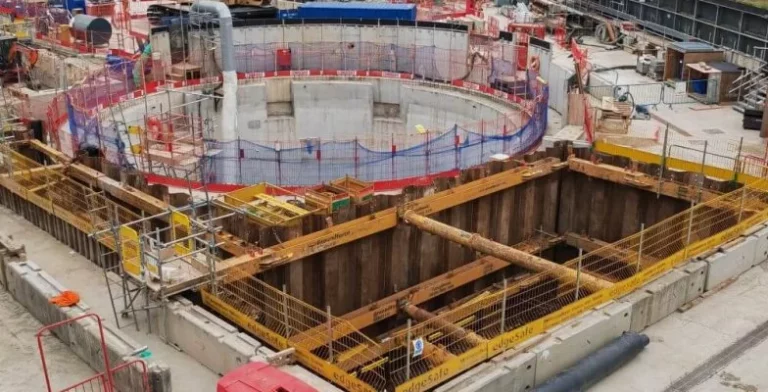
Vinci Construction Grands Projects and Bachy Soletanche JV, the Costain, demanded mining support to install an air treatment unit (ATU) at Tideway’s Deptford Church Street site in Lewisham. The ATU will control and treat air exhausted from London’s 25km long “super sewer” tunnel. The Costain has installed the ATU alongside a 60m deep, 16m diameter shaft that is said to move effluent from street level to the main sewer tunnel downward. In turn, Groundforce Shorco supplied a sheet piling and structural support solution for the ATU excavation. It is located in a confined area adjacent to the main shaft and includes three separate sections. The section engineer, Freddie Gorman, pointed out: “When the sewer is operating, air will build up inside and needs to be vented,” “We can’t just let it come straight out; it needs to be filtered. When the shaft is completed, it will be capped and any air trapped inside will be fed through the ATU, where it’s treated. It then goes into a ventilation chamber before being vented out into the atmosphere.” For supporting the excavation, Groundforce supplied KD6 sheets and Larssen sheet piles with its Mechshore, Maxi and Mega Bracing frames. Three levels of the frame with the larger capacity Mega Brace frames located at the bottom to support the higher loads were installed. Arpad Nagy, Groundforce area manager, illustrated that the temporary works design was complicated since the three sections of the excavation, each a distinct size and depth, were built back-to-back. Nagy expressed: “The frames work with and against each other and are interdependent. That means we couldn’t make any changes to one frame without affecting all of the others.” In addition, the steel sheets lining the excavation act as the outer skin of the formwork necessitates to pour the reinforced concrete walls of the ATU chamber. He continued: “The original plan was to use formwork to construct the ATU walls, but by pouring the concrete against the sheet piles the project cost has been reduced.” The excavation’s complexity, merged with varying ground levels and the proximity of the main shaft, meant the temporary works design process was tough. Nagy claimed: “The whole evolution of the temporary works design took around seven months and went through eight different versions.” The first design meeting was in April 2021, and the first delivery of equipment to the Tideway site was not until December 2021. Another obstacle for the site team was the ground conditions on the site, which were extremely hard and stony. This made it challenging to install the steel sheet piles just with the excavator-mounted vibrating hammer. Therefore, a pre-augering method had to be acquired. Also, several sheet piles still remain to be installed. However, the proximity of the current shaft resulted in additional problems. Ross Hope, a senior engineer, explained: “We were tasked with designing a system to allow the removal of the sheets which were blocking the connection, as well as providing enough clearance to allow the concrete walls to be fully cast. We came up with using a trapezoidal frame in order to transfer loads to the existing capping beam, followed by a secondary temporary frame propping off the top of the capping beam in order to allow the removal of the frames below.” The task has now advanced onto a second phase which was the excavation to obtain a long culvert that channels the filtered air from the ATU to the ventilation chamber. Nagy clarified: “This excavation will be just as complicated, but we’ve learned a few things in phase one, so I’m sure we can provide a suitable solution.” The ATU is located near the historic St Paul’s Church in Deptford and is an element of the £4.3bn Thames Tideway Tunnel project. It is said to create a combined sewer, running mainly beneath the tidal section of the River Thames across London, to capture, store and convey 95% of the raw sewage and rainwater which presently overflows into the Thames. Building, Design & Construction Magazine | The Choice of Industry Professionals

Read More »

HS2’s plans for Balsall Common Viaduct capture local feedback

HS2’s plans for the Balsall Common Viaduct in Warwickshire, recently submitted to Solihull Council, incorporate local feedback focussing on environmental sustainability, landscape integration, visual connectivity and public access. HS2’s main works contractor, Balfour Beatty VINCI (BBV), supported by a Design Joint Venture of Mott MacDonald and Systra together with architects Weston Williamson + Partners, have engaged with people in the local area over the last year to gather feedback on the viaduct – a 425-metre-long section of the UK’s new zero-carbon high speed rail line. Understanding the landscape context was a key focus of the design, allowing the team to create a viaduct that ‘reflects and reveals’ itself within the landscape. Planting and species selection was another key focus, with the plans now including wet woodland planting using native species to the local area; mixed native woodland plants such as midland hawthorn and black poplar, two notable local species; woodland edge planting to provide screening; and hedgerow planting to improve wildlife connections. Reflecting the historic local growing of flax for weaving into linen, an alternative grass species mix will incorporate blue flowered plants including blue flax, cornflower and forget-me-nots. Bird boxes will be added in the trees in various locations to serve common bird species such as robin, blue tit and great tit. A realignment of Bayleys Brook will increase habitat for fish, aquatic invertebrates and potentially water vole. Design changes have also reduced the size of the railway embankment running parallel to Bayleys Brook by 75 metres, improving the resiliency of the area to flooding, and enhancing views through the viaduct to the wider landscape. To improve connections, the Kenilworth Greenway will be extended to Station Road on the south-eastern side of the existing railway line and a further extension towards Lavender Hall is currently under consideration. Options for cycling and bridleway extensions are also being considered. HS2 Ltd’s Senior Project Manager for Balsall Common, Alan Payne said: “Over the last couple of years, we’ve worked closely with the community and local councillors to incorporate their feedback on Balsall Common Viaduct as much as possible. We’re confident that our plans respect and enhance the local history and natural environment of the area, and will provide new green areas for people and wildlife to enjoy. “The HS2 project supports nearly 30,000 jobs – of which nearly 9,000 are employed in the West Midlands, with local businesses across the region benefitting from supply chain contracts. Once complete, HS2 will transform journeys across the UK, help boost the economy and provide extra capacity on the existing rail network.” Shaun Ruffles, Landscape Architecture Director from HS2’s Design Joint Venture said: “The team have worked hard over the past 4 years to significantly improve on the hybrid Bill design to ensure that the environment and people using the area are at the heart of the design. “The finalised design for the Balsall Common Viaduct has been driven by its context and responds directly to it. The concept of ‘reflect and reveal’ has been key to this, with views of the viaduct revealed and filtered by the mature oak trees in the wider historic landscape. The viaduct is further integrated through its reflection in local water features and in the polished acoustic parapets which will reflect the skyline, lightening the structure further.” BBV will construct a total of 16 piers to carry the viaduct 10m above ground, crossing over Station Road, Bayleys Brook, Heart of England Way Walk and the local floodplain. Construction refinements have reduced the size of each pier by as much as 17% for single piers and 28% for double piers, giving the structure a lighter appearance. Responding to feedback about the look of the viaduct, a section at Station Road will be finished with a bespoke pattern, referencing the local history of the area. People can register to attend an event on Thursday 16 February at Balsall Common Village Hall to view the latest plans and talk to the team: www.hs2.org.uk/balsall-common Building, Design & Construction Magazine | The Choice of Industry Professionals

Read More »