Kenneth Booth

DERBY MARKET HALL MARKS COMPLETION OF ROOF RESTORATION

AFTER undergoing extensive roof and structural restoration assisted by a scaffolding structure weighing more than eight blue whales, the team behind the transformation of Derby’s iconic Market Hall has revealed that the first phase of work has now completed. The Grade II listed Victorian market hall, which has been trading

Read More »

Enrok Construction Secures £4.6m Brixton Construction Project

The new partnership with Node will see the firm deliver 63 luxury apartments in Brixton, with premium views across London.  Enrok Construction has commenced work with Node to deliver 63 one-and-two-bed luxury apartments in Brixton, London. The construction specialist has worked on the project since March 2022 and is now

Read More »

Local Authority Building Control launch funded trainee scheme

Earn while you learn with LABC’s funded training scheme Local Authority Building Control (LABC), the membership organisation for 3,500 public service building surveyors in England and Wales, has launched a fully funded trainee scheme to attract new recruits into the profession. Following the landmark Building Safety Act 2022, LABC is

Read More »

Henry Brothers completes Glossopdale school extension

Contractor Henry Brothers has handed over a new extension at Glossopdale School to Derbyshire County Council. The £4million extension is the second phase of the Council’s plan to increase capacity at the school, which can now take up to 1,440 pupils. The new space will provide an additional nine teaching

Read More »

ROCKWOOL® announces the launch of NyRock technology

Rockwool’s new launch of NyRock technology delivers improved thermal performance, while maintaining non-combustibility and acoustic capabilities As pressure mounts on the construction industry to deliver more thermally efficient buildings whilst preserving standards of fire and acoustic performance, ROCKWOOL has launched NyRock technology. NyRock is an evolution in stone wool composition

Read More »

PROPOSED PART Z AND EMBODIED CARBON REGULATION

Despite research by the UK Green Building Council (Nov 2021) showing that embodied carbon emissions due to the construction process, maintenance and demolition of buildings, created 40 to 50 million tonnes of CO2 annually – more than aviation and shipping combined, the UK government has failed to regulate the embodied

Read More »
Latest Issue
Issue 335 : Dec 2025

Kenneth Booth

DERBY MARKET HALL MARKS COMPLETION OF ROOF RESTORATION

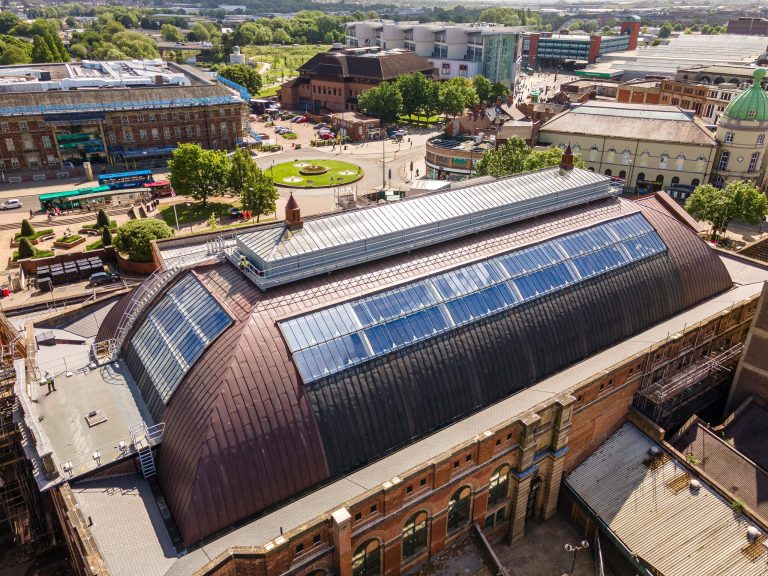
AFTER undergoing extensive roof and structural restoration assisted by a scaffolding structure weighing more than eight blue whales, the team behind the transformation of Derby’s iconic Market Hall has revealed that the first phase of work has now completed. The Grade II listed Victorian market hall, which has been trading since 1866, will be transformed into a contemporary and vibrant cultural and retail destination. Wates Construction, which has an extensive track record of heritage restoration projects around the UK, has been leading an expert project team of local architects and engineers on the flagship project, comprising Latham Architects, Rogers Leask, and Clancy Consultants. The work completed includes masonry repairs to the building envelope, internal cleaning of the roof structure, and lead paint removal before the challenging and extensive heritage glazed roof replacement works. This included increasing ridge height to accommodate natural ventilation for the building, copper roof replacement, gutter and rainwater works, access equipment, localised electric works, lightening protection, and decoration. John Carlin, Regional Director at Wates Construction, said: “It has been a privilege to work on the restoration and transformation of such an iconic and unique building, maintaining its historic charm but also bringing it into the council’s overall modern vision for the revitalisation of the wider city centre.  “Before this work on the roof was carried out, the Market Hall often had to close to customers for safety reasons if there was possibility of strong winds, snow, or heavy rain in case the glass windows came out of their frames. Along with the extensive restoration of the roof structure, all of these windows have now been replaced, meaning that closing the market and disrupting trade just for weather will no longer be necessary.” “Making sure that trading could continue while initial surveys and work on the roof took place was particularly important. To do this, we installed a scaffolding structure to give access to the roof without disrupting ground level activity. It was an impressive feat of engineering all by itself, which would have spanned more than 62 miles if placed end-to-end and weighed almost 900 tonnes, but it really was the key to making sure trade could continue despite our ongoing work, supporting the city’s traders post-pandemic.” Throughout the process, the project team supported traders and the council project team to a high level, offering tours and site visits, as well as engaging with local sixth-form college students and a range of industry professionals to involve the local community in the project. The team is now looking forward to commencing the second phase of the regeneration programme, which is set for later this year and will focus on internal and external configuration to transform the look and feel of the building. Raised concrete floor plinths that currently house individual market stalls will be removed to create a more airy, open and accessible space, with the ground level intended to provide space for up to 32 market stalls, which will be portable for flexibility. Meanwhile, the interior balcony area will provide an opportunity to accommodate a small business incubator, and to provide space for special themed markets, such as antiques or crafts. The entrances to the Market Hall are also set to be improved in the upcoming phase of work, allowing market activity to flow seamlessly into the surrounding streets and creating an attractive and flexible space in the adjacent Osnabruck Square. The Market Hall is located within Derby’s City Centre Conservation Area, which also contains Derby Cathedral, the Silk Mill, and the Guildhall Theatre, and was originally designed by Derbyshire engineer Rowland Mason Ordish. When completed, it will complement the emerging Cultural Hub, which aims to re-energise the day and night-time economies and drive stronger footfall in the Market Place and wider city centre Councillor Mick Barker, Cabinet Member for Governance and Deputy Leader of Derby City Council, said: “Derby Market Hall is one of the city’s most beautiful and prominent buildings, which connects key areas of our city centre. “As a Grade II listed building, it deserves tasteful and sympathetic attention to detail to its renovation. Quality takes time and we’re delighted to see that this striking copper roof has now been finished, which paves the way for the rest of the Market Hall’s transformation. “Soon we can move onto the internal renovation and give Derby a fantastic market, which is full of life and which will help draw people back into the heart of our city.” Wates Construction was appointed via SCAPE’s Major Works framework. The second phase of development is set to commence on site in Q4 2022, with an aim to complete in 2024. For more information, please visit https://www.wates.co.uk/

Read More »

Paramount designers rise to challenge of creating ‘inspirational’ office in historic Bath

Commercial interiors specialists Paramount say they are “proud” to have been appointed to create an “inspiring workplace” at the heart of historic Bath’s flagship regeneration project. The Paramount Bristol-based team are masterminding the interior design of the prestigious new office space in the Bath Quays office building for leading local financial services consultancy and software provider, Altus. Paramount, whose headquarters are in Cardiff, were engaged by Altus to transform the 9,445 sq ft workspace on the top floor of the five-storey, energy-efficient office building, after Altus had signed a deal to move its headquarters to the city centre site. It confirmed Altus as one of the first tenants of No 1 Bath Quays – the first new office block to be built in Bath for a generation and a key part in Bath and North East Somerset Council’s ambitious regeneration programme and climate emergency priority. Paramount Client Lead Carly Willis said: “Paramount create places where people want to be; workspaces that inspire employees and embrace well-being. “We have relished working closely with Altus to create an inspirational, attractive, sustainable, and eco-friendly workplace for a company at the forefront of bold local authority plans to revitalise Bath as an economic hub. “Our objective for the new Altus office is to create an uplifting workplace that is both a showcase to clients and a joy for staff – high-end destination space that encourages positive interactions between staff and clients. “Bath is a stunning city, famously steeped in history. We are proud to play a part in ensuring it enjoys a vibrant commercial future, creating a workplace that will help Altus – and Bath as a whole – go from strength to strength.” In order to ensure that the new workplace met Altus requirements and post-pandemic hybrid working habits, Paramount conducted a company-wide staff survey and several stakeholder engagement sessions. Results showed an increased need for a variety of meeting places, easy access to video conferencing, privacy, enhanced acoustics and plenty of collaborative social space. Paramount Lead Designer Bethan Hellings said: “The words ‘collaborative’, ‘spacious’ and ‘fun’ came up time and again during our engagement sessions and they’ve coloured my work in more ways than one. “Finishes have been carefully selected to be soft and calming yet also happy and bright and we have been particularly mindful of enhancing light and space, avoiding dark colours and keeping the space as open as possible. A calming base palette is unobtrusive and minimises visual stress, but we have also added uplifting colour accents to add life to the space.” Timber finishes provide warmth and bring natural texture. Rounded corners provide soft transitions and easy movement between spaces and angles have been used throughout in desk positioning and floor finishes to create more interesting sightlines. Now the new office, which includes a terrace offering stunning views of the city, is in the final stages of development, with Altus staff expected to move in by mid-October. The move will represent a significant milestone for the Bath business, which was founded in 2005 by a small group of friends, but which now employs more than 100 people and prides itself on its strong roots in the local community. Altus Consulting Director Martyn Evans said: “Paramount are very much like Altus in size, culture, values, and their team just ‘got us’. They are very receptive to our ambition to provide an inspiring workplace for our staff while focusing on environmental consciousness. “Our new HQ will provide the next step in the growth of our business and will provide an inspiring place to work for current and future staff. We are delighted to be moving the business to No 1 Bath Quays and to be part of the city’s regeneration journey.” The 4.5-acre Bath Quays project incorporates a blend of historic buildings and contemporary architecture and will become a key strategic site for the city centre. Councillor Kevin Guy, Bath and North East Somerset Council leader, said: “We are delighted Altus has chosen No 1 Bath Quays for its new headquarters. This is an excellent endorsement of our commitment to delivering market-leading, next generation workspaces to help attract skills and talent to Bath.”

Read More »

Enrok Construction Secures £4.6m Brixton Construction Project

The new partnership with Node will see the firm deliver 63 luxury apartments in Brixton, with premium views across London.  Enrok Construction has commenced work with Node to deliver 63 one-and-two-bed luxury apartments in Brixton, London. The construction specialist has worked on the project since March 2022 and is now able to announce the formal contract. In a short time Enrok has played a pivotal role, completing roof works, installing windows and commencing the cladding and internal fit out, and is now committed to the successful completion of the scheme. In its entirety, the project will see the conversion of a four-story building on Shakespeare Road with work to include the development of a fifth additional floor containing 6 additional luxury apartments. The penthouses will boast premium views across the capital city with a number of iconic buildings in sight, including The Shard, The City, Canary Wharf, Big Ben and the Palace of Westminster. Speaking on the project, Simon Bennett MCIOB, Enrok’s Operations Manager, commented: “We have been working closely with the team at Node for four months now, and it’s great to be able to shout about what will become our flagship project. “Building outwards is not always feasible in high-density areas, so developing upwards is an effective solution – and something that is becoming increasingly popular across London and other densely populated cities where space is at a premium. “Working in London does come with its own challenges, but our project planning and existing presence in London has enabled us to hit the ground running on the scheme and we are looking forward to delivering it successfully. “We hope that this marks the start of a strong working relationship with Node and very much look forward to the prospect of future collaborations.” Enrok Construction is a privately owned construction company, operating across the UK from its headquarters in Derbyshire. The firm provides developers and clients from the UK and beyond with an all-inclusive construction service. It has built a reputation across the Midlands for consistently designing, building and project managing the delivery of homes and commercial buildings that people aspire to live, work, socialise and visit and which benefit their communities.

Read More »

Prologis UK acquires two prime last-mile logistics estates in Greater London

Prologis, a leading owner and developer of UK logistics real estate, has further strengthened its portfolio in London and the South East, with the acquisition of two prime urban logistics estates in Park Royal and Watford. This transaction continues the company’s strategic focus on Greater London, following recent acquisitions in Croydon and Erith in July.  Comprising more than 360,000 sq. ft. of prime last-mile logistics space, on a total of 17 acres, both estates offer a range of Grade A units and are 100% leased to customers operating in diverse industry sectors including distribution, construction, pharmaceutical and film and television. Located in two densely populated urban markets, Prologis Central Park (Park Royal) and Prologis Imperial Park (Watford) are strong additions to the UK portfolio, with both benefiting from excellent connectivity to London and beyond. Situated at the heart of Park Royal, the capital’s premier industrial and logistics estate, Central Park was built in 2014 to BREEAM ‘Excellent’ specification. Imperial Park was built in phases from 2000 and is well located less than 5 minutes from Junction 5, M1 in Watford, north west London’s principal commercial district. The purchase of both assets complements Prologis UK’s existing portfolio – expanding holdings at Park Royal and, in the case of Watford, increasing the company’s presence along the southern M1-London corridor. The Watford site in particular adds to a number of successful projects in Hemel Hempstead. Paul Weston, Regional Head of Prologis UK: “The purchase of these prime urban logistics estates illustrates our confidence in and appetite to grow our last mile offering servicing London and the South East. We look forward to working with new customers across the two parks, all of whom are welcome additions to our business.” The assets were acquired from Schroders Capital who were advised by Gerald Eve. 

Read More »

Local Authority Building Control launch funded trainee scheme

Earn while you learn with LABC’s funded training scheme Local Authority Building Control (LABC), the membership organisation for 3,500 public service building surveyors in England and Wales, has launched a fully funded trainee scheme to attract new recruits into the profession. Following the landmark Building Safety Act 2022, LABC is boosting building control capacity in light of new responsibilities and support for the Building Safety Regulator. The regulator will be responsible for ensuring the safety of all new higher risk buildings and for the oversight of 12,000 existing occupied tall buildings. The capacity building programme will see more than 150 people recruited into the building control profession with a three year fully funded learning and development plan. LABC is looking for people who can demonstrate leadership skills, solve problems creatively and work under pressure. The programme is nationwide with a clear progression pathway. The funded scheme means learning and development will be fully subsidised, and recruits will be paid while they study and progress.  The programme allows trainees to gain the skills, knowledge and experience to be able to competently deal with the full range of building work and other statutory functions undertaken by building control. Trainees’ specific development and learning will be supported while they undertake studies for the Level 4 and Level 5 Diplomas in Building Control followed by funded level 6 (degree level) learning once they are in permanent employment with a local authority.  The educational programme provided by LABC is combined with experiential learning gained while being placed with a local authority building control team. Shadowing building control professionals gives recruits first hand opportunity to see how the knowledge they gain is applied practically to make sure buildings are safe. Once a trainee successfully completes each stage of learning and has gained sufficient experience, they can take the relevant validation assessment through the Building Safety Competence Foundation (BSCF).  After the three-year programme trainees will be able to apply for roles within local authority building control teams – this could be as an assistant building control surveyor or higher, depending on how well they progress. Details of the scheme can be found here. 

Read More »

Innovative New Photovoltaic-Thermal Collectors for Heat Pumps Launched by NIBE Energy System

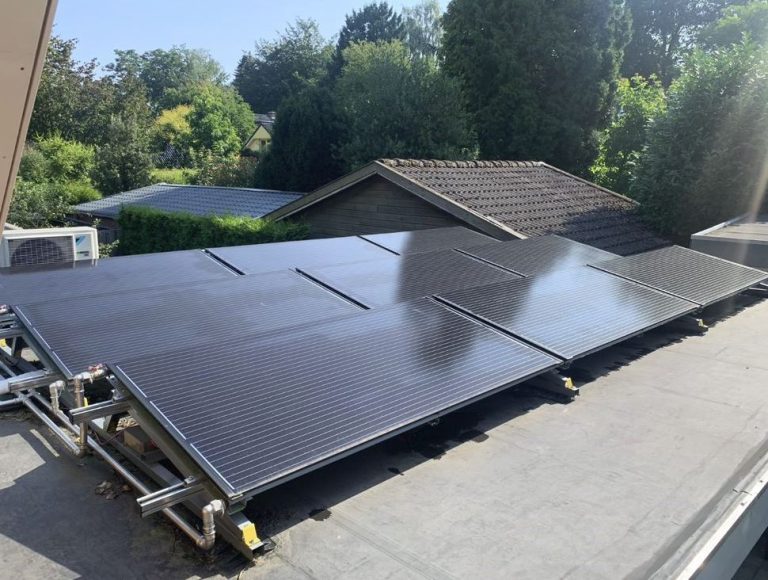
NIBE Energy Systems has launched a brand-new Photovoltaic-Thermal (PV-T) and Heat Pump solution which offers an innovative approach of transforming a NIBE “ground-source” heat pump product into a “multi-source” heat pump product. NIBE PV-T collector is an alternative, innovative, and silent heat source for use with NIBE ground source heat pumps, removing the requirement of a ground or bore hole collector array. The PV-T collectors produce electrical energy that can be used to operate a ground source heat pump. On a hot day, the circulating brine helps cool the PV-T panel, increasing PV-T generation efficiency.​ Following successful trials in homes and public sector buildings in the UK, NIBE is pleased to officially launch this new technology which produces two types of energy, thermal energy and electricity, by using a unique solar panel. The PV-T system builds on NIBE’s promise to continuously update its products, and to make it easy to be ‘smart.’ The system was recently successfully installed at the University of West London. The ground-breaking scheme is considered as one of the largest of its kind in the world and was made possible thanks to a £5 million Public Sector Decarbonisation Fund. The project involved the replacement of old gas boilers with ground source heat pumps alongside 580 solar PV-T panels. The site remained active throughout the build due to the use of prefabricated structures and the innovative PV-T design removing the need for extensive groundworks. Jonny Hancock, Product Manager at NIBE Energy Systems (UK) said: “The NIBE PV-T collector is an alternative, innovative and silent heat source for use with NIBE ground source heat pumps. The installation of a PV-T array can be utilised as a direct alternative or supplement to a traditional borehole or surface collector, while delivering the same levels of efficiency. It is also an excellent solution for when an air/water solution is not desirable. “PV-T panels are equipped with PV cells at the front that convert sunlight into electricity. The rear consists of a thermal heat exchanger that extracts aerothermal energy from the ambient air. The operation of the heat exchanger is therefore comparable to that of an air/water heat pump, without the requirement of a mechanical fan. A PV-T system therefore works 100% silently. Depending on the heating requirements, they can replace traditional boreholes or ground arrays, minimising disruption and removing the need for extensive ground works which can be impractical on some sites.” The PV-T collector is designed so that even on cloudy days and at night, the heat exchanger provides sufficient energy for the heat pump. In warmer months, the heat extracted by the collector helps cool the PV aperture surface, improving generation efficiency. The system has also been designed to provide additional comfort in the summer through passive cooling – increasing efficiencies and maximising carbon savings. It can also be used in new build properties to provide an efficient solution where noise is a concern and space is at a premium.

Read More »

Henry Brothers completes Glossopdale school extension

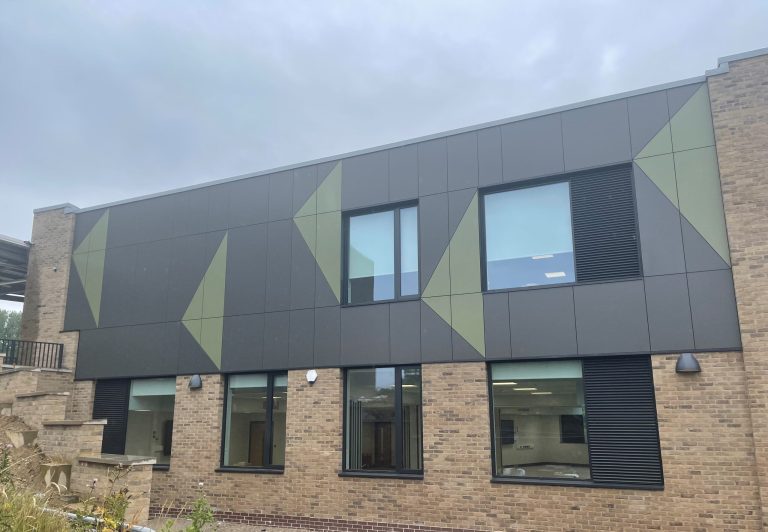
Contractor Henry Brothers has handed over a new extension at Glossopdale School to Derbyshire County Council. The £4million extension is the second phase of the Council’s plan to increase capacity at the school, which can now take up to 1,440 pupils. The new space will provide an additional nine teaching spaces comprising eight standard classrooms and a demonstration science lab. It will also provide flexible options for dining and social spaces and extra staff workrooms. Ian Taylor, Managing Director of Henry Brothers Midlands, said: “Having built the main Glossopdale School, which has proved so popular, Henry Brothers is delighted to have now delivered an extension to create additional space for a further 200 students. “We have partnered with Derbyshire County Council on several school projects over recent years, helping to enhance facilities, and it’s great to see the completion of this latest scheme. “Working alongside employers agent Concertus, DLA Architecture, civil and structural engineer Curtins and Couch Perry Wilkes for M & E services, Henry Brothers has helped to deliver a superb scheme, which will allow additional pupils to attend this popular school.” The addition, which was funded by the Council, is set into the hillside and also includes a new multi-use outdoor games area for play and PE. Derbyshire County Council’s Cabinet Member for Education, Councillor Alex Dale, said: “It’s great to see the handover of the new phase of the planned Glossopdale expansion, and we’re really pleased that it’s been delivered ahead of the original strategy to help us meet local demand. “We’re committed to ensuring young people in Derbyshire have the best possible start in life and access to a high-quality education is at the heart of that. I’m really pleased that the school will be welcoming pupils back into this new space from September.” Jess Etienne, Key Account Manager at Concertus Design & Property Consultants, said: “Considering the economic climate during the construction period, we are pleased to have been able to play our part in delivering these high-quality educational facilities and we are so thrilled with the outcome. The close and positive working relationship between Concertus, Derbyshire County Council, and Henry Brothers has played an instrumental part in the success of this project, and we are excited to see the students continue their journey in their new setting.” Nottingham-based Henry Brothers Midlands is part of The Henry Group, which comprises a number of manufacturing and construction sector companies, ranging from external construction through to interiors fit-out. Henry Brothers is on a carbon reduction journey and is committed to cutting its carbon emissions by 50% by the year 2030, and to achieve net zero carbon emissions by 2050. For more information, visit www.henrybrothers.co.uk

Read More »

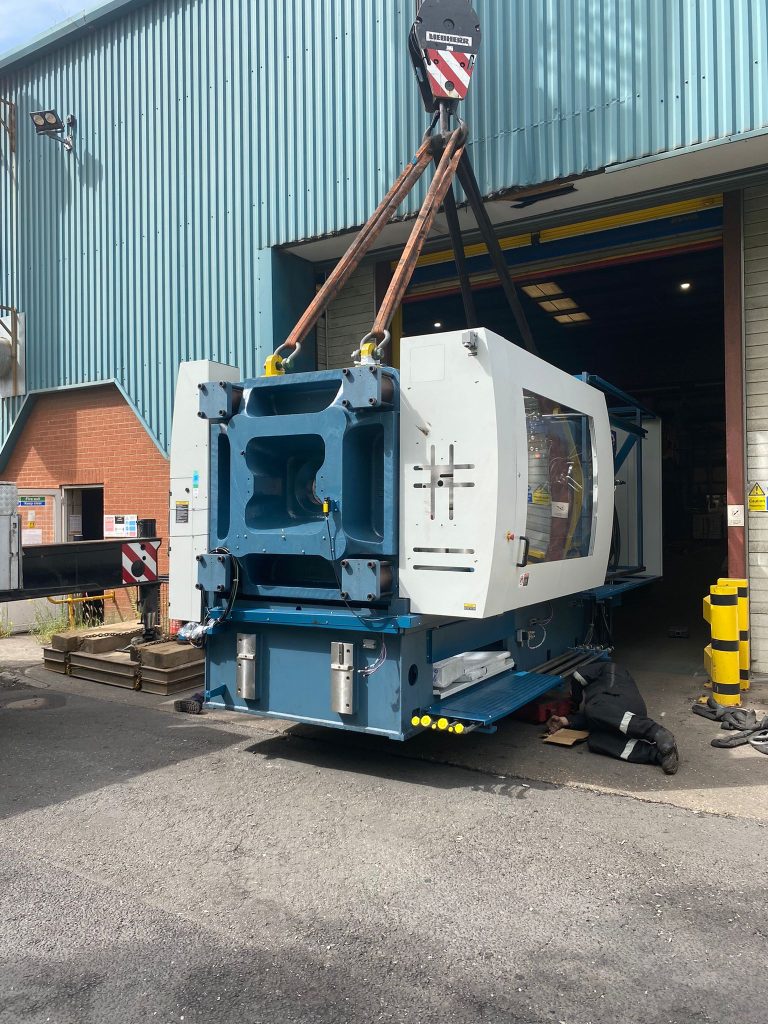
KAYFLOW UNVEILS LATEST MACHINERY INVESTMENT TO AID PRODUCT DEVELOPMENT AND REDUCE ENERGY CONSUMPTION

Kayflow continues to demonstrate its commitment to both product development and sustainability by investing in a new injection moulding machine, which is just one element of the company’s ongoing investment programme for 2022. Kayflow’s new Romi – 800T Injection Moulding Machine with Axis Robot will be used for the ongoing production of Kayflow’s underground soil and waste range of mouldings. The machine’s extensive collection of innovative features will aid production as well as helping to reduce the company’s energy consumption. The machine’s ‘Stop and Go’ system is driven by a Servopump for high precision, repeatability, and energy efficiency, whilst the modernised power system will result in a 60 percent reduction in energy usage. Its reduced cycle times will also help to improve machine utilisation and capacity, both of which support a more sustainable operation. In addition to contributing to Kayflow’s energy efficiency objectives, the Romi – 800T also enables consistent production and a superior finish aiding the company’s commitment to providing only the highest quality products on the market. Alan Tunnicliffe, Technical Director at Kayflow, explains: “The Romi – 800T is one of ten new machines we plan to purchase in 2022, following on from our investment in three machines last year. Overall, 70 percent of our machinery has been modernised over the past two years, which has enabled us to maintain our high-quality standards and increase productivity, whilst reducing our energy consumption and carbon footprint. “Quality will always be at the heart of everything we do, but we are constantly aware of the impact our processes have on the environment. This is why we strive to employ systems and procedures that work to mitigate any negative environmental effects and increase our sustainability. “We’re confident that the investments we have made – and continue to make – will have a positive impact on our business processes, both in terms of product quality and energy consumption, for many years to come.” Further information about Kayflow and its product range can be found at www.kayflow.co.uk or by calling 01827 317 269.

Read More »

ROCKWOOL® announces the launch of NyRock technology

Rockwool’s new launch of NyRock technology delivers improved thermal performance, while maintaining non-combustibility and acoustic capabilities As pressure mounts on the construction industry to deliver more thermally efficient buildings whilst preserving standards of fire and acoustic performance, ROCKWOOL has launched NyRock technology. NyRock is an evolution in stone wool composition that delivers the lowest lambda stone wool insulation available in the UK. NyRock has a more efficient fibre structure to deliver low thermal conductivity Created using a new patented production process, this next generation stone wool insulation has a more efficient fibre structure that can deliver thermal conductivity as low as 0.032 W/mK. This means that U-values can be met with comparatively thinner constructions, which in the case of external wall applications, creates the potential for additional interior floor space over a given building footprint. Alongside its improved thermal efficiency, NyRock technology still delivers all the additional benefits of stone wool insulation including durability, the ability to be recycled indefinitely, and acoustic and fire performance. Comprising naturally non-combustible volcanic rock, ROCKWOOL solutions powered by NyRock technology achieve Euroclass A1 (the highest possible rating) and can withstand temperatures in excess of 1000°C. A solution to the rapidly evolving needs of the built environment Paul Barrett, head of product management at ROCKWOOL UK, commented: “Our new products featuring NyRock technology will be significant for the construction industry, giving specifiers and building owners a true solution to the rapidly evolving needs of the built environment and its biggest challenges. “To limit the impact of climate change and support the delivery of net zero carbon in the UK by 2050, it’s the responsibility of manufacturers like ourselves to go further, re-inventing and improving on existing solutions. NyRock technology does just that. “While stone wool insulation is already known for its proven benefits such as longevity, ease of install, circularity, and non-combustibility that is crucial for protecting people and properties, our patented technology builds on these advantages further. “Whether specifiers need a solution to the lower U-values of England’s new Approved Document L that also maximises floor space, or a non-combustible option for a high-rise property with enhanced thermal and acoustic performance, NyRock technology’s industry-leading lambda value for stone wool and ability to reduce the thickness of a construction element support those requirements.” NyRock technology will be rolled out across a range of ROCKWOOL insulation solutions during 2022. To register for updates on the launch of products featuring NyRock technology, visit rockwool.com/uk/nyrock or click here.

Read More »

PROPOSED PART Z AND EMBODIED CARBON REGULATION

Despite research by the UK Green Building Council (Nov 2021) showing that embodied carbon emissions due to the construction process, maintenance and demolition of buildings, created 40 to 50 million tonnes of CO2 annually – more than aviation and shipping combined, the UK government has failed to regulate the embodied carbon cost of construction whilst focusing solely on operational emissions. As a result, experts in the field of decarbonisation have worked together to develop a proposal for amendments to the Building Regulations that could be used to mandate the reporting and limiting of carbon emissions. Head of Sustainability at Whitecode, Ellen Huelin, takes a look at the proposed Part Z amendment to the Building Regulations and the concept of embodied carbon regulation. She argues that without such regulation the UK could easily fail to meet its ambitious carbon emissions targets.  There has been a great deal of focus trained on the energy efficiency of properties being built and operational emissions, but not enough attention has been paid to the sustainable aspect of the construction process. I agree with the authors of the proposed amendments to The Building Regulations 2010 that there is the need for legislation to be introduced that would ensure that embodied carbon is assessed on all projects as part of a comprehensive whole-life carbon assessment.  The House of Commons’ Environmental Audit Committee agree. In its report in May 2022 entitled Building to net Zero: costing carbon in construction, it states that the single most significant policy the government could introduce is a mandatory requirement to undertake a whole-life carbon assessment for buildings and that this requirement should be set within building regulations and the planning system. It says the government should then develop progressively ratcheting carbon targets for buildings, with a clear timeline for introducing this in place by the end of 2022. This is the biggest indication yet that the government is beginning to listen to our industry which has been actively supporting the concept behind a new Part Z and recognising that, as a result of a lack of policy, no real progress has been made in reducing embodied carbon emissions within the built environment. Our sustainability team at Whitecode has a great deal of experience carrying out whole life-cycle carbon (WLC) emission assessments, that consider operational as well as embodied carbon emissions together over a project’s expected life cycle, because the London Plan (policy SI 2) sets out a requirement for development proposals to calculate and reduce WLC emissions as part of a WLC assessment. London has an ambitious target to become zero-carbon by 2050, but even the London Plan has no specific embodied carbon targets, only ones around reducing carbon in operation. Outside of London it seems that only the most forward-thinking developers or those where sustainability is their Unique Selling Point (USP) are carrying out voluntary whole-life carbon assessments.  Policy change will be the quickest route to transform the industry so that we can match countries including the Netherlands, France and Sweden who already regulate embodied carbon emissions. It is frustrating that we are lagging behind others when we have an industry that is calling for it! Any new policy needs to be progressive otherwise the industry will not achieve substantive change. The government’s Future Homes and Buildings Standard will ensure that all future homes will be net zero ready from 2025, if new regulations around embodied carbon emissions don’t come into play soon, this will be a standard that will be difficult to meet. We also need regulation and quickly, around the use of sustainable construction materials to ensure that as an industry we are working towards net-zero. To do this I believe the government needs to incentivise their use and their development. We need to consider the circular economy. We know that we shouldn’t be putting things into landfill and that we should be looking to recycle where possible, but we don’t want to just be able to recycle; we need to be able to re-use construction materials again and again. We need to look at how functional and adaptable they are and ensure they are designed for assembly so they can be remodelled and repurposed. We can no longer just stick materials together if we want to work towards a whole life-cycle approach. Industry standardisation will support moves to regulate embodied carbon. Notes on the proposed Part Z say that a cross-industry team is developing a free-to-use Built Environment Carbon Database (BECD) that will be launched this year, the idea being that it minimises the cost and complexity of the process of measuring embodied carbon. The BECD will also include a product database. The standardisation and bringing together of information is vital to allow new regulations to be easily implemented. The government needs to adopt this approach by standardising methodology, creating reporting frameworks and setting minimum targets for the construction sector.  Industry support for regulation is clear, with major developers and industry bodies stepping forward to support the concept of Part Z. I am also seeing a change of mindset coming from within the sector around environmental, social and corporate governance (ESG). Recently I have been asked by a number of clients for advice around ESG and one client has asked me to join their sustainability steering group to help them with the mechanisms of placing sustainability intrinsically within their business. These are positive developments that demonstrate a real appetite by companies to accelerate their reduction in carbon emissions. The government needs to recognise that the construction industry is ready and willing for change. The time is now.  There has been a great deal of focus trained on the energy efficiency of properties being built and operational emissions, but not enough attention has been paid to the sustainable aspect of the construction process. I agree with the authors of the proposed amendments to The Building Regulations 2010 that there is the need for legislation to be introduced that would ensure that embodied carbon is assessed on all projects

Read More »