

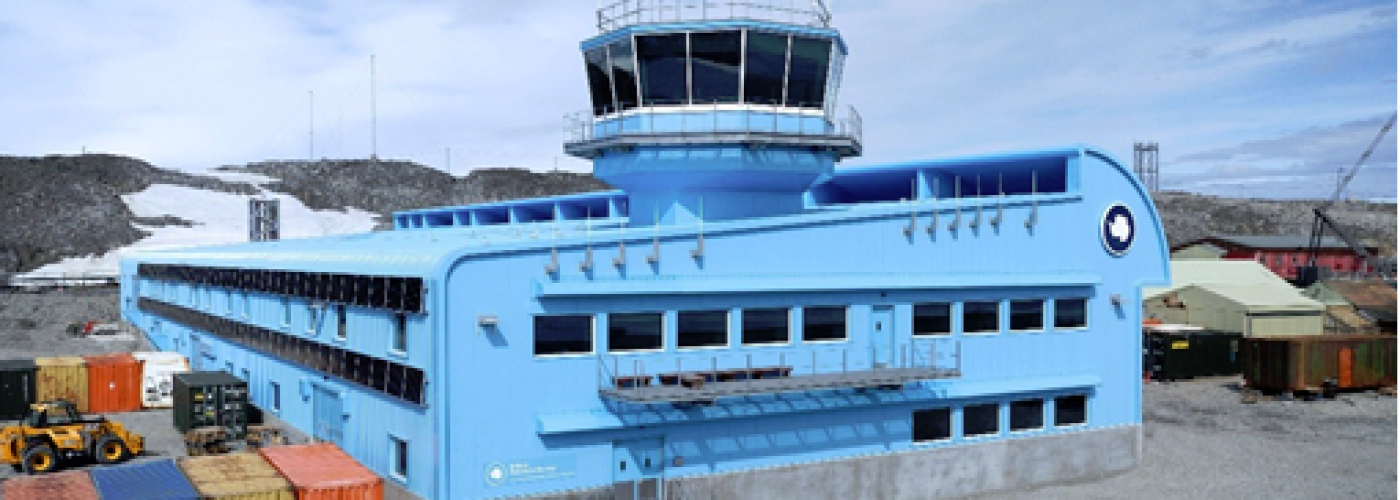


British Antarctic Survey has completed a significant phase of construction at Rothera Research Station in Antarctica, delivering new infrastructure that will power cutting-edge polar science for decades ahead.
The Discovery Building, which came into full operation on 7 May, marks a significant milestone for the UK’s largest research station on the Antarctic Peninsula and BAS’s long-term polar research. Part of the Antarctic Infrastructure Modernisation Programme (AIMP), the new hub brings together day-to-day operations, power and healthcare under one roof, allowing the station to run more efficiently and with a smaller environmental footprint than ever before. The Discovery Building made history as the first in Antarctica to achieve BREEAM Outstanding accreditation, awarded to fewer than 1% of projects worldwide. This surpassed its original BREEAM Excellent target, setting a new benchmark for sustainable construction in extreme environments.
David Brand, Rothera Modernisation Senior Project Manager, said: “This transition is an important step in ensuring that the infrastructure at Rothera can support science in the long-term. What matters now is that these systems perform reliably, supporting people and sustaining the UK’s presence in Antarctica.”
The end of the Antarctic construction season coincides with the 48th Antarctic Treaty Consultative Meeting (ATCM) – the annual forum of signatories to the Antarctic Treaty, which governs how Antarctica is protected and managed. BAS is fundamental to the UK’s role in this international framework, providing world-leading research that informs global policy on the polar regions, while championing the highest standards of environmental protection across the Southern Ocean. Through sustained investment in its stations, vessels and aviation capability, the UK ensures its Antarctic operations continue to offer a safe, sustainable and effective role to one of the world’s most important scientific and strategic partnerships.
A season supporting scientific advancements
Alongside construction activity, BAS scientists continue to carry out vital marine research at Rothera, with long-term monitoring programmes tracking decades of environmental change to help distinguish the signals of climate change from natural variability. This work, including studies of blue carbon stocks and marine biodiversity, informs government advice on the health of polar ecosystems and contributes to the protection of the waters around UK Overseas Territories.
This season is demonstrating how modernised infrastructure is supporting scientific output. Projects such as POLar Ocean Mixing by INternal Tsunamis (POLOMINTS) and the long‑running Rothera Time Series (RaTS) rely on consistent power, logistics and environmental stability to generate high‑quality, long‑term datasets.
POLOMINTS is investigating how underwater tsunamis triggered by glacier calving influence ocean mixing. Meanwhile, RaTS, one of the longest‑running ocean monitoring programmes in the Southern Ocean, continues to track physical and biological changes in one of the fastest‑warming regions on Earth.
Engineering and efficiency
A significant focus has been on optimising the engineering systems that enable Rothera to operate continuously under extreme conditions.
A major programme of work this season has centred on the temperature stabilisation and the heat recovery from the Combined Heat and Power (CHP) system. Heat is captured and reused that would otherwise be lost and the CHP units improve overall energy efficiency while reducing fuel consumption.
Work was completed on the Building Management System (BMS) so that the mechanical and electrical systems could communicate with a central control computer interface. This has transformed BAS’ way of working as operators can now see what is going on in legacy building plant rooms and across the Discovery Building.
Work across the wider site has also made Rothera more resilient. The structure over which overground pipes and cables sit have been strengthened while the Discovery Building has been further weatherproofed to help prevent water ingress.
Preparing for Winter
As the station prepares for winter, there has been large‑scale demobilisation across Rothera. Containers have been consolidated and prepared for return to the UK, heavy equipment including a crawler crane dismantled, and materials have been prepared for shipment during the annual logistics window, supported by the cargo vessel MV Stevie. Temporary and legacy infrastructure has been removed, and former working areas reinstated through completed groundworks, with land reshaped and returned to operational use.
Elen Jones, AIMP Programme Director said: “Seeing the containers removed and the natural landscape re-emerge has been a symbolic moment. From consolidating materials to removing temporary infrastructure, this work is essential to ensuring the station can operate safely and continue supporting science through the winter. It’s all part of delivering infrastructure fit for the future.”
Huw Jones, Executive Director at BAM UK & Ireland, adds: “This achievement is so much more than another completed project. The handover of the Discovery Building marks a major milestone for the programme and reflects seven years of collaboration, commitment and expertise from teams across Antarctica and the UK. I’d like to thank our partners, supply chain and everyone involved in helping bring this phase of the project to completion in one of the world’s most demanding environments. We are immensely proud to have played our part and look forward to seeing what inspiring work comes out of the new hub.”
Building, Design & Construction Magazine | The Choice of Industry Professionals