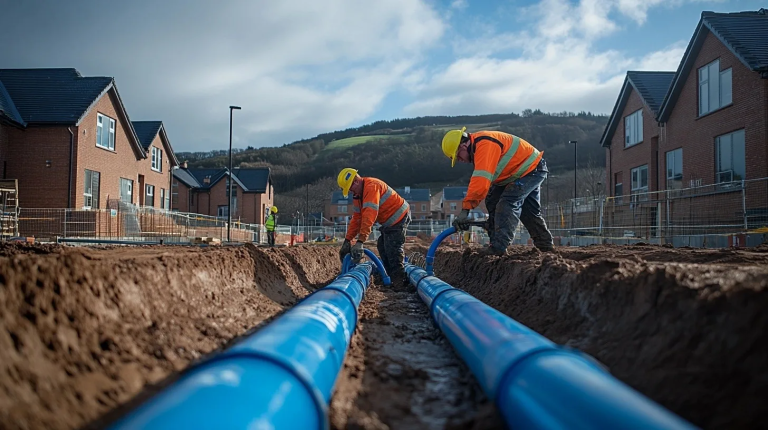
Every new development that needs a water main faces the same early fork in the road. The developer can requisition the main from the incumbent water company and wait for it to be built by others, or the developer can appoint an accredited self-lay provider to carry out the contestable construction while the water company retains its regulatory role and eventually adopts the finished network. Most developers reach for the first option by default, because it is the one the water company puts in front of them. The second is often the one that protects the programme, and understanding why means understanding how the cost and the timeline actually break down. Where the two routes actually differ The confusion usually starts with the word “cost”, because a new water connection is never a single price. The water company’s own charges are fixed and published in its annual charging arrangements: an infrastructure charge levied per property and a connection charge that varies with surface type, pipe size and who carries out the dig. Those figures are the same whichever route a developer takes, and they are public, so there is nothing to negotiate. The variable part is the construction, the physical work of getting a main to and across the site. This is the contestable element, and it is the only part of the equation where the route genuinely changes the outcome. Ofwat’s guidance on self-lay is explicit that a provider accredited under the Water Industry Registration Scheme can carry out contestable works across any water company’s area without having to satisfy twenty-two separate sets of local requirements. When that work is done by an accredited provider rather than the water company, the developer pays the contestable rate rather than the water company’s own delivery rate. There is a second, less-understood cost mechanism worth knowing. Until 2020 the water company made an asset payment to the developer or provider when it adopted a self-laid main. For new schemes in England that ended on 1 April 2020, and the value is now recognised through an income offset against the infrastructure charge instead. It is not money in hand any more, but it is a real reduction against a published charge, and it applies specifically to the self-lay route. Time is the variable that actually bites On a live development, the water company’s delivery timeline is a dependency the developer does not control. Design approval, scheduling and gang availability all sit inside another organisation’s programme, and they are rarely aligned to a housebuilder’s build sequence. A self-lay provider installs to the developer’s programme, coordinating the main and services around the groundworks rather than waiting for a slot. That is where weeks come out of a scheme, and it is why self-lay tends to earn its keep on multi-plot sites, on schemes that need genuinely new mains, and anywhere a shared utility trench helps the wider programme. For a single short connection in soft ground the coordination overhead may outweigh the saving, and it is worth being honest about that rather than pretending self-lay always wins. The water companies themselves frame the two routes this way. Thames Water’s self-lay overview tells developers plainly that the right installer “might not be us”, that independent providers may offer more flexible timescales and multiple-utility installation, and that because it is required to provide connections at cost, it makes no profit from new water mains. The choice, in other words, is not being sold against by the incumbent. It is a genuine programme decision the developer is expected to make. Adoption is the part that has to be designed in The mechanics of the handover matter here too. Once the pipework is laid, chlorinated, pressure tested and connected, the water company adopts it under a legal agreement made under Section 51A of the Water Industry Act 1991, the adoption provision inserted by the Water Act 2003 and in force since 2004. The agreement is signed by all three parties, the developer, the provider and the water company, before construction starts, and the standards, inspections and materials that make the network adoptable have to be built in from the first day on site. Since 2021 that process has run under Ofwat’s Code for Adoption, a common set of rules binding water companies in England, which replaced the older self-lay code of practice. This is precisely why the accreditation behind the provider matters more than the day rate. A network built to the wrong standard does not get adopted, and an unadopted main is a liability that sits with the developer. A provider offering self-lay water services, such as the Welwyn Garden City contractor McFadden Utilities, will typically carry the scheme end to end, from the point-of-connection enquiry through installation, chlorination, pressure testing, final connection and the handover paperwork that supports adoption, which removes the interface risk of splitting design, build and adoption across three parties. What developers should actually compare A like-for-like comparison is not “self-lay price versus water company price”. It is a comparison of total programme risk against a construction saving plus an income offset. The published water company charges are constant. The contestable construction is where the money moves, the programme is where the value sits, and the point-of-connection enquiry, which is usually free, is the single most useful early move on either route. It tells the developer where the connection will be made and flags any network reinforcement before a design is committed, which is what stops a late and expensive surprise. For contractors and developers weighing the two routes, the practical conclusion is unglamorous but consistent. The water company charges are what they are. The saving on contestable construction, and the income offset that comes with adoption, are worth having but are not the whole story. The story is who controls the programme, and on any scheme where the build sequence matters, that is the comparison worth running first.