

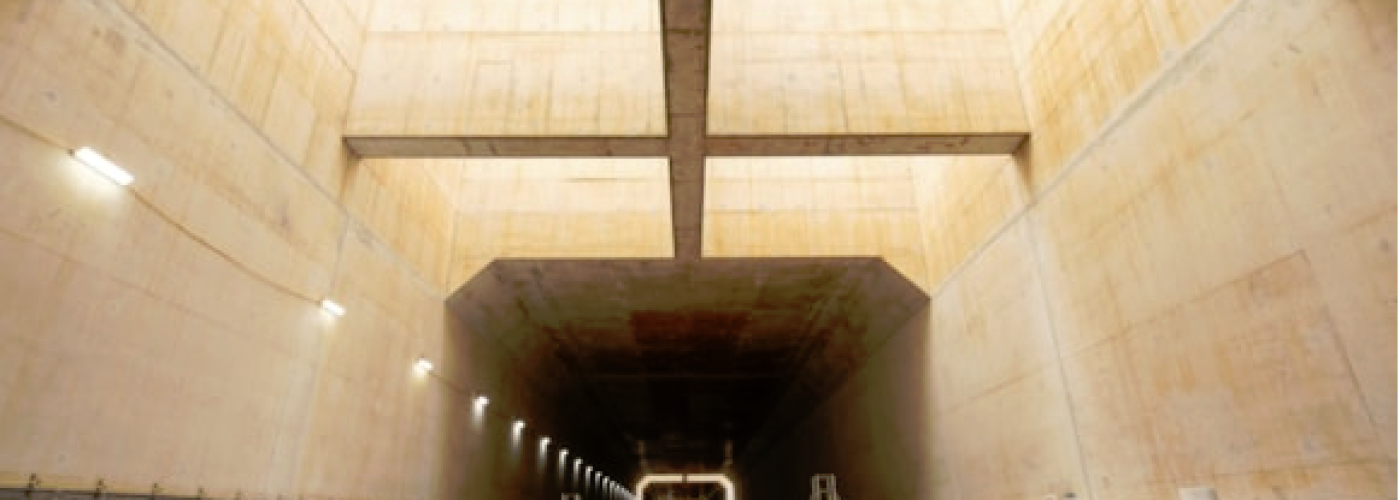


The first completed cut and cover tunnel on Britain’s new high-speed railway has been revealed at a site on London’s western periphery.
HS2’s 880-metre Copthall ‘green’ tunnel near West Ruislip has been created using 1.2 million cubic metres of material excavated during construction of the line’s nearby twin-bore Northolt tunnel.
Originally planned as an open cutting, engineers opted for a cut and cover design. The decision enabled the Northolt tunnel material to be kept on site – negating the need to transport it elsewhere by road in an operation that would have resulted in around 100,000 truck movements.
It is the only ‘single bore’ tunnel on the new high-speed line and its cavernous size is engineered to accommodate the forces generated by 200mph passing trains.
The tunnel is built by SCS – HS2’s main civil engineering contractor for the route’s southern section – which is made up of Skanska, Costain and STRABAG.
Copthall is the first of five cut-and-cover tunnels to be completed on the HS2 route between London and the West Midlands – meaning both the tunnel structure and the covering of earth over the top is finished. The next stage of works includes the planting of trees, plants, and shrubs on top to blend into the landscape.
The other four green tunnels are also well advanced, with an announcement earlier in July that the structure of Chipping Warden tunnel in Northamptonshire has been completed ahead of works to backfill material.
The milestone underlines the scale of the progress being made on HS2 that will create vital new rail capacity between London and the West Midlands – providing faster and more reliable journeys while releasing space on the crowded West Coast Main Line.
HS2 Ltd CEO Mark Wild is now leading a comprehensive reset of the project to ensure that it is delivered as efficiently as possible and for the lowest reasonable cost. The 140-mile railway is now at a peak construction and significant improvements in productivity have been made over the last year, with six major milestones being reached ahead of schedule.
In May, the Department for Transport confirmed a new delivery schedule and costs for the programme as part of the project’s reset, providing certainty for the taxpayer and local communities. It also announced plans to simplify the railway – operating trains at the same speed as those in Japan and mainland Europe – in a move designed to save up to £2.5bn and cut a year from the construction programme.
Rail Minister Lord Peter Hendy said:
“The completion of Copthall tunnel marks another significant milestone for HS2. Making use of innovative design, the tunnel reduces the impact on nearby communities by blending into its surroundings whilst keeping thousands of truck journeys off local roads by using materials close to the site.
“Our reset of HS2 is driving faster, more efficient construction on-the-ground and supporting thousands of jobs as we work to deliver the project at the lowest reasonable cost.”
James Leeming, Head of Delivery – HS2 said:
“Finishing civil works on HS2’s first-completed ‘green’ tunnel clearly demonstrates the progress that’s being made to deliver the first new intercity railway north of London in over a century.
“I pay tribute to the dedicated workforce that has worked since early 2021– and in all weathers – to deliver this remarkable structure, which was a key component of our plan to deal with the muck excavated to build part of HS2’s tunnelled sections.”
Copthall is positioned between the twin-bore Northolt tunnel and the Colne Valley viaduct – Britain’s longest railway bridge, which was completed last year.
It is more than half a mile long, 12m high and up to 16m wide inside. Its five natural ventilation shafts reach down a maximum of 17metres to the tunnel’s roof from the newly-created landscape above.
The team used innovative travelling ‘form work’ and ‘false work’ systems that moved forward 20m at a time enabling them to achieve the tunnel’s gentle curve.
Situated next to the Chilterns railway and at the southern end of HS2’s viaduct across the Colne Valley, engineering this route section involved moving the busy Harvil Road and rebuilding it to modern standards that included a new bridge to carry it over the high-speed line.
Jonathan Morris, Managing Director at SCS, said:
“Combining an ambitious tunnel design, engineering expertise, and high-quality construction, Copthall Tunnel is a fantastic example of how we are building the railway in harmony with the environment.
“Skanska Costain STRABAG joint venture has delivered this key part of HS2 thanks to great partnerships and a collaborative approach to every stage of construction. My thanks go out to the brilliant team who has delivered this milestone whilst maintaining the highest levels of safety throughout delivery.” With civil works now complete, over the coming two years Copthall tunnel’s earth covering will be planted, and then start to blend into the surrounding environment.
Building, Design & Construction Magazine | The Choice of Industry Professionals