

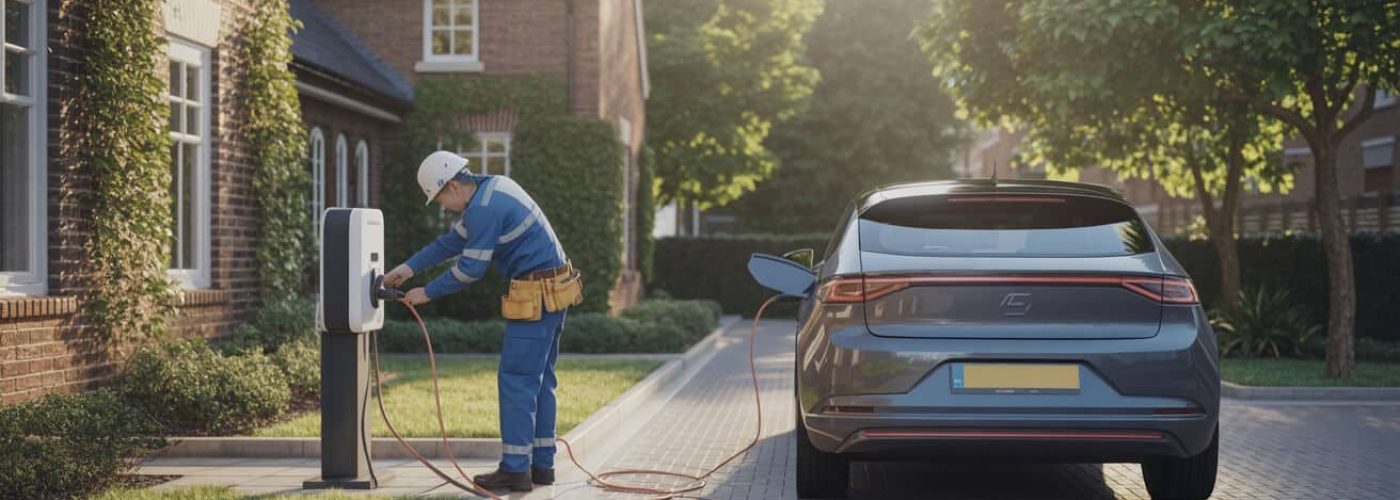


Every parking space in your next commercial or residential development will need to support electric vehicles. As a C-level executive or developer, you’re designing for a world where EV charging infrastructure sits alongside Wi-Fi and HVAC as a baseline utility. What makes charging different is the power demand, revenue potential, and software requirements needed to integrate with existing energy systems.
Why will EV charging become a default feature in buildings?
Three forces are converging: tenant expectations, regulatory pressure, and fleet operator demands, reshaping how developers approach parking infrastructure.
How tenant, employee, and EV fleet expectations are reshaping building design
Tenants ask about EV charging before signing leases. At the same time, employees expect workplace charging as part of their compensation package. Fleet operators take this a step further by excluding sites without dedicated charging capacity from their location searches.
Consider what’s happening in major markets. Norway passed 90% EV share of new car sales in 2023, while California mandates that all new car sales be zero-emission by 2035. As a result, properties without charging infrastructure lose tenants to competitors who planned ahead.
Adding chargers after construction costs significantly more than building infrastructure from the start:
- Panel upgrades require expensive electrical work
- Running conduit through finished spaces disrupts operations
- Transformer upgrades demand months of planning
- Permitting processes take longer for post-construction additions
Planning for charging during initial design saves capital and avoids operational disruptions. For CTOs and product leaders at building management platforms, understanding these market dynamics helps position offerings correctly.
What does software-driven EV charging look like inside a building?
Software transforms charging infrastructure from basic electrical service into intelligent energy systems. In practice, this means buildings manage power differently, coordinate with other systems better, and adapt to changing conditions faster.
Smart charging and load management on top of the limited grid capacity
Your building’s electrical service has a ceiling. Twenty EV chargers pulling maximum power simultaneously can trip breakers or trigger costly demand charges. An EV charging management system monitors total building demand and adjusts charger output dynamically.
Smart charging and load management capabilities include:
- Real-time load monitoring. It tracks building demand and throttles charger output when HVAC, lighting, or other systems peak
- Intelligent queuing. This capability is needed to prioritize vehicles by departure time, battery level, or user tier when capacity is limited
- Off-peak optimization. It runs chargers at full speed overnight when demand drops
- Transparent communication. Communication through apps is intended for showing drivers’ estimated completion times
This dynamic balancing keeps buildings under demand limits without expensive service upgrades while eliminating conflicts over access.
Coordinating EV charging infrastructure with HVAC, solar, and storage
Buildings run multiple energy assets that must work together rather than compete for the same electrons. Here are the regulated energy assets requiring coordination:
- Rooftop solar arrays generating variable power throughout the day
- Battery storage systems charge and discharge based on tariffs and demand
- HVAC systems create significant cooling and heating loads
- Elevators and pumps produce periodic demand spikes
- EV charging stations are adding new, controllable loads
Without coordination, these systems work against each other. For instance, solar exports to the grid while chargers import expensive peak power. Similarly, storage charges during high-price hours when it should discharge.
Integration with building energy management systems (BEMS) solves this. The BEMS sees solar production, battery state of charge, time-of-use tariffs, and EV charging demand, then orchestrates everything to minimize cost and maximize onsite energy use. When solar output peaks, EV charging ramps up automatically. Conversely, when the grid sends demand response signals, chargers pause and storage discharges.
This coordination requires APIs and event-driven architecture. In other words, your EV charging software must communicate with BEMS, metering systems, and utility tariff feeds through compatible protocols.
How can an EV software development company integrate charging with building systems?
Integration creates control loops responding to building conditions in real time. As a result, these loops enable operational capabilities that weren’t available before.
Connecting EV charging management software with BEMS and metering
EV charging management software for buildings exchanges data and control signals with existing systems through a structured flow:
Step 1: Session initiation and authentication
- Vehicle plugs in and authenticates via RFID, mobile app, or Plug & Charge
- EV charging software queries the access control system to verify permissions
- System checks the applicable tariff based on the user type and the time of day
Step 2: Real-time load monitoring
- Software pulls live metering data from building meters
- The system calculates available capacity based on the current total load
- Software determines the maximum safe charging rate
Step 3: Dynamic power allocation
- Software sends setpoint to individual charger hardware
- Charger adjusts output to stay within building demand limits
- System monitors continuously and adjusts as conditions change
Step 4: Session logging and billing
- Software logs start time, energy consumed, and cost per kWh
- Data flows automatically into the property management system
- Tenant receives an itemized charge on the monthly statement
Step 5: Reporting and analytics
- Session data feeds into the analytics dashboard
- System tracks utilization, revenue, and equipment performance
- Reports export for accounting, compliance, and strategic planning
Submetering becomes critical in mixed-use buildings where retail, office, and residential tenants share parking. In these cases, the software tracks which vehicles are charged and allocates costs accordingly.
Using APIs and event-driven architecture to sync tariffs, access control, and reporting
Building operators need flexibility as utility tariffs change seasonally, access policies differ by user type, and reporting requirements vary by region.
Event-driven architecture provides several key capabilities:
- Session events that check the vehicle owner, applicable tariff, and access permissions when vehicles plug in.
- Real-time updates that trigger events other systems listen for, such as “session started” or “payment authorized.”
- Automated workflows that update billing platforms without manual intervention.
- Audit trails that log access with timestamps and user details.
- Live dashboards that refresh as sessions progress.
This approach supports new use cases as they emerge. For example, offering dynamic pricing for EV charging in buildings becomes possible without system overhauls. Likewise, adding vehicle-to-grid capability later works because event architecture already handles bidirectional power flow.
Partnering with an experienced EV software development company ensures these integrations are designed correctly from the start.
What new business models appear when buildings run software-driven EV charging?
Software-enabled charging infrastructure creates revenue opportunities that basic electrical service couldn’t support.
Dynamic pricing, shared public/tenant charging, and workplace EV fleet charging
Dynamic pricing aligns incentives better than fixed rates:
- Peak pricing charges more during high-demand hours to encourage off-peak use
- Solar incentives offer discounts when solar production peaks
- Demand response adjusts rates when grid operators signal high demand
Shared charging opens additional revenue streams. Parking garages serve tenants during the day and public users at night, while software manages access, pricing, and billing automatically.
EV fleet charging in depots and workplaces adds another layer. Delivery companies leasing space need reliable charging without overpaying for peak power:
- Scheduled charging during low-cost hours
- Battery optimization through gradual charging profiles
- Fleet reporting for management visibility
These models work because EV software development supports flexible pricing, access control, and billing across user types.
Preparing building sites for vehicle-to-grid and flexibility markets by design
Vehicle-to-grid (V2G) turns parked cars into distributed energy resources. When grid demand spikes, vehicles discharge stored energy back to the building or grid, allowing property owners to earn revenue.
Pilot programs operate in California, the UK, and Denmark. Designing vehicle-to-grid ready architecture in buildings requires:
- Bidirectional chargers that charge and discharge batteries
- Dispatch software sending power on demand
- Battery management tracking discharge cycles
Buildings with onsite storage, solar, and V2G-ready architecture become energy hubs buying power when cheap and selling when prices spike.
What should developers and operators ask from EV charging software solutions?
Selecting the right platform requires evaluating current capabilities and future-readiness. The choices you make now will affect building competitiveness for years to come.
Requirements checklist for scalable, building-ready EV charging infrastructure
Start with scalability questions. Can the platform handle ten chargers today and a hundred next year? Does it support multiple sites under one account? Can it integrate with existing property management and billing systems?
Beyond these basics, key technical requirements include:
Access and authentication:
- Role-based permissions for tenants, guests, contractors, and fleet operators
- Support for RFID cards, mobile apps, and QR codes
- Pricing tiers, time-based access, and spending limits
- Guest access management with temporary credentials
Monitoring and analytics:
- Real-time visibility into energy consumption and charger status
- Revenue tracking by tenant, location, and time period
- Charger uptime monitoring with automated alerts
- User behavior analytics for capacity planning
Integration and reporting:
- Export capabilities for accounting, regulatory compliance, and strategic planning
- Consolidated reporting across multiple properties
- API access for custom integrations
Interoperability matters. Your EV charging management system should work with chargers from multiple hardware vendors to avoid lock-in and protect your investment through open protocols.
How to evaluate an EV software development partner for long-term building projects
Choose a partner with domain expertise in both EV software development and building energy systems. Generic software vendors won’t understand demand management, tariff optimization, or BEMS integration.
Evaluation criteria should cover several critical areas:
Domain experience:
- Case studies in similar building types and markets
- Track record with BEMS integration projects
- Understanding of utility tariff structures and demand charges
Technology roadmap:
- Development plans for V2G support
- ISO 15118 implementation timeline
- AI-driven optimization features
Support and reliability:
- SLA-backed uptime guarantees with clear remediation terms
- Response times for critical issues outside business hours
- Dedicated account management and technical support
Integration capabilities:
- Pre-built connectors for common BEMS platforms
- Compatibility with metering infrastructure
- Property management system integration options
Building projects have long lifespans, which means your software partner should evolve with the industry. Integration complexity drives cost and timeline risk, so assess capabilities carefully before committing.
Conclusion
Buildings under construction today require EV charging infrastructure as a baseline utility. Software-driven systems manage load, create revenue streams, and adapt to market conditions without hardware replacement. Consequently, buildings integrating EV charging software from the start attract better tenants, command higher rents, and maintain competitiveness as electrification accelerates. For CTOs, product leaders, and real estate developers, the design question centers on the sophistication level rather than whether to include infrastructure.