
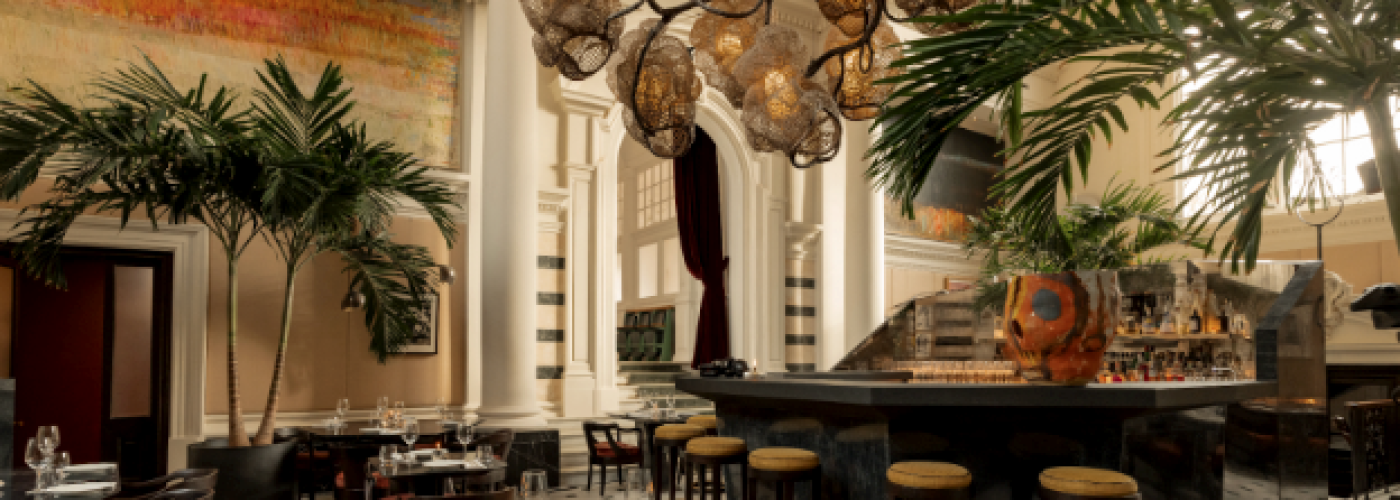


Pollini at Ladbroke Hall enters a new chapter defined not by what is on the plate, but by the evolution of its physical space — a considered reworking of interior architecture, materiality and atmosphere within one of West London’s most distinctive heritage buildings.
Set inside Ladbroke Hall’s Grade II-listed Beaux Arts structure in Notting Hill, the restaurant forms part of a wider 43,000 sq ft adaptive reuse project that has transformed the former 1903 Clément-Talbot car factory into a multi-layered cultural destination. The building’s grand portico, heraldic crest and vast arched window remain defining architectural features, anchoring the contemporary interventions within a historic framework.
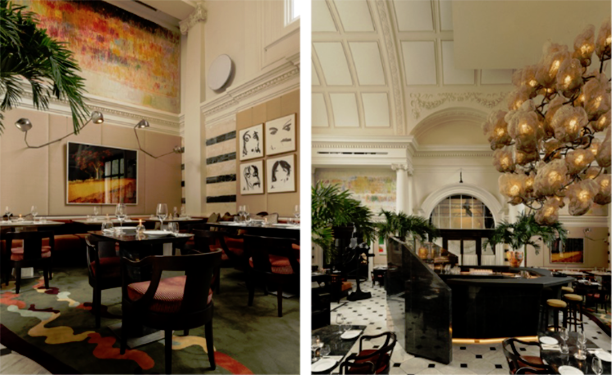
Originally conceived by Linda Boronkay, Founder and Creative Director of Boronkay Studio, the restaurant’s latest evolution reflects a careful process of refinement rather than wholesale redesign. Working within architecture shaped by Vincenzo De Cotiis Architects, the updated scheme enhances the dialogue between historic fabric and modern craftsmanship, demonstrating how retrofit-led hospitality design can deliver both intimacy and theatricality within a landmark setting.
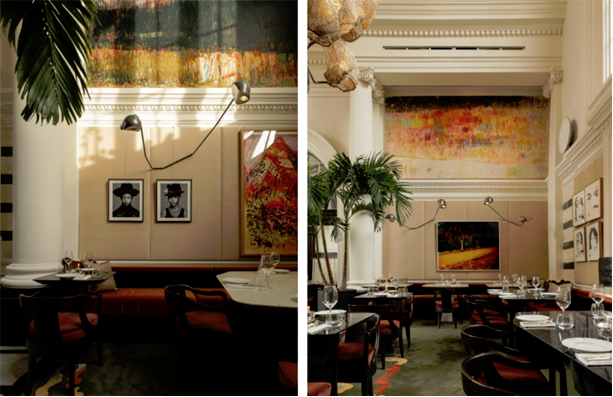
What began as a raw shell has progressively matured into a layered, textural environment. The recent interior works have focused on deepening warmth and improving spatial flow. Reconfigured banquette seating reshapes the dining layout, creating softer sightlines and more flexible group arrangements. New upholstery and textile treatments introduce richer tactility, absorbing sound and improving acoustic comfort within the high-ceilinged volume.
Lighting has been embedded and recalibrated to create zones of intimacy beneath the grand proportions of the hall. Rather than relying solely on statement fixtures, the scheme now incorporates concealed and low-level illumination to enhance depth and shadow, drawing attention to surfaces and materials rather than spectacle alone.
Curtaining has been introduced to envelope the dining area, forming a subtle architectural threshold between the restaurant and the adjoining gallery spaces. This intervention strengthens the sense of enclosure without compromising the openness of the original structure — a key consideration in retrofitting heritage buildings for contemporary hospitality use.
Greenery and internal planting have also been amplified, softening the architectural lines and introducing a biophilic layer that complements the building’s historic grandeur. The addition of an outdoor bamboo garden patio further extends the spatial experience, offering a seamless transition between interior and exterior environments while maintaining the cohesive design language established indoors.
Art and collectible design remain integral to the interior identity. Four large-scale, site-specific works by Sir Christopher Le Brun PPRA continue to anchor the space visually, alongside a sculptural chandelier by Nacho Carbonell and bespoke furniture pieces curated through Carpenters Workshop Gallery. These elements reinforce Ladbroke Hall’s ‘living gallery’ ethos, where art, design and hospitality intersect.
Boronkay describes the project as an exercise in creating a retreat within the city — intimate yet expressive, layered with shadow, texture and warmth. The intention has been to craft an environment that feels instinctively welcoming while quietly sophisticated, allowing materials, proportion and craftsmanship to speak first.
The refinement of Pollini reflects a broader movement in London’s hospitality sector towards thoughtful retrofitting and adaptive reuse rather than ground-up development. By working sensitively within a historic envelope, the project demonstrates how heritage assets can be reactivated through careful spatial planning, material layering and contemporary detailing.
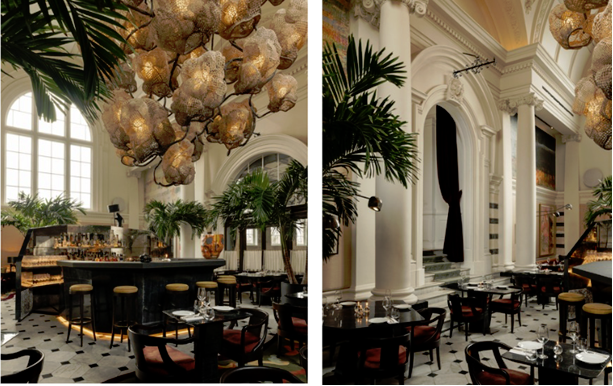
At its core, Pollini remains inseparable from Ladbroke Hall’s wider vision: a place where architecture, art, performance and social gathering coexist. With this latest evolution, the restaurant strengthens its identity not simply as a dining destination, but as a carefully constructed interior environment shaped by restoration, design intelligence and respect for its architectural past.
Building, Design & Construction Magazine | The Choice of Industry Professionals