



New report also discovers that for skyscrapers, shape is as important as height
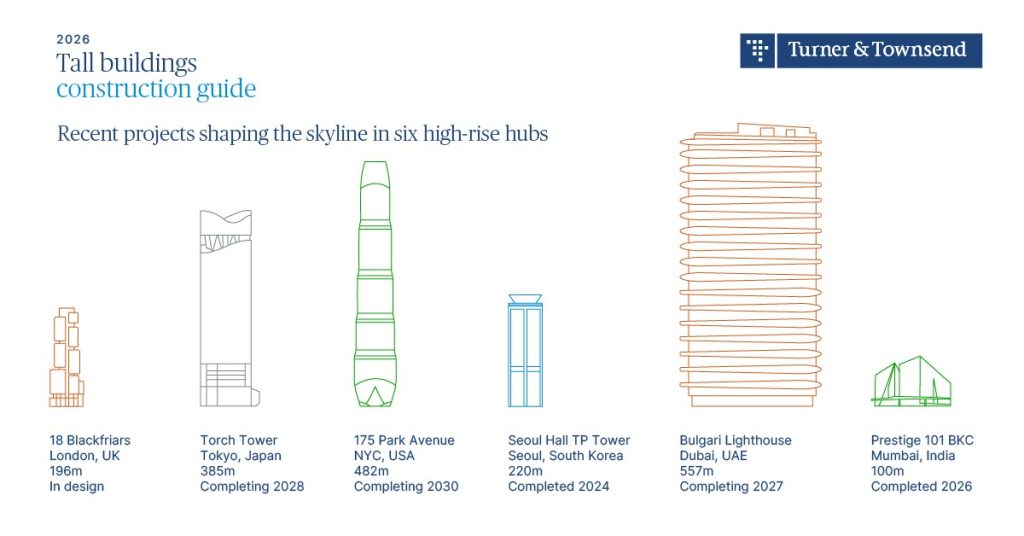
A new report published today by the global professional services company Turner & Townsend provides a unique perspective on the market for tall buildings across six global cities. The Global Tall Buildings report draws on Turner & Townsend’s exclusive data to provide insights into the challenges and opportunities facing developers building skyscrapers in London, New York, Seoul, Tokyo, Mumbai, and Dubai, including costs and the impact of designs and height on viability.1
The report found that the cost of delivering a new office building in London has increased by up to 40% since 2020, one of the largest price increases out of the cities analysed, and it is now more than three times as expensive to build skyscrapers in the city as it is in Seoul, and ten times as it is in Mumbai. This significant cost rise is the result of a range of factors that include price inflation prompted by conflicts and geopolitical events, significant regulatory changes, enhancements to the product, and challenging trading conditions following Brexit.
However, more positively, demand for high quality, sustainable space remains strong, and confidence is beginning to return, with some large investors using their ability to take a longer-term view to get their towers into a favourable letting market. As a result, it is still possible to deliver a high quality, financially successful skyscraper in London, but only if project teams work together to address viability issues from the outset.
One key finding from the report is that the shape of a skyscraper is as important as the height when it comes to the overall cost. In a city like London, there can be a 25% difference in price between the most ambitious and the most cost-efficient projects, with massing being a key determining factor.
With its diverse skyline and broad range of buildings, London stands out globally for having progressed through four distinct but overlapping waves of high-rise construction in just three decades, driven by differing typologies, and developers have learned important lessons along the way. Looking to the future, London is moving through its fifth wave where there is a deep focus on value, and high-quality towers are being realised against a challenging economic backdrop:
- Making a splash: The first wave of tall buildings such as Salesforce Tower (then Heron Tower) and The Shard brought landmark towers that showed how height could play a positive architectural role in the London skyline, setting the foundations for the marriage between height and heritage.
- Focus on financials: Next came a move towards more efficient building forms such as 22 Bishopsgate – channelling investment into enhanced amenities and infrastructure to provide more for occupiers.
- Embracing sustainability: Buildings such as The Dovetail Building prioritised reductions in both embodied and operational carbon and are looking at specific initiatives to improve the health and wellbeing of building users.
- Opening up to the community: Increasing the scale and mix of amenities in towers to stand out in a competitive market – looking beyond occupiers, opening up lower levels, and blurring private/public boundaries with community uses and viewing galleries, as 99 Bishopsgate is doing.
- Doing more with less: The latest phase is a response to a complex global construction environment – with higher costs, constrained finance, and greater risk profiles. Tall buildings are seen as a necessity for urban growth, and expectations of quality, beauty, sustainability and social impact remain high, while projects must ultimately also be viable for investors.
Turner & Townsend is one of the industry leaders when it comes to providing project management, cost and commercial management and programme advisory services, and has helped deliver over 200 tall buildings across the world, including the likes of 22 Bishopsgate, London; 30 Hudson Yards, New York; The Jewel, Australia; and Piramal Aranya in Mumbai.
Steve Watts, Head of Tall Buildings at Turner & Townsend, said: “Demand for tall buildings globally remains incredibly strong, although the latter in London has suffered a difficult period. With elevated construction costs further pressured by continuing inflation, as well as unfriendly financing conditions and softened yields, viability is now the most pressing issue, and doing “more with less” is the order of the day in a lot of markets, particularly London.
“Now more than ever, it is important to recognise that shape is as important as height when it comes to delivering a project cost efficiently, and there is an ever-increasing focus on ensuring tall buildings are integrated into the broader cityscape, whether that is by offering public amenities or a greater range of uses on the ground floors.
“In this context, to deliver a successful project in London, it is critical for project teams to work together at the outset to address viability issues: to test briefs; apply greater focus at an earlier stage to both design strategies and detailing; to secure the help of key parts of the supply chain sooner; and to set up projects with clarity and alignment. London boasts one of the most compelling and diverse skylines in the world, and with the right processes in place, there is no reason why the city can’t continue to lead the way for many years to come.”
Building, Design & Construction Magazine | The Choice of Industry Professionals