


The European construction sector is currently walking a tightrope. If you are managing a fleet in Germany or bidding on infrastructure projects in the Netherlands, you know the reality: material costs are fluctuating, environmental regulations are tightening by the month, and project deadlines are unforgiving.
In this high-stakes environment, the strategy for acquiring construction equipment EU-wide is changing. The decision to purchase pre-owned heavy equipment has moved from a Plan B to a primary strategic advantage. It is about agility, balance sheet optimization, and sustainability.
Here is why integrating used machinery into your fleet is becoming the sophisticated move for EU-based firms.
Economic Reality: Beating the Depreciation Curve
The most compelling argument for pre-owned equipment remains financial, but it goes deeper than the sticker price.
Let’s be honest about new machinery: it burns cash the moment it hits the dirt. A brand-new excavator undergoes its steepest depreciation within the first 12 to 24 months. Industry data suggests a loss of 20% to 40% in value during the first year alone.
Smart buyers target the sweet spot — machines in the 3,000 to 5,000-hour range.
- You pay 50-70% of the new price.
- You get a machine that retains significant operational life and stabilizes your fleet’s total equipment resale value.
- You free up CAPEX. That liquidity can be redirected to where it matters most right now: skilled labor retention and digital project management tools.
Speed Wins: Navigating Supply Chain
Global supply chains have healed since the post-pandemic fractures, but they aren’t perfect. Ordering a heavy-lift crane or a wheel loader configuration from the factory can still mean a wait time of six months or more.
In the European construction equipment market, time is penalty clauses. A project delayed by a missing asset bleeds profit.
Right Now Advantage
The secondary market offers immediacy. A machine listed on a marketplace is physical, present, and ready to load onto a low-loader tomorrow.
Scenario
A mid-sized infrastructure firm in Belgium wins a sudden tender for a dyke reinforcement. They need two additional articulated dump trucks immediately. Ordering new is impossible within the timeframe. Sourcing used allows them to mobilize within the week, securing the contract while their competitors are still calling dealers.
Risk Management: Lowering the Break-Even Point
Beyond availability, there is the critical factor of monthly overhead. In a volatile market where projects get paused or cancelled, being leveraged to the hilt on new machinery is a vulnerability.
Buying new requires a high utilization rate to justify the monthly finance payments. The machine must be working constantly to pay for itself.
Low-Leverage Advantage
By purchasing used, you lower the capital cost, reducing the hourly rate the machine needs to generate to be profitable.
Competitive Bidding
Lower equipment costs allow you to bid more aggressively on tenders. You aren’t passing on the cost of a brand-new fleet to your client; you are passing on the efficiency of a paid-for fleet.
Sleep Factor
If a job site shuts down for two weeks due to weather, a used machine sitting idle costs you far less than a new one with a massive bank note attached to it. It transforms your fleet from a financial burden into a flexible asset.
Market Intelligence: What is Europe Buying?
The European construction equipment market is a collection of regional needs.
- Western Europe (Benelux, France): High demand for compact equipment (mini-excavators) for urban renewal and tight residential sites.
- Eastern Europe: Stronger demand for heavier earthmoving equipment for large-scale infrastructure and road building.
- Nordics: A heavy emphasis on advanced attachments (tilt-rotators) even on second-hand units.
Rental vs. Ownership
Rental penetration is high, but with inflation driving up daily rental rates, the math is shifting. If you have a pipeline of work exceeding 12 months, owning a used asset beats a long-term rental contract.
Brand Reliability and Resale Potential
Brand reputation plays a massive role in equipment resale value. Top-tier manufacturers like Caterpillar, Komatsu, Volvo, and Liebherr maintain their value better than lesser-known brands.
When buying used, sticking to major brands ensures three things:
- Spare parts availability: You can find parts anywhere in the EU within 24 hours.
- Service knowledge: Mechanics know how to fix them.
- Exit strategy: When you resell the machine in three years, the equipment resale value remains robust because the market trusts the badge on the side.
Here is the revised version. I have smoothed out the transitions between these sections so they read as a continuous narrative rather than isolated blocks of text.
Below the text, I have included a “Change Log” to highlight exactly where and how the transitions were softened.
Digital Shift in Machinery Acquisition
Knowing what to buy is half the battle; knowing where to find it safely is the other half. The days of buying a bulldozer based on a handshake and a grainy photo are over. The industry has professionalized to serve the needs of modern resellers and buyers.
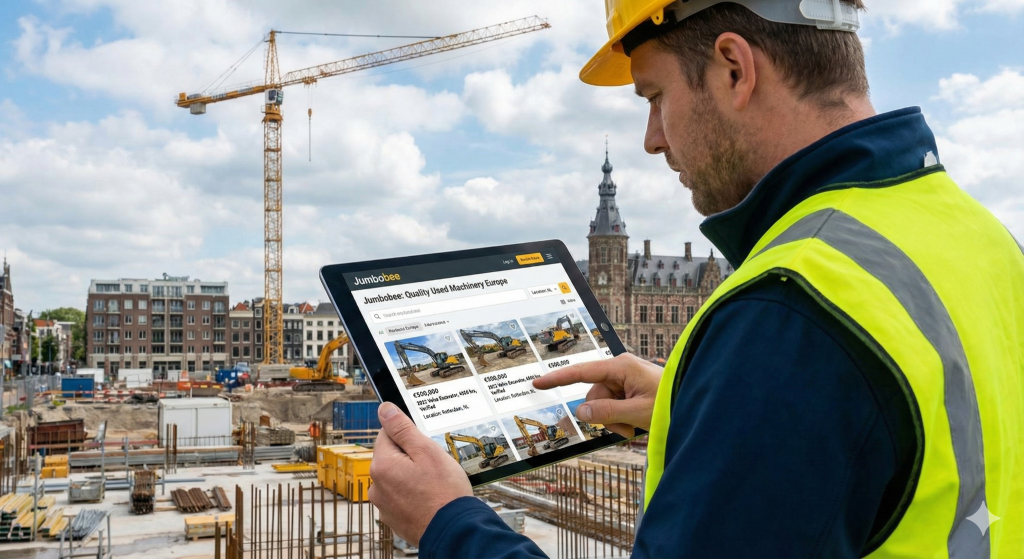
Digital platforms have changed how machinery moves across borders, further accelerating the speed advantage. Marketplaces focused on new and used construction equipment in Europe now allow buyers to source inventory across regions with greater visibility and reduced friction, as seen on platforms like JumboBee.
While digital marketplaces simplify equipment sourcing, the physical movement of heavy machinery across borders remains a separate operational challenge. Transporting oversized construction equipment within and beyond Europe typically requires project cargo expertise, including port handling, route planning, compliance documentation, and coordinated delivery to the site. These stages are usually managed by specialized freight forwarding teams experienced in heavy and oversized cargo execution.
Verification
However, finding a machine on a trusted platform is just the start — you still need to verify the asset. Buying used is smart, but only if you buy right. A cheap machine with a bad history is a liability, not an asset.
Pre-Purchase Checklist
- Fluid analysis: Oil samples from the engine and hydraulics reveal internal wear you can’t see.
- Undercarriage check: On tracked machines, the undercarriage is 50% of your future maintenance cost. Measure those pins and bushings.
- Service history: A documented service log is worth paying a premium for.
Used European Construction Equipment Market in 2026: Smart?
The stigma of buying second-hand has evaporated. For the modern builder, used construction equipment EU-wide is a strategic lever. It is a hedge against inflation, a solution to supply chain delays, and a pathway to sustainable growth.
By focusing on reputable brands, conducting due diligence, and exploring trusted marketplaces, you can build a fleet that is robust, capable, and financially sound. The European construction equipment market favors the agile. In a sector defined by thin margins and hard deadlines, the smartest choice is the one that delivers maximum utility for every Euro spent.
Can you afford to ignore the competitive advantage it offers?