


Topping out marks the moment a building hits its highest structural point. For contractors and developers, it’s one of very few opportunities during a build to get clients, council figures, subcontractors and the wider team together on site in a way that actually means something. The tradition itself is centuries old, but pulling one off today means juggling celebration with the reality that you’re still standing on an active construction site, surrounded by people who’ve probably never worn a hard hat in their lives.
That changes everything, because suddenly you’re responsible for making guests comfortable and keeping them safe, all while trying to make the whole thing look intentional and well put together instead of thrown together at the last minute.
Pick the Right Date and Confirm Site Readiness
Once the structure hits frame stage, the project director will typically confirm a date, and that’s your starting gun for planning. Three to four weeks of lead time is the minimum you’ll want, because there’s far more coordination behind these events than anyone outside the project tends to realise. The frame has to be structurally complete and signed off before you invite anyone near it, and any crane or lifting operations in the ceremony zone should be stood down for the day.
Weather is obviously a gamble in the UK. Midweek dates tend to pull better attendance from press and council reps, and mornings are usually safer than afternoons when it comes to ground conditions on site.
Sort the Safety Routing Before Anything Else
Most of your guests won’t know a thing about site protocols. The walking route from the car park to the ceremony area needs to be planned, marked and physically checked well before anyone arrives. Lay temporary pedestrian walkways where the ground is rough, and go over every metre of the route to clear trip hazards, fence off open excavations and stop any overhead works along the path.
Assign a dedicated escort for VIP guests. Brief them properly on the exact route, muster points and emergency procedures, because they’ll be the ones answering questions when a council member asks what happens if the fire alarm goes off. Every visitor will need a full PPE induction at the sign-in point, which means hard hats, high-vis vests and steel-toe boots at a minimum. Stock spare PPE in a range of sizes, because guaranteed, at least a handful of guests will show up with nothing.
Set Up a Covered Hospitality Area
This part can make or break your event. At frame stage, there’s no finished indoor space to use, so you’ll need a temporary structure that can handle formal speeches and catering at the same time. A solid marquee or event tent will give you a dry, sheltered space that keeps things moving if the weather turns, and on a UK site in any month of the year, you’d be foolish not to plan for rain. Gala Tent offers commercial-grade structures in a range of sizes, built to go up quickly on uneven ground, which is exactly what you’re working with on a construction site.
Place the hospitality area close enough to the ceremony point that guests aren’t trekking across the site in full PPE, but far enough from active works that you can actually hear the speeches without competing with angle grinders. Power will most likely come from a generator, so position it well away from the tent to keep noise to a minimum during the formal bits.
Get the Catering Right for a Site Environment
Catering on a live site is nothing like catering at a hotel or conference venue. There’s no running water, no commercial kitchen and nowhere to plug in a bain-marie, so you need a caterer who’s used to working from vans or mobile setups and won’t panic when they see the conditions. Finger food and canapés work best here, because your guests will be eating while standing up in hard hats and high-vis, and nobody wants to juggle a plate and cutlery with gloves on.
Skip alcohol if the ceremony falls during working hours on an active site. Hot drinks go down a treat at morning events, and honestly, a decent coffee station will win you more goodwill than a champagne toast that nobody can properly enjoy.
Arrange Press Photography and the Formal Moment
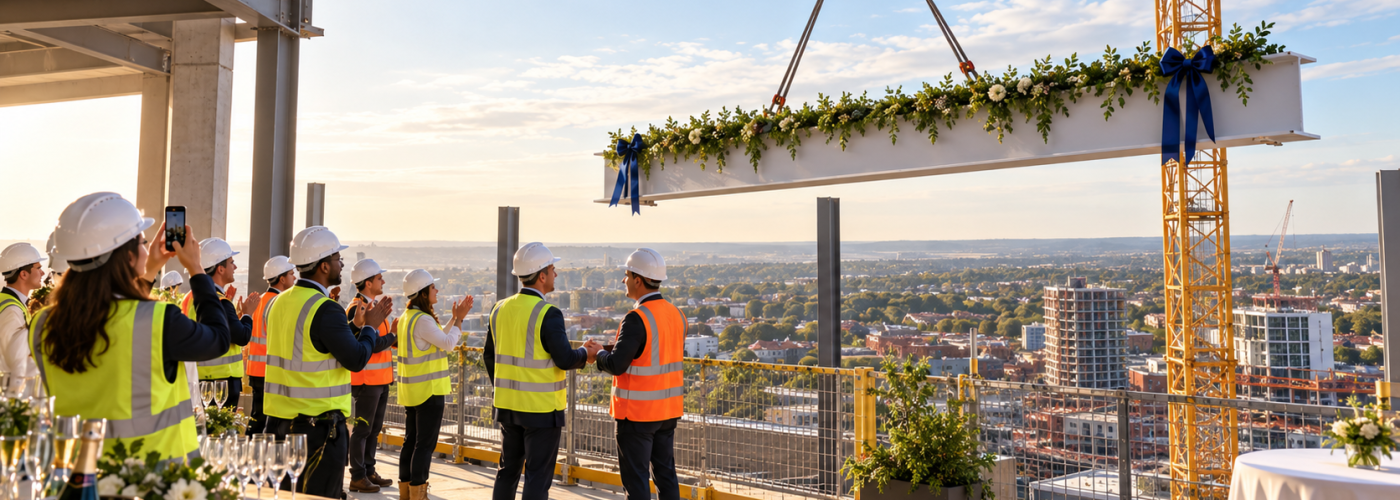
The topping out itself is the main event. Traditionally, it involves fixing a branch, flag or final beam to the highest point of the structure, and you’ll want your photographer already in position before it happens. Brief them clearly on where they can and can’t go, give them a full PPE kit, and pair them with an escort if they’ll need to move beyond the hospitality area at any point during the day.
Have the project director or client say a few words, but keep speeches short. Make sure someone captures the key handshake or plaque-unveiling moment, because local press will want a clean, usable image they can run without heavy cropping. Think about the backdrop too, and check that any client branding is visible and positioned where the camera can pick it up.
A Ceremony That Earns Its Place on the Programme
A well-run topping out does more than tick a box on the construction programme. It brings the contractor and the client closer together at a point in the project where trust and momentum really count, and it gives the whole team a reason to stop and appreciate what they’ve actually built so far.
The details are what separate a ceremony people remember from one that felt like an obligation, things like a properly planned safety route, a covered hospitality setup that doesn’t blow over in the wind, and a photographer who knows exactly where to stand and when to shoot. If your guests leave the site knowing they were genuinely welcomed and properly looked after, without a single compromise on safety, you’ve done the job right.