BDC News Team
Firethorn Trust makes progress at North Yorkshire logistics development

Firethorn Trust makes progress at North Yorkshire logistics development

Real estate developer, Firethorn Trust, is making significant progress at Sherburn42, a North Yorkshire logistics development owned by Cain International, as structural steelwork is now in place. Firethorn Trust is acting as asset and development manager on behalf of the scheme’s owner,  privately held investment firm, Cain International. With steels

Read More »
Aggreko Batteries Save Keltbray Over 200 Tonnes of Carbon in a Year

Aggreko Batteries Save Keltbray Over 200 Tonnes of Carbon in a Year

New analysis of site data from 12 Keltbray construction projects has revealed staggering savings since the business introduced Aggreko’s battery technologies to decarbonise its power usage and reduce running costs.  Keltbray is a construction engineering specialist delivering integrated solutions for complex building and infrastructure sectors across the UK. Recognised by

Read More »
Causeway acquires UK’s leading competence, safety and skills passport provider

Causeway acquires UK’s leading competence, safety and skills passport provider

Construction technology provider Causeway Technologies has acquired Reference Point, developer of the UK’s leading workforce competency and authority-to-work system. This is the third strategic acquisition since Five Arrows made a significant investment in Causeway in 2021, and reinforces Causeway’s platform strategy to digitise the processes that underpin the construction and

Read More »
Linbrooke Services appoints Will Wilson as new Chief Executive

Linbrooke Services appoints Will Wilson as new Chief Executive

Linbrooke Services Ltd (Linbrooke), is pleased to announce the appointment of Will Wilson as Chief Executive Officer. Linbrooke is a leading UK engineering company specialising in the design and integration of multi-sector power and telecom solutions, combined with Rail related signalling, telecoms and power systems and multi sector, multi-discipline consultancy.

Read More »

SCAPE Adopts the Common Assessment Standard

SCAPE has become the first public sector body following publication of Procurement Policy Note (PPN) 03/23 to adopt the Common Assessment Standard for its pre-qualification requirements, joining a growing list of major contractors and clients specifying the standard for their supply chains. PPN 03/23, which was issued by the Cabinet

Read More »
The key to the green building industry

The key to the green building industry

Environmental Product Declarations offer facts for environmental and climate protection The building sector is responsible for over 30 percent of global CO2 emissions. In the fight against climate change and for an environmentally friendly future, it is therefore particularly important to build in a sustainable and resource-saving way. But how

Read More »
Latest Issue
Issue 339 : Apr 2026

BDC News Team

It’s time for construction to go full circle – WorldGBC launches groundbreaking Circular Built Environment Playbook to advance regenerative

WorldGBC launches groundbreaking Circular Built Environment Playbook to advance regenerative

World Green Building Council (WorldGBC) and its network of over 75 Green Building Councils are launching the Circular Built Environment Playbook — a critical guide for the building and construction sector around the world to accelerate the adoption of circular economy and resource efficiency principles. The principles of the circular economy can help us to achieve global climate targets: from minimising the extraction of materials and using more efficient designs, to optimising nature-based solutions and closing material loops at the end of a building’s lifecycle. This report presents strategies for the built environment to reduce its resource consumption and features market leadership and solutions from across WorldGBC’s global network. The use and waste of materials and products is trending in a dangerously unsustainable direction, with latest estimates showing that the world is only 7.2% circular, meaning over 90% of everything we make is discarded after use. Furthermore, in 2022, a year’s worth of biological resources were used in just seven months — that means currently we consume 75% more than the earth is able to replenish each year [1]. With our cities producing an estimated 70% of all global greenhouse gas emissions [2], and consuming almost half the resources extracted globally, our sector holds a significant portion of the responsibility. In ‘The Circular Built Environment Playbook’ WorldGBC acknowledges the essential role of the circular economy in tackling the global environmental crisis; whilst providing an unparalleled opportunity to regenerate resources and accelerate socio-economic development.  Circularity is fundamental for humanity to thrive alongside the natural environment, and within planetary boundaries. Through this playbook we hope to make the complex principles of the circular economy easy to understand for every actor in the built environment. We have mapped out more than 20 strategies of implementing circular design, construction and operation for the built environment, illustrated with best practice case studies from all over the world. All stakeholders must be ‘circular ready’ and lead the sector towards circularity becoming the new business-as-usual. Every actor in the building and construction supply chain must take action and help the transition — cross-sector collaboration will be key to overcome barriers towards a circular future. WorldGBC’s network aspires to see leadership from all governments and businesses. A circular economy is an essential part of the sustainability solution providing a foundation for future policy change and business innovation. Cristina Gamboa, CEO, WorldGBC, said:  “It is clear that if we want to secure a future for our planet and people, then we cannot keep going on this path of consumption and waste. That’s why our network is taking action to increase awareness and accessibility of circular economy solutions, by guiding all stakeholders towards sustainable, circular decision-making. The need for a circular built environment has never been more important and our Circularity Accelerator programme is shining a light on the solutions available.” Jona Byskata, Head of EU Public Affairs, Kingspan, said: “Circularity in the buildings sector is a very broad topic, and requires collaboration across all stakeholders. The Accelerator partnership allows such discussions to develop to help set future priorities where the environmental impacts matter most.” Dorota Bacal, Sustainability and Innovation Lead, VinZero, said: “You can only improve what you measure” has become the mantra of our industry. Data-driven decision making completely revolutionises the sustainability outcomes for the companies we work with. Data insights can significantly boost operational efficiencies, improve processes and reduce waste, whilst delivering cost, raw material consumption and carbon savings.”  Chris Trott, Partner Head of Sustainability, Foster + Partners, said: “Adopting circularity in the built environment is essential to achieve a regenerative balance, by facilitating the decarbonisation of the industry, limiting finite raw materials extraction and waste production all while staying within planetary boundaries.” Thank you to our global programme partners: Brightworks Sustainability, Foster + Partners, Vinzero and Kingspan and our technical partners, WSP, CBRE. We also thank our steering committee, expert panel, designers and dedicated team at WorldGBC for their support in developing the Circular Built Environment Playbook. References: [1] Circle Economy, 2022 Circularity Gap Report, January 2022 [2] United Nations (2018)  Building, Design & Construction Magazine | The Choice of Industry Professionals 

Read More »
Firethorn Trust makes progress at North Yorkshire logistics development

Firethorn Trust makes progress at North Yorkshire logistics development

Real estate developer, Firethorn Trust, is making significant progress at Sherburn42, a North Yorkshire logistics development owned by Cain International, as structural steelwork is now in place. Firethorn Trust is acting as asset and development manager on behalf of the scheme’s owner,  privately held investment firm, Cain International. With steels now in place, the development is progressing at pace and will be ready for occupation from Q3 2023. Comprising four highly specified industrial units, ranging from 57,750 to 280,000 sq ft, the 37-acre development is being delivered by McLaren Construction Group. In line with Firethorn’s commitment to sustainability, the scheme will be accredited by the UK Green Building Council for its net-zero carbon construction, with a modern and future-proofed specification that will empower occupiers to reach their own operational sustainability targets, both now and in years to come. Paul Martin, Development Director at Firethorn, said: “With a market-leading specification, Sherburn42 is an ambitious development, demonstrating our focus on creating quality spaces that are smart, modern and flexible. Occupiers will benefit from a design that will support evolving operational requirements and market demands, whilst inspiring them to think big on sustainability. “We’re delighted to see the significant progress that has already been made on-site, and look forward to swiftly bringing the scheme to completion later this year.” Rated BREEAM ‘Excellent’ and ‘WELL-ready’, Sherburn42 features full PV coverage and LED lighting to offices, in addition to existing and future EV charging capabilities. The development also offers eaves heights of 15m to haunch, 11 ground-level access doors, 633 parking spaces and up to 4MvA power. Sitting adjacent to the Sherburn Enterprise Park, the scheme’s close proximity to Junction 42 of the A1 (M) provides direct connections to Leeds, the M1, M62 and coastal ports of Hull and Grimsby, as well as a number of regional rail stations and airports. Enquiries should be directed to the scheme’s letting agents: Colliers, Lambert Smith Hampton, and Carter Towler. For more information on Sherburn42, please visit https://sherburn42.co.uk/. Building, Design & Construction Magazine | The Choice of Industry Professionals 

Read More »
Aggreko Batteries Save Keltbray Over 200 Tonnes of Carbon in a Year

Aggreko Batteries Save Keltbray Over 200 Tonnes of Carbon in a Year

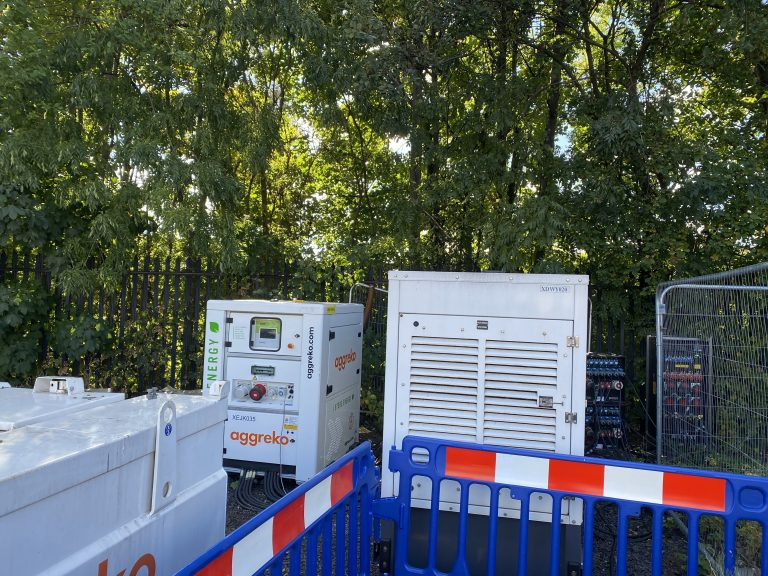
New analysis of site data from 12 Keltbray construction projects has revealed staggering savings since the business introduced Aggreko’s battery technologies to decarbonise its power usage and reduce running costs.  Keltbray is a construction engineering specialist delivering integrated solutions for complex building and infrastructure sectors across the UK. Recognised by the Institution of Civil Engineers (ICE) for its efforts to quantifiably reduce the carbon emissions on its projects, the business is continually looking at new processes, technologies, and forward-thinking suppliers to partner with to continue such work. Data-led Improvement At the helm of its sustainability agenda is Kiro Tamer, Head of Environmental Sustainability, and ICE Carbon Champion. In 2021, Kiro approached Aggreko for support with Keltbray’s site power provision due to the capability of its specialist telemetry systems, which would allow the company to monitor equipment remotely. This was of particular interest to Kiro and his team as it would allow them to start monitoring power equipment performance around the clock to better inform their decarbonisation strategy. Battery Viability and Versatility In early 2022, Aggreko Sector Engineer Kath Argent began working in partnership with Keltbray to audit its power requirements across certain sites and identified the common issue of generator oversizing. Kath comments: “We often see hired equipment that is oversized as an attempted level of resilience, but it also means it is often running at less than 30% load and therefore inefficient. Aggreko right-sizes its equipment and implements other techniques, such as load on demand, for maximum efficiency.” Kath and her team also introduced battery energy storage system (BESS) technology as part of Aggreko’s Greener Upgrades portfolio. According to Aggreko, while the sustainable benefits of batteries have long been undisputed, until recently there had been low uptake across the construction industry due to the perceptions the technology was in its infancy. Kiro comments: “We wanted to look at batteries for some time, but it also needed to make commercial sense and market conditions just hadn’t made it viable until that point. When fuel prices started to rise around April, that’s when things started to change. Since then, the adoption of the technology has come along so quickly.” Throughout 2022, Keltbray introduced Aggreko’s battery storage systems on 12 projects which spanned six different counties. It included a wide array of developments such as the construction of the iconic East London neighborhood at Silvertown Keys, maintenance of a cargo shed at Heathrow Airport, new flood defenses for Sheffield City Council, a new housing development for a leading UK housebuilder and a large infrastructure project concerning the A30. Kiro adds: “The versatility of this technology is demonstrated via the wide variety of projects and sites we have been able to introduce it into, making it a fundamental part of our decarbonisation strategy. In just 12 months, we went from using no batteries, to them accounting for at least 25% of our temporary power procurement with Aggreko.” Staggering Savings As part of its commitment to work in partnership with Keltbray to help achieve its Net Zero goals, Aggreko’s insights team used its specialist telemetry system to analyse data from the 12 projects spanning 2022. By looking at load information and comparing traditional generator-only running costs against the new hybrid running costs, they were able to evaluate a reduction of over 200 tonnes of carbon. This was the result of saving over 75,000 litres of fuel, which equated to over £100,000 in fuel costs. Kiro adds: “Our industry is working relentlessly to become more sustainable, but there are still many hurdles to overcome. Power procurement has never been simple, and I think there is a general lack of understanding on how to reduce reliance on diesel generators where there is no access to the grid. But there are solutions out there – as evidenced in this sustainability success story. For those who want to reap the rewards, the technology is there for the taking and companies like Aggreko can help implement it smartly and quickly.” Building, Design & Construction Magazine | The Choice of Industry Professionals 

Read More »
Causeway acquires UK’s leading competence, safety and skills passport provider

Causeway acquires UK’s leading competence, safety and skills passport provider

Construction technology provider Causeway Technologies has acquired Reference Point, developer of the UK’s leading workforce competency and authority-to-work system. This is the third strategic acquisition since Five Arrows made a significant investment in Causeway in 2021, and reinforces Causeway’s platform strategy to digitise the processes that underpin the construction and maintenance of the built environment. Through SkillGuard, its mobile workforce management system, Reference Point is best known in the UK for delivering the Network Rail Sentinel system (the largest health and safety passport system in the world), as well as the Highways Passport scheme. Reference Point’s solutions are also used globally, extending as far afield as Australia where the Rail Industry Worker Programme covers the entire Australasian rail industry. Reference Point also provides Gencarda, a cloud digital membership software platform with virtual cards, and CourseSight, a comprehensive training, e-learning and course management solution which is used by London Underground to manage all training courses across its supply chain. This acquisition provides Causeway with a single platform for industry bodies, asset owners and contractors to manage operatives’ identity, training compliance, health, safety, and resource management across the supply chain. Additionally, it provides a secure place for operatives to hold their competencies and identify themselves. Ollie McGovern, chief commercial officer at Causeway, said: “We understand that the skills shortage is one of the largest pressures facing the industry right now, and so with this latest acquisition of Reference Point, Causeway is committed to providing technology solutions that help our customers tackle this head-on. “By integrating Reference Point with Causeway’s solutions, we can now offer a platform that provides a single solution which benefits the operative and their employer in some of the most challenging areas of our sector including skills, resourcing, attendance management and compliance with health and safety regulations. “The addition of Reference Point will also enable Causeway to further build on the work we are doing to provide awareness and interventions with mental health for site workers, where rates of suicide are three times that of other industries. We are well placed as a technology provider to help drive real change across the industry, and by incorporating Reference Point’s expertise and technology into our platform, we’re striving to help our customers create safer, healthier work environments for their workforces.” Beric Davis, chief executive officer of Reference Point, said: “Having previously worked alongside Causeway, we knew that its ambitions and company culture aligned with our own. We’re delighted to be part of this rapidly growing, dynamic business where we will continue to deliver world-class solutions that best serve the workforce, their employers, and clients alike.” With combined key clients like Balfour Beatty, Kier, National Highways and Tarmac, Causeway and Reference Point will build unparalleled integration and end-to-end solutions for clients on an international scale. Reference Point has more than 35,000 organisations using its systems, supporting more than 3.5 million workers. Key customers include Thames Water, Tarmac, Kier, National Highways and Network Rail. Causeway Technologies was founded in 1999 by chief executive, Phil Brown. Headquartered in Buckinghamshire, it serves over 3,000 customers globally and has over 500 employees. Causeway provides enterprise and cloud software solutions to support the construction and maintenance industries, serving consultants, contractors, suppliers, and their clients on an international scale.  www.causeway.com Building, Design & Construction Magazine | The Choice of Industry Professionals 

Read More »
Linbrooke Services appoints Will Wilson as new Chief Executive

Linbrooke Services appoints Will Wilson as new Chief Executive

Linbrooke Services Ltd (Linbrooke), is pleased to announce the appointment of Will Wilson as Chief Executive Officer. Linbrooke is a leading UK engineering company specialising in the design and integration of multi-sector power and telecom solutions, combined with Rail related signalling, telecoms and power systems and multi sector, multi-discipline consultancy. Lee Hallam, Executive Chairman said: “We are pleased to welcome Will Wilson to Linbrooke and he will lead the company into the next phase of growth, bringing into his new role a wealth of experience in the engineering and rail industries.” Prior to joining Linbrooke, Will held senior leadership positions at a number of global companies including Siemens, Alstom and GE Transportation. He was formerly the CEO of Siemens Mobility in the UK. During his career Will has gained extensive rail and transport experience on an international basis, and has majored in railways, aerospace, traffic and general transportation for over 27 years. With a current personal passion for carbon free transport he is a recognised authority in the sector. On joining Linbrooke as Chief Executive, Will said: “I am delighted to be joining Linbrooke at such an exciting time in its evolution. With many sectors growing especially around the global de-carbonisation agenda we are so well positioned to deliver innovative bespoke solutions as well as growing our unique position within the rail sector as the only multi-tier signalling integrator.” “The company has an outstanding reputation in the industry and a talented team of engineers, project managers and hugely dedicated staff in all areas. We are already building on this strong foundation, continuing to deliver high-quality projects for our clients, while also expanding our capabilities and exploring new growth opportunities.  A renewed focus on the customer and delivery will be implemented due to Linbrooke’s culture based upon safety and integrity.” Building, Design & Construction Magazine | The Choice of Industry Professionals 

Read More »

SCAPE Adopts the Common Assessment Standard

SCAPE has become the first public sector body following publication of Procurement Policy Note (PPN) 03/23 to adopt the Common Assessment Standard for its pre-qualification requirements, joining a growing list of major contractors and clients specifying the standard for their supply chains. PPN 03/23, which was issued by the Cabinet Office in response to calls from Build UK and its members, updates the pre-qualification requirement for central Government departments and wider public sector bodies, meaning they can now use the Common Assessment Standard to pre-qualify suppliers for construction works contracts, rather than PAS 91. The Common Assessment Standard was developed by Build UK to raise the bar in assessing the competence of the construction supply chain. It has two levels – desktop and site-based – allowing companies to apply for the appropriate level dependent upon their trade, size and the requirements of their public and private sector clients. Currently available from any one of the Recognised Assessment Bodies, the Common Assessment Standard delivers on the commitment in the Construction Sector Deal for a standardised pre-qualification process and was recommended for use in the public sector by Professor David Mosey as part of his independent review of frameworks to “reduce waste and duplication [and] creat[e] efficiency savings for clients and industry”. The Common Assessment Standard will help to streamline public sector procurement as suppliers that hold certification from a Recognised Assessment Body will have already been assessed for stage 1 pre-qualification, meaning contracting authorities can focus on project specific requirements. SCAPE Group Procurement Director John Simons said: “Being able to use the Common Assessment Standard is a significant step forward in the simplification of the selection process for the public sector. Its use will not only de-risk elements of the process, but also enable public sector organisations to focus on project specific requirements for those firms who have already met the standard. The Common Assessment Standard will effectively standardise the selection process for the construction supply chain as only one annual assessment will be required in order to gain access to valuable opportunities.” Build UK Deputy Chief Executive Jo Fautley said: “We are delighted that SCAPE has joined organisations across the industry using the Common Assessment Standard. With pre-qualification costing the industry up to £1 billion each year, the efficiency savings offered by the Common Assessment Standard are more important than ever in the current market, and PPN 03/23 means that projects and programmes across the public sector can also now benefit from a reduction in duplication of time, effort and resources.” Building, Design & Construction Magazine | The Choice of Industry Professionals 

Read More »
Role of digital growing despite continued dominance of over-counter merchant sales, new report confirms

Role of digital growing despite continued dominance of over-counter merchant sales, new report confirms

The findings of a recent report have indicated the growing need for independent merchants to find the right balance between fulfilling in-person trade sales and providing support via digital channels. The new report from National Buying Group (NBG), Valuing Local Independent Trade Merchants in a Digital World, analysed the role of digital in the traditionally low-digital builders’ merchant sector. Specifically, it surveyed UK tradespeople to find out if and how buying channels had changed post-COVID, why customers continue to buy from independent builders’ merchants, and the role digital has to play in the industry. Despite the post-COVID rise of digital channels, the survey revealed that 92% of trade sales continue to be made over-counter, marking the builders merchants’ sector as uniquely low-digital. Although 61.5% of tradespeople said they bought more online during the pandemic many have now reverted to a hybrid approach to sourcing supplies, with 60.5% claiming to buy both in-store and online now. According to NBG Managing Director Nick Oates, these findings demonstrate the strength of the sector, which is adopting the best of both the physical and non-physical worlds. “As our new report demonstrates, while digital sales have made huge inroads across the retail sector post-COVID, builders’ merchants are bucking this trend,” he explains. “This is understandable – unlike in some other industries, there are many factors to in-person buying in this sector, and especially with independent merchants, that are hard to replicate online. “But this is not to say that the sector, and more specifically, our Partners and Suppliers, is not implementing digital practices. As our report makes clear, tradespeople are using these channels to carry out activities that complement the trade counter, including research, price-checking, basket building, videos, reviews and business administration. It is clear there has been a sea-change in best practice, and the role of digital for tradespeople may not lie solely in sales, but mainly in support functions that bolster over-counter sales.” The survey highlighted the main reasons tradespeople choose to buy in-store or in-person, with location (54.5%), customer service (54%), convenience (40.5%) and access to product knowledge and advice (32.5%) deemed the main lures of the trade counter. By comparison, when it comes to buying digitally, convenience (60.5%), price (41.5%) and product range (41.5%) were given as the main reasons why tradespeople choose to buy online. The report also collected qualitative evidence from respondents to further explore the reasons behind these findings. According to Nick, the data demonstrates the key role independent merchants can play in customers’ buying decisions, citing factors such as personal relationships, expertise, personalisation and feeling part of a community. “While it has been heartening to see that the digital literacy of tradespeople is increasing, it is also highly encouraging to see feedback showing how customers have returned to trade branches,” Nick concludes. “This is testament to the strength of independent builders’ merchants, and the value of strong relationships. We believe tradespeople are more inclined to work with merchants they know and trust on a personal level, and this will be vital to ensuring all parties are able to thrive despite the challenges 2023 might bring.” To download National Buying Group’s latest report, Valuing Local Independent Trade Merchants in a Digital World, click here. For more information on National Buying Group, including how to join the premier buying group for independent merchants, visit https://www.nationalbuyinggroup.com/. Building, Design & Construction Magazine | The Choice of Industry Professionals 

Read More »
BM TRADA & Warringtonfire to explain product performance and third-party certification at FIREX 2023

BM TRADA & Warringtonfire to explain product performance and third-party certification at FIREX 2023

BM TRADA/Warringtonfire will be returning to FIREX with a stand explaining the process of fire testing and classifying construction products, and the importance of third-party certification. Delegates attending the show at the London ExCeL between 16 – 18 May 2023, can visit the BM TRADA/Warringtonfire stand (FI.1430) to interact with display models of key construction products including fire doors, glazing systems, pipes and cables, all of which have been subjected to fire resistance testing. The team’s technical experts will also be on hand to discuss the principles of third-party certification for manufacturers, installers, and maintainers of passive fire protection products and the important role played by its Certifire and BM TRADA Q-Mark certification schemes. Each day, BM TRADA/ Warringtonfire, which are UKAS-accredited third-party certification bodies, will carry out live demonstrations of correct fire door installation, and how to install fire stopping measures – running at 12pm and 2pm respectively. Visitors attending on Wednesday 17th May can hear about the methods used to derive European classifications for construction products, when technical manager, Peter presents in the FIREX theatre at 2.15pm. The European classification standards (EN 13501 series) define harmonised procedures for classifying the resistance and reaction to fire performance of construction products. Peter’s presentation will cover test methods, the extension of scope using direct (DIAP) and extended application (EXAP) rules, classification process, product families and using classifications for UKCA marking and third-party certification. Peter Barker, technical manager at Warringtonfire, said: “Third-party certification is once again the overriding theme of FIREX, given its fundamental importance to the design, construction and operation of safe and secure buildings. We are looking forward to engaging with delegates on a broad range of topics and hope to provide direct and informed guidance on navigating the fire safety challenges facing today’s built environment.” For more information, please visit: www.warringtonfire.com / www.bmtrada.com. Building, Design & Construction Magazine | The Choice of Industry Professionals 

Read More »
New City College pioneers green skills agenda with launch of Low Carbon Technology Lab

New City College pioneers green skills agenda with launch of Low Carbon Technology Lab

New City College is proud to announce the launch of FE’s first low carbon technology lab which will provide green skills training for London’s workforce. The lab, equipped with cutting-edge technology, was launched at a special breakfast presentation on Thursday 4 May, attended by industry experts and business leaders who had the chance to tour the new facilities and hear about the benefits they will provide in the challenge for a new way of working to meet cleaner energy and net zero targets. The launch followed the creation of the Central London Forward Partnership, led by New City College, which comprises nine colleges across Central London. The partnership successfully secured a £2.7million bid from the Strategic Development Fund (SDF) to deliver high quality technical education in the low carbon energy industry. The lab has been developed at New City College Hackney and will be invaluable to employers who need to retrain employees in green skills and low carbon technologies. Courses and training for the next generation of installers include Solar PV, Solar Thermal, Air Source Heat Pumps, Electric Storage, Electric Vehicle Charging, Retrofit, and Energy Efficiency. Gerry McDonald, CEO and Group Principal of New City College said at the launch: “This new and innovative training facility represents a major step forward in our commitment to sustainability and makes us the sector leading college for the low carbon energy agenda. We have invested in it and have delivered, making us well placed to be pioneers in this essential work.” To the attendees, Gerry added: “You are the people who are going to make this happen. And you need a college to work hand-in-hand with industry and other partners, to make sure that London and the UK has the right people and skills to make the necessary changes to reach net zero.” Guest speaker Catherine Barber, Director of Environment and Energy for the GLA, congratulated New City College on the lab launch and said: “The Mayor wants London to be net zero by 2030, so this agenda on climate change, on clean technology and providing the skills that London needs to meet this ambitious target, is so vital. “There are currently about 4,000 people working in retrofit in London, but that figure needs to be closer to 60,000 people, so there is an enormous demand for skilled workers and the training you are offering.” As well as tours of the facilities, guests also saw Gerry McDonald unveil a commemorative plaque and present awards to two Low Carbon Skills Champions, industry experts Dan White from MCS and Hazel Mealy from Lewisham, Lambeth and Southwark Councils, who had been instrumental in helping to set up the lab. In accepting the award, Dan said: “There is an immediacy about where we are in renewables. They are not our future, they are our now. One of the greatest challenges is persuading employees out of their old ways and into the new. Older people need to retrain in the middle of their carers – and this is the first challenge we are facing. “Right now the market is going crazy, searching for skilled staff. We need to lift the standard of training, of qualifications and of competence in low carbon technologies – that’s what the customer deserves. And this lab is where it will all start.” Jamie Stevenson, NCC Group Executive Director for Apprenticeships & Business Development, who leads the SDF project for Central London, thanked key partner Quantum Group. He said: “I am delighted this project has culminated in FE’s first low carbon lab, which is an excellent resource for Londoners and industry. We can now deliver tailored, hands-on and bespoke training to existing employees and the future workforce to help London work towards net zero. “The SDF funding has enabled us to invest in facilities, resources and our staff, to deliver the green skills required for today and for future proofing our tomorrow. “We’re excited about the impact our project is having on the local community. We will continue to develop our offering and invest in the next generation of low carbon energy professionals.” Guests at the launch were treated to a fantastic breakfast prepared by NCC Hospitality and Catering students who train in Hackney’s OKN1 restaurant. For more information, visit Central London Forward Green Skills Partnership. Building, Design & Construction Magazine | The Choice of Industry Professionals 
Read More »
The key to the green building industry

The key to the green building industry

Environmental Product Declarations offer facts for environmental and climate protection The building sector is responsible for over 30 percent of global CO2 emissions. In the fight against climate change and for an environmentally friendly future, it is therefore particularly important to build in a sustainable and resource-saving way. But how to find the most climate-friendly among all the products? How is sustainable planning and building possible? The best way is with measurable data and transparency. This can be found in the Environmental Product Declaration (EPD). Environmental Product Declarations are a method for the standardised presentation of the environmental impacts of products or services. EPDs provide a data basis that maps the entire life cycle of a building product or parts thereof and quantifies its environmental impacts. Environmental Product Declarations are based on the international standard ISO 14025, which applies to all sectors, but the construction industry is the pioneer in its application. The idea is that the standardised collection of environmental data on building products creates a comparable basis for sustainable construction planning. Planners, architects and builders then use this information to make an informed decision when making their selection. They use the EPD to determine which building products will minimise the environmental impact of their project. This supports sustainable construction and advances climate protection. At the same time, a sustainable way of doing business is also supported, which aims to conserve resources and reduce environmental pollution. In addition, customers can use them as evidence for various building certification systems such as LEED, BREEAM or DGNB. The most important contents of an EPD In an EPD, the environmental impacts of a product are recorded along the entire life cycle or in parts, including raw material extraction, production, transport, use, disposal and recycling, among others. For each area, various environmental criteria such as greenhouse gas emissions and resource consumption are recorded and evaluated. These results or environmental indicators flow into the EPD and enable comparability between building products. An important component of an Environmental Product Declaration is the assignment of the product to a specific product category. This classification in the Product Category Rules (PCR) is necessary to establish comparability between similar products. In each product category, the relevant environmental factors are recorded and included in the EPD. Environmental Product Declarations and Life Cycle Assessments – two that belong together Life Cycle Assessments (LCA) and Environmental Product Declarations (EPD) are two key elements of sustainability in the construction industry that are closely linked. Simplified, one can say that the EPD is a standardised summary of the results of a LCA. The LCA is carried out in four phases. First the purpose and scope of the LCA is defined. This is followed by a life cycle inventory, which records data collection and calculation methods to quantify relevant inputs and outputs of a product system. In the impact assessment phase, potential impacts on the environment are analysed with the help of the results of the life cycle inventory. In the final evaluation, the results of the life cycle inventory and the impact assessment are considered together. Depending on the building product, there are different approaches to assessing environmental impacts. All start from cradle and differ over the further life cycle of the product. The concept “cradle to grave” covers all phases of a product’s life, from raw material extraction to production, transport, use and disposal. It shows the complete ecological footprint from beginning to end. The approach “cradle to gate” records the ecological footprint of a product until it leaves the factory gate and before it is transported to the consumer. It does not take into account further environmental impacts during use and disposal. “Cradle to cradle” is the most comprehensive consideration. It is based on the principle of the circular economy, where products are designed so that they can either be fully recycled or composted at the end of their life cycle. It avoids the generation of waste and promotes the conservation of resources. How does aquatherm support its customers and partners with the LCA? aquatherm has had an ISO-compliant LCA carried out for four product families, which has been verified by an independent institute. Based on these Life Cycle Assessments, aquatherm provides customers with the corresponding EPDs for their projects. The results show that aquatherm piping solutions made of polypropylene have clear advantages compared to other materials such as copper or steel with regard to energy consumption, greenhouse gas emissions, water consumption and the amount of waste. The aquatherm environmental product declarations can be found at https://www.aquatherm.de/sustainability-2/?lang=en. Building, Design & Construction Magazine | The Choice of Industry Professionals 

Read More »