Kenneth Booth

The best locations for new-build availability by the sea

The latest research from Warwick Estates has revealed which coastal locations offer the most new-build availability for those looking to buy by the seaside. Warwick Estates analysed new-build availability across 45 of the best coastal towns across the nation based on the number of new builds available on the current

Read More »

Victoria PLC announces plans to move to Worcester Six Business Park

An international flooring designer, manufacturer and distributor has announced plans to move part of its UK operations to the Worcester Six Business Park as it looks to grow the business. Worcestershire-based Victoria PLC, the UK’s largest flooring manufacturer and distributor, has specified leading developer Stoford to deliver a bespoke unit

Read More »

Construction Sites to depend more on Monitored Tech for security

As the construction sector finds it feet again, and the costs of materials soar, once again building sites become prime targets for organised criminal gangs. The construction sector is now experiencing a boom period following the suppression of building work during the pandemic. But alongside the pipeline of busy works

Read More »

Kawneer systems supply a quintet of criteria at Greenwich

Windows and doors by Kawneer feature on apartments at Greenwich Square. Architectural glazing systems by leading UK manufacturer Kawneer were specified for a primarily residential building at the heart of the redevelopment of London’s Greenwich Square for their aesthetic, acoustic, thermal, fire-resistant and sustainability credentials. Kawneer’s AA®543 open-in windows and

Read More »

Growing Greenways In The Heart of Our Cities

The canal towpaths and redundant railway lines that pass through the hearts of our cities are a legacy of our industrial past. Built at a time when progress and pollution went hand in hand, many have lain unused since the 1960s when the road network was expanded and train travel

Read More »
Latest Issue
Issue 343 : Aug 2026

Kenneth Booth

The best locations for new-build availability by the sea

The latest research from Warwick Estates has revealed which coastal locations offer the most new-build availability for those looking to buy by the seaside. Warwick Estates analysed new-build availability across 45 of the best coastal towns across the nation based on the number of new builds available on the current market as a percentage of all properties listed for sale. The research shows that on average, just five per cent of all homes currently listed across coastal locations are new builds. However, Newquay in Cornwall offers the best chance of a new-build by the sea, with one in five homes currently listed for sale coming via the new homes sector. Shoreham-by-Sea in the South East is also home to some of the largest levels of coastal new-build availability, with new homes accounting for 12% of all homes currently on the market. Poole (11%) and Margate (10%) are the only other coastal locations where new-builds account for more than 10% of current for sale stock, while Deal (9%), Exmouth (9%), Scarborough (9%), Herne Bay (8%), Falmouth (8%) and Littlehampton (8%) also make the top 10. In contrast, there are currently no new-build homes listed for sale in Burnam-on-Sea, Stubbington or Fleetwood. COO of Warwick Estates, Bethan Griffiths, commented: “The property market DNA of many coastal locations has long been decided and the lack of available space means you will probably be hard-pressed to find a new-build with sea views. However, as our research shows, some coastal favourites are home to a limited level of new-build stock and so the dream of a new-build by the sea isn’t completely out of the question. While the chances are higher in some areas compared to others, those with their heart set on such a purchase should be able to find a coastal new-build contender in almost every region of the UK market.” Table shows new-build availability in each coastal town based on the number of new-builds for sale as a percentage of all homes listed for sale Location Region Total stock listed for sale New-build stock listed for sale % proportion of NB Newquay South West 373 74 19.8% Shoreham-by-Sea South East 407 47 11.5% Poole South West 2696 290 10.8% Margate South East 719 75 10.4% Deal South East 462 43 9.3% Exmouth South West 524 48 9.2% Scarborough Yorkshire and The Humber 1017 93 9.1% Herne Bay South East 728 61 8.4% Falmouth South West 325 27 8.3% Littlehampton South East 950 78 8.2% Ramsgate South East 588 46 7.8% Great Yarmouth East of England 1,045 81 7.8% Christchurch South West 508 36 7.1% Felixstowe East of England 523 34 6.5% Whitstable South East 625 40 6.4% Folkestone South East 830 49 5.9% Worthing South East 1895 111 5.9% Weymouth South West 762 43 5.6% Weston-Super-Mare South West 1561 88 5.6% Southport North West 1,374 75 5.5% Broadstairs South East 429 23 5.4% Torquay South West 1289 66 5.1% Formby North West 275 14 5.1% Clacton-on-Sea East of England 993 49 4.9% Lowestoft East of England 1,031 49 4.8% Bournemouth South West 3777 159 4.2% Eastbourne South East 1,698 71 4.2% Seaford South East 314 13 4.1% Cleethorpes Yorkshire and The Humber 348 14 4.0% Bridlington Yorkshire and The Humber 483 18 3.7% Bexhill South East 1,027 36 3.5% Bognor Regis South East 1102 37 3.4% Skegness East Midlands 290 9 3.1% Southend-on-Sea East of England 1,134 30 2.6% Paignton South West 812 21 2.6% Redcar North East 423 8 1.9% Clevedon South West 275 5 1.8% Hastings South East 1,571 21 1.3% Blackpool North West 2,106 25 1.2% Morecambe North West 561 5 0.9% Lytham St Anne’s North West 824 5 0.6% Whitley Bay North East 340 1 0.3% Fleetwood North West 313 0 0.0% Stubbington South East 187 0 0.0% Burnham-on-Sea South West 246 0 0.0% Average 39760 2118 5.3% Data sourced from Rightmove (25/08/2021)          

Read More »

Victoria PLC announces plans to move to Worcester Six Business Park

An international flooring designer, manufacturer and distributor has announced plans to move part of its UK operations to the Worcester Six Business Park as it looks to grow the business. Worcestershire-based Victoria PLC, the UK’s largest flooring manufacturer and distributor, has specified leading developer Stoford to deliver a bespoke unit at the business park, which will house one of its businesses, Alliance Flooring Distribution. Stoford has this week submitted a planning application to Wychavon District Council for a 180,121 sq ft unit for the company, which has been a major employer in Kidderminster since 1900 and has agreed a 15-year lease for unit 7.  The facility is expanding its existing locations and will be operational in Q4 2022. Edward Peel, Development Manager for Stoford, said both Stoford and Victoria PLC are committed to reducing their carbon footprint.  To achieve that, the base build of the unit will be net carbon zero in operation and will feature extensive electric vehicle charging points and photovoltaic panels on the roof. Two new ponds are also being created as part of the build, which will help to further improve the green infrastructure on the business park, providing an attractive setting and new wildlife habitats. “Attracting yet another global player to Worcester Six is a real success story,” he said. “The building of unit 7 will enable Victoria PLC to continue its growth plans, which can only be good news for the local economy. We’re looking forward to working closely with it as we develop its plans for a sustainable new base. “Worcester Six is living up to its reputation as a game-changer development. Ambitious businesses are keen to come here and take advantage of the strategic location, the high quality builds and the attractive environment that the business park sits in.” Philippe Hamers, CEO for Victoria PLC, said a new, bespoke building for Alliances UK headquarters will future-proof the business and allow the continued growth of the Victoria PLC brand portfolio and its third party customers. It hopes to create an additional 60 jobs over the next five years. “This move will allow us to further develop and grow our workforce using local skills and we are hoping to develop a work experience and apprenticeship scheme in the next two years to complement this and aid our continued growth,” he said. “The location of Worcester Six is perfect. This gives immediate access to the motorway network. Combine this with how long we have been an employer in this area, the local workforce who have great experience in flooring and the fact that we are able to future-proof our business by building a fit for purpose headquarters in an attractive setting with all of the green credentials we are striving for, offers an exciting future for us.” In the past three years, Worcester Six has welcomed Marmon Food and Beverage Equipment, Siemens, Spire Healthcare, Kimal, Kohler Mira and IONOS.  Victoria PLC was advised by Brasier Freeth and Stoford by BNP Paribas and Harris Lamb. For details about the scheme and other units that can be provided, contact the agent: Charles D’Auncey at Harris Lamb – charles.dauncey@harrislamb.com or Ben Wiley at BNP Paribas – ben.wiley@realestate.bnpparibas

Read More »

Cruden Group signs new green agreement to power homes with 100% renewable energy

Construction and development company, the Cruden Group, has expanded its green portfolio and commitment to green energy housebuilding by signing a 3-year enhanced green energy supply contract with ScottishPower. This means that the Group will purchase electricity which always comes exclusively from renewable sources, with 100% of green electricity from wind farms with zero CO2 emissions. In support of Cruden’s commitment to innovation and sustainability, ScottishPower as a Principal Partner for the 26th UN Climate Change Conference of the Parties (COP26), is working closely with the Cruden Group to further develop a range of renewable and other clean, green energy solutions and smart technologies to reduce emissions and drive down homeowner energy bills. The Cruden Group builds around 1,500 new homes each year and together with ScottishPower, they are working on several market leading initiatives to offer more zero carbon alternatives.  These include ground and air source heat pumps, installing infrastructure that will enable electric vehicle charging as standard across many developments, rolling out low carbon heating solutions for both apartment developments and family homes, installing photovoltaic solar panels and energy storage solutions and incorporating Passivhaus Standards to create energy efficient homes using innovative carbon neutral methods of construction. The Cruden Group’s commitment to green energy also extends to their management offices in Edinburgh and Glasgow.  Cruden’s head office in Cambuslang benefits from electricity from renewable sources via solar panels covering 90% of the roof of the office building.  ScottishPower is the first integrated energy company in the UK to generate 100% green electricity and is delivering almost £10 billion investment in clean energy between 2020-2025 to help unlock Net Zero. Kevin Reid, Chief Executive of the Cruden Group said; “We are pleased to continue our strong and successful 14-year partnership with ScottishPower with this new renewable energy agreement.  We strive to continuously improve the environment through innovation and this new green deal will help us further reduce carbon emissions, exceed carbon reduction targets and positively contribute towards the global climate change agenda.” Stuart Angell, New Connections Sales Development Manager at ScottishPower said: “I’m delighted to extend and enhance our relationship with the Cruden Group and for ScottishPower to be associated with a like-minded company that is striving to deliver excellence in the marketplace and prioritises the customer experience”.  “As ScottishPower have looked to deliver market leading initiatives, the Cruden Group have helped shape this change with their invaluable feedback and creative ideas. As work towards a carbon neutral future, we will continue to engage with the Cruden Group to understand their challenges and what we can jointly bring to the market to satisfy our goals and customer needs”.

Read More »

Panattoni increases speculative programme with over 200,000 sq ft scheme in Crawley, UK

Panattoni, the largest industrial real estate developer in Europe, is working up plans for a 202,200 sq ft speculative, last-mile logistics development in Crawley. The development, called Panattoni Park Crawley, is located in the established industrial area of Manor Royal Business District on a 10-acre brownfield site on Fleming Way, which Panattoni has just acquired from Aberdeen Standard Investments. Panattoni is aiming to submit an outline planning application in the fourth quarter of this year, with a view to beginning demolition and construction in the first half of 2022 and completing in the first quarter of 2023. Panattoni will aim to pre-let the space, which could either be one unit of 202,200 sq ft or two units. The development is part of Panattoni’s commitment to a significant speculative development programme in the UK in 2021 in response to strong demand from occupiers for immediately available space. In the south, Panattoni has acquired or progressed nearly 10 million sq ft of developments since the onset of Covid in March 2020. Panattoni Park Crawley is located in an established distribution location adjacent to London Gatwick Airport. It covers an area of 540 acres and is home to more than 600 businesses generating 30,000 jobs. Tony Watkins, Development Director at Panattoni, said: “This is a rare opportunity to acquire such a well-located site, as land in the south east for building a logistics facility of this scale is very scarce. This is a great site for accessing London”. Letting agents are JLL and Savills.

Read More »

Construction Sites to depend more on Monitored Tech for security

As the construction sector finds it feet again, and the costs of materials soar, once again building sites become prime targets for organised criminal gangs. The construction sector is now experiencing a boom period following the suppression of building work during the pandemic. But alongside the pipeline of busy works schedules, there is also a surge in site thefts, further exacerbated by the shortage of materials. The consequence is delayed projects and spiraling costs as some components’ prices soar. The price of copper has soared by 70% in just a year, whilst lithium carbonate, used to accelerate silica based cements and mortars, has all but doubled, rising by 97%. “The construction sector has always been a target for thefts of valuable plant and equipment.” comments Paul Corten, Sales Director for leading temporary security provider, The VPS Group. “But we are increasingly seeing opportunistic thieves replaced by organised criminal gangs, as the price of plant and materials means greater rewards for the risks they take. Surprisingly, the majority  of construction sites do not rely on Monitored Tech solutions, even though these systems provide the most efficient form of security and prevention.” In January this year a pan-European crime gang were convicted in a Belgian court over a €1-million series of thefts of cranes, excavators and trailers. The haul, including a €460,000 cement pumping truck, a €108,000 bulk tanker and €50,000 worth of trailers, were stolen, resprayed and sold to unsuspecting customers across the UK and Ireland. A month before that, a gang of metal thieves had been jailed for stealing 92km of cable over several raids in the UK. The Construction Equipment Association (CEA), owners of the CESAR scheme (the plant marking and registration initiative), noted a worrying increase in construction machinery theft in the UK since the introduction of lockdowns caused by the Coronavirus pandemic. One company, the Clancy Group, reported an increase in theft of construction machines from their sites by as much as 50 percent. Mr Corten adds: “Deploying traditional manned security guards can ensure there is a visual deterrent on-site with a quick response to incidents, but there can be substantial costs, especially for 24/7 manned guarding. Plus they are only able to be in one place at one time, which is a problem for larger sites. And they are, after all, human: they may not stay alert for night shifts, or they miss critical areas of the site.” Increasingly, site security managers are turning to monitored technology to provide more sophisticated solutions that enhance, improve or replace guards, without compromising the security of the site, and often for far less cost. Several technologies have been specifically geared to protect construction sites from intruders, and can differentiate between genuine breaches and false alarms, as well as secure and detect utility faults. “The latest CCTV Smart Towers comprise technologies with three key elements. They operate without an external power supply, so there is no extra cabling getting in the way of the workforce. They are highly flexible and can be rapidly moved, adapting to the site project development. And they can be fully loaded, with the latest high-definition camera technology that can see in daylight or at night, with additional sensors all linked wirelessly, throwing a wide ‘security net’ over an entire location.” Concludes Paul Corten. CCTV security systems can be monitored locally or remotely 24 hours a day, with ever more sophisticated software analytics that have helped significantly reduce the chance of false alarms. Accredited companies have SSAIB certification to provide clients with that additional safety of knowing their security provider is operating safely and securely.

Read More »

Kawneer systems supply a quintet of criteria at Greenwich

Windows and doors by Kawneer feature on apartments at Greenwich Square. Architectural glazing systems by leading UK manufacturer Kawneer were specified for a primarily residential building at the heart of the redevelopment of London’s Greenwich Square for their aesthetic, acoustic, thermal, fire-resistant and sustainability credentials. Kawneer’s AA®543 open-in windows and AA®540 fixed lights feature in the stairwells of Block 3 – a seven-storey, garden-courtyard block of 325 apartments for Mace Developments that was masterplanned by Make Architects and delivered by KDS Associates. In addition, Kawneer’s AA®543 windows, AA®540 series of fixed lights and AA®545 doors are coupled together on all elevations and complemented by the thermally superior AA®720 doors and fixed lights on the ground floor entrances. Work on the £80 million building by main contractor Mace took almost three years and delivers a 6,895m2 mix of studio and one- to three-bedroomed units, 292m2 of commercial space, and basement parking for 195 cars and 600 bicycles. Part of Phase 3 of the £250 million regeneration of a three-hectare brownfield site, Block 3’s build of concrete frame also utilised off-site methods, with prefabricated bathroom and utility pods. Nikhil Raj, Associate Director with KDS Associates, explained that Make Architects had been responsible for the whole masterplan of the site which included Block 3 that was developed to Stage 3 level. He said: “The original scheme was not commercially viable, therefore Mace development appointed KDS to rationalise and optimise the Make Architects’ original scheme. KDS assisted Make Architects in submitting an NMA by adding another storey and an additional 42 units to the existing scheme. Upon receiving a successful approval on NMA, KDS were appointed by Mace Developments to deliver Block 3. “We needed a slimline and robust look, along with the benefit of better acoustic and thermal performance. Aluminium also played an important part as we wanted to earn some additional BREEAM points.” He added: “I have worked with Kawneer products before, so it was no surprise that they delivered on their promise again.” Greenwich Square was a stalled development on Government brownfield land for more than 10 years before Mace, as principal equity investor, worked through the complex issues with a special purpose joint venture company, to finally unlock the site. The team brought together the numerous stakeholders involved to channel energy around a common purpose – to create a new community for east Greenwich that delivered 50% high-quality affordable housing as a key focus. The vibrant new destination comprises 686 new mixed-tenure homes and a community hub with facilities including a leisure centre, library, health centre, adult education college and shops, all planned around an attractive town square. One of the first schemes in the UK to make use of the “Buy now, pay later” land initiatives, the creative social housing model included a pre-sale to L&Q of 314 of the residential units and a commercial transaction with the council for the funding and future management of the Greenwich Centre. Phase 1 comprised 361 apartments, maisonettes and town houses as well as the public square, GP surgery, leisure centre, public library and retail space, while Phase 2 added 325 studios and one- to three-bedroomed apartments (239 private and 86 affordable). Sustainability was integral to the design of Greenwich Square, from the design of the apartments and townhouses to the facilities provided for residents. All the homes are designed to Code Level 4 Fabric First for sustainable new homes as well as meeting the Building for Life Silver Standard and CEEQUAL “Very good” for landscaping and public realm works. Nikhil said: “The key requirement was amendment to Approved Document B. This was not officially published at the time of registering with Building Control, therefore a lot of design changes were anticipated to future proof the building. The project that is delivered is robust and fully compliant in line with the latest amendments to Approved Document B.” Richard Blakeway, Deputy Mayor for housing, land and property for the Greater London Authority, said: “Greenwich square is a great example of GLA brownfield land being used to build much-needed housing of an excellent quality with fantastic public facilities to boost the local community.” Greenwich Square won the gold award for best mixed-use development at the What House? Awards in 2015.

Read More »

This is how much you have to spend to live at the top of your local housing market

Research from the national estate agent, Keller Williams UK, reveals the most expensive areas to buy a home across 18 major cities in England, and how much more they will cost you compared to the city wide average. House prices have been hitting historic highs across England, soaring by more than 13% in the last year alone. The nation’s cities, however, have not experienced the same price boom that rural, regional areas of the country have and many cities now have average house prices well below the national average. But all housing markets, urban or rural, have their expensive areas and Keller Williams has identified precisely where they are, thus showing exactly how much money homeowners will need to spend in order to live at the very top of their local market. For buyers, London is the most expensive city in England. The average house price is currently £510,299, a sum that dwarfs the national average and yet pales in comparison to the capital’s most expensive neighbourhoods. And none are more expensive than Knightsbridge and Belgravia where the average house price is a shade below £3 million: almost £2.5 million, or 478%, more than the London average. In Birmingham, the average house price is £208,241. The city’s most expensive ward is Sutton Four Oaks, located to the north-east of the city centre, where the average house price is £520,000. This makes Sutton Four Oaks 150% more expensive than the Birmingham average, a gulf that ranks second only to London. There is a 148% difference between Bradford’s average house price and that of its most expensive ward. The city average is £149,798, but in Ilkley, which is around 10 miles from the city centre, the average price is £372,500; a difference of £222,702. Oxford has a high average house price, but £451,385 is still less than half of what it costs to live in its most expensive ward: North Oxford. The North of the city has an average house price of £543,615, 120% north of the city average. In Newcastle, the average price is £172,770. In its most expensive ward, Gosforth, the average is 120% higher at £380,000. There is 111% difference between Bournemouth and its most expensive ward, Canford Cliffs: 105% between Sheffield and Dore and Totley: 95% between Cambridge and Newnham: 86% between Bristol and Westbury-on-Trym and Henleaze: 81% between Leeds and Harewood: 74% between Manchester and Chorlton: 72% between Nottingham and Wollaton West: 61% between Liverpool and Mossley Hill: 49% between Southampton and Shirley: 48% between Sunderland and Washington East: 45% between Portsmouth and Drayton and Farlington:33% between Leicester and Knighton: and 28% between Plymouth and Plymstock Dunstone. CEO of Keller Williams UK, Ben Taylor, commented: “The housing market has taken off and demand is pushing prices through the roof. Industry commentators keep predicting a sudden drop as demand lightens or at least evens out, but the truth is this is unlikely. The market will be as lively in a year’s time as it is now. But even if prices do drop slightly, these pinnacles of the UK property market will continue to command the highest house prices in their respective cities. The reason many of these wards are so expensive is that they offer rarified properties – large, spacious houses with good gardens; or tranquil, luxurious corners of otherwise frantic metropolitan areas. There will always be demand for these types of homes, as well as buyers with money to buy them. Especially when you factor in the foreign investor interest that our cities attract. If you’re lucky enough to be able to afford a step up into one of these wards, you can be sure that your financial stake will be well protected.” Table shows averate house price of English cities compared to that in their most expensive wards, ordered from largest price difference to smallest. City Average city house price Most expensive ward Average ward house price Difference £ – ward vs wider city average Difference % – ward vs wider city average London £510,299 Knightsbridge and Belgravia £2,950,000 £2,439,701 478.1% Birmingham £208,241 Sutton Four Oaks £520,000 £311,759 149.7% Bradford £149,798 Ilkley £372,500 £222,702 148.7% Oxford £451,385 North £995,000 £543,615 120.4% Newcastle £172,770 Gosforth £380,000 £207,230 119.9% Bournemouth £308,071 Canford Cliffs £650,000 £341,929 111.0% Sheffield £186,980 Dore and Totley £382,750 £195,770 104.7% Cambridge £473,534 Newnham £925,000 £451,466 95.3% Bristol £307,765 Westbury-on-Trym and Henleaze £571,250 £263,485 85.6% Leeds £212,943 Harewood £384,950 £172,007 80.8% Manchester £206,574 Chorlton £359,000 £152,426 73.8% Nottingham £166,153 Wollaton West £286,000 £119,847 72.1% Liverpool £163,580 Mossley Hill £262,750 £99,170 60.6% Southampton £218,192 Shirley £325,000 £106,808 49.0% Sunderland £133,359 Washington East £196,998 £63,638 47.7% Portsmouth £230,419 Drayton and Farlington £335,000 £104,581 45.4% Leicester £206,297 Knighton £275,000 £68,703 33.3% Plymouth £194,085 Plymstock Dunstone £249,000 £54,915 28.3% Sources UK House Price Index (HPI) ONS – Median house price by ward                

Read More »

Growing Greenways In The Heart of Our Cities

The canal towpaths and redundant railway lines that pass through the hearts of our cities are a legacy of our industrial past. Built at a time when progress and pollution went hand in hand, many have lain unused since the 1960s when the road network was expanded and train travel declined. Now though these overgrown trackways are being repurposed to form part of a growing active travel network that is encouraging us to leave the car at home. Getting out from behind the wheel has profound benefits and not just for individuals. Freed from traffic our city centres and local communities become friendlier, more sociable spaces. Electric cars may improve air quality and reduce both traffic noise and the burden on the environment, but walking and cycling bring us into direct contact with the other people who share our streets and when that happens connections are forged, neighbourhoods are strengthened, isolation decreases and crime rates fall. In Edinburgh, HarrisonStevens is about to create a cycle path and a park that will link Roseburn with the Union Canal. The unloved scrubland that runs parallel to the West Approach Road will be enhanced with woodland glades and fruit trees, while allotment sites will provide community growing spaces and the current sports and play facilities will get an upgrade. The result should be a safe route into town as well as a slice of nature where people and wildlife can happily linger. But it’s not just on brownfield sites that change is happening and drivers are having to adapt to the idea that they no longer own the road.  In the last decade street layouts in many new housing developments in the UK have been designed to give pedestrians priority, but now safe routes for walkers and cyclists are being carved out of existing thoroughfares. In Glasgow road space on Sauchiehall Street has been squeezed in favour of a wide, tree-lined avenue shared by walkers and cyclists and in Edinburgh the reduction of traffic and changed priorities on George Street is set to provide outdoor seating and dining areas as well as reduce congestion in the Capital. As the gaps in the City Cycleways Innertube Map that shows Edinburgh’s safe travel routes are being joined up, more people are being encouraged to ditch the car and enjoy the benefits of active travel. The benefits are considerable. Regular exercise lowers the risk of premature death by up to 30% and improves physical and mental health as well as reducing the burden on the NHS. But it’s not just the human population that stands to benefit. Green routes through our cities can become biodiversity highways, offering all kinds of creatures corridors to travel from city parks to outer suburbs. And as their habitat grows, so too does their numbers, offering us an opportunity to catch sight of owls and otters on our daily commute instead of just the exhaust pipe of the car in front. The change in our working and living patterns has given us time to reflect on all this and to feel the benefits of taking more exercise while enjoying the nature around us, and it has also highlighted the need for social connections. Active travel delivers all of this and as more routes open up so our reliance on cars looks set to slip in a way that would have seemed impossible just a decade ago.

Read More »

Plans approved for first stage of Countryside and Bracknell Forest Council’s £124m vision to further regenerate town centre

The Bracknell Forest Cambium Partnership has secured planning permission, subject to a Section 106 agreement, for its vision to develop the Coopers Hill site on the edge of Bracknell town centre – furthering the town’s continued regeneration.  Coopers Hill is the first site to be developed by the joint-venture (JV) partnership between Countryside, the UK’s leading mixed-tenure developer, and Bracknell Forest Council. This £124m partnership is continuing the council’s regeneration efforts, that began with the redevelopment of The Lexicon in 2017, to provide a fully revitalised town centre. The Coopers Hill development will provide 52 new homes, with 25% affordable (15% affordable rent and 10% shared ownership). These will comprise 12 two-bedroom flats, six three-bedroom flats, 22 two-bedroom houses and 12 three-bedroom houses. Countryside and Bracknell Forest Council will also be delivering high-quality public realm and landscaping across the site, comprising both private and communal amenity spaces. 78 car parking spaces are also being created, including six disabled parking spaces, alongside 122 bicycle parking spaces. A key principle of the regeneration is improving the area’s accessibility, and so a new pedestrian connection route is being provided for future access to the west of the site. With planning approval now granted, work is expected to begin later this year with the first completions due in 2023. Daniel King, Managing Director, West London and Thames Valley, Countryside, said: “Underpinning the landmark Bracknell town centre regeneration programme is the principle of working closely with the local community to deliver new homes that reflect the needs of residents. Therefore, we are delighted that our proposals for Coopers Hill have been so well-received, with unanimous approval from the planning committee. We now can’t wait to get started on the first of our joint-venture regeneration sites; working with the council to progress their creation of a town centre that’s fit for the future.” Cllr Marc Brunel-Walker, Executive Member for Economic Development and Regeneration at Bracknell Forest Council, commented: “The redevelopment of Coopers Hill is a significant part of our overarching regeneration of Bracknell town centre – the first new town to be comprehensively redesigned and regenerated. “Achieving planning permission is a key milestone in realising our joint vision for the site, which will seek to bring much-needed new homes for families right on the doorstep of the new shops, restaurants, leisure and entertainment facilities that we have in the heart of Bracknell town centre.”   Bracknell Forest Council and Countryside formed the joint venture partnership in December 2020 with the aspiration to redevelop three council-owned sites at Market Street, Jubilee Gardens and Coopers Hill. These first three sites have the potential to deliver approximately 400 homes in total, alongside flexible commercial and community space. Bracknell Forest Council is leading on widescale town centre rejuvenation which continues the long-term economic development of the town that has progressed over recent years with the delivery of The Lexicon and other major developments.  The redevelopment of these three sites in the town centre will deliver significant economic value to the borough overall. The council’s share of development proceeds will be reinvested into the borough’s front-line services. Additionally, the partnership is committed to creating social value focusing on the health and wellbeing of residents and the wider community.

Read More »

Places for People set to build another successful development for the Bordon community

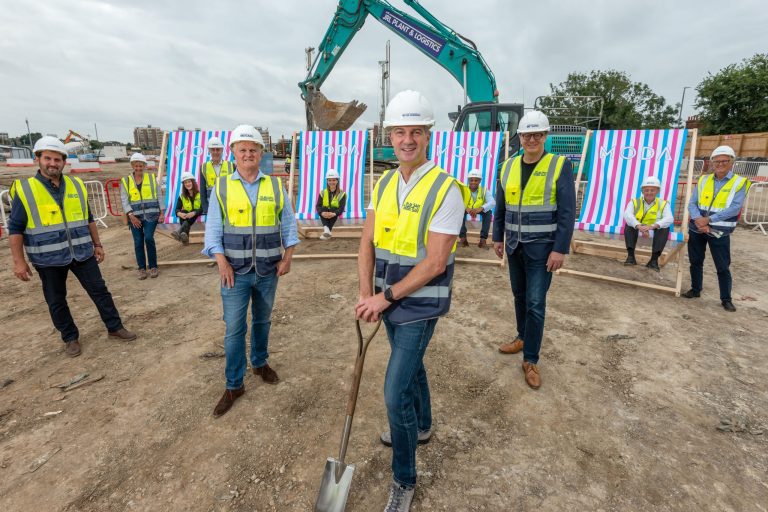
The first spade in the ground has taken place at Places for People’s latest development in Bordon, Hampshire. Work is underway at Places for People’s second development in Bordon – Maple Fields, located off Station Road – which features a collection of two and three-bedroom semi-detached and detached homes and one and two-bedroom apartments. Following on from the success of the first development in Bordon at Woolmer Copse, Maple Fields is bringing 60 new homes to the area, which is situated a stone’s throw away from Prince Philip Park. The properties will also boost the supply of new homes and make a positive contribution towards the supply of affordable housing in the area with homes available for sale through Shared Ownership and also to rent. 43 of the 60 homes will be modular, forming part of a wider £100 million joint venture between Places for People and ilke Homes leading modular housing company, which was announced in 2019. In the largest deal to date for Britain’s modular housing sector, Places for People agreed to purchase 750 units from ilke Homes. The two companies now have a modular development pipeline in excess of 1,000 units across a number of development schemes that are either already contracted or under negotiation. Places for People’s Managing Director for the South West region, Greg Hilton, said: “We are really pleased to be able to build on our success at Woolmer Copse and we are confident Maple Fields will achieve the same standards and create a sense of community, which are key priorities for us. “I am thrilled that work is underway on these high-quality new homes in Bordon and we are delighted to be working with ilke Homes once again. Thanks to their standardised processes, we are able to provide affordable housing in a quicker time period whilst delivering 43 homes to the highest quality and ready for occupation over a four-month period, reducing the build programme to a fraction of that which would be expected using traditional methods. “At Maple Fields we’re creating a range of affordable and well-designed houses and apartments which will give our customers unrivalled choice and quality in Bordon.” Phil Pearson, Development Director at ilke Homes, said: “Our joint venture with Places for People remains a sector-defining moment for the modular housing industry. The latest scheme we’re delivering for the Group is a great example of how offsite manufacturing can help speed up the construction of new-builds and improve quality while ensuring that the homes delivered are some of the most energy-efficient in the country.” Homes England, the Government’s national housing agency, has been championing modular housing as a solution to speeding up the delivery of affordable housing across the UK. Last year, the Government’s national housing agency announced that housing associations looking to sign deals under the new £11.5 billion Affordable Housing Programme will have to commit to using modern methods of construction (MMC) to deliver at least a quarter of their pipelines.

Read More »