Kenneth Booth

RETHINK AND REUSE BEFORE REBUILDING, SAYS SUSTAINABLE CONSTRUCTION EXPERT

THE CONSTRUCTION industry needs to rethink its approach to reusing and recycling buildings if it is to be seen as truly sustainable, according to a leading expert. David Cheshire, sustainability director for AECOM, told a recent webinar from property, construction and infrastructure consultancy Perfect Circle that reusing materials from demolition

Read More »

Collins Earthworks going back to old-school cool

Cat® 637K scrapers with push/pull attachment purchased as part of new equipment investment Earthmoving professionals Collins Earthworks has invested in several new Caterpillar machines, including four new Cat® 637K Coal Bowl Scrapers with push/pull systems. Finning UK & Ireland, exclusive distributor of Cat products, dispatched the new additions to the fleet,

Read More »

Milburngate’s 4,000 tonne steel frame completed

Phase One of Milburngate is on course for completion in the first quarter of 2022.  The latest milestone in the construction of the £120m Arlington Richardson development has been achieved with the completion of its structural steel frame. Comprising of 40,000 individual pieces of steel weighing a combined 3,800 tonnes,

Read More »

Should we be building more smart homes in the UK?

In recent years, there’s been a growing trend in smart technology for the home, with many homeowners upgrading their properties with all sorts of internet enabled features and devices that can be operated from a single interface such as a smartphone or tablet. Increasingly, contemporary homes have heating thermostats and

Read More »

7 Factors To Consider When Installing Hardwood Flooring

Hardwood flooring is the ideal material for various spaces in your home. The material gives off an attractive ambiance that significantly boosts the overall look of a room. If you’re eager to install new hardwood flooring in your living room or place it throughout your home, it’s an investment that

Read More »

Leaseholds on the rise with 8% growth in five years

The latest research from Warwick Estates shows that leasehold homes are playing an increasingly significant role in the UK housing market after enjoying significant growth in the past couple of years. There is an increasingly common narrative around the housing market that leaseholds should be a thing of the past.

Read More »

Knauf Insulation made Business Champion for net zero carbon

Knauf Insulation has been selected as a net zero ‘Business Champion’ by the Construction Leadership Council and Department for Business, Energy and Industrial Strategy (BEIS) for the CO2nstructZero initiative. It joins a select group of major contractors, consultants, architects, engineers, manufacturers and sub-contractors committed to demonstrating leadership and promoting best

Read More »

New guide helps SMEs adapt to a Net Zero future

A new Net Zero guide targeted at SMEs working in the built environment has been jointly released by the Association for Consultancy and Engineering (ACE) and sister organisation, the Environmental Industries Commission (EIC). Aimed at small and medium sized members of both of these business associations, the guide highlights the

Read More »

Next phase of Spirit Quarters regeneration in Coventry gets green light

National housebuilder, Keepmoat Homes, has been granted planning permission from Coventry City Council for the delivery of 94 brand new homes as part of the Spirit Quarters regeneration programme in North East Coventry. The multi-million-pound partnership led Spirit Quarters project, will enter its fifth phase following the completion of phases

Read More »
Latest Issue
Issue 344 : Sep 2026

Kenneth Booth

RETHINK AND REUSE BEFORE REBUILDING, SAYS SUSTAINABLE CONSTRUCTION EXPERT

THE CONSTRUCTION industry needs to rethink its approach to reusing and recycling buildings if it is to be seen as truly sustainable, according to a leading expert. David Cheshire, sustainability director for AECOM, told a recent webinar from property, construction and infrastructure consultancy Perfect Circle that reusing materials from demolition simply isn’t enough to offset the environmental and financial impact of acquiring them in the first instance. Cheshire said: “At the moment, we as an industry dig, mine and process hundreds of millions of tonnes of raw materials that we essentially steal from the planet. There is a focus generally on reducing things like operational energy use, but around half of all greenhouse gas emissions come from mining and processing resources. “We are also knocking down and demolishing buildings at a phenomenal rate, sometimes after only 30 years of use, so we’re losing at both ends of the scale. “While we congratulate ourselves as an industry for reusing large amounts of the waste products from demolition, it’s not ‘recycling’ in the truest sense of the word as the products don’t maintain their value. For example, structural concrete doesn’t get recycled into use as structural concrete; it is downcycled to secondary aggregates like road base or piling mats. While this is reuse, it’s not giving us the materials back that we spent so much energy getting in the first place.” Cheshire talked attendees through the basics of circular economy design principles for buildings and emphasised how its applications can improve sustainability throughout the supply chain. He said: “The current model the industry operates on is very much a linear approach – we win the resources, we use them, we throw them away and then the process starts over again. The circular economy looks to remedy this and find better, more sustainable ways of doing things. “The core of the model is retaining, refitting and refurbishing buildings. There are a number of design principles that feed into this, chiefly the idea of building in layers. There are thousands of components that make up buildings, all of which have different lifespans, so the circular economy model needs to work differently for each layer. “The foundations and structure of the building are long-life and should be around for a hundred years, but with the interiors, the thinking needs to be around reconfiguring for a new use rather than throwing everything out and starting again from base build. “Building in layers also means that you can peel those layers off as uses change. If you’re converting usage from office to residential for example, you might want to replace the facade, but equally it is thinking about how you’re putting everything together – you don’t want to have an electrical component that lasts 20 years hidden behind a ceramic tile that has a 2,000-year life. “If you can retain and refurbish a building and keep the main structure of it, there’s around a 50% reduction in embodied carbon over time in comparison to a new build, which is hugely significant.” Among the examples given by Cheshire was the work being done as part of The London Plan, which has several policies relating to the circular economy in the built environment. Cheshire said: “We’re working with the Greater London Authority on the inclusion of the circular economy in its wider plans. GLA policy now dictates that all referable projects much have a circular economy statement that sets out the project’s commitments against a series of targets. “Our cities and buildings are a gold mine of resources. We spend so much money, effort and time in bringing these resources out of our planet and into our cities, only to downcycle them once their original use is exhausted. “The circular economy goes hand in hand with the idea of urban mining and ensuring that we keep materials within the loop and reusing them to the best of our ability.” A full version of the webinar can be viewed here: For more information on Perfect Circle, please visit www.perfectcircle.co.uk.

Read More »

Collins Earthworks going back to old-school cool

Cat® 637K scrapers with push/pull attachment purchased as part of new equipment investment Earthmoving professionals Collins Earthworks has invested in several new Caterpillar machines, including four new Cat® 637K Coal Bowl Scrapers with push/pull systems. Finning UK & Ireland, exclusive distributor of Cat products, dispatched the new additions to the fleet, including a Cat D7, D9 and several D6 XEs to the company, to support the earthmover’s work around the Midlands. Collins Earthworks, based in Ripley, Derbyshire, has been managing earthworks projects for 20 years, developing a strong working relationship with Finning for the last 10–15. Due to this, Collins came to Finning with a need for machines to support its project on the Northampton Gateway and opted for the Cat 637 scrapers — machines rarely seen in the UK. Adding to the uncommon nature of these machines, Collins has also opted for push/pull systems, negating the use of trucks and excavators. The push/pull system concentrates the combined horsepower of the tractor and scraper onto one cutting edge, allowing two individual scrapers to act as a self-loading system — typically loading both machines in less than a minute, one after the other. “As we are continuing to work on various projects — big and small — throughout the UK, having the 637K scrapers in our fleet gives us the flexibility to fulfil any project efficiently” said David Collins, Managing Director of Collins Earthworks. “Earthmoving work comes in all shapes and sizes, and there is no “one fix for all” solution. Having a mixed fleet including the 637Ks, excavators and articulated dump trucks (ADTs) means that we have the versatility to complete any job, setting us apart from our competitors.” “It is amazing to see an investment into Cat 637Ks here in the UK — scrapers fill a niche in earthmoving that no other machine can compete with, and we haven’t seen these kinds of machines in the UK for a number of years” said Jake Wright, National Account Manager at Finning UK & Ireland. “A good fleet of scrapers can make it much cheaper than the number of excavators and trucks that would need to be used to move the same amount of dirt. “Convenience is also key here. An efficient groundworks operation with excavators and trucks will often take several people, whereas at a moment’s notice, one operator can get on the scraper and do the same job. For short distance bulk earthmoving they are lower cost and faster than any other haulage unit. I don’t think any other setup can compete with a push/pull tandem scraper setup in sand, gravel, clay or topsoil.” To get the most out of the new investment, Finning will also be providing Collins with machine familiarisation training on the wheeled-tractor scrapers, as well as operator efficiency training during a revisit in the next six months. The machines also benefit from an extended warranty and a full preventative maintenance program, so that Collins is safe in the knowledge that Finning experts will be on hand at any time of the day. To find out more about the Cat 637K Coal Bowl Scrapers or how Finning can assist with operator training and preventative maintenance, visit the Finning UK & Ireland website.

Read More »

CONSTRUCTION COMPLETES ON NEW WARWICK ARTS CENTRE IN UK’S CITY OF CULTURE

NATIONAL contractor Willmott Dixon has completed work in June on the new and improved Warwick Arts Centre situated on the University of Warwick’s campus.  The Arts Centre now boasts a large new building with a number of newly created spaces including three digital auditoria with high-end digital projection and sound, as well as a ground floor gallery to exhibit contemporary art, sculpture and photography. The building also features a new foyer offering a larger, more environmentally friendly and attractive entrance for visitors, in addition to a new restaurant and bar to ensure the complete experience. The project also involved the refurbishment and upgrading of the existing building. The £25.5 million investment in Warwick Arts Centre was supported by an award of £4.2 million in National Lottery funding from Arts Council England and is a key venue in Coventry’s year of UK City of Culture in 2021. Designed by Ellis Williams Architects with Bond Bryan as delivery architect and project managed by Turner & Townsend, the project aims to make Warwick Arts Centre the region’s leading cultural centre and a place where creativity, collaboration and innovation thrive.  Peter Owen, managing director at Willmott Dixon, said: “We are very pleased that, after a difficult time for the much-loved arts industry, Warwick Arts Centre will later this year be welcoming audiences back to a space that supports and enhances everything the arts has to offer. The project involved a number of challenges, not least the constraints of a tight site in the middle of campus and the changing requirements related to COVID-19, so a collaborative approach was vital. “We have a strong relationship with the University of Warwick, first established during our work on the University’s Oculus Building, then their Sports Hub and Wellness Centre in 2019, and earlier this year the IBRB. This means we are able to truly understand their campus vision and help make it a reality.  “We are very proud to have become a trusted advisor to the University and to have built a relationship which allows us to contribute to the wellbeing and development of not only students but also the people of Warwickshire and beyond.” Throughout the project, the equivalent of £1.8 million of social value return on investment was delivered to local people by way of a number of community initiatives. Over 17,000 hours was spent supporting local young people with work experience opportunities, as well as 20 weeks with the University’s civil engineering students. Warwick Arts Centre is now a hybrid consisting of new and old, following the demolition of an existing section of the site. By matching the existing build and bringing together the new elements of the project seamlessly, there are now over 20 different roof levels on the site.  Bruce Raw, Birmingham studio director at Bond Bryan, said: “We’re delighted to see Warwick Arts Centre completed. Our team are deeply passionate and proud of our growing presence and relationships across the West Midlands and this project has been at the heart of that drive for the last two years. “From start to finish the project has been a really positive team collaboration between client, end-users, architects, project managers, consultants and the contractor – with everyone all pulling in the same direction on what has been a very complex project on a constrained site, working closely together to solve challenges.” With the project beginning in 2019, followed by the closure of leisure, arts and entertainment venues for much of the last two years, the venue is all set to welcome audiences for shows beginning from October.   Commenting on the completion of Warwick Arts Centre’s redevelopment its Director, Doreen Foster, said: “Today is a fantastic day for Warwick Arts Centre as we are now one step closer to welcoming visitors back to their arts centre. We cannot wait for our audiences to enjoy the experience and make new memories as they engage with the exceptional range of arts and culture that has always been our hallmark, including in our new spaces – such as our new three screen cinema, restaurant and the reimagined Mead Gallery.  “With people throughout the UK and Europe set to visit our city to mark Coventry’s year as City of Culture, 2021 is set to be an exciting time for arts and culture in our region – and I’m delighted that we will be part of its success. I like to take this opportunity to thank everyone who has been involved with the redevelopment of Warwick Arts Centre for making this possible and ensuring that audiences and visitors will be able to join us for decades to come. We’re back, bigger and better than ever, and our doors will be open wider than ever before.” The University of Warwick’s Vice-Chancellor, Professor Stuart Croft, said: “Sat right at the heart of our main campus, Warwick Arts Centre has been an integral part of the cultural life of our University and region for almost five decades. As we celebrate Coventry City of Culture 2021, it is wonderful that Warwick Arts Centre will soon be open again for audiences and visitors to come and enjoy all that it has to offer.” Robert Freeman, Director of Ellis Williams Architects, said: “This is the culmination of many years of planning and working with Warwick Arts Centre and the University of Warwick and we are really excited to see the project completed. “The biggest design challenge we faced was to retain the unique character and top-light of the original Mead Art Gallery in the new galleries that was much loved by artists, whilst also providing new galleries at ground floor creating more accessibility to audiences and at the same time adding the three new large digital auditoria all on the original site. “We are extremely pleased that Willmott Dixon has completed the renewed Warwick Arts Centre in time for it to be part of Coventry City of Culture 2021.” Warwick Arts Centre is now taking bookings for shows from October. To find out more and to make a booking, please

Read More »

Milburngate’s 4,000 tonne steel frame completed

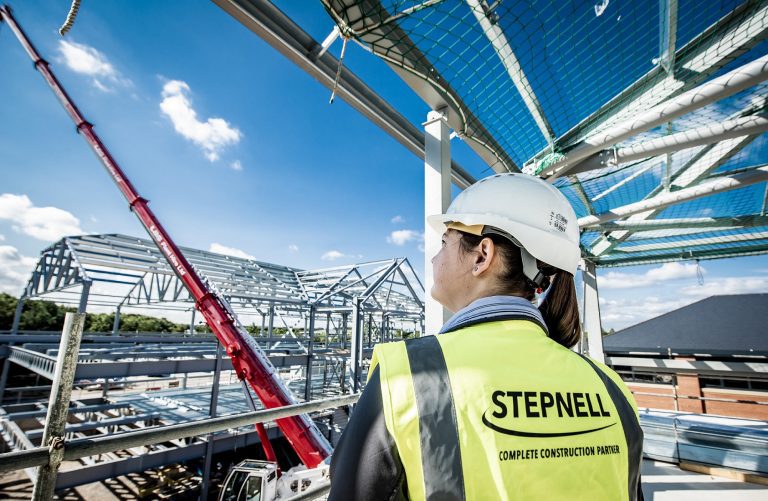
Phase One of Milburngate is on course for completion in the first quarter of 2022.  The latest milestone in the construction of the £120m Arlington Richardson development has been achieved with the completion of its structural steel frame. Comprising of 40,000 individual pieces of steel weighing a combined 3,800 tonnes, the key structures that will make up Phase One of Milburngate are now complete and visible on Durham City’s riverside. Following a 54-week build programme, the steel frames of the office building, hotel, boutique cinema, retail and leisure units, as well as the three apartment blocks, are now in place ready for external finishing and interior fitout to take place. The structural frame, which utilises 20,000 welded shear studs, is strengthened with 5,500 square metres of pre-cast concrete beams and supports over 100 flights of stairs through the development. More than 30 local operatives successfully delivered the steel work project with minimal delays to programme, despite the need to adhere to strict Covid safety guidelines including social distancing. Led by Milburngate’s main contractor Tolent, it was delivered in conjunction with County Durham-based constructional steel company Finley Structures and structural engineers Atkins. Allan Cook, managing director at Arlington said: “Erecting 40,000 pieces of steel in this timeframe in a sensitive riverside location such as Milburngate has its challenges, but to achieve this against the backdrop of a worldwide pandemic is testament to the expertise of our construction team and strength of their supply chain. “This is an important moment in the development of Milburngate, not only as a construction milestone, but also in terms of attracting new occupiers.  They can now visit site and see first-hand the unique position Milburngate occupies on the riverside and experience the fabulous views we have created of the river and World Heritage site peninsular. “When they visit Milburngate they can now appreciate the important role it will play as a living, working and leisure destination in attracting people to Durham from across the region and beyond.   This is certainly paying dividends with potential occupiers as interest in Milburngate has grown significantly in the first part of the year.” Michael Rutherford, project director for Tolent, said: “The completion of the steel frame programme is a significant milestone for the project and what you can now see on site is the best visual representation so far of just what a fantastic development this is going to be for Durham. “As the majority of the structures on site are now weather tight, we are progressing with internal fit out works of the apartment blocks, hotel and leisure and retail units. We recently passed 750,000 hours on site and have a workforce over 300 people which we continue to manage with health, safety and wellbeing as our number one priority.”

Read More »

Should we be building more smart homes in the UK?

In recent years, there’s been a growing trend in smart technology for the home, with many homeowners upgrading their properties with all sorts of internet enabled features and devices that can be operated from a single interface such as a smartphone or tablet. Increasingly, contemporary homes have heating thermostats and lighting controls that can be operated and adjusted from anywhere, WiFi connected security systems with live video footage that can be viewed remotely and, of course, all manner of smart appliances including TVs, fridge freezers and dishwashers that can be controlled via a smartphone app or smart speaker devices like Amazon Alexa or Google Nest. According to recent survey findings, 57% of homes in Britain now contain at least one smart device, and there are 2.22 million homes in the UK with at least two smart devices. For sure, smart homes are the future, however most features are retrofitted after construction. With the current drive to substantially increase the nation’s housing stock in full swing, why are UK housebuilders not integrating more smart technology into new builds right from the design stage? Let’s take a look at some of the most common hurdles. Higher build cost: A complete smart home system can add 5% to the cost of the build with an unproven return on the investment for housebuilders in a highly competitive market. It’s a financial risk many developers are unwilling to take. What’s more, building a home with smart technology requires niche skills, materials and methodologies that are comparatively new to the housing industry, adding time and cost to the process. New ways of cooperating between smart home professionals, architects and site managers are required. Security concerns: According to industry figures, 86% of real estate pros are concerned about cyber attacks and the risk of hacking with smart home technology is on the increase. The more smart features and devices are used, the greater the vulnerability to the householder. Outdoor devices with embedded computers that have little in the way of security protocol pose the greatest risk, such as garage door openers and wireless doorbells are a case in point. Weak communication protocols and configuration settings may also be an issue for smartphone app controlled devices such as personal home assistants, smart thermostats and even baby monitors. Software problems: Software integration can become a real issue for systems that use incompatible technologies and won’t ‘speak’ to each other, or are unable to accommodate additional connections further down the line. With the co-existence of various communication protocols as the proliferation of ever more sophisticated smart devices continues, there is no guarantee that the latest tech used today won’t be obsolete in a few years’ time Again, it’s a financial risk that many housebuilders will want to avoid. On the other hand, it is clear that the emergence of smart home technologies over the last 20 years can no longer be considered a passing phase. Home automation has steadily increased in popularity since the early 2000s, and it might be unwise for the UK housebuilding industry to ignore this fast-growing demand among consumers wanting the latest technology in their homes. Here are some of the main benefits of smart new builds: Smart homes sell faster than comparative properties without the added features, and they fetch premium prices too, particularly among younger homebuyers. Survey findings show that 61% of millennials would pay extra money to live in a home with smart features.  Reliable long-term performance of smart home systems is best achieved via upfront integration. Designing the entire system at the beginning will ensure smoother and more efficient operations as opposed to the piecemeal retrofitting of individual features. Greater vigilance offered via connected devices means homeowners are alerted to problems such as burglaries or fires early. This results in fewer home insurance claims and, in turn, potentially lower premiums. Smart homes enable the homeowner to cut down on energy waste such as lights left on or rooms heated unnecessarily, by up to a third. This can help UK housebuilders meet energy efficiency standards and build more sustainable homes. Smart home technology can be particularly beneficial to physically disabled and elderly residents. Home management tasks and home security all become much easier, creating more inclusive home environments. The fact that a growing number of home buyers are now prioritising technology in the home is a clear sign that there is an opportunity to maximise future profits for the UK housebuilding industry by building more smart homes. Not only is the Internet of Things already bringing the benefits of connected living to an increasing number of people, but the next generation of property buyers are looking for homes that align with their values. From environmentally conscious and energy-efficient solutions to more interconnected communications for work and home, smart homes are able to offer all that and more.

Read More »

7 Factors To Consider When Installing Hardwood Flooring

Hardwood flooring is the ideal material for various spaces in your home. The material gives off an attractive ambiance that significantly boosts the overall look of a room. If you’re eager to install new hardwood flooring in your living room or place it throughout your home, it’s an investment that requires your full attention.   Investing in superior quality flooring for your home, such as hardwood, can provide several long-term benefits. First, it adds timeless elegance and beauty to any space and can be a wise choice if you plan to remodel your home in the future. Hardwood flooring can also last for many years, which is why it’s crucial to choose a suitable hardwood floor for your home. To learn more about hardwood flooring, you can look into custom wood shops such as Elmwood Reclaimed Timber to get an idea of how it will look like once installed.  Once you decide to go for hardwood flooring, maintenance is a factor to consider. The material is prone to scratching, and exposure to excessive moisture can increase the risk of rotting. Before installing hardwood flooring in your home, here are several factors to consider to ensure that you’re making the right decision.  1. Interior Design Before deciding on the type of flooring to install in your home, it’s essential to consider the interior of your home first. It would be best to consider the furniture, especially the cabinet trimming, door casings, and other design elements. Doing so will ensure that the floor will seamlessly blend in with your home.   2. Location  It’s crucial to note that not all types of hardwood floors work best in all parts of your home. With this in mind, you should carefully think about the areas where you want to install them. In areas below ground level, such as the basement, engineered wood is a good choice.   Solid wood is not a suitable option due to the moisture in spaces below the ground. Moisture can rise from the ground and result in problems with solid wood flooring. 3. Subfloor Type  Subfloors serve as the base for finished floors in all houses, which should be one of your considerations when selecting hardwood flooring. Generally, the common types of subflooring include particle boards, concrete slabs, and plywood. If you want a versatile option, plywood is ideal since it can support solid wood and engineered floors.   4. Price  The price of hardwood flooring includes the installation cost and floor maintenance. It will also depend on the number of years you intend to stay in your current home.   If you’re planning to stay in your current home for many years to come, you might want to think about renovating the space and selecting suitable flooring options during that period. Additionally, you should also consider the costs of the removal and disposal of the old flooring.   5. Lifestyle  Depending on your lifestyle, you should consider the wear and tear of the flooring you’ll choose. For those who regularly host gatherings with family and friends or have pets around, it’s best to consider a durable type of wood that’s resistant to scratches or damages. You can go for red oak since it’s affordable and resilient enough to endure most damage.   6. Finishing And Staining Options  Hardwood flooring is a preferred option for most homeowners due to its beauty and elegance in its natural form. One of the most common concerns in installing hardwood is when the color deteriorates, especially in areas that are constantly exposed to the sun.   In maintaining hardwood flooring, you should polish the floor using various finishes to lessen its chances of deteriorating. You can apply any finish of your choice as long as it matches the entire look of your house.   7. Tree Species  Various tree species produce distinct hardwood flooring. Each tree showcases unique grain patterns, characteristics, and variations that make them stand out. Here are some of the popular wood types.  Oak. You can choose from two types such as red and white. Red oak is a popular option with visible graining and color variations in every plank. White oak, with varying grain patterns, is a suitable option for high-traffic areas in your home.   Hickory. When it comes to durability, hickory is the ideal option due to its high density and shock resistance.   Ash. The bold graining in each plank, ranging from wavy, straight, or curly, makes it stand out in any space.  Conclusion  Hardwood flooring is a worthy investment if you want to upgrade the overall look of your home. Before installing hardwood flooring, you should take note of these factors to help you along the way. But one thing’s for sure—once you have installed hardwood flooring in your home, it will give your house that promised lasting elegance for years to come.

Read More »

Leaseholds on the rise with 8% growth in five years

The latest research from Warwick Estates shows that leasehold homes are playing an increasingly significant role in the UK housing market after enjoying significant growth in the past couple of years. There is an increasingly common narrative around the housing market that leaseholds should be a thing of the past. This argument often starts by saying leaseholds don’t give owners sufficient freedom and protection in their homes. But, from analysing the past five years of the UK leasehold market in the private sector, it’s clear that they aren’t going anywhere. In fact, they’re growing in prominence. The industry analysis by Warwick Estates shows that In 2015/16, leaseholds accounted for 20.8% of the private housing market.  In 2017, this had slumped to an all-time low market share of 20.3% and it looked as though leaseholds were quickly becoming the least desirable form of homeownership. But the slump didn’t last long. In 2018/19, the leasehold sector’s market share increased to 21.1%, with the total number of leasehold dwellings increasing by 5.3% from just over 4 million to more than 4.2 million. This growth continued into 2019/20, with leaseholds now accounting for 21.6% of all private dwellings, having increased by 3.4% annually. So the idea that leasehold ownership is falling out of favour seems to be incorrect. Instead, after a few years of strife from 2015-2018, leaseholds are on the rise having risen by 8.15% across the five-year period examined in the data.  COO of Warwick Estates, Bethan Griffiths, commented: “Leasehold prominence in the UK housing market is on the up and this should come as no surprise as the sector provides a vital service to many. Those who argue leaseholds are increasingly defunct fail to consider how essential they are for the housing market, for the economy, and for buyers. “Take a walk around any city; there are new developments and high rise flats going up everywhere. Those that are destined to be sold will be done so with leaseholds. For as long as people want to live in urban areas and in flats, leaseholds will provide the ability to secure and maintain this lifestyle choice. “That’s not to say leaseholds don’t come with challenges, but with intelligent and communication-focused management that caters to landlords and leaseholders alike, these challenges can be mitigated and nullified.“ Leasehold dwellings across the private sector (owner occupied and private rented sector) Period Leasehold dwellings as % of stock Change (%) TOTAL – number of leasehold dwellings Change (n) Annual Change (%) Change – 2015/16 to 2019/20 (%) 2019-20 21.6% 0.5% 4,378,000 146,000 3.4% 8.15% 2018-19 21.1% 0.8% 4,232,000 212,000 5.3% 2017-18 20.3% -0.2% 4,020,000 -1,000 0.0% 2016-17 20.5% -0.3% 4,021,000 -27,000 -0.7% 2015-16 20.8% – 4,048,000 – – Data sourced from Gov.uk – Leasehold Dwellings              

Read More »

Knauf Insulation made Business Champion for net zero carbon

Knauf Insulation has been selected as a net zero ‘Business Champion’ by the Construction Leadership Council and Department for Business, Energy and Industrial Strategy (BEIS) for the CO2nstructZero initiative. It joins a select group of major contractors, consultants, architects, engineers, manufacturers and sub-contractors committed to demonstrating leadership and promoting best practice to reduce construction carbon emissions. “Net zero is a colossal challenge, and to achieve it will require unprecedented collaboration” said Neil Hargreaves, Managing Director, Knauf Insulation Northern Europe. “As the biggest supplier of insulation into newbuild homes in the UK, and the nation’s only manufacturer of both Glass and Rock Mineral Wool, we know we have an important role to play. Especially as the industry transitions towards much stricter ‘real performance’ standards. We look forward to working with our partners across the supply chain to create a built environment that’s fit for the future.” Established earlier this year, CO2nstruct Zero is the construction industry’s zero carbon change programme. Business Champions are required to share tangible evidence of the steps they are taking to respond to the net zero carbon challenge, and to commit to sharing data and learnings with the industry. Business Champions include Arcadis, Costain, JCB, Laing O’Rourke, Mace and Travis Perkins. “Improved insulation will be at the heart of UK construction’s efforts to decarbonise, but operational carbon is only one side of the equation,” said Hargreaves. “To create genuinely low-carbon buildings, we’ll need to create them using low-carbon materials. That’s why we’re taking bold action now to reduce the embodied carbon and environmental impact of our products.” Knauf Insulation has set specific targets for 2025 as part of its recently published sustainability strategy, ‘For a Better World’. These include: Reducing the embodied carbon of its products by 15% compared with 2019; Investing 10% of its general capital expenditure on new sustainability projects; Cutting its organisational carbon footprint by at least 25%; Sending zero waste to landfill from its manufacturing plants across the group; Reducing virgin plastic packaging by 25%; Setting new higher minimum levels of recycled materials in products and packaging. For further information on Knauf Insulation’s ‘For A Better World’ sustainability strategy, visit www.knaufinsulation.co.uk/for-a-better-world.

Read More »

New guide helps SMEs adapt to a Net Zero future

A new Net Zero guide targeted at SMEs working in the built environment has been jointly released by the Association for Consultancy and Engineering (ACE) and sister organisation, the Environmental Industries Commission (EIC). Aimed at small and medium sized members of both of these business associations, the guide highlights the steps that should be taken towards a carbon free future, explores how Net Zero is already influencing client decision making, and outlines how to meet new client expectations while seizing the business opportunities created. The guide also provides a handy reference to previously released publications, reports, pledge schemes and sector plans, directly sign-posting to the most important and relevant sources of information. Commenting on its launch, Dr Sarah Prichard, UK managing director at Buro Happold, and chair of the ACE and EIC Net Zero group, said: “We designed this guide to help SMEs with practical and tangible advice to support them to make the right choices on their Net Zero journey. “While much has been written around national targets and global conferences, the truth is that we will only succeed if we bring small and medium sized business on board. The UK economy is made up of six million SMEs making up 99.9% of the business population. Our guide is the first step towards this in our industries and I’m looking forward to further engaging both membership bases on this fundamental issue in the weeks and months ahead.” Available to download from the ACE website, EIC members will be sent a copy directly. The guide is released during Net Zero Week, a new national awareness campaign which is bringing together nearly 30 business associations and major organisations to explore all things Net Zero. ACE and EIC are founding partners of the week. Matthew Farrow, director of policy at ACE and EIC, added: “We are delighted to share this guide during the inaugural Net Zero Week. “New ways of working will – of course – mean challenges and change over the near term, but it will also create new business opportunities. Our guide aims to help small and medium sized businesses in our sectors be as well-prepared as possible to seize these.”

Read More »

Next phase of Spirit Quarters regeneration in Coventry gets green light

National housebuilder, Keepmoat Homes, has been granted planning permission from Coventry City Council for the delivery of 94 brand new homes as part of the Spirit Quarters regeneration programme in North East Coventry. The multi-million-pound partnership led Spirit Quarters project, will enter its fifth phase following the completion of phases one to four which have delivered 979 new homes in the area, 275 of which were allocated for affordable housing in partnership with Citizen. The latest phase will comprise of a further 74 properties for the open market, comprising of two, three, and four-bedroom houses and 20 affordable homes.  Charlotte Goode, Regional Managing Director at Keepmoat Homes, said: ‘’We’re delighted to have received planning permission for the fifth phase of construction at Spirit Quarters. This significant regeneration project will not only deliver 94 much-needed new homes to the area, but every aspect of the development has been designed to fulfil the needs of this brand-new community.  “We’ve already welcomed over 700 new homeowners to Spirit Quarters and are excited to start construction on phase five, which will provide even more new homes for both first time buyers and those looking to up or downsize.  “This latest planning approval is a fantastic opportunity to strengthen our already existing presence in the city and is another positive step for our ambitious growth plans in the West Midlands.’’ Dianne Williams, Chief Executive of Moat House Community Trust, said “It is very exciting to be able to announce that the next phase of the redevelopment will be starting very soon and that we are entering into the final stages of delivering the vision that the residents had to transform their area through physical and social regeneration and investment.” Citizen’s Director of Regeneration Services Kevin Roach said: “We are delighted to be entering the next phase of our ambitious Spirit Quarters regeneration project. “We believe passionately in the power of transforming communities here at Citizen and that successful regeneration is about much more than bricks and mortar. It means creating the right mix of homes and environment so that people value and stay in their area; it means creating real ownership in a community and investing in education, health, employment, transport, and leisure. “The change that has taken place in the area and continues to take place would not have been possible without the continued drive, support and commitment of the community and our partner Moat House Community Trust.” Cllr David Welsh, Cabinet Member for Housing at Coventry City Council, adds: “Spirit Quarters is not only creating much-needed housing in the city, it is building a community. “It is providing attractive housing with open spaces and is exactly the sort of development we are looking for as we work to meet housing demand for growing families, first time buyers and everyone in between. “The first four phases have helped to transform the area and these latest plans will continue that good work.” Construction is due to commence in the summer of 2021, with the first homeowners due to move in June 2022. The development will take around two and a half years to complete.

Read More »