Kenneth Booth

Developer sought for £800m Salford campus revamp

Salford City Council and the University of Salford have launched a search for a private sector partner to deliver their £800m masterplan for Salford Crescent. Salford Crescent will see the University of Salford campus and the surrounding area turned into a new city district that will include a residential neighbourhood,

Read More »

Build nears completion at Legacy Wharf in Stratford

The regeneration of Stratford is reaching a new milestone, with construction work on one of the area’s new residential communities nearly complete. Housebuilder Bellway London is behind Legacy Wharf, a development of one, two and three-bedroom apartments off Cooks Road. Building work is due to finish next month on the

Read More »

Wait for the potential trade setups to make money

In the currency trading business, we will have to things correctly. There will be a lot of volatilities in the markets. Even with some proper market analysis, the trades will not be proper. This is a fact of the Forex trading business. All of the traders will have to work

Read More »
Latest Issue
Issue 345 : Oct 2026

Kenneth Booth

The healing hospital. Siemens Smart Infrastructure: well-designed hospitals help patients heal faster

When patients are allowed to recover in a more comfortable environment studies show there is a positive impact on their healing and well-being.  Effective building design has been widely used to help patients recover more quickly and hospital staff to work more efficiently.  Evidence-based design (EBD), the process of making changes to the built environment based on research to improve outcomes, has helped lower the incidences of hospital-acquired infections, medical errors, patient accidents, and staff injuries. “The environment’s influence on a patient’s well-being was first, scientifically, explored by professor Roger Ulrich in his 1980s study that sought to determine whether there was any measurable positive influence in a patient’s recovery when they were given rooms with different views,” commented Gareth Rees, Head of UK Strategic Market – Healthcare Siemens Smart Infrastructure.  “The research showed that patients who had views overlooking nature [rather than that of a building] experienced shorter stays, needed fewer pain medication and were more optimistic about their prospects.  These findings paved the way to a greater awareness and understanding of how space and hospital architecture can affect our physical condition and state of mind.” Using EBD techniques today architects and designers have been developing solutions for better healing environments.  Healthcare facilities often have unique individual requirements with specialised hospital rooms requiring bespoke implementations for patient recovery wards, operating theatres, pressurised rooms and laboratories.  Careful design can improve safety and productivity, reduce staff stress levels, lower resource wastage and enhance environmental sustainability. There is a delicate balance between providing the ideal recovery conditions in patient rooms and an optimal work environment for staff to deliver the best possible care.  The provision of WiFi and personal control over room conditions are important elements for patient satisfaction.  Room automation controlled by a patient’s smartphone or tablet allows the precise control over temperature, ventilation and other functions that affect comfort.  Wearable tags can also be deployed to monitor the vital signs of patients to automate control of a recovery environment.  Circadian lighting that follows a patient’s natural daily rhythm or sleep/wake cycle reduces tiredness and enhances recovery sleep while audio levels can be improved through the use of sound-absorbent materials installed in ceilings and flooring.  Acuity-adaptable spaces lessen the movement of patients reducing stress on both patients and staff.  Operating theatres are complex environments that need to be spacious, hygienic and well-lit (with overhead surgical lights).  Generally windowless temperature and humidity levels are tightly controlled.  Pressurised rooms are designed to isolate a patient with infectious diseases and require air management and filtering systems.  Medical or clinical laboratories where approximately 70 percent of treatment decisions are made require stable conditions with exact controls over temperature, humidity and sometimes, pressure. Smart infrastructure and IoT technologies are an expanding area of interest to healthcare planners and allow owners and operators of hospitals to leverage more from their existing assets which are becoming more intelligent- producing and using data to perform better throughout their lifetime. Total Integrated Power and lighting control systems, air, space and asset tracking solutions all improve energy usage, space utilisation and real-time location usage. Concluded Rees: “Hospitals are never going to be places that any of us are going to particularly enjoy visiting but through better physical environments designers can speed up our recovery and alleviate a lot of the stress and fear.  Better performing buildings can provide higher comfort levels and well-being for all occupants.”  

Read More »

Business technology has the potential to boost mental health in the workplace

Mental Health Awareness Week: 13-19 May 2019 In our digital age, technology is often considered to be a big stressor for our mental health. Research and health warnings have helped us to realise that social media and too much screen time can increase the risk of depression and anxiety. With so much awareness around the topic now, we’re becoming more mindful as a nation and looking at ways to make changes. However, technology can work well in steering us into creating positive habits and boosting our mental health. To help deal with rising levels of anxiety and depression, many of us now use health apps as part of our daily routines, including Headspace, Calm and Stop, Breathe & Think. Does your business function in a way that works to combat stress in the working environment? Read our guide below to understand how businesses can employ technologies to help address the issue. Find out if your business could do more… 59% of UK adults claim their biggest cause of stress is their workplace 59% of UK adults experience workplace stress (Perkbox), making it the most common cause of stress in the UK. What’s more, over one in five experience moderate-to-high levels of stress at work several times a week. The biggest work-related contributor to stress is long working hours, which impacts 21% of people. Happiness in a job is essential to employee productivity; 39% work harder if they’re happy in their current job or workplace (One4all). Artificial intelligence (AI) can help drive business efficiency Productivity is the holy grail businesses across the world are trying to achieve, and a lot of them are turning to technology to help. Innovations like artificial intelligence (AI) are driving efficiencies by eliminating manual, repetitive and time-consuming tasks like data re-entry. Employees with jobs that require a lot of manual data input could save hours by using technology that now comes as standard in many of the latest versions of the software solutions they use daily, like their financial systems or CRM solution. While this functionality is built into a lot of these programmes now, it’s the latest versions, meaning businesses operating on older legacy systems won’t reap these benefits. Plus, old clunky software that is difficult to use can make an employee’s job even more difficult. Additionally, Randstad found that one of the top factors in employee satisfaction is having the latest digital and technology tools. Improve remote employees engagement levels with intranet solutions The businesses most likely to report issues with employee engagement are those with frontline or remote workers; 21% of businesses cite low engagement amongst frontline staff as a barrier, while 78% believe connecting with those employees is the key to success (Harvard Business Review). Many studies evidence the advantage of offering remote working to your employees, with improved satisfaction, increased productivity and a better work-life balance just a few of the benefits, it can be easy for those workers to feel out of the loop with the office and company culture; 21% report feeling lonely and struggle with communication. A lot of businesses are engaging and communicating effectively with these workers by using intranet solutions. By keeping up-to-date with key business updates and more informal topics, remote workers feel like they’re truly a part of your organisation’s culture. You can use this space to share social media feeds, event details or even take the opportunity to publish focus pieces on those remote workers to introduce them to the rest of your workforce. Alleviate pressure on staff with time management technologies Thanks to our always-on culture and high workloads, we’re working longer hours than ever before. Employees often feel obligated to either work longer hours or to be contactable and working outside of hours, with 50% of people checking their emails outside of work (Dissent). Working more hours than standard can affect health, as the Australian National University found anything over 39 hours a week could be detrimental to health. To gain control over workloads and reduce the pressure they put upon themselves, employees can use time management technologies. Ultimately, management must play a role in helping employees to reduce extensive working hours, but workers can proactively take steps to support themselves. Time management tools are available to individuals for free, or as part of wider business solutions. From personal to-do lists to more comprehensive team or business-wide solutions where tasks can be assigned with a deadline and space for updates, the sky is the limit. The key to reducing stress at work: a blend of technology & support from management There isn’t a magic catch-all solution that exists to solve workplace stress. In addition to using technology to manage stress, employees must be supported by their managers and businesses. But, amidst all of the headlines that identify technology as a killer of productivity and mental health, it’s reassuring that it can also be used to vastly improve them, too.   Article produced by Natasha Bougourd from TSG, a UK firm and provider of managed IT services, specialising in IT support and solutions, security and applications including Office 365 and Sage.

Read More »

Ibstock Brick shortlisted for Most Inspiring Apprenticeship Programme award

Ibstock Brick has been shortlisted for The Inspire Awards which celebrate diversity and inclusion in the construction, engineering and housing sectors in the UK. The leading brick manufacturer, part of Ibstock plc, has been named as a finalist in the Most Inspiring Apprenticeship Programme category. Ibstock Brick offers two engineering apprenticeship programmes, both four years in duration; Advanced Mechanical Engineering and Advanced Electrical Engineering. There are currently 35 apprentices within the business, ranging from 16 to 25 years old, including two female engineering apprentices. One of these is Courtney Scarlett, a Dual Engineering Apprentice. She says: “I wanted to do something where I could use my practical skills rather than just learning about the theory behind it. An engineering apprenticeship allows me to do exactly that. Women are still a minority in engineering, and this is why I love working in an engineering team and showing other people that women can also be successful in a male-dominated field.” Paula Wardle, Group Learning & Development Manager at Ibstock plc, commented: “We are delighted that Ibstock Brick has been shortlisted for the Most Inspiring Apprenticeship Programme. It recognises the investment we have made in developing a comprehensive programme focussed on delivering world-class engineering skills and knowledge. As a building products manufacturer, our apprentice population currently reflects the traditional nature of the industry, yet we are working hard to encourage a more diverse range of apprenticeship applications, and are proud of the steps we are taking. “Our apprenticeship scheme has gone from strength to strength, and ensures that we create a pool of engineering and technical specialists who will help drive forward innovation and manufacturing excellence. It is only by nurturing our future talent that we will have people with the technical expertise and skills to manufacture our products for years to come.” The winners of The Inspire Awards will be announced on June 5th at The Hilton, Deansgate in Manchester.  

Read More »

Developer sought for £800m Salford campus revamp

Salford City Council and the University of Salford have launched a search for a private sector partner to deliver their £800m masterplan for Salford Crescent. Salford Crescent will see the University of Salford campus and the surrounding area turned into a new city district that will include a residential neighbourhood, the redevelopment of the university campus, an industry innovation park and a cultural quarter. The project includes five zones: Adelphi, Crescent, Innovation, Health Village and Peel Park. For more details of the masterplan, see www.salfordcrescent.com. University of Salford vice-chancellor Helen Marshall said: “The Salford Crescent masterplan represents a once in a generation opportunity for a partner to get involved in one of the largest mixed-use development schemes in the UK. It will see the creation of an inspirational campus that will create a natural home for industry – local, national and international, cultural partners, the people of Salford and it will create a city district that will drive local and regional economic growth across a number of sectors from health, technology, the arts, biosciences, the environment and energy. “It is a project that will have a lasting, transformative effect on Salford and the wider Greater Manchester city region. We are looking for a partner whose vision, ambition and creativity matches that of the university and the City of Salford.” Salford mayor Paul Dennett said: “We are looking for a private sector partner who understands the unique social and economic impact that this development will have and who recognises the city’s ambition for inclusive growth and development which benefits the people of Salford. “We will want to know they recognise and understand the unique social value opportunities afforded by these developments, local jobs and training as well as the supply chain and explain how they can best be delivered through inventive processes and partnership working. “The district aspires to be a beacon of planning and design, incorporating modern infrastructure and R&D. If it is done right we have an opportunity to drive the kind of development and approach to place-making here that could be a model cross the world.” Salford City Council and the University of Salford have been working with 5plus architects and CBRE since summer 2017 to prepare the Salford Crescent and University District masterplan. The contract notice was published in the EU Official Journal today. CBRE is leading on the search for a developer. The deadline for the return of expressions of interest is Friday 14th June. There will be a period of dialogue between July and October with a select number of bidders, before a preferred bidder is chosen towards the end of the year. For all interested parties, the documents will be published on www.the-chest.org.uk.  

Read More »

Build nears completion at Legacy Wharf in Stratford

The regeneration of Stratford is reaching a new milestone, with construction work on one of the area’s new residential communities nearly complete. Housebuilder Bellway London is behind Legacy Wharf, a development of one, two and three-bedroom apartments off Cooks Road. Building work is due to finish next month on the first phase of Legacy Wharf, which comprises five linked apartment blocks around an attractive communal courtyard with flower beds, meeting places and a children’s play area. The development includes commercial and retail premises, as well as landscaped podium gardens, a gym and a concierge service for residents, all within walking distance of one of London’s largest shopping centres, world-class sporting facilities and fantastic transport links. Emma Hamlett, Sales Director of Bellway London, said: “We’re delighted that this new community at Legacy Wharf is nearly complete, with many of our new residents already settled in and loving their brand new home in this flourishing part of the capital. “The 2012 Olympics legacy has made Stratford one of London’s most sought-after and fastest-growing residential districts and Legacy Wharf offers a great chance for first-time buyers and central London commuters to get their feet on the housing ladder in this fantastic location. “What’s more, Help to Buy London is making buying here possible for people who might otherwise not be able to afford their own place in the capital. “With apartments selling fast, I would encourage anyone hoping to take advantage of the opportunities here to act now and avoid missing out.” Help to Buy London allows purchasers to buy a new-build home with a five per cent deposit and a 55 per cent mortgage. The remaining 40 per cent is provided in the form of an equity loan from the government, which is interest free for the first five years of homeownership. The scheme is available on new-build homes in London worth up to £600,000. The final three-bedroom home within the first phase at Legacy Wharf is available from £593,000. Further one, two and three-bedroom designs are due to be released for sale soon. More information is available at bellway.co.uk   CAPTIONS A computer-generated image of Legacy Wharf, Stratford

Read More »

VINCI CONSTRUCTION UK LEADS CONSORTIUM TO DEVELOP PROJECT COSTS AND TIME SAVINGS TOOL

VINCI Construction UK has partnered with BRE, nPlan, Assentian and Skanska to develop PLASMA, a digital planning and supply chain management toolbox that has the potential to deliver 25% cost and time savings for projects. The two-year project funded by UK Research and Innovation, the UK’s innovation agency, started in March 2018 and seeks to produce a proof of concept version of a toolkit that will improve efficiency in the construction process for planning and supply chain management. Built on a blockchain platform, it aims improve construction productivity via better project planning, improved supply chain collaboration, and analysis of supply chain and IoT data.   Better project planning. The tool enables planners to create and quantitatively rehearse project delivery scenarios such as sequences, critical path and logistics. This reduces risk by taking account of context-specific restrictions and supply chain ‘pinch-points’, for example where increased capacity or automation could improve overall productivity.   Improved supply chain collaboration. PLASMA enables supply chain businesses to collect, share and store ‘tamper-resistant’ data without the need for central control and management. This optimises complex supply chains and facilitates the tracking of elements such as task completion via existing IoT-based data capabilities. It also enables change managementand incremental payments to be made via smart contracts.   Analysis of supply chain and IoT data.Task parameters such as cost, and time will be quantified for planning scenario optioneering and optimisation. The tool will also enable the development of quantified KPIs that are specific to construction supply chains, identifying best practice and the range of performance across the sector. KPIs can be linked to and benchmark a range of established performance improvement approaches, as well as innovations such as robotics and automation.   The project represents innovation in its truest form and its successful development will lead the way in delivering much-needed efficiencies for the sector. Sam Stacey, Director of the Transforming Construction Challenge UKRI, said: “Projects such as PLASMA are funded by the Industrial Strategy Challenge Fund and play a key role in advancing the transformation across the sector. It will help the construction industry work directly with talented innovators to explore new ways of working in construction that will speed up assembly, save money, and improve the quality of building projects.”

Read More »

HS2 Green Corridor planting programme reaches 350,000 new trees milestone

More than 350,000 trees have been planted by HS2 as part of efforts to create a Green Corridor of trees and wildlife along the route of the new railway. As well as improving connectivity, boosting the economy and unlocking new jobs and opportunities, HS2 will also work for the environment and local communities. The Green Corridor consists of new wildlife habitats, native woodlands and community spaces to help integrate the new railway into its surrounding landscape and environment. Eventually, HS2 will plant seven million new trees and shrubs on Phase One of the railway. More than 40 different species of tree are being grown at a specialist nursery in Lincolnshire, including species that are native to each area that HS2 passes through. In total, 48 habitat mitigation sites have been created along Phase One of the railway, which include trees, grassland, ponds, wildlife refuges, reptile basking banks, and structures for bat and barn owl homes. One of the sites is Decoypond Wood, part of the Bernwood Forest area of Buckinghamshire, where mitigation work has already started. HS2’s enabling works contractor Fusion and their suppliers Forkers are currently completing the planting of over 1,000 trees at the site.  This has been designed to create a new flight path for a rare species of bat known as the Bechstein’s Bat which is native to this area. Further north on the route, on the banks of the River Tame in the north of Coleshill in Warwickshire, HS2’s landscape architects WSP and early works contractor LM JV have recently finished a new wildlife habitat which contains a mix of grassland and wetland areas, providing a home in which the endangered water vole can thrive. In addition to the mitigation works, HS2 has a number of different funds, projects and partnerships designed specifically to support the environment and communities. Community and Environment Funds and Business and Local Economy Funds have seen £2.5m awarded across 47 projects in 14 constituencies. Among the successful bids was Forest Enterprise England who secured £450,000 CEF funding towards the creation of a visitors hub at Wendover Woods which it is hoped will attract 420,000 visitors and £4.3m into the rural economy each year. Work is also taking place in the Colne Valley and Chilterns Area of Natural Beauty where a £3m fund has been set up in each area by HS2 to deliver individual environmental projects. In the Colne Valley, 12 projects have already been funded worth over £800,000. Additionally, £1 million has been allocated through the HS2 Woodland Fund, which will see 18 projects deliver 85ha of new woodland and 50ha of ancient woodland restoration. Peter Miller, HS2 Environment Director, said: “Our ecological work is really important in reducing our environmental footprint and minimising the expected impact of our construction work. “Green Corridor and the various funds we are making available along Phase One of the route have seen our work on the ground accelerate over the last 12 months as we prepare for the main works. “This will continue and people can expect to see new sites developed in the years to come and the gradual emergence of the new Green Corridor along the route.” Watch the HS2 Green Corridor film here

Read More »

Wait for the potential trade setups to make money

In the currency trading business, we will have to things correctly. There will be a lot of volatilities in the markets. Even with some proper market analysis, the trades will not be proper. This is a fact of the Forex trading business. All of the traders will have to work in the best possible way with their trades. Because there is more concern needed for the safety of the trading capital. So, the traders will have to think of the best possible ways to deal with the business. In the following, we are going to talk about one more important thing. By the title, you have already learned about the patience required in the currency trading business. The traders will have to think in the best possible way for the trades. In the process of currency trading, there will have to be some good thinking of the business. We are going to talk about some proper ways to manage your trading mind. There will have to be some kind of influence from the traders themselves for a quality trading performance. There will have to be patience As we were saying, almost all of the trading process will need patience. The more time you can spend on the trades, the better it will be for the executions because the market analysis work will be done right. Most of the traders will also be able to manage the trades with proper income. At least the minimization of the losses will be possible. It is the most important task for novice traders because the process in currency trading will not be right without some good management of the trading business. All of the traders will have to work in the most proper way for some quality trading business. There are some ways for the traders to maintain such good performance to accept the right kind of patience. If any trader is not good with patience, there will not be a good performance. More importantly, all of the plans will be the short cut to success. This is not good for Forex and there will be a lot of losing trades from things like overtrading or micromanaging. Learn price action trading Many traders in the United Kingdom prefer to trade the market with indicators. Indicators are nothing but helping tools. In order to make a living out of trading, you have to learn price action trading strategy. Use the Saxo Forex trading account to ensure free access to their robust trading platform SaxoTraderPro. Analyze the different formations of the Japanese candlestick pattern and execute a trade at the key levels. Once you master the price action trading strategy, it won’t take much time to become a successful trader. All will have to focus properly In the system, the traders will also have to think about the actual achievement because it is very common for most of the traders to think about getting profits will be the right thing. Actually, it is not like that. The traders will have to think in the most proper way with the trades. And for some quality performance in the business, all of the traders need to think about safety. We have already talked about it but without some good consciousness of the traders, it is not adaptable. So, think about the trading edge itself and being good with the trading approaches. If you can handle the position sizes properly with the key swings, there will be some good profits. Focusing on intentions to make money will not help at all. Follow a proper trading method Now that you have learned about some good management of the trading mindset, it is time for the method. There will be about 4 in the Forex trading business. But the traders will have to choose either the swing or position trading method because they help traders to stay organized and relaxed.

Read More »

Use and Applications of Expanded Metal and Wire Mesh for Industry and Architecture

Expanded metal is obtained by cutting and simultaneously ironing the sheet metal. This process creates diamond-shaped openings in the material that allow the free flow of air, fluids or light.  This type of metal is produced from a sheet of any solid metal, including stainless steel, aluminum, galvanized steel, titanium or copper. Expanded Metal, a versatile product Expanded metal includes diamond shaped openings, which distinguish it as a versatile and commonly used product in areas such as platforms, walkways, conveyor belts and railway fences, and others. It can also be retrofitted to existing gratings, floors or diamond sheets and in many areas is a cost-effective solution. Here are four common types of expanded metal.   The most common forms of use of expanded metal for Industry are circles, squares and diamonds, of which diamonds are the most requested forms because of the form’s ability to absorb energy and resist mechanical deformation after installation. Other aspects of construction are represented by the dimensions and angles of the shapes, which also influence the way in which the metal absorbs energy and the point where the energy spreads throughout the expanded metal. Wire cloth can be used in many specific applications and is available in many fabric and material versions. This type of product is an element that allows the use of different types of protection, support and custom applications. The metallic fabric is braided together with a manufacturing process specialized in industrial production factories. Expanded Metal as durable material for construction Expanded metal is commonly used for the construction of fences, walkways and grids, as it is a very robust and durable material. Wire mesh, on the other hand, is lighter and also less expensive. Thanks to the small openings of the material, it is possible to pass through air, water and light, while maintaining a mechanical barrier to larger objects. A further point in favour of using expanded metal, unlike simple metal, is that the exposed edges of expanded metal offer greater adhesion, which has led to its use in walkways or drainage covers. Metal mesh screen is a particularly ductile material for use in many applications. Flexible, individual, resistant and eco-sustainable, the decorative wire mesh is available in different models.   Expanded metal in the Construction Industry Expanded metal is used by the construction industry as metal strips to support elements such as plaster, stucco or adobe in walls and other structures.   Expanded Metal in Modern Architecture In the field of modern architecture, expanded metal or steel mesh are an exposed or screen material that can be transformed into simple or complex decorative forms. Photographic images can be printed on the surface, creating textures or large graphic images that allow light to filter through the external surface of a building.   Wire Mesh for Industry Wire mesh is widespread in the industrial, transport, agricultural, horticultural and food sectors. The characteristic that makes wire mesh such a versatile product is that it can be produced in an unlimited number of specifications. Depending on the manufacturing possibilities, there are almost countless possibilities for combinations of aperture sizes and wire diameters that can be achieved, depending on whether we are talking about woven or welded construction.   Wire Mesh in Modern Architecture Wire mesh has significant benefits for conventional architectural materials leading to greater freedom of modern and flexible design. Its very nature allows it to be used in a very wide range of architectural projects, starting from the interior and ending with the exterior and external applications. You can create impressive visual effects while being strong, durable and flexible.  Whether it is a single part or a combination of parts, the wire mash can be tailored to any architectural project or construction.


Read More »

KEY LEICESTER REGENERATION SITE PROGRESSES WITH STEPHEN GEORGE + PARTNERS’ £7.3 MILLION OFFICE BUILDING

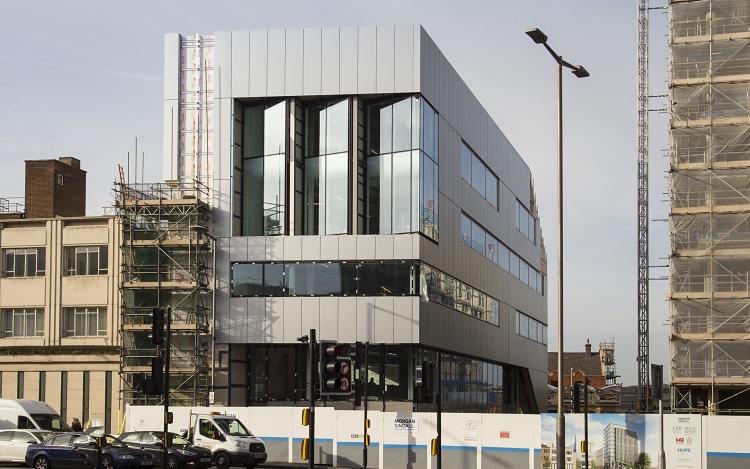
Cladding work to Stephen George + Partners’ £7.3 million office building, now named No1 Great Central Square, at the old Stibbe factory site in Leicester is nearly 90% complete. Part of a £45 million masterplan designed by Stephen George + Partners LLP (SGP) for Charles Street Buildings Group, No1 Great Central Square is the latest component in the transformation of the 1.89 hectare site into the wider Great Central Square redevelopment, which is set within the Waterside Strategic Regeneration Area. The building will offer up to 33,000sq.ft of Grade A offices whilst the scheme will also feature two new hotels, the refurbishment of the Great Central Railway Station and a new public plaza, all of which are overseen by SGP. Adjacent to the All Saints conservation area and flanked by several listed buildings, the five-storey office’s V-shaped form evolved with the design of SGP’s masterplan. Double storey height curtain walling at ground and high level achieves a critical lightness whilst the twisting roof parapet adds further visual interest to the building, creating an attractive and aspirational place for future tenants to work and do business. The slanting element in the façade was a conscious design decision to reduce the building’s scale in respect of its neighbours, creating street harmony and  bringing forward the once neglected Great Central Railway Station. To further emphasise the sleek modern design, joints were kept to a minimum. This was achieved through large cladding panels up to 5m long together with specially constructed 3D pre-formed corner panels. SGP’s meticulous detail is crucial to give a quality edge to the building. Explains Hing Ow, Associate at SGP: “Due to the twisting form and building tolerance, precision is of utmost importance to ensure correct installation can be achieved. Furthermore, there are nearly 250 individual aluminium panels and up to 270 different sizes of ceramic panels used in the building. To avoid errors, we had to use a 3D modelling tool to draw up each panel, so each panel can be precisely cut in the factory and correctly installed on site.” For the cladding, aluminium with a natural muted colour was chosen to give a light contemporary feel that contrasts and highlights the softer finishes of the hotel. On at the bottom level, ceramic panels were specified in a similar colour tone to ground the building, as well as giving a visual connection between No1 Great Central Square and the hotels. Continues Hing: “We worked closely with the client and the contractor through a number of design reviews and cost analysis exercises to uphold the essence of the design while meeting the budget constraints.” Explains Ian Yallop, Chairman at SGP: “The new development is a key piece in the central Leicester jigsaw, transforming a neglected site into a vibrant and engaging destination as well as a safe and welcoming link between the city centre and the City Council’s ambitious Waterside development.” Work started on site in March 2018 and is expected to complete in December 2019. Morgan Sindall is the contractor for the highway works, hotels, and new office building, and the contractor for the refurbishment of the station is Charles Street Buildings (the client’s construction arm).

Read More »