Kenneth Booth

Hiab renews its light range loader crane portfolio

Hiab, part of Cargotec, has launched its renewed HIAB light range loader cranes with a capacity from 4 to 11 tonne meters. This range of HIAB loader cranes combines strength and reliability with ease of use. Four options for remote and manual control systems ensure that the customer can choose

Read More »

How much does the UK slack with gas safety checks?

Despite the regulations the landlords must follow, there has been new research that claims that gas safety checks are slacking within the UK’s five million privately rented properties. It’s also, not just property owners that are slacking, small business energy users are also in the firing line as one in

Read More »

Fire at facility could have been ‘potential nightmare’

A huge fire which broke out at a recycling plant facility for the second time in two month was “an accident waiting to happen”, according to a councillor. The Daily Post reports that David Wisinger, Flintshire county councillor for Sandycroft and Queensferry, said that had the wind been blowing in

Read More »

PRP’s planning team announces expansion

PRP has made several promotions and new appointments to its planning team after a significant year of new business and growth. Rebecca Rogers joins as associate from DP9 and Tom Brooke joins as a planner from RPS. Within the current team, Jonathan Greenberg has been promoted to associate and Lucy

Read More »

How Organizations Can Benefit from The Personal Style Indicator Assessment

PSI stands for Personal Style Indicator, a personality assessment based on Carl Jung’s personality theory. It can be used as a learning and communication tool, for individual purposes, but also for organizational purposes. This assessment helps people understand their dominant personality, as well as their preferences towards work tasks, situations

Read More »

COSAC BECOMES FIRST TO OFFER ONLINE CSCS TRAINING

For the first time, UK construction workers seeking to obtain the Construction Skills Certification Scheme (CSCS) Labourer card will now be able to complete a course online. Operated by COSAC, the work-focussed training academy based in Runcorn, Safe2Site is the first online course approved by CSCS as a route to

Read More »

Why You Need DSE Training

The Health and Safety Executive in the UK states that it is a legal requirement for all employees who use computers, laptops, mobile devices and tablet computers for a continuous period of time to undertake DSE training. Individuals who fall into this category are referred to as users of DSE.

Read More »

Station Street Scheme in for Planning

Award-winning urban developer Bildurn is a step closer to delivering an exciting new mixed-use development on Station Street in Nottingham. The city centre scheme’s development brief provides for the construction of new Grade A offices, in addition to residential accommodation, including student. The office element, designed by Franklin Ellis Architects,

Read More »
Latest Issue
Issue 344 : Sep 2026

Kenneth Booth

Hiab renews its light range loader crane portfolio

Hiab, part of Cargotec, has launched its renewed HIAB light range loader cranes with a capacity from 4 to 11 tonne meters. This range of HIAB loader cranes combines strength and reliability with ease of use. Four options for remote and manual control systems ensure that the customer can choose between the systems that meet specifically the level of precision needed when operating a crane. “When we started the development of this HIAB loader crane series, we wanted to ensure that the renewed equipment will make work easier for the operators, keep it safe and increase efficiency, as we have learned that these are our customers’ priorities when choosing a loader crane. The unique X-4 SPACE system on the light range loader cranes enables the operator to handle the crane with the greatest ease and with higher load cycling speeds” says Jan Vink, Director, Light Range Loader Cranes, Hiab. As the HIAB light cranes are made with durable high-tensile steel, they combine low weight with the capacity to deliver heavy loads. Also, an external display gives a better overview of the active crane and service status. Depending on the choice of control system, a range of features are available for improving capacity, durability, flexibility, as well as safety. These features include Semi-Automatic Folding system, Load Stability System and remote control systems. “To avoid unnecessary downtime in our end customers’ operations, HIAB light cranes are designed for easier everyday maintenance. Key parts and components that require regular attention are located where they are easy to access. A good example is the integrated oil tank in the crane base, which can be installed without rearranging truck components and is quicker and simpler to reach. Also, these new models can be configured with various options, to enable easy mounting on the truck chassis. The whole installation is designed for the lowest possible overall weight,” Mr. Vink continues. The light range loader cranes come with the market’s only two-year warranty as well as a five-year warranty for the steel structure, as with other HIAB loader cranes. “The reliable performance and productivity are guaranteed through the offering of our comprehensive service network,” Mr.Vink says. “At Hiab, we set the standards for the loader crane industry. We want to be the number one loader cranes brand and partner to our customers, offering the best solutions on the market. Over the past two years we have renewed successfully both our medium-range cranes and now light range cranes. The positive feedback from our customers ensures that we are on the right path with our development work,” concludes Joakim Andersson, Senior Vice President, Loader Cranes, Hiab.

Read More »

British and migrant workers at risk of exploitation on UK construction sites, says CIOB

The Chartered Institute of Building (CIOB) is urging UK contractors to face up to the significant human rights risks in their supply chains, with the launch of a new report that finds both British and foreign workers at risk of exploitation. Construction and the Modern Slavery Act, tackling exploitation in the UK is published as the Gangmasters and Labour Abuse Authority (GLAA) and National Crime Agency (NCA) jointly lead a national enforcement campaign involving police forces and other agencies aimed at tackling labour exploitation. NCA analysis has identified construction as one of the most common sectors for labour exploitation in the UK. Criticising the industry’s slow response to the Modern Slavery Act, CIOB’s report highlights the aggressive business models that are creating an environment for unethical procurement and recruitment practices, and the systemic auditing failures that are allowing criminals to infiltrate major projects undetected. Problems are set at the top of supply chains with lowest cost tendering, abuse of the retentions system and late payment pricing out ethical practice. The situation is creating an imbalance of power that leaves all nationalities vulnerable to exploitation. Illegal activities such as blacklisting are also believed to be continuing, despite recent high profile court cases. Major contractors in construction typically have long and fragmented supply chains, with little visibility beyond tiers one or two. They are also heavily reliant on temporary migrant labour, a significant indicator of risk. Nevertheless, the report found examples of complacency and disbelief that major projects were vulnerable to criminal infiltration and human trafficking. This contrasted with incidents of modern slavery being found on major UK infrastructure programmes, PFI hospital projects, power plants, recycling centres, renovation projects, demolition sites and local authority schemes. The report highlights: How industry is conflating immigration checks with modern slavery checks. This is ineffective because many people trapped in modern slavery have a legitimate right to work in the UK. Severe weaknesses in commercial auditing models, with auditors disincentivised to report problems to the police. Poor transparency in supply chain reporting standards, with many eligible companies failing to produce a modern slavery report in the first annual reporting cycle. A significant number of published statements do not follow minimum legal requirements, including being visible on the company homepage and being signed off by a board director. A tendency for companies to water down their modern slavery statements to remove mention of risk, against the spirit of the Modern Slavery Act. Examples of sharp practice, with major players defaulting to legal compliance exercises that push responsibility onto their less well-resourced suppliers. This is also against the spirit of the legislation. Construction and the Modern Slavery Act includes interviews with a number of leaders and influencers, including: Independent anti-slavery commissioner Kevin Hyland OBE The late Paul Broadbent, former chief executive of the Gangmasters and Labour Abuse Authority (GLAA) Leading barrister Caroline Haughey QC Chief constable for Devon and Cornwall Police and national policing lead for modern slavery Shaun Sawyer Justine Currell, executive director of Unseen and the Modern Slavery Helpline The report explores the legal, investor and social pressures for driving change. It also highlights examples of industry best practice as well as platforms for information sharing, such as the GLAA’s construction forum.  Strategies for rehabilitating survivors of slavery are included through the Co-op Group’s Bright Future programme. CIOB is calling for a new industry narrative: asking contractors to acknowledge that every supply chain is at risk and collaborate more widely to combat crime. It is launching a Routemap to Fair Business which sets out steps for raising standards for all workers and suppliers, encouraging a more proactive approach to tackling systemic issues. Chris Blythe OBE, chief executive at the CIOB said: “It’s time to get real about the challenges facing UK construction. Contrary to public perceptions, modern slavery is not confined to small illegal operators. Criminals are attracted to big business because of the greater profits that they can earn. Unscrupulous labour providers, operating in the grey area of the law, are also creating misery for thousands of British and foreign workers. “We need to change the conversation that we have with clients, our peers and the media. Suppliers and labour agencies should be rewarded for finding and reporting problems, contractors need to promote fairer business models and clients need to be more explicit about their ethical expectations. This goes to the heart of professional leadership. We need to empower everyone working in this industry to act, share and collaborate for the greater good.” Independent anti-slavery commissioner Kevin Hyland OBE said: “The construction sector is recognised around the world as one of the highest risk industries for workers to be exploited in forced labour. It is therefore crucial that construction companies take meaningful action to prevent this crime from taking place within their operations and to ensure that anyone working in the sector within the UK or abroad are protected from abuse. “This new report from the CIOB builds on its previous good work highlighting the issue. It provides clear ways for responsible companies to tackle slavery and ensure their labour supply is protected. I hope to see many construction businesses taking up its recommendations and making real changes, so that it can set an example to other high risk sectors.” Roger Bannister, interim chief executive of the GLAA, said: “There are huge profits to be made for those unscrupulous enough to exploit vulnerable workers and the building industry is extremely lucrative for them. We have carried out operations targeting those who traffic migrant workers into the UK and then force them to work on construction sites, often with false IDs. “The protocol we developed in the autumn with the construction industry was a step in the right direction with some big names committing themselves to share information and play their part in tackling exploitation. We’d like to see more companies put their name to it and work with the GLAA in helping eradicate slavery altogether.” Andrew Wallis OBE, CEO of anti-slavery charity Unseen, which operates the Modern

Read More »

How much does the UK slack with gas safety checks?

Despite the regulations the landlords must follow, there has been new research that claims that gas safety checks are slacking within the UK’s five million privately rented properties. It’s also, not just property owners that are slacking, small business energy users are also in the firing line as one in five are failing to have an annual gas safety check which could invalidate their insurance. It’s important that gas safety is taken serious and it’s not just about ticking the right boxes. A poorly fitted gas appliance can cause fuel leaks, fires and even explosions, as well as carbon monoxide poisoning. As a result, landlords who fail to comply with gas safety regulations can face tens of thousands of pounds in fines. With so many properties in the UK, and many lives-at stake, are the UK’s gas safety rules simply too lax? And how can landlords make sure their premises stay safe? Are we doing enough when it comes to gas safety? Currently, the gas safety regulations that impact landlords differ from place to place. Under the Landlord Licence Scheme, landlords must prove they’ve met the legal requirement for an annual gas safety check in all their properties before they can let them out. However, just 40 local authorities across the country currently operate a Landlord Licence Scheme in their area. This discrepancy has created a ‘postcode lottery’ when it comes to gas safety. It’s true that most landlords are quite aware of what’s required to keep their properties maintained and their tenants safe – yet there are still many properties being neglected by landlords who carry out suspect DIY heating repairs or skipping annual gas checks altogether. What’s more, with 7,500 unregistered gas fitters responsible for 250,000 illegal gas jobs in the UK every year, rogue traders are still very much a problem nationwide. As well as the limitations of the current rules and regulations, there’s also a lack of awareness amongst energy users to contend with. For example, a shocking number of small businesses that are using mains gas are failing to stay on top of gas safety in the workplace. In fact, a recent survey found that 23% had no idea that their gas appliances need to be checked on an annual basis – and a worrying 18% haven’t had a visit from a Gas Safe Engineer in the last year. What gas safety regulations mean for landlords With so many factors at play, the landlord’s role in keeping properties gas safe is crucial. So, how can landlords ensure their premises are fit for purpose – and keep energy users in the loop? Business gas supplier Flogas Energy gives a rundown of the steps to take: Keep all gas appliances and systems properly maintained This means always using a Gas Safe registered engineer to service your boiler and any other gas appliances, and to maintain any gas pipework and chimneys or flues. The manufacturer’s instructions should outline how often appliances should be serviced, but if these are not available then the Gas Safe Register recommends servicing once a year. Appliances owned by tenants don’t fall within this remit, and neither do flues that connect only to tenants’ appliances. Carry out an annual gas safety check You must arrange for a full gas safety check once a year – this is carried out by a Gas Safe registered engineer and covers all gas appliances and flues. Again, you don’t need to organise checks for any of your tenants’ own appliances (or flues that connect only to appliances owned by the tenant). Keep a record of all checks (and provide copies) All gas safety checks carried out in your property must be recorded on a Landlord Gas Safety form. As well as keeping a copy for yourself (for at least two years, or until a further two checks have been carried out), you must provide your tenants with their own copy within 28 days. For new tenants, it’s at the start of the tenancy, and for any rental periods shorter than 28 days, simply display the record in a prominent place in the property. What’s new in 2018? As of April this year, new regulations have been introduced that allow landlords to arrange their annual gas safety check up to two months in advance without impacting on the expiry date of the existing certificate. You can now arrange a new check any time within 10-12 months of the last one – and when the old certificate runs out, the new one will simply run for the next year. If for any reason you need to carry out a gas safety check less than 10 months (or more than 12 months) after the last one, the expiry date will be a year from when your new certificate is issued. It’s worth noting that landlords who make use of the new rules must keep their gas safety records until two further gas safety checks have been carried out. This new ‘MOT-style’ approach allows landlords to arrange a new check in plenty of time before the old one expires (without shortening its lifespan) – instead of rushing to book a visit from a Gas Safe engineer just before the deadline. It also makes it easier to keep track of renewal dates, as these stay the same each year. Because of this, the new 2018 rules have been welcomed by landlords. They’re a way to uphold the very highest gas safety standards – whilst making the checks process more flexible and straightforward all round. To find your local Gas Safe registered engineer, visit: www.gassaferegister.co.uk.

Read More »

Fire at facility could have been ‘potential nightmare’

A huge fire which broke out at a recycling plant facility for the second time in two month was “an accident waiting to happen”, according to a councillor. The Daily Post reports that David Wisinger, Flintshire county councillor for Sandycroft and Queensferry, said that had the wind been blowing in a different direction, it could have been a “potential nightmare”. Around 60 firefighters battled the blaze at 300 Recycling Ltd in Flintshire. The site lies next to CamGas, a company which supplies gas bottles and bulk tanks for domestic gas, commercial gas, holiday park gas and autogas. It burned into the night, sending huge plumes of black acrid smoke across residental areas and affecting motorists. The blaze came just over seven weeks after another huge inferno which took hold of the same plant earlier this year. Cllr Wisinger, who told the Daily Post in March that he was “extremely concerned” by the blaze, said following Tuesday’s fire: “It was an accident waiting to happen. “I’ve had complaints from people working in the area and residents phoning me up saying they could see the danger. “The site is right next to a gas storage facility, which is very worrying. “They’re concerned about the sheer amount of plastic and tyres, which are highly flammable. “If this fire would have happened on a hot summer’s day and the wind would have been blowing towards the gas cylinder company next door, it could have been a potential nightmare.” Council chief executive Colin Everett said: “This incident was dealt with effectively on a multi- agency basis. “The council has no specific controlling planning powers over the site, but North Wales Fire and Rescue Service has provided advice on the site owner’s requirements to comply with the Regulatory Reform (Fire Safety) Order 2005. “Our Streetscene Teams provided assistance as required to North Wales Fire and Rescue Service yesterday and today as they dealt with the incident. “Officers from the council’s Public Protection Service will provide any appropriate advice, if requested, to Natural Resources Wales as they undertake their investigations of the site. “As public sector partners, we will work with the company to help prevent future incidents in the interests of public safety.” Original source Daily Post

Read More »

PRP’s planning team announces expansion

PRP has made several promotions and new appointments to its planning team after a significant year of new business and growth. Rebecca Rogers joins as associate from DP9 and Tom Brooke joins as a planner from RPS. Within the current team, Jonathan Greenberg has been promoted to associate and Lucy Morris has been promoted to planner. Andrew Black, Planning Director at PRP, said: “These new appointments and promotions reinforce our commitment to growing the team. The team is currently managing over a thousand homes through a significant number of planning applications currently in the planning system. It’s important that we work with the best talent in the industry and continue to deliver the highest quality of service to our clients. We’re feeling positive about the year ahead, particularly the continued expansion and success of our land finding work.” PRP’s planning team, which has six staff, work on a mix of projects and across a wide range of typologies, including housing for older people. They are passionate about providing innovative solutions to the housing crisis and responding to issues in the current climate, particularly the provision of sufficient housing to meet the needs of a changing society. In 2017, the team started a land finding and promotion business to assist clients in identifying off market opportunities and providing land holders access to the various disciplines within PRP to unlock the potential of their land. The team has also been shortlisted for RTPI’s Small Planning Consultancy of the Year Award, which champions the power of planning in creating prosperous places and vibrant communities. Winners will be announced during a ceremony held at Milton Court at The Barbican, London on 24 May 2018.

Read More »

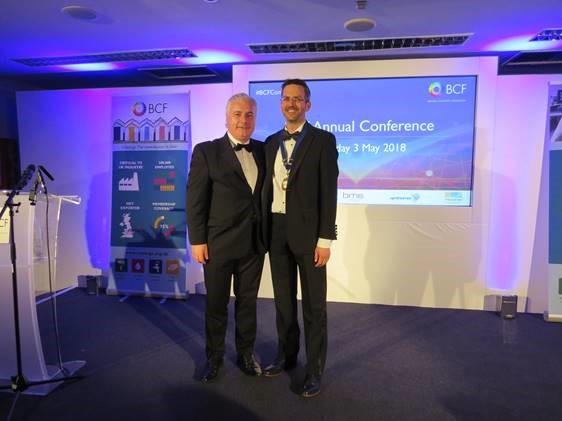
BCF presidency handed over to Pronto Industrial Paint’s David Beckford at BCF Annual Conference

In May 2018, the British Coatings Federation (BCF) held their Annual Conference and Gala Dinner in Oxford. During the event, outgoing BCF President Vincent O’Sullivan, of PPG Architectural Coatings handed over presidency of the BCF to David Beckford, of Pronto Industrial Paints. Commenting on his new role, David said: “The coatings industry faces a number of challenges, including the uncertainty surrounding Brexit, the defence of TiO2 and continued pressure on raw material prices. It’s in times like these we need our trade associations, and I know the BCF will continue to work hard on our behalf to ensure that we have the support and knowledge to be able to adapt accordingly, so that we continue to grow and prosper as an association and industry.” Vincent O’Sullivan thanked the BCF team and said it had been an honour and a privilege to serve as BCF President and that he was incredibly proud of the achievements of the BCF during his term. The Gala Dinner followed a day long business conference, with topics ranging from the political and economic position of the coatings industry, recruiting and retaining talent, to apprenticeships and sustainability. The afternoon focussed on cybersecurity and how to protect your business online, and a review of the last 12 months from BCF completed the programme. Tom Bowtell, BCF’s Chief Executive commented: “I’ve really enjoyed working with Vincent O’Sullivan as President – he’s challenged myself and the team to take things to the next level, and I look forward to working with David Beckford as we continue working on Brexit and other challenges, to support the future prosperity of the UK coatings industry.”

Read More »

How Organizations Can Benefit from The Personal Style Indicator Assessment

PSI stands for Personal Style Indicator, a personality assessment based on Carl Jung’s personality theory. It can be used as a learning and communication tool, for individual purposes, but also for organizational purposes. This assessment helps people understand their dominant personality, as well as their preferences towards work tasks, situations and people. It is a great self-discovery tool that helps people learn their strengths and weaknesses, so that they can be more efficient in achieving their personal and professional goals. Who can benefit from the PSI? A self-discovery journey is valuable for any individual, as the lessons that you learn from this assessment can assist you in both your personal and your professional life. However, few individuals are aware of the benefits of this personality test, so the PSI is mainly used by schools, organizations and psychologists. The people who are more likely to come in contact with this personality tool are employees and potential employees, students, business partners, families, and leaders/managers. Main uses of the PSI As we mentioned this tool is mostly used in organizations, mostly for professional purposes. It is mainly used by trainers, supervisors, HR consultants and carrier guidance counselors. It can be used in numerous work-related situations. For example, it can be a part of a hiring process, as a way to clarify careers, as a tool for building team spirit or as a training instrument for improving leadership and communication skills. In personal contexts, it is mainly used to enhance communication between partners. This tool can be the main instrument for a leadership development program, as a diagnostic tool for career planning, as an ice-breaker for personal counseling or even as an instrument for improving group dynamics. How it works While there are several personality tools based on Carl Jung’s theory, we advise you to opt for the HRDQ’s Personal Style Inventory, as it is the most efficient personality assessment tool. The HRDQ tool is also very easy to use. The assessment can be taken online, or it can be printed. It contains a series of 32 statements that individuals must complete according to their preferences. The statements are meant to interpret personality styles based on 4 major dimensions: extroversion or introversion, sensing or intuition,thinking or feeling and perceiving or judging. The results will consist in a personality profile, defined by the abbreviation of four letters which symbolize each dimension. The test only takes 15 minutes to complete, after which the assessment facilitator will interpret the results of the profile with the test participants. The test can be used with one individual at a time, or it can be used as part of a team exercise.  It can also be a part of a longer training program. Real benefits of the PSI We already established that the PSI can be used in numerous situations, but to know how your organization can benefit from it, you must understand the clear learning outcomes that you can expect after the assessment. Identify the dominant personality style of any individual – this helps individuals understand themselves better, and it also helps superiors understand their teams better. Understand the 16 different personality styles – understanding yourself is important, but to improve relationships with the people around you, it is essential to understand the different personalities that people have. Learn the main traits, as well as the strengths and weaknesses of each style – a great skill for recognizing different personalities, and for knowing the right way to interact with each style. Learn how different personality styles interact with one another – an ideal skill for putting together the perfect teams Learn what tasks are best suited for each personality – ideal for improving work performance Make a plan to improve work performance and group dynamics As you can see, the personally style indicator helps people understand themselves better, and it equips them with the right tools and knowledge to efficiently grow and improve their performance.

Read More »

COSAC BECOMES FIRST TO OFFER ONLINE CSCS TRAINING

For the first time, UK construction workers seeking to obtain the Construction Skills Certification Scheme (CSCS) Labourer card will now be able to complete a course online. Operated by COSAC, the work-focussed training academy based in Runcorn, Safe2Site is the first online course approved by CSCS as a route to the Labourer Card. The Labourer card was introduced to help site managers verify that people working in Labouring occupations have achieved the RQF Level 1 (Level 4 in Scotland) Award in Health and Safety in a Construction Environment, or an approved alternative course, such as Safe2Site. In a move that aims to revolutionise the way that construction health and safety courses are delivered, those seeking the CSCS Labourer card will be able to take the Safe2Site course at a place and time that suits them – using a computer or laptop. CSCS cards provide proof that individuals working on construction sites have the required training and qualifications for the type of work they carry out. By ensuring workers hold the appropriate qualifications and training, the CSCS card plays its part in improving standards and safety of UK construction sites. Although not a legislative requirement, most contractors and major house builders require construction workers to hold a valid CSCS card before permitting them on their site. Last year alone, there were approximately 140,000 green Labourer cards issued. Andy Mason, managing director of COSAC, said: “We’re delighted to be able to offer this new, more convenient method of gaining the CSCS Labourer card. “One of the main challenges currently being faced in the construction industry is getting workers qualified to the required standards for their occupation. However, our Safe2Site course allows Labourers to study in short, interactive bursts which maximises knowledge retention and helps them get the necessary skills to obtain the CSCS Labourer card. “In addition, this new initiative will also deliver many benefits for the wider company that the individuals work for, saving both time and money as staff will have less time off-site. “In line with Theresa May’s bid to prioritise house building in the UK, the need for fully trained construction workers has never been more pertinent. We are committed to providing new, innovative and convenient training options to help even more workers get the safety training they need.” Using the power of remote invigilation technology, the online course allows a course supervisor the ability to monitor candidates as they take part in the exam using audio, video and remote screen share tools. CSCS scheme manager, Angeleen Hill, added: “Ensuring the integrity of the examination process is absolutely paramount to CSCS and we work closely with our partners in the industry to tackle fraudulent behaviour “I am pleased to confirm that Safe2Site is the first course to adhere to CSCS’s strict e-assessment policy. COSAC has demonstrated that learners can sit their exam online while being monitored in real-time by TestReach supervisors, who fully maintain the security of the exam process. This is the first time a course has met all the Regulatory Principles contained within CSCS’s e-assessment policy.” COSAC delivers courses in a range of specialities, including one to five-day classroom programmes and online self-study courses for the construction, retail and utilities industries. Find out more about COSAC at www.cosac.co.uk  

Read More »

Why You Need DSE Training

The Health and Safety Executive in the UK states that it is a legal requirement for all employees who use computers, laptops, mobile devices and tablet computers for a continuous period of time to undertake DSE training. Individuals who fall into this category are referred to as users of DSE. Typically this would involve people who work in an office such as administrators, marketers and IT professionals to name a few. If an employer fails to provide DSE training, this is a breach of regulations which means that an employer can face prosecution and a fine. Providing this training also helps to protect employers from suffering liability claims from employees. As an example an employee may decide to pursue a claim for back pain because of their working position. Employees find that there are multiple benefits to participating in training for Display Screen Equipment such as reduced problems with vision and posture and fewer reports of stress or fatigue. When employees are more comfortable within their work environment, both employee satisfaction and productivity increase. What is DSE Training? As employers need to carry out display screen equipment training, it is important to understand what this is. DSE training should outline the best ways to use equipment and the most effective way to use workstations. Training will include: How to set up and maintain a comfortable workstation for desktops and laptops Recommended time lengths for continuous use of these devices The regulations state that all staff who use DSE should complete the training. In addition, refresher training should be carried out whenever there is a change in the workstation, the employee has been on a long period of absence or if the place of work changes The DSE regulations require employers to undertake a number of things: Evaluate workstations and users who work with DSE to assess and reduce risk Verify that workstations meet the minimum requirements and suitable controls are in place Establish an effective plan so that the work day includes breaks or activity changes Provide employees with eye tests when requested Deliver DSE training Monitor the working environment and review DSE policy when there is a change in staff, workstations or workplaces At the very least, employers should undertake an assessment for each employee where DSE appears in their role. A DSE self assessment can be carried out to encourage staff to take ownership of their own health and safety. Employees should be able to assess their own workstations which can be achieved by equipping them with the necessary knowledge and skills during training in the use of DSE. Poorly designed workstations, difficult working practices, repetitive activities and health limitations can result in sickness absence and ill health. As a result employers need to be aware of these risks and employees need to understand how they can adapt their workstations to reduce stress and fatigue and improve posture. Only through suitable DSE training can this be achieved.

Read More »

Station Street Scheme in for Planning

Award-winning urban developer Bildurn is a step closer to delivering an exciting new mixed-use development on Station Street in Nottingham. The city centre scheme’s development brief provides for the construction of new Grade A offices, in addition to residential accommodation, including student. The office element, designed by Franklin Ellis Architects, is set to deliver 50,000 sq ft of accommodation, including car parking and roof terraces, in what will be one of the most strategic office buildings delivered in the city to date. Moving the scheme on a step, Bildurn has now signed an agreement with Vita Group to bring forward the residential element under its Vita Student brand, subsequently, Planning applications for both buildings have now been submitted.  The site, which is over an acre in size, is a prime location in Nottingham city centre. Situated opposite to the entrance to Nottingham’s train station – which has undergone a multimillion pound facelift – Station Street is at the heart of the city’s public transport network and the best-connected scheme in the city centre. The planning applications follow the start of demolition works on site last year, including the removal of the old employment office building which will be completed this month (May). Managing Director at Bildurn Sean Akins said: “We’re thrilled to be able to submit a comprehensive planning application to Nottingham City Council for Station Street. For many visitors to Nottingham, these buildings are the first that they see when they step out of the train station – and as our images show, our vision for the site is quite dramatically different to what has stood there for years previously. “Our scheme will see Grade A offices and high quality residential accommodation reinvigorate the first approach to our city centre, regenerating a large chunk of currently disused and unattractive space in this prime location. “The two buildings are next to each other, backed by the canal and fronted by a pedestrianised highway, which presents a challenge for the sequence of construction. Following completion of demolition, the residential phase is planned to start in September of this year, followed by the construction of the office block next door at No.11.” Agents for the scheme JLL have reported how pleased they are with interest in the scheme to date. Director at JLL James Keeton said: “The submission of a planning application for both elements of Station Street, following commencement of demolition, is a real positive for the south side of the city and regeneration of this area. “Securing Vita Group, subject to planning, to bring forward high quality student residential use on the scheme is vitally important in kick starting the wider development. Its Vita Student brand will also compliment the proposed adjacent office use and boost the wider vibrancy of the area. “Alongside this, we are pleased with the initial response from occupiers to the office element following commencement of marketing. Offering up to 50,000 sq ft of space, 11 Station Street really will raise the bar in terms of office space delivered in Nottingham to date with a large feature reception, open plan modern floor plates, balcony areas and external ground floor space, all combined with first class on-site staff amenities. “It will be fantastic to hopefully see commencement of construction on the site this year and the transformation of this highly prominent and important scheme for the city.”  Tim Witt, Development Manager at Vita Group, added: “We’re very pleased to be part of this exciting development for Nottingham. Vita Group’s ethos is all about our commitment to creating connected communities, innovatively bringing together work, leisure and living. We’ve done extensive research about this prime location in Nottingham city centre and concluded it fits perfectly with our aspirations as a business to develop trusted and respected communities, bringing vitality and vibrancy to the area.” The office space which faces the new pedestrianised area on Station Street will offer secure basement parking and cycle storage, 24-hour access, electric car charging points and high quality contemporary finishes as well as backing on to a waterway aspect. The building will also feature a roof garden – which would be one of Nottingham’s first dedicated office developments to offer a terrace for employees overlooking the city. Privately owned and based in Nottingham, Bildurn has experience in developing commercial and mixed-use schemes, both new build and refurbishment, for a range of occupiers. Notable Bildurn schemes in the city include The Pod, Lace Market Square and 1-9 Bridlesmith Gate. http://www.stationstreet.co.uk/


Read More »