Utilities & Infrastructure : Rail & Transport News
Network Rail to Redevelop Oxford Station

Network Rail to Redevelop Oxford Station

The UK Government has announced it will allocate £161 million to renovate Oxford station. Out of that, the Department for Transport has awarded £78.6 million to Network Rail to participate in the redevelopment of Oxford station and railway. The funding follows the granting of a Transport Works Act Order (TWAO)

Read More »

HS2 completes first tunnel cross passages

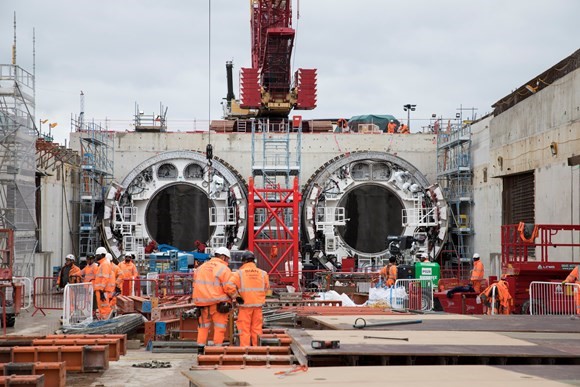
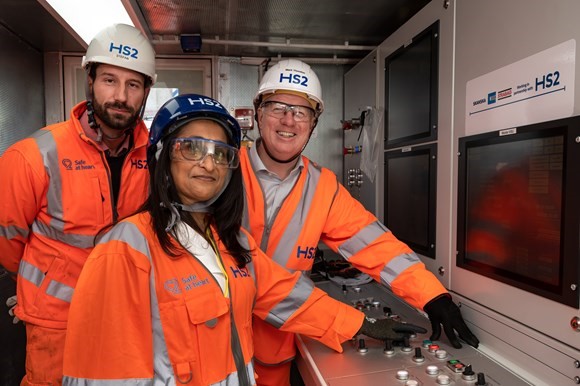
As the tunnelling machines under the Chilterns approach the four-mile mark, HS2 completes the first of thirty-eight underground connections between the northbound and southbound tunnels The construction of HS2’s longest tunnels stretching for 10 miles under the Chilterns has begun a new phase with the start of work on thirty-eight

Read More »
Balfour Beatty Wins Highways Maintenance Contract

Balfour Beatty Wins Highways Maintenance Contract

Buckinghamshire Council has announced Balfour Beatty as the the winner of its £176 million highways maintenance contract. The two will work closely together to provide a safe and resilient local road network, maintaining over 5,000 kilometres of highways, carriageways, footpaths, and cycle routes. With the possibility of extension for a

Read More »

HS2 reveals huge new tunnel at Euston station

New video shows extensive tunnelling work that will help relocate equipment and provide ventilation for the Northern line: HS2 Ltd continues to make progress at Euston, as work continues behind the hoardings to make way for Britain’s new high-speed railway. To create space for the new HS2 station, HS2’s station

Read More »
Latest Issue
Issue 335 : Dec 2025

Utilities & Infrastructure : Rail & Transport News

Construction commences to transform iconic Derby building into classic vehicle centre of excellence

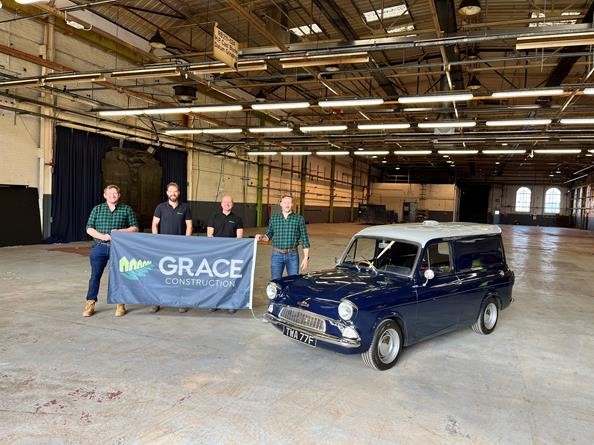
East Midlands-based design and building contractor, Grace Construction, is set to commence work on the transformation of the iconic Derbyshire building, Victoria Ironworks. The former foundry, which currently serves as the Rolls Royce Heritage Centre, will be converted into as classic vehicle restoration workshop and showroom, becoming the new home of heritage vehicle initiative, Great Northern Classics. Led by Grace Construction, the extensive renovation project has begun following years of planning and design. With a dedicated team of 40 contractors on site, it is expected to take approximately one year to complete. The vast site encompasses four conjoined factory buildings, which will enable Great Northern Classics to house a fully equipped training school, workshops, a vehicle storage area, exhibition and entertainment space. As part of the plans for the project, Grace Constructions will install a full glass frontage leading to a feature staircase and mezzanine floor. As well as restoring the building’s existing character features. Stuart Bennett, owner of Grace Constructions, commented: “It’s a real honour and privilege to be leading this important conservation project. The site holds so much history and heritage to Derby and indeed to the whole country, having witnessed and contributed to some of the most significant industrial developments throughout the twentieth century. “When working on the designs and plans, the real challenge was to balance preserving the building’s rich past and full character, while adding new elements to enable the building to become a fully functional and secure. “We hope that the project will enable future generations of vehicle enthusiasts to fulfil their passion and hone their skills, as well as creating a destination for Derbyshire and adding to the legacy of this iconic building. We’re looking forward to getting construction work and the next chapter of Victoria Ironworks underway,” he added. Shaun Matthews, the Driving Force behind Great Northern Classics, added: “Stuart and I have been working closely on this project since our first meeting in 2018, whilst many things have changed since then our shared passion for classic vehicles and delivering something spectacular for Derby has remained constant.” “Now we have the ownership of the site and its rich history we are very excited to begin the job of converting it into Great Northern Classics, a truly unique project and opportunity for the East Midlands.” The transformation of Victoria Ironworks is one of the latest high-profile projects undertaken by Grace Construction, having previously completed construction of Derby’s Kings Crescent residential development, Nottingham-based Whyburn Business Park and We Are Padel Derby, to name but a few. For more information about Grace Construction, visit https://graceconstruction.co.uk/ Find out more about Great Northern Classics at https://www.greatnorthernclassics.co.uk/

Read More »

Giant HS2 TBM cutterhead’s impressive journey back to start second dig in Warwickshire

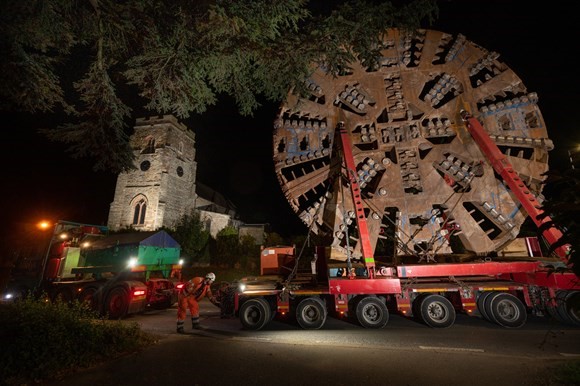
Night-time operation in Warwickshire takes the giant ‘Dorothy’ Tunnel Boring Machine’s cutterhead back to Long Itchington Wood Tunnel north portal Impressive sight as the 160 tonne cutterhead was moved upright on a 12 metre-long, 48-wheel Self Propelled Trailer (SPT) on its 2.5 mile journey Once reassembled, ‘Dorothy’ will start her second tunnel bore later this year Dramatic photos and video capture the night-time transportation of HS2’s Long Itchington Wood Tunnel TBM’s giant cutterhead back to the tunnel’s north portal site in Warwickshire. After HS2’s first tunnel breakthrough by Tunnel Boring Machine ‘Dorothy’ at the south portal site in July this year, the front part of the TBM has been dismantled and transported back to the tunnel’s north portal in a 24/7 intricate operation, managed by the plant and logistics team at HS2’s contractor Balfour Beatty VINCI (BBV). The cutterhead, weighing 160 tonnes and with a 10-metre diameter, was moved during the night of Wednesday 21 September. Standing upright on a 12 metre-long, 48-wheel Self Propelled Trailer (SPT), it was transported from the south portal site, along the A425, through the village of Ufton and onto HS2’s north portal site.  The TBM’s 120 tonne tail skin, also 10 metres in diameter, was also moved in the same operation. The 2.5-mile journey took 180 minutes, with the loads arriving at their destination at 03.00 hours on Thursday 22 September. Eight other large pieces from the TBM’s front shield and middle shield, have already been transported by specialist equipment, which was used specifically to avoid any temporary alterations to the road layout through Ufton. The rest of the 120-metre long TBM will be pulled back through the one-mile tunnel by a special ‘caterpillar’ system, at a pace of 150 metres per day. Once all the parts are back at the north portal, the TBM will be reassembled before starting the second bore later this year. Tom Comer, Balfour Beatty VINCI’s Logistics Manager said: “This has been an intricately planned operation, using specialist equipment to transport these large, heavy pieces of machinery safely and carefully, over a 2.5-mile route, and onto our north portal site. The whole team was proud to see the operation culminate in such an impressive sight, as the huge TBM cutterhead completed its short journey. “We worked closely with the local authority, Warwickshire Police and British Transport Police, and would like to thank them for helping us ensure a safe operation, carried out at night to minimise disruption to the local community as much as possible.” Alan Payne, HS2’s Senior Project Manager said: “The BBV logistics and site teams have done a great job to make this a safe and successful operation. We’re now looking forward to the reassembly of the TBM over the coming weeks, and the start of the second bore of the tunnel later this year. When we celebrate the breakthrough next summer, this will be the first fully completed twin bore tunnel on the HS2 project.”

Read More »

HS2 celebrates first million cubic metres of chalk laid as part of Chiltern grassland transformation

Chalk excavated from the Chiltern tunnels being used to landscape the site which is set to become a 127 hectare wildlife haven featuring new chalk grassland, woodland, wood pasture and wetland habitats. The transformation of HS2’s largest construction site into a haven for wildlife reached a major milestone this week with the millionth cubic metre of chalk laid out around the south portal of the Chiltern tunnel. The ambitious environmental project will eventually see 2.6 million cubic metres of chalk excavated during the construction of the 10 mile long tunnels used to create one of the largest areas of chalk grassland in the Chiltern hills. Instead of removing the material by road, it is being used to landscape the site as part of plans to create 127 hectares of new chalk grassland, woodland, wood pasture and wetland habitats. Welcoming the news, HS2 Ltd’s Environment Director Peter Miller said: “The south portal project is one of the most important parts of our Green Corridor programme to establish better connected, sustainable and biodiverse landscapes along the route of the new railway and will contribute substantially to HS2’s carbon reduction target. “It’s great to see how much chalk has already been laid on site and I look forward to seeing the site completely transform over the coming years.” Chalk grassland – a type of calcareous grassland – is habitat of international conservation importance mainly found on limestone and chalk downlands of south-east England and the Isle of Wight. Lime-rich, but low in nutrients, the thin soil holds little water and drains well. These conditions encourage a huge variety of smaller herbs and wildflowers and over 40 plant species can be found in one square metre of grassland, including some of the UK’s rarest orchids as well as highly diverse invertebrate populations. Only 700 hectares of chalk grassland exist across the whole of the Chilterns AONB. The plans have been developed by HS2’s main works contractor, Align – a joint venture formed of three international infrastructure companies: Bouygues Travaux Publics, Sir Robert McAlpine, and VolkerFitzpatrick – working with its design partners Jacobs, Rendel-Ingerop, and LDA Design, that form Align D. Chris Chantler, Align D, Design Director “This innovative, multi-discipline project is providing a unique opportunity to create a huge expanse of new grassland using chalk being excavated from the Chiltern tunnels. With the first million cubic metres of chalk having already been placed to create the grassland, we are well on the way to creating a landscape which will be both rich in diversity and a place for people to explore and connect with the natural environment.” Two giant tunnelling machines – named Florence and Cecilia – are currently around 4 miles into their journey under the Chilterns. The material they excavate is mixed with water to form a slurry before being pumped out of the tunnel. It is then processed at a slurry treatment plant at the south portal site where the flint is removed and water extracted, to leave chalk cake which is then carefully laid out on site – together with recycled concrete and aggregates from construction works – in order to create a naturalistic landscape with all the temporary construction buildings removed. Ninety hectares of chalk grassland will be seeded into re-profiled soil layers. This will sit alongside new areas of woodland, wood pasture and wetlands, including almost 65,000 trees and shrubs of 32 species and nearly 3.5km of new hedgerows. Around 4.5km of new footpath, cycling and horse-riding routes will give the public areas to large parts of the site, which sits between the Colne Valley Regional Park and the Chilterns AONB. Field trials are in preparation ahead of final seeding, and planting of trees and shrubs in 2025.

Read More »
Network Rail to Redevelop Oxford Station

Network Rail to Redevelop Oxford Station

The UK Government has announced it will allocate £161 million to renovate Oxford station. Out of that, the Department for Transport has awarded £78.6 million to Network Rail to participate in the redevelopment of Oxford station and railway. The funding follows the granting of a Transport Works Act Order (TWAO) and will enable Network Rail to significantly transform Oxford station, the railway in Oxfordshire and nearby road network, boosting the number of passengers the station can serve, accommodating new services including freight and improving the accessibility of the station. “We are delighted to have been awarded this significant amount of funding from the Department for Transport, which will enable us make positive substantial improvements to Oxford station and railway for the benefit of our passengers and freight customers,” said Mike Gallop, Network Rail’s Western Route and Strategic Operations Director. The redevelopment plan includes the introduction of a new track and platform to be added alongside the existing platform 4, creating an island platform on the west side of the station. A new western station entrance will also be built next to Botley Road and will link up to the new platform via a subway, stairs and lift. The new entrance will make the station more accessible to people living to the west of the station, reducing walking time. Moreover, there will also be improvements to the nearby road network and replacement of Botley Road bridge, including the lowering of the road to enable standard double-decker buses to pass underneath for the first time. The new bridge design will include a four-metre-wide cycle/footpath on each side to encourage sustainable transport and improve safety. “This £161 million will truly transform the region, increasing the number of services for passengers, boosting economic growth by connecting people to new opportunities and increasing freight services between the South and Midlands,” added UK Rail Minister Wendy Morton. The latest funding announcement follows £69 million of investment from the government last May to support the development of the design and enabling work. The Oxford Local Enterprise Partnership (OxLEP) are also contributing an additional £10.5 million towards the project. Building, Design and Construction Magazine | The Home of Construction and Property News

Read More »

HS2 completes first tunnel cross passages

As the tunnelling machines under the Chilterns approach the four-mile mark, HS2 completes the first of thirty-eight underground connections between the northbound and southbound tunnels The construction of HS2’s longest tunnels stretching for 10 miles under the Chilterns has begun a new phase with the start of work on thirty-eight cross passages linking the northbound and southbound tunnels. The Chiltern tunnels will carry high speed trains between London and the North at speeds of up to 200mph (320km/h). The trains will travel through two parallel tunnels linked by short passages for use in emergencies. With the two giant tunnelling machines – named Florence and Cecilia – now almost four miles into their journeys, attention has turned to the first cross passages. An expert team of miners used a remotely controlled excavator to break out of and excavate from one running tunnel to the adjacent tunnel.  As the excavation is progressed the ground is supported using a sprayed concrete lining (SCL). Delivered by HS2’s main works contractor, Align – a joint venture formed of Bouygues Travaux Publics, Sir Robert McAlpine, and VolkerFitzpatrick – each passage is between 15 and 20 metres in length. Once the team had completed the SCL lined tunnel, a water-proof membrane was installed followed by a secondary concrete lining constructed by placing concrete behind formwork installed in the cross passage. Martyn Noak, HS2 Ltd’s Head of Tunnel Engineering, said: “HS2 is making huge progress, with 25,000 jobs supported by the project, construction in full swing between London and Birmingham and now the start of this new phase of tunnelling work under the Chilterns. “While invisible to the travelling public, the cross passages have a key role in providing a safe operational railway.  In an emergency they allow the safe evacuation of passengers into a place of relative safety – the other tunnel.  Constructing cross passages is different than using a tunnelling machine as the ground is excavated in short lengths with each advance being left unsupported for a short period of time until the sprayed concrete lining is installed.  It is a different set of risks and a specific skilled workforce is needed.  “It’s great to see the first one complete and I’d like to congratulate everyone involved in this important milestone, one down 37 to go.” Daniel Altier, Align Project Director said, “The completion of this cross passage is a significant milestone for the team at Align JV, delivering the first mined cross passage on HS2 phase 1. I’m proud of the team, their hard work and collaboration to get us to this point.   “In partnership with our supply chain; KVJV responsible for the ground treatment, specialist contractor Euro Diamond Drilling and waterproofing specialist Rennesco, the sub-surface team at Align have already commenced preparation work on several other cross passages and are making good progress.” Once the passageway is complete, the safety doors can be installed at either end. These are being manufactured by Bolton-based Booth Industries who won the contract to provide more than 300 units for all the tunnels between London and Birmingham. The win allowed Booth Industries to establish a new facility in the town and create up to 50 jobs over the next 10 years. The sliding doors have been subjected to rigorous fire and fatigue testing to take account of the train speeds, associated pressures and frequency of the trains.  Each running tunnel has an emergency walkway that allows passengers to safely evacuate the train and walk through the cross passages into the other tunnel where they can be rescued on a passenger train.  Access for emergency services is from either the portal or one of the five ventilation/emergency access shafts.

Read More »

Five things every builder needs to know before they buy an electric van

Electric vans are increasing in popularity, but should you buy one for your business? Dan Powell from Desperate Seller reveals the top five things every electrician needs to check before going electric.  With the 2030 ban on petrol and diesel vans looming large over the horizon, you may be wondering if now is the right time to make the switch to electric.  Electric vans are more expensive to buy than their diesel counterparts but they offer significant long-term savings when it comes to fuel, tax, and maintenance costs. Electric vans are easier to drive and more refined than their diesel rivals too, which means they tend to be more comfortable over a long journey.  The latest crop of electric cargo carriers from Ford, Vauxhall and Peugeot will also deliver heavy-duty load carrying capacity that will easily match the latest diesel panel vans. However, before you ditch your diesel, there are some important things you should be aware of. Dan Powell, editor at the online van marketplace Desperate Seller, reveals the top five things you need to know before joining the electric revolution.   Work out your mileage How many miles do you drive a week? Does your daily commute involve long motorway trips or are you a local electrican who covers lots of short journeys? Before you set foot in a van showroom, you’ll need to work out what your daily and weekly mileage is (then add 20% to cover those unexpected site visits and trips to the local wholesaler).  Once you have an idea of your mileage, you can start shortlisting vans. The Ford E-Transit will cover between 166 and 196 miles on a full charge, while the Vauxhall Vivaro-E is advertised with a maximum range of 205 miles.  It’s important to note the real world range may be slightly lower than the advised figure as things like air conditioning and heating will require power from the van’s EV battery.   Do the maths An electric van could save your business thousands every year. Charging the 75kWh version of the Vivaro-E will cost around 28p/kwh and give you around 200 miles of range. A diesel van that returns 47mpg will cost at least £37 to fill (at 191p-per-litre) and you could save even more if you charge your van at home on an overnight tariff. Electric vans are more expensive to buy than their diesel rivals, however. The Vivaro-E, for example, is around £5000 dearer than the standard diesel model. But road tax is free and electric vans also have fewer moving parts than diesel vehicles, which means maintenance and servicing costs tend to be lower.  Many supermarkets and public car parks will also let you charge your van for free while electric vans are exempt from clean air zone charges, like the London ULEZ.  Take charge Obviously, if you buy an electric van then you’ll need somewhere to charge it. And a home charger is the cheapest and most convenient way for your business to operate an electric van. Charging your van via a three-pint plug will take all day, so invest in a home wallbox if you have a driveway as this will cut the charging time to six or seven hours.  There are more than 33,000 public EV charging points in the UK. And more are being added to this figure every day. Some public charging stations are free to use. Rapid charging is the most expensive way to charge your van but is useful if you get caught short, boosting your battery from 10% to 80% in around 30 minutes.  Check your weight Electric vans tend to have lower towing capacities than their diesel counterparts. The Vivaro-E, for example, will tow a braked trailer up to 1,000kg – so always check the spec if you need your electric vehicle to tow tools or equipment. Payload capacity and loadspace is generally the same as diesel and petrol vans. In 2018, the Government changed licensing laws to make it easier for people to drive electric vans. This means you can operate an electric van weighing up to 4,250kg with a standard driving licence (instead of the 3,500kg you’d normally be limited to with a petrol or diesel vehicle).  Take a test drive Have you ever driven an electric van before? If you haven’t, you’ll probably find the experience a little strange at first because electric vans are silent and don’t have a manual gearbox.  Electric vans also use regenerative braking, which recovers energy to top up the battery when you slow down. This means the van will lose speed when you lift your foot off of the accelerator much quicker than a standard diesel vehicle. As a result, we’d recommend taking an electric van for a lengthy test drive so you can see if it is something you feel comfortable with.  

Read More »
Balfour Beatty Wins Highways Maintenance Contract

Balfour Beatty Wins Highways Maintenance Contract

Buckinghamshire Council has announced Balfour Beatty as the the winner of its £176 million highways maintenance contract. The two will work closely together to provide a safe and resilient local road network, maintaining over 5,000 kilometres of highways, carriageways, footpaths, and cycle routes. With the possibility of extension for a further four years, the contract will see Balfour Beatty responsible for the delivery of winter maintenance services for the local community and travelling public, as well as the operation and maintenance of the county’s street lighting and key community assets including gullies and traffic signals. Steve Helliwell, Managing Director of Balfour Beatty, says that the announcements “builds on our longstanding expertise and commitment to providing best-in-class highways maintenance services, whilst offering customer-focused solutions in a collaborative partnership.” “Wherever we operate, we go above and beyond for our customers with an unrelenting focus on leaving a lasting positive legacy for the communities we serve; working with local supply chain partners whilst also creating numerous apprenticeship and graduate opportunities,” Steve adds. In order to reduce carbon emissions and waste during the project, Balfour Beatty will come up with innovative solutions and materials. These solutions include ideas such as using reused rubber asphalt when laying new road surfaces and installing electric charging points at its depots to facilitate its electric vehicle fleet, in line with Balfour Beatty’s sustainability strategy, ‘Building New Futures’. “We are pleased that, after a rigorous selection process, Balfour Beatty Living Places will be working with Buckinghamshire Council to provide a new model of highways services that meets our aspirations for a faster and more responsive service to best meet the needs of residents and road users. With their impressive track record of managing contracts of this nature, we are keen to embrace their expertise and experience, whilst realising their delivery of innovation and quality onto our network,” comments Councillor Steven Broadbent, Buckinghamshire Council’s Cabinet Member for Transport. Moreover, Balfour Beatty will establish an Operational Efficiency Hub, which is a data-driven Hub to monitor all activities in real-time, track progress of works and capture data to drive further efficiencies across the network. This will ensure the continuous effective maintenance of highways assets across the county. Balfour Beatty Living Places will also dedicate 50% of its spend to local businesses, and as part of its commitment to The 5% Club, will ensure a minimum of 5% of its workforce comprises of graduates, apprentices and trainees. “We know how important the condition of our roads and footpaths is for local residents and this new contract will allow us to map out a detailed strategic plan for the future. We are focused on channelling our resources into making lasting improvements, whilst at the same time standing by our commitment to cut our carbon emissions and take the lead in adopting new and innovative techniques that achieve value for money,” concludes the Councillor. Building, Design and Construction Magazine | The Home of Construction and Property News

Read More »

Balfour Beatty Living Places secures £176 million highways maintenance contract for Buckinghamshire Council

Balfour Beatty Living Places today announces that it has been awarded an eight-year, £176 million contract by Buckinghamshire Council for the maintenance of highways assets across the county. There is an option to extend the contract for a further four years. Balfour Beatty Living Places will work closely and collaboratively alongside the Council to provide a safe and resilient local road network, maintaining over 5,000 kilometres of highways, carriageways, footpaths, and cycle routes. In addition, Balfour Beatty Living Places will also be responsible for delivering winter maintenance services for the local community and travelling public, as well as the operation and maintenance of the county’s street lighting and key community assets including gullies and traffic signals.   The company will harness innovative solutions and materials such as reused rubber asphalt when laying new road surfaces to drive down carbon emissions and reduce waste, as well as installing electric charging points at its depots to facilitate its electric vehicle fleet, in line with Balfour Beatty’s sustainability strategy, “Building New Futures.” To ensure the continuous effective maintenance of highways assets across the county, Balfour Beatty Living Places will also establish an ‘Operational Efficiency Hub’ – a data-driven Hub to monitor all activities in real-time, track progress of works and capture data to drive further efficiencies across the network. Balfour Beatty Living Places will also dedicate 50% of its spend to local businesses, and as part of its commitment to The 5% Club, will ensure a minimum of 5% of its workforce comprises of graduates, apprentices and trainees. Steve Helliwell, Managing Director of Balfour Beatty Living Places, said: “Today’s announcement builds on our longstanding expertise and commitment to providing best-in-class highways maintenance services, whilst offering customer-focused solutions in a collaborative partnership. “Wherever we operate, we go above and beyond for our customers with an unrelenting focus on leaving a lasting positive legacy for the communities we serve; working with local supply chain partners whilst also creating numerous apprenticeship and graduate opportunities.” Councillor Steven Broadbent, Buckinghamshire Council’s Cabinet Member for Transport said: “We are pleased that, after a rigorous selection process, Balfour Beatty Living Places will be working with Buckinghamshire Council to provide a new model of highways services that meets our aspirations for a faster and more responsive service to best meet the needs of residents and road users. With their impressive track record of managing contracts of this nature, we are keen to embrace their expertise and experience, whilst realising their delivery of innovation and quality onto our network. “We know how important the condition of our roads and footpaths is for local residents and this new contract will allow us to map out a detailed strategic plan for the future. We are focused on channelling our resources into making lasting improvements, whilst at the same time standing by our commitment to cut our carbon emissions and take the lead in adopting new and innovative techniques that achieve value for money.” The contract commences on 1st April 2023.

Read More »

HS2 reveals huge new tunnel at Euston station

New video shows extensive tunnelling work that will help relocate equipment and provide ventilation for the Northern line: HS2 Ltd continues to make progress at Euston, as work continues behind the hoardings to make way for Britain’s new high-speed railway. To create space for the new HS2 station, HS2’s station contractor, Mace Dragados JV (MDjv), has excavated a 20-metre deep ‘box’ that will be home to a new Traction Substation (TSS). Traction substations are used to convert electrical power to a form suitable for a rail system. This TSS will enable the relocation of equipment needed to provide services and ventilation for the safe operation of the Northern Line at Euston. Connecting this highly-secure new Traction Substation – dubbed the ‘sugar cube’ due to its eye-catching white tiled exterior – to the London Underground network is a 90-metre long – as long as the Statue of Liberty laid down – 6.5-metre wide tunnel running under the HS2 construction site. The work to construct the tunnel took 16 months and saw the MDJV team sink a 20-metre deep shaft before carving out the underground passage and coating it with a primary sprayed concrete lining (SCL). After applying waterproofing, the team reinforced the tunnel with steel and concrete to give it the strength and structure needed ahead of the construction of the HS2 Station that will be taking place above it. MDjv, supported by its principal sub-contractors Cementation Skanska, Careys and JGL, brought forward innovations to improve the environmental credentials of the works. Redesigning the tunnel to lower the carbon impact during construction – through reduced material and water use, a reduction in vehicle movements, and a lower energy consumption – resulted in an overall carbon saving of 140 tonnes, while efforts to reuse material already on site resulted in over 1,000 fewer lorry movements and an associated saving of 76 tonnes carbon dioxide from vehicle emissions. Andy Swift, Euston Project Client for HS2 Ltd said: “Our Euston team has been working hard behind the hoardings at Euston to create the space required for us to build HS2’s new Euston station, as well as a better connected London Underground station. The progress to date has been great, moving the existing underground infrastructure, with seamless collaboration between contractors and stakeholders, with a focus on minimising community disruption.” Throughout the tunnelling works, the shaft has been enclosed by an acoustic shed, designed to reduce noise impact on the community and businesses nearby. This enabled 24 hour working which was required to meet the demands of the programme. Rob Williams, Senior Project Manager for the Traction Substation at Mace Dragados joint venture said: “The progress we’ve made at the Traction Substation has been the by-product of fantastic collaborative working between HS2, Mace Dragados, our supply chain partners and critical external stakeholders, including TfL. Our one-team approach has allowed us to build a culture and leverage the expertise needed to deliver this complex and highly constrained project, which is essential for the construction of the new HS2 station at Euston.”  Lorena Naylor, Lead Sponsor at Transport for London, said:  “Our team has been working closely with HS2 on the relocation of our traction substation to make space for the new HS2 station at Euston. We are also working with HS2 to ensure the heritage features from the original building, including the oxblood tiles from 1907, are salvaged and re-used at other stations such as Oxford Circus. Alongside the new traction substation here, HS2 will deliver a capacity upgrade to Euston underground station ticket hall as well as a new bus station.” With the tunnelling and excavation works at the site now complete, the team will be working to construct the below and above ground structures for the new Traction Substation, before fitting it out with the necessary equipment and connecting it to the Northern line. The building will have three storeys below ground and four above. Once the new structure is complete, the existing TSS on Melton Street will be demolished. The building, opened in 1907, was once an entrance and exit to what Londoner’s now know as the Northern line, and was designed by the Architect Leslie Green. In 1914 changes to the Underground at Euston meant that the building was no longer used as a ticket office and entrance but was used to house ventilation equipment for the underground. HS2 will be carefully removing some of the iconic historic features and tiles donating these for reuse and heritage displays.

Read More »

HS2 Minister hails outstanding achievements of individuals and businesses supporting HS2’s construction

An awards ceremony, hosted by HS2 Minister Andrew Stephenson MP, was held in Parliament today (Monday, 4 July) to recognise the outstanding achievements of individuals and businesses supporting the construction of Britain’s new railway. Members of Parliament joined Mr Stephenson for the ceremony, which shone a light on those who are going the extra mile to ensure that the project raises the bar for equality, diversity and inclusion and leaves a lasting skills legacy. HS2 Minister, Andrew Stephenson MP said: “With almost 25,000 people across 340 sites now supporting HS2’s construction, today is a chance to reflect on the personal achievements of those who are working hard to ensure that HS2 transforms communities and changes lives. I feel privileged to have held the role of HS2 Minister for the last two and half years, and what inspires me most is seeing the work you are all doing on this landmark project. You inspire me and I know you are inspiring others too.” Shortlisted finalists, in eight award categories, were invited to attend the event and the winners were announced as follows: Community Impact award Three projects, designed to improve outcomes for those who live near to HS2’s construction sites, were shortlisted for the community impact award, with the public voting for the overall winner – Costain Skanska joint venture (CSjv). CSjv saw first-hand the devastating effect of rough sleeping in Euston and eager to help, they formed partnerships to help rehouse, reskill and create pathways to support people into employment. The team worked with local charity St Mungo’s to provide temporary accommodation and established the first ever floating homeless hub, based on a construction site, by transforming an empty building into a shelter with beds, wrap around care, food, toiletries and 24 hour security. A new partnership with Buses 4 Homeless (B4H) who refurbish decommissioned London buses and turn them into spaces for eating, sleeping, cooking and learning, led to a three-month pilot at a HS2 site in Acton, where people were housed and supported. Seven of the guests went on to secure full time employment, including four who secured jobs working on HS2. The team’s support for the local homeless community continues today. Apprentice of the Year award (level 3 and below) 25-year-old Divine Makondele, a tunnelling operative apprentice with TG Tunnelling, was announced as the winner. The judges hailed Divine as an inspiration to other young women and credited her determination to follow her dream and play a part in major infrastructure projects. Divine was inspired by the transformational impact of the London 2012 Olympics and sought to follow a career path which would allow her to transform communities and change lives. Apprentice of the Year award (level 4 and above) 21-year-old Sam Arrowsmith, an associate project management apprentice, impressed the judges with his drive to make a fundamental change to the industry. Sam completed his apprenticeship six months early and scored the highest grade amongst his cohort in his final exams. Sam plays an active role in HS2’s volunteer education programmes, inspiring other young people to consider a career in the sector. He was also recognised for his role in HS2’s Back to Better programme, which sought to ensure the safety of staff working across construction sites during the pandemic. Skills Legacy award HS2’s construction partner, Balfour Beatty VINCI (BBV) scooped the award for the establishment of their Birmingham Skills Academy, which upskills local people ready for employment on HS2 in just 4-6 weeks. BBV’s Skills and Employment team were applauded for the role they have played in bringing together local partners, securing funding and changing the lives of those who have been out of work for an extended period by supporting them into meaningful careers on HS2. STEM Contribution award HS2’s construction partner, Align, received the award for the innovative and original nature of its schools programme, which enables pupils with special educational needs to gain real life experience of working in construction. Align places a strong focus on supporting pupils with disabilities and has developed a close working relationship with the Meadow School in Hillingdon. The judges praised the team behind the project for pushing boundaries and striving to encourage more people with a disability into the sector. Inclusive Leaders award Katherine Grigg, a Construction Manager with HS2’s construction partner Skanska Constrain STRABAG was awarded for her outstanding contribution to inspiring inclusivity. Nominated by her fellow colleagues, Katherine was recognised for the steps she has taken to build a diverse pipeline of talent, ensuring that the unique needs of women and BAME employees are accommodated on site. She was recognised as a person who is striving to inspire change and take the industry forward. Minority-owned Business Champion award SCS Railways was recognised for the role it is playing to build a supply chain that reflects the communities in which they operate. To date, the company has awarded contracts totalling £135m to minority owned businesses in their local area and has placed a strong focus on ensuring small firms have every opportunity to thrive by providing access to free training and business development opportunities. Modern Slavery Prevention award The judges praised VGC Group for their comprehensive and robust approach to addressing the dangers of modern slavery. Chief Operating Officer, Ciara Pryce, has been named one of the top 100 Modern Slavery influencers and the judges felt it was clear from the practices put in place that she is leading the way on this important agenda to tackle hidden labour exploitation. 

Read More »