

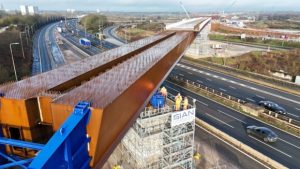
HS2 cuts traffic delays with innovative M6 bridge slide
Engineers working for the HS2 project claimed a UK-first over the weekend when they successfully slid an enormous 4,600-tonne viaduct across the M6 without closing the motorway – significantly reducing disruption to drivers. The 17 hour-long operation was the culmination of an epic three-stage process to assemble and install the 315-metre East deck of the M6 South viaduct, which will carry high-speed trains heading to Birmingham and further north. While the previous slide had required a weekend closure of the main carriageway, the team – led by HS2’s main work contractor Balfour Beatty VINCI (BBV) – worked closely with National Highways to develop the ‘fully restrained’ process which allowed them to safely slide the final section above the moving traffic. It is thought to be the first time this technique has been used on a UK motorway. To deliver this, they initially closed the M6 overnight between Junctions 4 and 5 on Thursday 11 December to shift the viaduct slightly forward by twelve metres. This was to ensure that both ends of the enormous beam were fully supported on concrete piers during this weekend’s slide. The viaduct was then pushed the rest of the way across the busy motorway on Saturday at a speed of 13 metres per hour, with only the M42 slip closed during the weekend. The successful operation means the project to construct the M6 South viaduct has reached the halfway point. Over the next year, the same process will be repeated, with a parallel West deck slid into position alongside the first one to carry trains heading south. Caroline Warrington, HS2 Ltd’s Head of Delivery, said: “Along the HS2 route we are pioneering new approaches to engineering and construction in order to deliver more efficiently and with less impact on our neighbours. “We believe this fully restrained slide was a first for the country, but most importantly it means we’ve been able to cut in half the number of times we’ve had to close the motorway. I’d like to thank everyone who worked so hard to make the operation a success.” Mark Wild, HS2 Ltd’s Chief Executive, is currently leading a comprehensive reset of the programme – making sure the new railway is built as efficiently as possible and for the lowest reasonable cost. Over the last year, HS2 has focused on safely boosting levels of productivity across the construction programme. The M6 South viaduct has been designed in stages to increase efficiency and reduce disruption for motorists. Each section is assembled to one side before being pushed out over the motorway, with the next section added behind it. In the latest phase, the team moved the viaduct using a series of winches, known as strand jacks. To reduce friction, the structure was slid across non-stick pads, using a material usually found on the surface of a household frying pan. Russell Luckhurst, the BBV engineer leading the delivery of the works, said: “We’re all feeling a huge sense of pride after sliding a 4,600-tonne viaduct into its final position this weekend. The third and final slide of the East deck viaduct was delivered over a live motorway for the first time in the UK, making this achievement even more special. “Using this ‘fully restrained’ technique meant we were able to keep disruption to an absolute minimum. Our focus will now turn towards the neighbouring West deck viaduct, which will be launched in multiple phases throughout 2026, as well as the East deck finishing works.” Each viaduct is formed of a hollow double-box structure made of weathering steel. The steel boasts a natural protective layer of oxidisation which gives it a characteristic ‘rusty’ appearance and reduces maintenance by eliminating the need for regular repainting. Four pairs of concrete piers support the viaducts with the tallest one measuring 9.9m in height. A 4.5-metre-high parapet will be installed on the side facing Chelmsley Wood to reduce noise and disturbance from passing trains. The viaduct was launched with 82 precast slabs already installed on top of the steel structure. This will further reduce the number of road closures in the future, to complete the viaduct deck works. The structural design has been carried out by Balfour Beatty VINCI’s Design Joint Venture (DJV), made up of Mott MacDonald and SYSTRA, plus WW+P Architects. National Highways Regional Director for the Midlands, Victoria Lazenby, said: “Our key focus is the impact that these major construction works have on our roads – we must both ensure the safety of road users and minimise the disruption they face. “So we are delighted that this innovative technique has meant that not only was this enormous structure slid into place without having to close the motorway during the day but also that the total number of closures needed has also been halved.“We will continue to work with HS2 and their partners to ensure the smooth running of our roads while this huge infrastructure project takes place and support any initiatives which will reduce disruption for drivers and local communities.” Building, Design & Construction Magazine | The Choice of Industry Professionals

STARK UK wins HR Excellence Award by putting branch teams at the heart
STARK Building Materials UK has won the prestigious HR Excellence Award for Best HR Technology Strategy, in partnership with AdviserPlus. The Award was made in recognition of the successful collaboration between STARK UK, one of the UK’s leading group of builders’ merchants and materials distributors, and technology partner AdviserPlus, who together delivered a bespoke digital Employee Relations (ER) solution to support the company’s branch managers to self-serve people matters. Over the past two and a half years, STARK UK has been undertaking a comprehensive organisation transformation to provide the form of modern merchant proposition that general builders and the professional trades need. Central to the company’s improvements has been simplifying the organisation to put branch teams at the heart of its now highly efficient operations so that they are in the best position to support customers with their business and project needs. Providing branch teams with the right technology solutions has helped make line managers’ people management tasks easier and quicker to complete. Giving managers a technology-enabled approach to ER has also boosted their capability and confidence, as part of a transformed colleague experience. Carol Kavanagh, STARK UK’s HR Director said: “Focusing on the things that service our branch colleagues is core to our HR transformation strategy. Increasingly, we are working in partnership with branch teams to make sure the solutions we develop match their needs. There’s still lots to do and I am hugely proud of how the team continues to deliver at pace, engaging the business and always with our colleagues and customers in mind.” Simon Fowler, CEO of AdviserPlus and Empowering People Group, added: “This award is a brilliant recognition of the power of combining technology and partnerships that align with business goals. Working with STARK UK to build a solution that genuinely empowers their managers and transforms their employee experience perfectly aligns with our mission. It’s a testament to what can be achieved when innovation and trust come together to simplify complex HR challenges.” With 70% of employee relations tasks now manager-led, the outsourced ER advice has helped to ensure that HR support can be focused on the other important people areas that will help branch managers the most. Building, Design & Construction Magazine | The Choice of Industry Professionals

Taylor Wimpey showcases entry-level construction careers during Education Secretary visit
Taylor Wimpey North East welcomed MP Bridget Phillipson, Secretary of State for Education, and students from Harry Watts Academy to its Burdon Manor development for an immersive construction careers experience. The visit began with a presentation at the school, delivered by Ben McKie, Trainee Assistant Quantity Surveyor, and Ellen Page, Assistant Engineer and representative from the Young Persons Forum. Students then took part in a full site induction, before exploring the site and seeing the different stages of construction in action. Accompanied by Ben McKie, Ellen Page and Bridget Phillipson MP, students gained insight into the range of career opportunities available within the industry. The day concluded with an informal question-and-answer session over lunch, giving students the chance to speak directly with industry professionals. Ben McKie, Trainee Assistant Quantity Surveyor at Taylor Wimpey North East, said: “The students gained a real insight into life on a live construction site, from their induction, through to exploring the showhomes and seeing different roles in action. It was a great opportunity to showcase the variety of careers available, and we’re looking forward to continuing our partnership in 2026.” Martin Thompson, class teacher at Harry Watts Academy, said: “The visit was an outstanding experience for our students and something they will remember for a long time. They came away with a far better understanding of what it is like to work on a construction site and the range of career opportunities available within the industry. The real-world experience they gained goes far beyond what a classroom can offer.” The initiative reflects Taylor Wimpey’s ongoing commitment to supporting young people and promoting careers in construction across the North East region. Building, Design & Construction Magazine | The Choice of Industry Professionals

Burges Salmon acts for Benniman on back-to-back transactions delivering major UK logistics and industrial projects
The Construction and Engineering team at Burges Salmon has advised independent construction company Benniman Limited on a series of significant projects across the UK. Led by director Christian Mulvihill, the firm provided legal support on large-scale developments for leading names in the logistics and industrial sectors. Notably, Burges Salmon advised Benniman on the creation of three new logistics and distribution facilities at Daventry International Rail Freight Terminal (DIRFT) in Northamptonshire. Totalling 618,000 sq ft, the schemes will deliver high-quality space and strengthen DIRFT’s position as a key hub for rail-connected logistics, supporting efficient supply chain operations and sustainable freight solutions. Further advice was provided across three other projects including on the construction of a c. 50,000 sq ft best-in-class industrial and warehousing estate in Reading, the development of eight industrial units in Milton Keynes totalling 200,765 sq ft., as well as recent work delivered for property developer Clowes Developments. The team also advised Benniman in relation to the construction of three industrial units in Birmingham on behalf of Coltham as well as a 57,000 sf ft unit in Worcester Six Business Park for Stoford. Christian Mulvihill, director at Burges Salmon, says: “We are delighted to have supported Benniman on these projects, which demonstrate the strength of the UK logistics and industrial sectors. Completing five transactions back-to-back within a short timeframe required careful co-ordination and a thorough understanding of contractual and regulatory issues. It is a testament to the strength and agility of our team that we were able to deliver seamless advice across multiple projects simultaneously, ensuring our client could move forward with confidence and efficiency.” Paul Barfoot, Commercial Director at Benniman, comments: “Delivering major projects concurrently was a significant undertaking, and Burges Salmon’s ability to manage the legal complexities was outstanding. Their proactive approach, responsiveness and sector expertise gave us the confidence to progress each development without delay.” With over 40 specialist lawyers working across the firm’s Built Environment, Infrastructure and Energy & Utilities sector groups, Burges Salmon has one of the largest construction and engineering legal teams in the UK and is a first port of call for highly complex and innovative projects. Building, Design & Construction Magazine | The Choice of Industry Professionals

Engineers scale iconic Liverpool tower for after-dark inspections
Technicians suspended nearly 140 metres in the air carried out tests on the concrete and steel of St Johns Beacon in Liverpool using specialist rope access techniques. RSK Group company CAN Structures was contracted to carry out a defect survey and concrete testing of the iconic Grade II listed communications tower following previous inspections in 2011 and 2015. Work was carried out on the 138-metre-high St Johns Beacon, originally built in 1969, through the night over the course of nine days so that the streets below could be closed during the works. CAN Project Manager Louis Thomas said: “We carried out acoustic hammer tests – tap tests – on the entire concrete façade of the tower. Defects were recorded and depth of carbonation and covermeter tests were taken. The steelwork at the top of the tower and the windows to the ‘doughnut’ also received a full visual inspection. “Access to the underside of the ‘doughnut’ proved particularly challenging. Initial access was gained through lighting openings on the underside of the tower, and we then put up rigging between the adjacent openings. The staging platform we call ‘CAN-Span’ was then winched up from ground level to enable technicians to get within touching distance of the underside of the tower to carry out their inspections.” Louis explained that, for safety, a considerable cordon was necessary. Several roads, footpaths and pedestrian areas within an extended footprint of the tower were closed by Liverpool City Council. Munroe K Asset Management manages the building. Director Roger Fulford said: “The Beacon tower is iconic in Liverpool and, like all buildings, needs to be inspected and maintained. For most buildings, the view while doing so is significantly less dramatic. The information gathered during this inspection will be used to assess maintenance schedules and inform us of the condition of the structure so that it can be future-proofed, ensuring it remains an integral part of the city’s skyline for many years to come.” St Johns Beacon is a notable feature of the city’s skyline and a popular destination for tourists, with the building’s first floor giving visitors 360° panoramic views of the city. It was refurbished between 1999 and 2000 and has been used as a revolving restaurant, a communications tower, offices and a tourist site. Building, Design & Construction Magazine | The Choice of Industry Professionals

Young unemployed offered training or job opportunities in construction – BCIS chief economist
Dr David Crosthwaite, BCIS – chief economist, said: There is a risk that schemes built around compliance or sanctions place young people into roles that do not align with their skills, interests or longer-term aspirations. For construction, which already faces persistent challenges attracting and retaining new entrants, the priority should be creating conditions that make the sector a positive and deliberate career choice rather than a default option. There is also the practical concern of placing inexperienced young people on potentially dangerous work sites without adequate training. Fundamentally, the industry is suffering from a skills shortage rather than a shortage of general labour, so the focus should be on building capability, not just filling labourer vacancies. At the same time, there could be clear benefits for employers. Many construction firms have stopped replacing workers or paused plans to grow their teams because of cost pressures and uncertainty in the market. If government programmes provide meaningful support with hiring and training costs, this could help firms take on young people they might otherwise be unable to afford to recruit or develop. That could strengthen early-career pipelines at a time when workforce capacity is one of the biggest constraints on delivery. Building, Design & Construction Magazine | The Choice of Industry Professionals