Building Design and Construction Magazine

Partnership is key to asset management  

As we embrace post-pandemic life, social landlords as well as focussing on building new homes are also putting repairs and maintenance of existing stock at the top of their priority list.  This drive to make significant improvements to tenants’ homes relies on key partnerships with contractors.We had to postpone some

Read More »

7 Signs Your Property Has A Gas Leak

The gas serves an important purpose in households and even in commercial establishments. It’ll enable you to utilize several appliances in your home, such as the furnace and cooker. However, unmanaged gas is hazardous with exposure to the atmosphere. This exposure happens due to leaks through gas pipes. You must

Read More »

THE BUILD-TO-RENT OPPORTUNITY AND HOW DE-RISKING IS KEY FOR DEVELOPERS

The build-to-rent (BTR) market is bigger and more diverse than it has ever been. Once largely the domain of students and young professionals in big cities, the demand for rented property is skyrocketing, with developers that had previously worked to more well-worn revenue models now looking at how to get a slice of the pie. What’s more, getting

Read More »

Vehicle safety in construction still cause for concern

Safety on construction sites has improved greatly over the past fifty years. However, the latest report by HSE (Health & Safety Executive) shows that construction tops the most dangerous occupations in the UK for fatal injuries. One of the main causes of fatal incidents for workers is being struck by

Read More »

WORK BEGINS TO DELIVER UK’S LARGEST SPECULATIVE WAREHOUSE

Commercial real estate investor and developer, Firethorn Trust, has broken ground at Link Logistics Park, its landmark 42-acre development in Ellesmere Port. More than 760,000 sq. ft. of industrial space will be created on the former brownfield site, including a single unit spanning 655,000 sq. ft., making it the biggest

Read More »

STEELWORK COMPLETED ON £54MILLION GLASS FUTURES’ DEVELOPMENT

Work is on schedule at the £54million Glass Futures Global Centre of Excellence in St Helens with the steelwork structure now completed. Contractors Bowmer + Kirkland, who started on site in January, say the next phase of the scheme is already underway with the cladding and external elevations expected to

Read More »
Latest Issue
Issue 335 : Dec 2025

Building Design and Construction Magazine

Energys Group welcomes positive impact being made by Public Sector Decarbonisation Scheme

Energys Group, one of the UK’s leading decarbonisation delivery companies, has welcomed the positive impact being made by the Government’s Public Sector Decarbonisation Scheme (PSDS), and believes it is playing a critical role in delivering decarbonisation across the public estate. In announcing the latest round of successful projects to be awarded funding, the Government also revealed that the implementation of affordable, low carbon heating and energy efficiency upgrades across public sector buildings – including hospitals, schools, libraries, museums and leisure centres – will save local authorities and taxpayers an average of £650 million per year on energy bills over the next 15 years. The first round of funding allocated through Phase 3 of PSDS will provide grants – totalling £553 million – to 160 public sector organisations across England, forming part of £1.425 billion that will be issued through Phase 3 until 2025. As well as cutting the use of expensive fossil fuels and saving millions of pounds on energy bills, the scheme provides a major opportunity on the path to reducing emissions from public sector buildings by 75%, compared to 2017 levels, by 2037. Whilst the primary objective of PSDS is to help decarbonise heating, the scheme has also made funds available for other energy efficient technologies that can make a real difference to carbon and energy cost reduction – including LED lighting. Energys Group calculated that it has been responsible for the delivery of approximately 20% of the total spend on lighting upgrades as part of the PSDS, having been involved in over 70 projects that were given the go-ahead under PSDS equating to a total value of around £6m. Kevin Cox, Managing Director of Energys Group, commented: “The announcement of the expected savings local authorities will make as a result of the Public Sector Decarbonisation Scheme funding clearly shows the positive impact it is having across the public estate. By boosting the implementation of energy efficient and low-carbon technologies, it is providing a major opportunity on the path to realising the UK’s 2050 Net Zero emissions targets. As Phase 3 of the scheme continues to roll out over the next three years, it is critical that public sector organisations continue to take of the funding being made available. For anyone looking for advice on how they can benefit from the scheme, Energys Group is on hand to provide specialist support and guidance.” Guidance on how to apply for Phase 3b will be published in July, with the next round of applications expected to open in September. Building Design and Construction Magazine | The Home of Construction & Property News

Read More »

Partnership is key to asset management  

As we embrace post-pandemic life, social landlords as well as focussing on building new homes are also putting repairs and maintenance of existing stock at the top of their priority list.  This drive to make significant improvements to tenants’ homes relies on key partnerships with contractors.We had to postpone some investment during the pandemic and are now playing catch-up by investing more than ever before in the maintenance and improvement of our housing stock. The Caledonia Group this year alone will be investing over £8m improving more than 30% of our existing 5,500 homes, however this will be challenging as we deal with a perfect storm of supply chain issues, including availability of materials and resources, leading to spiralling costs.Whilst we are weathering the storm, as a landlord and client, we recognise that in order to deliver this investment we need to have robust long-term contracts in place with trusted contractors and suppliers to partner with us to improve tenants’ homes. This process of good relations starts with clear client requirements, a fair procurement process and negotiated contract terms.  With this in mind, quality as well as cost are key factors in our procurement process. Our network of contractors plays an integral role in our asset management, and we have a policy of introducing quality as a prerequisite when selecting contractors, looking in detail at the expertise, approach, and contractors’ ways of working, as well as the price. We also want to make sure any contractors who have responded to a tender have done so in a way that is sustainable for them. We have already seen a price rise of over 10% for kitchens, bathrooms and windows, and other raw material costs are also still on that upward trajectory.    Experience tells us that prices seldom come back down, therefore it is important for us that we choose contractors who are building sufficient resource into their initial responses to the tendering process. There is also an imperative on us to be a good business partner.   Last year, 175,000 people left the UK construction industry.   We can see there is a shortage of contractors and the current boom in the construction industry means that the clamour to respond to tenders is no longer a reality.   Furthermore, tenders may only have a short shelf life due to cost volatility.  We therefore need to be responsive and agile as social housing partners to get the best deal and service for our tenants.   Our Asset Management team and network of Neighbourhood Officers are the main contact points for tenants with regard to the work in their homes.  However, once appointed, the contractor is also providing a service in Caledonia’s name. We therefore have to trust our contractors crossing the threshold into our tenants’ homes to uphold Caledonia’s values and play a significant role in the successful delivery. We want our tenants to feel comfortable about contractors being in their home and, whether they are replacing their kitchen, bathroom or heating system, our reputation is in their hands. Our aim is therefore to create long-term partnerships.  Ideally, we want our contractors to understand how we do business and be sensitive to the needs of our tenants and their families. At the same time, we need to understand the pressures contractors are under themselves, and the difficulties that they encounter in managing our expectations in an incredibly challenging environment.  This requires us to work closely together as we constantly manage all projects – from small refurbishments to larger capital improvement programmes.   On the ever-increasing number of priorities on our asset management teams’ to-do lists, fostering partnership and building positive relationships with our contractors is crucial to delivering our ambitious investment plans. Building Design and Construction Magazine | The Home of Construction & Property News

Read More »

Keeping construction skills up to date – CLF introduces new suite of CPD courses

Digital construction, net zero and retrofitting are key issues for the construction sector. In recognition of the importance of career progression, industry collaboration body the Scottish Construction Leadership Forum (CLF) has worked to develop a new suite of free-to-use continuing professional development (CPD) modules. Working with Built Environment – Smarter Transformation (BE-ST), formerly the Construction Scotland Innovation Centre (CSIC), the CLF is aiming the new modules at educators, who will cascade the information to a wide variety of different learners. The modules, which have just been launched today (Tuesday 31st May) can be found on the BE-ST Learning Management System, will focus on key areas of the recovery and transformation of the construction sector. They are free to use and include an understanding of digital construction by BE-ST: building a net zero environment with a focus on retrofitting by the Association for Environment Conscious Building; and a course on timber technologies and innovation by Edinburgh Napier University. Kirsty Duncan, Associate Impact Manager at BE-ST, said: “The construction sector is increasingly seen as a very attractive career option and CPD is an important part of that. “These new digital assets and resources will be used by educators to enhance learning provision and will be hosted on our learning management software, requiring only a username and password. “The courses will be short and to the point and will include case studies, videos and real-life scenarios. They will be free of charge and users will be able to do them at their own pace, coming and going as they choose. Certificates will be awarded on completion.” The CPD plan is the latest initiative from the CLF, which recently launched a revolutionary new data dashboard to collect and disseminate statistical knowledge, creating greater openness, transparency and information exchange in the construction industry in Scotland. It has also introduced the Built Environment Workforce Development Portal, a new guide which will provide a breakdown of re-skilling and up-skilling courses by theme, occupation and region across Scotland. The CLF was established in March 2019 to develop and implement a Recovery Plan of actions aligned with Government policies and the Construction Scotland Industry Strategy.  Building Design and Construction Magazine | The Home of Construction & Property News

Read More »

7 Signs Your Property Has A Gas Leak

The gas serves an important purpose in households and even in commercial establishments. It’ll enable you to utilize several appliances in your home, such as the furnace and cooker. However, unmanaged gas is hazardous with exposure to the atmosphere. This exposure happens due to leaks through gas pipes. You must take note of these leaks and have experts look into them and perform repairs. Leaks could lead to explosions should someone unconsciously light a matchbox or start a fire. How will you know there’s a gas leak?  This article highlights the tell-tale signs of gas leaks on your property; read on and look out for these signs: Odor Like any other gas, all gases in your home are colourless and have no smell. Due to the dangerous nature of natural gas and propane in your home, manufacturers have developed ways to help you identify a gas leak by smell. They add a sulphurous substance known as methyl mercaptan. This substance gives the gas a Sulphur or rotten egg smell.  Therefore, should you encounter this smell in your home, seek emergency gas repairs services. As you wait for their arrival, leave your home for safety. Hissing Sound In general, a hissing sound is a sign of leakage. You’ll experience a hissing sound if you blow air into a pipe or straw with an opening. A gas leak also presents itself by hissing as it flows through your gas pipes.   The hissing sound originates from the speed at which gas is flowing. If the sound is loud, it’s a possible sign of an extensive leak. Whether loud or mild, you need to be wary and call in the experts for an inspection. Dying Plants Plants require oxygen and water to grow. They’ll start deteriorating, dry up, and eventually die without these. How will your plants show you there’s a gas leak? If your plants suddenly start dying, yet you’ve done your part in taking care of them.   To rule out other causes, look out for patterns. For gas leak causes, you’re likely to see only a given area experiencing drying up, with the surrounding areas having healthy plants.  Dying plants in a given area show there’s an underground gas leak. The gas absorbs any oxygen and moisture from the soil. It causes the drying up of the plants. Another tell-tale sign is if the plants turn yellow or rusty brown.  It’s good to note that you can also use your indoor plants to detect gas leaks. Here, you’ll also experience the sudden death of your potted plants for no reason. Most will wither and turn brown.   Bubble Formation There are situations when you can’t identify any tell-tale signs of a gas leak in your home. Therefore, you can perform certain tests regularly to check the condition of your gas pipes. One of the common tests used for gas leaks is the bubble test.  Start by making a mild soap solution; dishwashing soap is preferred. Take a sponge, dip it in your solution, and wipe your gas pipes’ surfaces. After doing this, watch out for any bubbles that’ll form. Bubbles are an indication of a gas leak. Once you note this, take the necessary precautions like leaving your home and calling in experts. Dry Patches On The Ground Dry patches on the ground can help you identify gas leaks if you live in an area prone to rain. In such an area, the ground is always wet most of the time. Therefore, if you start observing dry patches on normally wet ground, consider performing an inspection on your underground gas pipes.  As previously stated, gas will absorb moisture from its surroundings. For this reason, you’ll witness the dry patches.    Health Complications Natural gas isn’t only harmful to plants; it’s also harmful to human beings and animals. Therefore, excessive exposure to natural gas in your home can lead to certain health complications.  One tell-tale sign is frequent headaches and dizziness. As previously stated, gas tends to absorb any oxygen in an area. It’ll do the same in your space, which causes headaches and dizziness. How do you distinguish between gas leaks and normal health issues? It’s simple: if you leave your home and the headache and dizziness stop, it shows your home is the issue.  Besides dizziness, the gas is also likely to affect your skin. Prolonged exposure to harmful gases can cause you to develop pimples, which might become blisters with time.   Discoloured flames Your home’s gas furnace relies on natural gas to heat your home. When functioning normally, your furnace ignites with a luminous blue flame.   Your furnace will burn with a yellow non-luminous flame if there’s a gas leak. Since this is hardly noticeable without being keen, observe your furnace as you utilize it regularly.   Conclusion The content above has discussed ways to identify gas leaks on your property. And with the sensitivity of gas leaks, consider adopting the tips to keep your property safe. As good practice, it’s best to perform gas pipe inspections every six months, whether or not there are signs of gas leaks. Also, refrain from handling any gas leaks independently. Please leave the work to the experts for safety reasons.  

Read More »

Britishvolt partners with Prologis to build £200m West Midlands scale up facility to create “battery corridor”

Britishvolt has partnered with logistics real estate operator Prologis to build its UK battery cell scale-up facility in the West Midlands, home to the internationally renowned battery ecosystem of WMG, Advanced Propulsion Centre and UK Battery Industrialisation Centre With a budget exceeding £200m, the plan looks to create upwards of 150 highly skilled, well-paid jobs; unifying the Britishvolt Northumberland Gigaplant with a centrally located scale-up/technology hub The “Battery Corridor” concept enhances the UK’s existing battery ecosystem and powers the country ahead in the next industrial revolution The Hams Hall site will spearhead new cell formats and electro chemistries to create higher performance, production ready, batteries of the future whilst helping lower cell costs for more affordable EVs, aiding mass adoption New facilities, based at Prologis Park Hams Hall, are net zero carbon in construction and will achieve an EPC A Rating in operation Battery pioneer Britishvolt will anchor its UK battery scale up facilities in the West Midlands, with an investment exceeding £200 million, with partner Prologis that will create and sustain upwards of 150 highly skilled and well-paid technology jobs. Leasing the facility enables Britishvolt to rapidly ramp up cells that are production ready to be manufactured in larger volumes at its Northumberland Gigaplant. Paul Franklin, Property Director, Britishvolt: “This is another important milestone for Britishvolt, UK plc and its world class automotive industry. The UK’s battery ecosystem is a global leader in integrated technology development and industrialisation with the Warwick Manufacturing Group, Faraday Institution, UK Battery Industrialisation Centre and the Advanced Propulsion Centre. I am delighted to see Britishvolt lead the UK’s journey into re-industrialisation with the first full-scale battery Gigaplant. The new R&D and scale-up facilities announced today will help the UK build on its home-grown battery intellectual property and level up the country ready for the energy transition.” To summarise the importance of the facility: Hams Hall is destined to become a centre of excellence for all things EV/Electrification, with major automakers close by. The facility will complement the Britishvolt value proposition for customers at Cambois, Northumberland and support the smooth startup of Gigaplant operations in 2024. Practical completion of the development is anticipated in July with fit out and equipment installation to be undertaken through to end Q3, 2023. Tom Price, Capital Leasing & Deployment Director, Prologis UK: “Partnering with innovative technology brand Britishvolt has been a pleasure. The reputation of Hams Hall and the location’s connections to the UK automotive sector has allowed us to embark on a wider conversation with Britishvolt. With battery technology seen as the way forward, it’s exciting to be working in this growing sector. “Prologis is committed to embedding sustainability into every aspect of our business. When looking at “last-mile” logistics, that is the final delivery of goods to people’s homes, it’s clear that the work Britishvolt are embarking on will contribute to reducing emissions in supply chains” The West Midlands is already a “golden triangle” of international battery excellence with the Warwick Manufacturing Group, Advanced Propulsion Centre and UK Battery Industrialisation Centre. This new investment and commitment to the region will further unlock the huge economic potential of the UK’s world-class battery cell ecosystem. Andy Street, the Mayor of the West Midlands: “Britishvolt’s investment in the West Midlands is another seismic vote of confidence both in the future of our region and our automotive prowess. We are already the heartland of the UK’s automotive industry with the country’s biggest car manufacturer, Europe’s largest research centre of its kind, the UK’s only battery industrialisation centre, and a world-leading supply chain. So, it is incredibly exciting that as we accelerate our Gigafactory plans for Coventry Airport, Britishvolt are adding their expertise to our cluster. “I am determined the West Midlands becomes a global leader in the research and production of state-of-the-art battery technology, and today’s announcement is another step towards achieving that.” Charles Spicer, Industrial and Logistics Director at Savills Birmingham, comments: “This is a hugely exciting emerging sector that Savills has been tracking for number of years. We are delighted to have acquired this new site for Britishvolt at the heart of the UK’s automotive industry, which is a major endorsement for the wider West Midlands industrial market.” Britishvolt has already developed pre-A battery samples at WMG in Warwick and is scaling up its unique A-Sample cell formulations at UK Battery Industrialisation Centre in Coventry. This new £200 million investment, coupled to the unique regional battery expertise, enables Britishvolt to develop new formats and formulations helping to make both higher performance and more affordable cells for the world’s future electric cars & commercial vehicles. Britishvolt’s collaborations with academia, industry and private enterprise will also help transition the UK from fossil fuels to a low carbon, battery-based electric future. Britishvolt has already confirmed MoUs with Lotus Cars and Aston Martin Lagonda, which, alongside other commitments to be announced shortly, have cumulative demand in excess of 7GWh in 2024 and 2025, and set the stage for the full 38GWh factory capacity that will be supplied annually from its Gigaplant site in Northumberland. The release of an official A-sample battery cell to customers, which is scheduled in 2022, will help to further accelerate commitments. Britishvolt is one of the fastest growing battery technology companies in Europe and globally. The company is also in discussions with the Canadian Government regarding its expansion plans in the country. https://www.linkedin.com/feed/update/urn:li:activity:6935860075269926912 Building Design and Construction Magazine | The Home of Construction & Property News

Read More »

THE BUILD-TO-RENT OPPORTUNITY AND HOW DE-RISKING IS KEY FOR DEVELOPERS

The build-to-rent (BTR) market is bigger and more diverse than it has ever been. Once largely the domain of students and young professionals in big cities, the demand for rented property is skyrocketing, with developers that had previously worked to more well-worn revenue models now looking at how to get a slice of the pie. What’s more, getting the right partners involved can help steer the direction of travel down the most profitable road, according to Paul Staley, managing director of BTR specialist Wise Living.   The BTR market has grown rapidly in the past decade or so, largely off the back of investment from the U.S and Europe. While the rental market in the UK is behind the curve set in central Europe – where in some countries around half of homes are rented – the rising cost of owning a home is going to be a catalyst for the ever-increasing number of people in this country viewing renting property as a viable, long-term option.   With the average house price in this country in the region of £270,000, households would realistically need to have a sizeable deposit and combined income in excess of £50,000 to even be considering a mortgage of that size. Factor in the cost-of-living crisis, and the challenges of society are beginning to stack against home ownership.   The make-up of the BTR market is something that has developedorganically, and while investors are beginning to see the nuance, it can often be difficult to proceed without the right partners involved.   The student market has been well established for decades now and is often seen as an easy win for investors, but it is the emerging sectors in which the most opportunity lies.   The new breed    What is clear is that BTR now means so much more than the previous perception of student flats, and as the sector grows, this will start to become more apparent to investors, housebuilders and – most importantly – prospective tenants.   The newest element to the BTR mix is the single family – those cohabiting rather than sharing, typically with dependents and looking more at suburban housing rather than city centre apartments. This market is usually based around two-or-three-bed family homes and is one that is going to be of increasing relevance to investors and developers.   The main barrier is therefore not the lack of opportunity, but how we as an industry make the transition to delivering more BTR schemes by changing perceptions. For instance, if a developer has become quite comfortable selling houses on the open market, making a reasonable margin and ticking over, BTR is usually a topic that may only be discussed once a year before being shelved.   However, in times where money is tight and the spectre of recession continues to loom, BTR becomes a highly viable way to de-risk a developer’s expansion. If they can work with the right partner, an upfront block of units is taken off their hands and begins to generate income at a quicker rate.   The critical point there, however, is that it needs to be the right partner – one which can work with the developer on an end-to-end basis. Only then is the majority of risk ushered away, and only then will BTR be the best option.   The key starting point is establishing the criteria for the where, how, and what of a BTR development. The wrong type of BTR in the wrong place will not maximise returns, and the standard open housing market model won’t work. As a result, developers and investors must factor in the planning early on to truly achieve a partnership model that is successful.   Pinpointing the correct location   As an example, at Wise Living the first thing we consider is the location. For those renters looking at the two-to-three bed single family homes we specialise in, being close to local amenities and good transport links is often a make-or-break situation. However, we also need to be aware on behalf of our partners of areas where capital values outpace rental values.   The next step is looking at the product type with the housebuilder and ensuring that what is being offered is right for the target market and area. This is often a sticking point with developers when they ask for pricing against certain specifications, but equally it is where early engagement and clear discussions are most worthwhile.   By working together closely at an early stage, schemes can be finessed. Fresh house layouts and types can be looked at and specifications developed to maximise return on investment, while also providing housing that is both high quality and value for money.   This de-risking conversation is particularly pertinent when large and challenging sites are involved. Anywhere with potential groundwork issues and lots of remediation to be done would usually throw up significant red flags for developers and investors. Identifying a partner at an early stage that can take that risk on – paying for the land upfront, then dealing with the groundwork and infrastructure side –  has its clear advantages.   The earlier the conversation, the more the risk is shared, and the less capital is drained at the start of the project, where typically costs are at their highest. It’s a value solution that may not have been on the table before, but will be increasingly viewed as viable as the public demand for rented accommodation grows.   Changing a mindset   It’s no secret that private rental properties are some of the worst maintained properties in the UK, which is why there’s a lot of pressure through legislation to try and rectify standards across the board. At Wise Living, our end-to-end service proposition provides an altogether different experience and means that we can ensure quality at every stage.   Because Wise Living also handles the letting process, vetting of tenants and the continued maintenance of the homes and surrounding greenery, this type of service is helping to debunk the perception that some rented housing can be unpleasant and not well-built or maintained.    We can add value to a scheme, rather than detract from it as we work with our partners to create genuine family homes that are professionally managed without hidden fees. So, not only can a BTR partner like Wise Living provide reassurance in the early stages by helping to design the best scheme, take on challenging locations and buy the units as fast as they can be built – the tenants will also be happy.   It’s a mindset that is changing among tenants, and investors and developers are catching on that there is a growing niche in the market, but only if you


Read More »

Vehicle safety in construction still cause for concern

Safety on construction sites has improved greatly over the past fifty years. However, the latest report by HSE (Health & Safety Executive) shows that construction tops the most dangerous occupations in the UK for fatal injuries. One of the main causes of fatal incidents for workers is being struck by a moving vehicle. In fact, when compared to the causes of non-fatal injuries, incidents involving a moving vehicle resulted in at least one death on all reported occasions in 2020/2021.  Since the introduction of the latest set of Construction Design and Management Regulations (CDM) in 2015, those found guilty of breaching health and safety rules have faced even heftier fines. In 2021, BAM Nuttall Limited was ordered to pay more than £700,000 after an employee was run over and killed by a dumper vehicle at one of its sites. The construction company was found guilty of breaching section 15 (2) of the CDM Regulations, which specify that a contractor must plan, manage and monitor construction work carried out either by the contractor or by workers under the contractor’s control, to ensure that, so far as is reasonably practicable, it is carried out without risks to health and safety. But what does this mean exactly? In BAM Nuttall’s case, the HSE found that the company had failed to adequately assess the risks to their employees while they were repairing and replacing equipment. It also found that the company had failed to provide a place or places where such work could be carried out safely and which segregated people from vehicles. Clearly, vehicle safety should always be taken seriously. But regulations can also be open to interpretation. Certainly, there are question marks over the duties and responsibilities of companies, operators and individuals when it comes to ensuring hazards posed by vehicles on worksites are prevented. The CDM Regulations for vehicles state where a person may be endangered by the movement of a vehicle, suitable and sufficient steps to give warning to any person who is liable to be at risk from movement of the vehicle must be taken by either or both: the driver or operator of the vehicle, or where another person is directing the driver or operator because, due to the nature of the vehicle or task, the driver or operator does not have full visibility Large construction vehicles are notorious for having complex and numerous blind spots and visibility has long been an issue for drivers and workers on the ground. While the CDM Regulations don’t indicate precisely what the suitable and sufficient steps operators should take to prevent incidents are, it is clear that operators and their drivers have a legal obligation to ensure people are not endangered by vehicles under their control. In the event of an incident, an operator or driver could be prosecuted and face hefty fines if they were found to be in breach of these rules. So how can operators and drivers ensure they do not violate these rules? Standards introduced by the industry, such as CLOCS, specify fitting vehicle safety equipment to address such safety concerns. This equipment includes technology like 360-degree cameras, radars and warning alerts. Emily Hardy is a vehicle safety expert and Marketing Manager at Brigade Electronics UK – a leading supplier of safety devices and solutions for construction vehicles. She said: “Construction sites can be extremely challenging and unpredictable environments. Therefore, maintaining safety at all times can be very difficult. On construction sites, the need for safety is paramount, particularly as the slightest mistake can have devastating consequences. “Smart technology is helping to address the problem of restricted visibility and blind spots on vehicles operating on construction sites. These include the very latest RFID (Radio Frequency Identification) technology, such as Brigade’s ZoneSafe proximity warning system.” Ideal for construction sites, ZoneSafe usesvehicle-mounted antennas that communicate with detection tags, which can be worn by workers, set up in restricted areas or placed on objects or property. When a tag enters a detection zone, the vehicle operator will automatically receive a visual and audible alert via the in-cab control unit, which will enable them to take the necessary action. Tags worn by workers on foot will also vibrate to warn of an approaching vehicle. Due to the RFID technology, which does not require line-of-sight, tags will be detected regardless of obstructions, blind spots, adverse weather conditions or poor visibility. Each tag can be uniquely identified and linked to individual people. Emily continued: “This technology is ideal for all types of construction vehicles that frequently operate within close proximity of workers and other machines. The system provides fast, reliable and accurate data exchange without any limitation on the number of tags or antennas in operation, making it perfect for large areas like busy construction sites.” As the industry prepares for Hillhead in June, safety remains top of the agenda. Emily added: “Driver training is key to ensuring safety standards are adhered to. However, vehicle safety technology can add an additional layer of security and peace of mind for operators who are keen to ensure that their workplaces remain hazard free.” Brigade Electronics will be attending Hillhead 2022 at Hillhead Quarry Buxton Tuesday 21st to Thursday 23rd June and exhibiting its range of plant and construction vehicle safety systems, including ZoneSafe. Find them at Stand RF1. Building Design and Construction Magazine | The Home of Construction & Property News

Read More »

WORK BEGINS TO DELIVER UK’S LARGEST SPECULATIVE WAREHOUSE

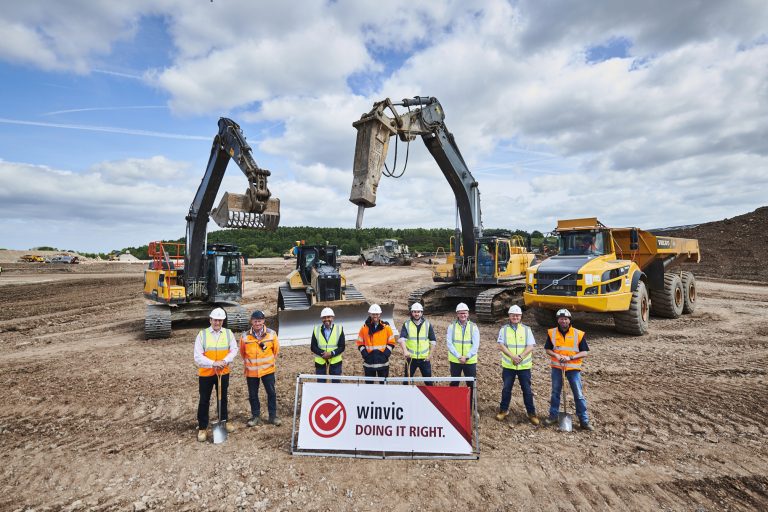
Commercial real estate investor and developer, Firethorn Trust, has broken ground at Link Logistics Park, its landmark 42-acre development in Ellesmere Port. More than 760,000 sq. ft. of industrial space will be created on the former brownfield site, including a single unit spanning 655,000 sq. ft., making it the biggest single cross-docked warehouse being developed in the UK this year. The first phase of development is set to be available for early occupation in Q4 2022, and is being delivered by Winvic Construction Ltd. The contract is the second awarded to Winvic by Firethorn, following the delivery of Ascent Logistics Park in Leighton Buzzard. Delivered to net-zero carbon construction, and BREEAM Excellent, the scheme’s highly-specified design is at the forefront of the market. The scheme’s base specification includes 15% rooflight coverage, Photovoltaic arrays, and is 100% commercial electric vehicle ready including 32 electric vehicle charging points. Up to 25MV of power will also be available from a local carbon-neutral ‘Waste to Energy’ facility. The design also incorporates features to help occupiers reach their own operational sustainability and wellbeing targets, with future full PV coverage, and battery ready features allowed for within the design, as well as WELL ready accreditations. Chris Webb, Partner at Firethorn Trust, said: “We’re delighted that work is now underway to deliver this landmark development, which is one of the largest speculative projects across the country to be built this year. Link Logistics Park is a prime example of our commitment to creating modern and sustainable logistics spaces, offering excellent connectivity, market-leading specification and best-in-class design features. “The scope and scale of this development is reflective of Firethorn’s growing ambition and it’s a hugely exciting addition to our expanding national portfolio. We look forward to working closely with Winvic to bring the project to completion.” Danny Nelson, Director of Industrial, Distribution and Logistics at Winvic, added: “Following the completion of the enabling works at Link Logistics Park in Ellesmere Port, we’re delighted to be able to start on site to create over 760,000 sq. ft. of net zero carbon industrial space. Having worked with Firethorn Trust to deliver Ascent Logistics Park – an eight-facility net zero carbon project – in less than 12 months, we have a fantastic relationship with their team and aim to exceed their expectations delivering this landmark 42-acre development.” Immediately adjacent to Junction 7 of the M53 and within a 45-minute drive of Liverpool and Manchester airports, the multi-modal industrial development lies in close proximity to the Manchester shipping canal, just 22 miles from the Port of Liverpool, offering exceptional transport links to the UK logistics network. All enquiries should be directed to the scheme’s letting agents, CBRE, B8 and Moriarty & Co. For more information on Link Logistics Park, and to watch live progress on-site, visit https://linklogisticspark.co.uk/ Building Design and Construction Magazine | The Home of Construction & Property News

Read More »

Insulation specialist Actis poised to launch CPD on revised Part L regulations

Revisions to Part L of the building regulations, which come into force in June, are the subject of a new CPD devised by insulation specialist Actis which is due to be launched to the industry in a few weeks’ time. Tomorrow’s Insulation Solutions for Future Homes Standards is currently awaiting certification by the Construction CPD Certification Service and will become the fourth in Actis’ series of popular professional CPD certified training programmes. Other sessions are the RIBA-approved CPD on addressing the performance gap with reflective insulation, a CPD module on building regulation compliance and a mini training course specially designed for use at LABC roadshows on the new SAP 10. The new CPD, aimed at architects, specifiers, builders and building control officers, looks at how the changes will impact the industry and how to ensure professionals meet the targets laid down in the revised building regulations. With new build homes obliged to see carbon emissions reduced by 31% over the current levels after June 15, the Actis CPD will explain the importance of focusing on ‘fabric first’ to help achieve this goal. There will be a one-year grace period for projects currently going through the planning process. Actis UK and Ireland technical director Thomas Wiedmer explained: “In order to achieve this 31 per cent uplift over current regulations we have to focus on ensuring the fabric of the building is the main driver of energy efficiency. This will need to be combined with more use of efficient building technologies. “Energy efficiency standards should always be based on reducing the need for energy first and in particular limiting the heat loss through thermal elements – that is through achieving excellent U-values, reducing thermal bridging and improving air tightness – the fabric first principle.” The CPD will look in detail at ways to improve U-values, reduce thermal bridging, address the performance gap and improve air tightness while ensuring there are no issues with overheating. Thomas added: “Ensuring insulation is continuous, with no gaps, plays a vital role in reducing thermal bridging – and this is one area in which the Actis Hybrid range excels, with its flexible nature and ease of cutting and moulding into corners, gaps and awkward junctions.” The CPD will also look at SAP 10, the latest update to the Standard Assessment Procedure, which is incorporated within the revised Part L regulations, and which is designed to ensure correct thermal modelling junctions are used. The Part L changes are a stepping stone towards the far more stringent energy efficiency requirements for new homes to be laid down under the forthcoming Future Homes Standard, which should be in place by 2025. That in turn will play a key role in enabling the UK to meet its 2050 net zero target.  Building Design and Construction Magazine | The Home of Construction & Property News

Read More »

STEELWORK COMPLETED ON £54MILLION GLASS FUTURES’ DEVELOPMENT

Work is on schedule at the £54million Glass Futures Global Centre of Excellence in St Helens with the steelwork structure now completed. Contractors Bowmer + Kirkland, who started on site in January, say the next phase of the scheme is already underway with the cladding and external elevations expected to be completed on the 165,000 sq. ft facility by the end of the summer. B+K’s work on the scheme is expected to complete in January 2023, ready for fit-out by Glass Futures. The facility has been pre-let to St Helens Borough Council on a 15-year head lease and will be sub-let to Glass Futures which will occupy and manage the building to deliver industry and government backed research and development projects focused on decarbonising glass production. It will also provide a platform for the industry to access an experimental scale furnace to test and run trials for implementation at commercial scale on a state-of-the-art line, both collaboratively and individually. Delivery of the project was conceived and is being managed by landowner and developer Network Space Developments (NSD), on behalf of a partnership including not-for-profit research organisation Glass Futures , St Helens Borough Council, the Liverpool City Region Combined Authority and UKRI (UK Research & Innovation). NSD will continue to manage the delivery of the project through to practical completion. Earlier this year the building was presold by NSD to global investor Standard Life Investments Property Income Trust, part of abrdn, to secure forward funding and conclude a viable delivery strategy. Catherine Chilvers, Development Director at Network Space, said: “We’re delighted with the progress so far on site with a completion date of January 2023 still very much in our sights. The outline structure of the facility is now visible and symbolises the scale and ambition of both St Helens Council and the Glass Futures project to bring significant investment and skilled jobs back into St Helens and the wider Liverpool City Region economy. She added: “None of this would have been possible without the exceptional partnership formed between NSD, Glass Futures, St Helens Borough Council, the Liverpool City Region Combined Authority and UKRI.  The partnership is proud to see the noticeable progress being made on site following the tremendous efforts to achieve this key milestone.” David Baker, Project Manager on the Glass Futures’ site for B+K said:“We’re making significant progress on site with the steel frame now completed and roofing works commenced. The B+K team is proud to be part of this iconic build for St Helens and its future role in glass manufacturing and development in the area. The scheme is transformational in every sense, not just for the town but also for its future contribution towards zero carbon production in the global glass industry.” Building Design and Construction Magazine | The Home of Construction & Property News

Read More »