
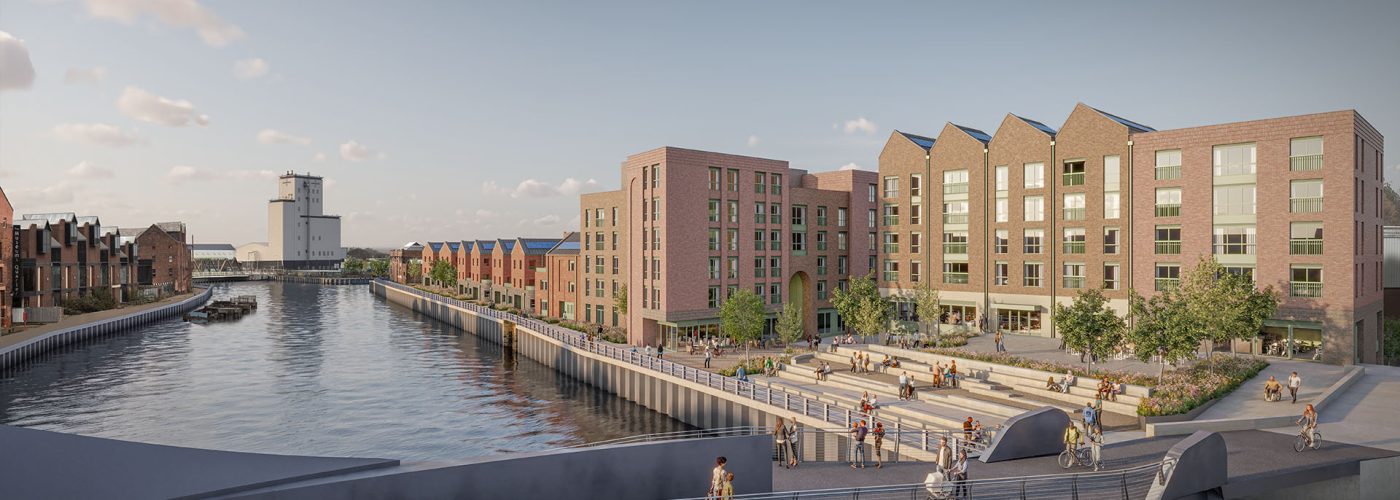


Hull City Council has submitted plans for the first phase of the East Bank Urban Village, a major regeneration scheme set to transform land along the River Hull into a new residential neighbourhood.
The council is working in partnership with ECF, a development collaboration between Homes England, L&G and Muse, to deliver what is expected to become one of the city’s largest regeneration projects. The initial application includes detailed proposals for phase one, alongside outline plans for a wider development that could eventually deliver around 850 homes opposite Hull’s Old Town.
Once central to the city’s maritime economy, the East Bank area has seen decades of decline and is now largely made up of surface car parks and vacant brownfield land.
The East Bank Urban Village is planned as a 15-year development that will introduce a mix of affordable housing and Build-To-Rent apartments, alongside retail, leisure and community spaces. Plans also include new streets, public squares, green areas and a riverside promenade aimed at improving connectivity and encouraging walking and cycling.
Phase one will form the foundation of the project, delivering 37 townhouses and 78 apartments across two buildings. All homes in this phase will be designated as affordable housing, targeting local demand and promoting accessibility.
The first phase will also incorporate infrastructure improvements, including a landing for the Scale Lane bridge on the eastern side of the River Hull and a connection to the Trinity Buoy Shed, a historic structure set to be brought back into use as part of the wider redevelopment.
Future phases are expected to deliver more than 700 additional apartments, both Build-To-Rent and affordable, while improving links to nearby areas such as the Fruit Market district. Plans also include the revitalisation of the Drypool Basin area into a new community space.
Public consultation played a key role in shaping the proposals. During engagement sessions held in September and October 2025, residents highlighted priorities such as increased green space, better traffic management, enhanced biodiversity and the reuse of historic buildings like the former Lock Keeper’s Cottage.
The project is backed by £9.8 million in government Levelling Up Partnership funding, which will support early infrastructure and enabling works. It is also expected to contribute significantly to the council’s target of delivering 2,500 new homes in Hull city centre under its Local Plan.
Sustainability is a key focus, with the development incorporating modern materials and technologies such as sustainable drainage systems in line with the city’s ‘Living With Water’ initiative.
The East Bank Urban Village has also been selected as a national case study by the UK Real Estate Investment and Infrastructure Forum, an annual industry event held in Leeds. A newly released video case study highlights the partnership between the council and ECF and aims to attract further investment into Hull’s regeneration efforts.
If approved, the project is expected to play a key role in shaping the future of Hull’s riverside and boosting confidence among investors as development progresses.
Building, Design & Construction Magazine | The Choice of Industry Professionals