

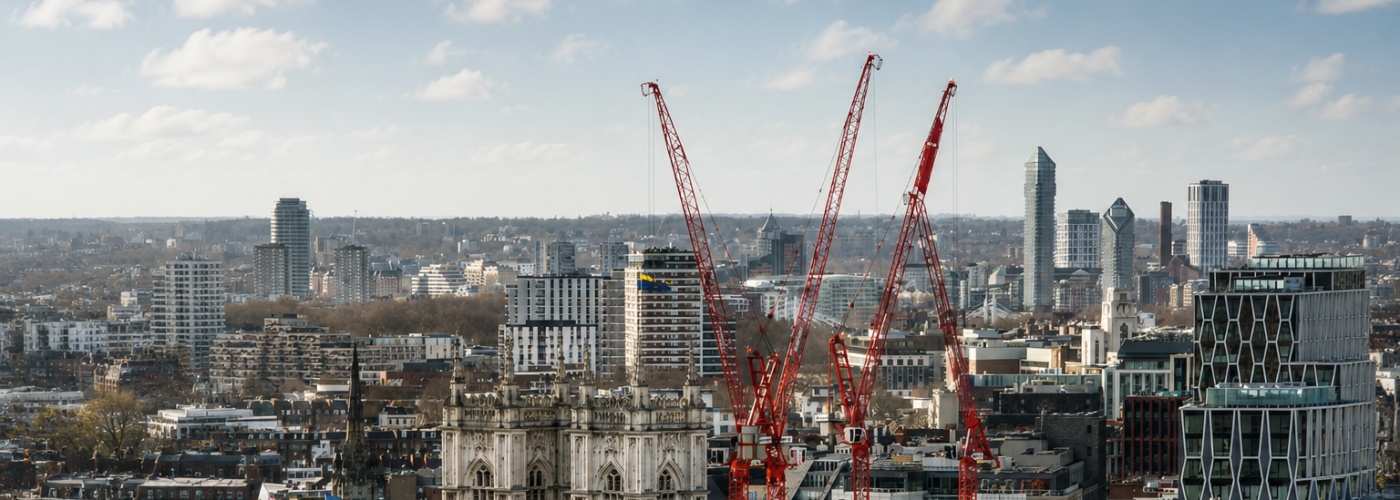


A highly complex office redevelopment in the heart of Westminster is demonstrating how innovative engineering and careful planning can help deliver major retrofit projects in some of the UK’s most constrained urban environments.
Specialist tower crane manufacturer Wolffkran has played a pivotal role in supporting the transformation of 1 Victoria Street, where contractors Keltbray and Mace Construct are delivering the redevelopment of a prominent 1960s office building through an ambitious programme focused on retaining much of the existing structure.
Rather than demolishing and rebuilding the entire building, significant elements of the original structure are being preserved, helping to reduce embodied carbon by eliminating the need for extensive new piling and foundations. However, this sustainable approach has introduced a series of unique engineering challenges.
Because the original foundations are being retained, the tower cranes have been installed within the building’s basement on structural foundations more than 60 years old. This required an entirely bespoke lifting strategy, with crane positions dictated by the existing structural layout rather than conventional construction practices.
The project has been carefully phased, with a total of nine Wolffkran tower cranes supporting demolition and construction activities. During the initial demolition phase, a Wolff 355 B luffing jib crane handled heavy lifting operations within the confined site, including excavators, structural steel and demolition equipment.
As construction progressed, four further cranes were installed to support the delivery of the building’s reinforced concrete core and early superstructure works, including the demanding slipform construction process that requires continuous concrete placement and highly coordinated lifting operations.
One of the most technically challenging aspects of the project has been adapting the cranes to work on the retained foundations. Wolffkran’s adjustable cross-frame system enabled each crane to be precisely aligned with the existing structural support points, with individual support legs configured to varying lengths to accommodate the complex geometry below ground.
The engineering challenges will continue into the final stages of the project. Once the basement slabs have been completed around the crane bases, dismantling the equipment will require a carefully planned operation using ceiling hoists, specialist forklifts and skating systems, as conventional mobile cranes will not have sufficient access within the completed structure.
Later this year, lifting operations will move to roof level as the next phase of construction begins, with larger luffing jib cranes supporting the installation of the upper floors, façade and building services.
Scheduled for completion in early 2028, the redevelopment of 1 Victoria Street is expected to become one of central London’s most technically demanding retrofit projects, showcasing how innovative construction techniques and specialist engineering can help deliver sustainable regeneration while preserving existing building assets.

Building, Design & Construction Magazine | The Choice of Industry Professionals