

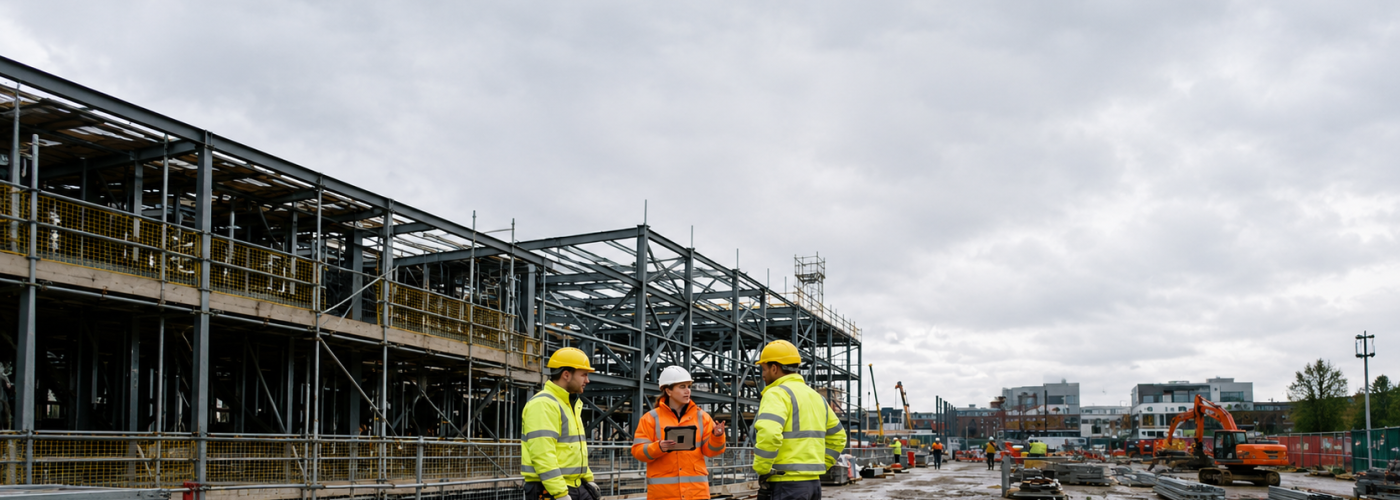


Construction workwear is one of the few site costs decided quickly and regretted slowly. Somebody orders what the last supplier sent, the kit arrives, and the problems surface months later. Trousers split at the knee, hi-vis fades to a dull lime, and nobody can reorder the same jacket in the same colour.
The garments were not wrong on the day they arrived. They were wrong when they were specified. This guide covers how to specify and buy construction workwear properly, working from the site risk assessment outwards.
What counts as construction workwear?
Construction workwear is the clothing and protective equipment worn by teams on building sites. It normally covers hi-vis garments, work trousers, base layers, outer layers, footwear and head protection.
Every order splits into three parts, each governed differently:
- PPE: Protects against a specific identified risk. Certified, and legally the employer’s responsibility to provide.
- General construction workwear clothing: Trousers, polo shirts, sweatshirts and fleeces. Durable and practical, but not protective in the regulatory sense.
- Branding: the logo. On a multi-contractor site, branded construction site workwear identifies who somebody works for at a glance.
Start with the risk assessment, not the catalogue
The most common buying mistake is starting with a product list. Somebody opens a catalogue, picks garments that look about right, and works out afterwards whether they suit the work.
Work in this order instead:
- Identify the hazards: What the site risk assessment says workers are actually exposed to.
- Define what the clothing has to do: The performance requirements that follow from those hazards, garment by garment.
- Then buy: Match products to a written specification, rather than working backwards from what a supplier stocks.
That sequence also gives you a defensible record. If a client or inspector asks why a garment was chosen, the answer traces back to an assessment rather than a catalogue page.
Which class of hi-vis does a site need?
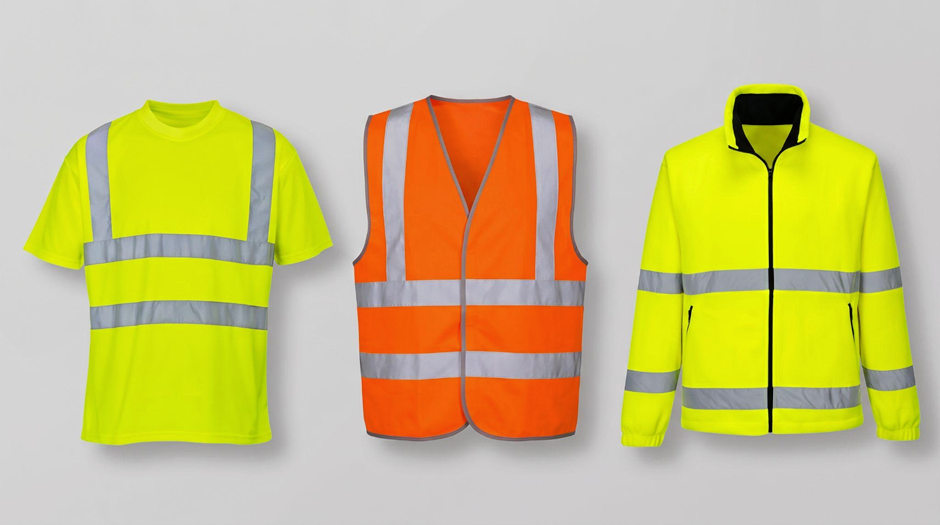
High-visibility clothing is divided into three performance classes under UK and European standards. The class is determined by the minimum surface area of fluorescent background and retro-reflective material a garment carries.
| Class | Minimum material | Typical application |
| Class 1 | 0.14 m² fluorescent, 0.10 m² reflective | Lowest risk. Warehouses, delivery yards, car parks, slow-moving traffic. Not suitable for roadside work. |
| Class 2 | 0.50 m² fluorescent, 0.13 m² reflective | Medium risk. Traffic control, deliveries, waste collection, work near moving vehicles. |
| Class 3 | 0.80 m² fluorescent, 0.20 m² reflective | Highest risk. Motorways, high-speed traffic, railways. Requires sleeves or trousers carrying reflective bands. |
Three practical points sit alongside the classification:
- Layering can break compliance. A compliant vest under a non-compliant coat does very little on a wet afternoon.
- Reflective performance degrades. Washing and abrasion both reduce it, so a garment that passed on day one may not perform two winters later.
- Ask what a garment is certified to. Manufacturers with certified ranges like Portwest workwear state the standard their hi-vis is approved to. A range that cannot be traced to a standard is not one to choose.
Who is responsible for providing PPE?
Employers are legally responsible for providing suitable PPE free of charge. That duty covers anyone they employ or control on site, wherever risks cannot be controlled by other methods. Companies cannot charge workers for standard work PPE or deduct it from wages.
Employer duties:
- Free supply — hard hats, hi-vis and safety footwear at no cost to the worker.
- Training and fit — staff must know how to use it, and it has to fit properly.
- Maintenance — kept clean, repaired, and replaced when worn out.
- Accessibility — ready to use or easy to collect on site.
Worker duties: wear it as trained, store it correctly, and report damage straight away.
This is worth checking rather than assuming on sites using subcontracted or agency labour. The commercial arrangement does not always match the legal duty.
Building a core kit list for a site team
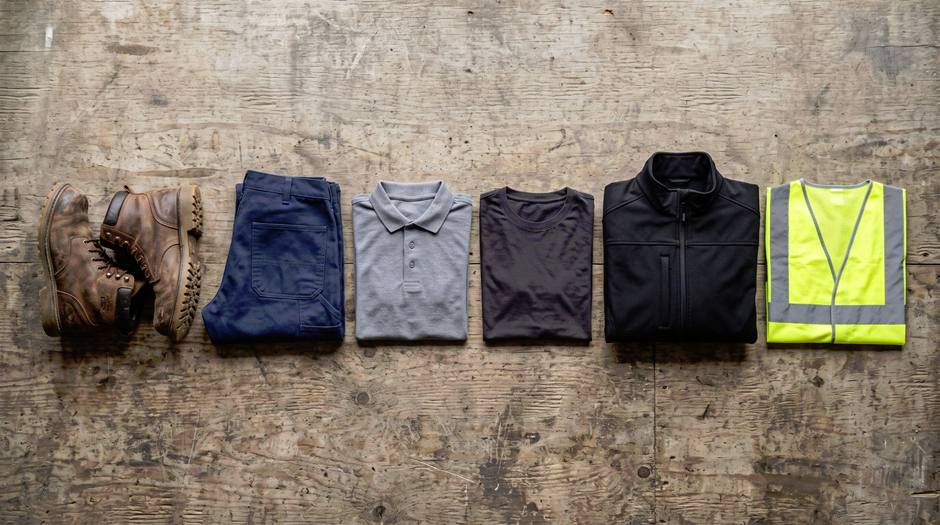
Most site teams need four things: something against the skin, something on the legs, something high-visibility, and something for weather.
- Base: Polo shirts in polycotton or a technical blend, three or four per worker.
- Legs: Two pairs of work trousers, specified on fabric weight, knee pad pockets and leg length.
- Visibility: Two hi-vis items in the correct class for the site.
- Weather: A fleece or softshell mid layer, plus a waterproof shell with taped seams.
The simplest way to buy this is in sets rather than garment by garment. Workwear bundle deals group a standard kit per worker, which is quicker to order and easier to repeat. It also solves reordering before it starts, because new starters and replacements match what is already on site.
Getting work trousers right
Trousers take more abrasion than any other garment on site, so they wear out fastest. They are also the item most often replaced mid-project, which makes them worth closer attention than they usually get.
Check the seams, the knees and the hems, because that is where trousers fail. Triple stitching and reinforced knee panels last noticeably longer, and knee pad pockets should always be adjustable. Buy lighter cloth for summer and heavier for winter.
Getting fit and sizing right
Fit is a safety consideration, not a comfort preference. Loose garments catch on scaffolds and moving plants. Tight garments restrict movement, so they get unfastened or removed.
Women’s fit still gets handled by issuing smaller men’s sizes, which produces poor sleeve length and hi-vis sitting wrong on the body. Ranges of ladies construction workwear cut for women’s proportions now cover most site categories. Order sizing samples before any bulk commitment, because a fitting session beats exchanging eighty garments.
Choosing workwear jackets and outer layers
The usual mistake is one heavy waterproof coat expected to cover the year. It is too warm for most of the working day, so it comes off, and then it is not on when the weather turns. A base, mid and shell system works better, because workers adjust through the day instead of choosing between overheating and getting wet.
When specifying workwear jackets, check three things: whether seams are taped rather than only stitched, whether the garment is genuinely waterproof or merely water-resistant, and whether it is cut with room for layers underneath.
Getting your logo on it: what to expect from a supplier
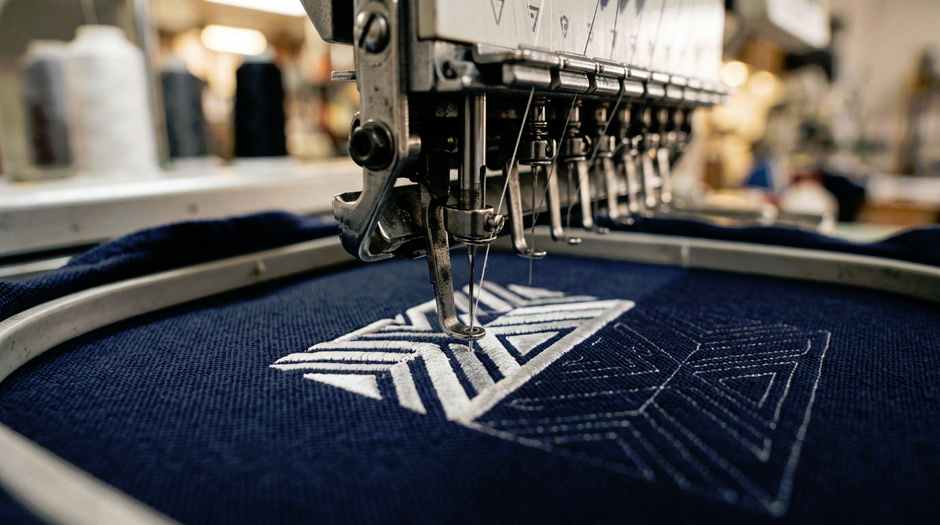
Branding is where suppliers differ most, and the easiest part of the process to judge before committing. Two methods dominate.
| Embroidery | ||
| Best on | Polo shirts, sweatshirts, fleeces, jackets | Technical fabrics, lightweight garments, hi-vis |
| Strength | Hard wearing, handles repeated industrial washing | Reproduces detailed and full-colour artwork accurately |
| Watch for | Puckering on lightweight polyester | Method must match the fabric |
A supplier who recommends a method for your logo on your garments is worth more than one applying the same process to everything.
Insist on a proof before production
This is the single most useful question to put to any supplier. Your logo is first converted into a production-ready file, a process called digitising for embroidery.
Before production, expect a stitched sample photo for embroidery or a position and colour visual for print.
You approve it, then production starts. Any supplier skipping that step is asking you to accept whatever arrives. Production run in-house rather than subcontracted also helps, because problems get fixed rather than passed along a chain.
Where a logo can go on hi-vis
Branding must not reduce the certified fluorescent or reflective area. Logos go in plain fluorescent gaps, never over reflective tape.
- Left chest: Above the lower tape line. The standard position.
- Upper back: Between the shoulder and waist bands, kept strictly within them.
- Upper sleeves: Suits secondary logos.
Keep the logo small enough that it does not eat into the required background area. Print is generally preferred over heavy stitching on hi-vis and waterproofs, which avoids damaging the safety fabric.
Which construction workwear brands should be on your shortlist?
Brand matters less than specification, but it is not irrelevant. The better manufacturers hold sizing and colour steady between production runs. That consistency is what makes a uniform still look like a uniform a year later.
For general site teams, the popular Uneek workwear range spans polo shirts, sweatshirts, jackets and hi-vis. Kitting a whole team from one range keeps colours matched and reordering simple. Mascot and Blåkläder suit garments taking heavy daily abuse, and Portwest covers breadth across PPE and hi-vis.
Judge on cost per wear rather than unit price, since a trouser at twice the price lasting three times as long is cheaper. Shortlist two or three brands rather than one. No single manufacturer leads across trousers, hi-vis and outer layers at once.
Construction workwear FAQs
Can small teams order branded workwear, or is there a minimum?
Many suppliers apply no minimum order quantity, so a sole trader can order a single embroidered jacket. Minimums are a supplier policy rather than a technical limit.
How long does branded construction workwear take to produce?
Around seven to ten working days after artwork approval is a realistic professional turnaround. Faster dispatch options exist for urgent requirements. Delays usually come from unapproved artwork rather than production capacity.
How often should construction workwear be replaced?
Replace protective garments as soon as their protective function is compromised, not on a fixed schedule. Faded hi-vis, damaged reflective tape and worn knee reinforcement all count.
Specify once, buy well
The teams who get this right are not the ones spending most. They decide what the kit has to do before deciding what to buy, and they ask the awkward questions early. What is this certified for? Will you proof my logo? What happens when I reorder in a year? A specification written once serves several years and several intakes of staff.