BDC News Team
RSK Group acquires engineering and energy transition experts PD&MS

RSK Group acquires engineering and energy transition experts PD&MS

PD&MS, a specialist engineering services company operating within the energy transition, conventional energy, low carbon and renewables sectors, has been acquired by RSK, a global leader in the delivery of sustainable solutions. The Aberdeen-based company has been operating since 2002. Synergie Environ and Optimus joined PD&MS in 2021 and 2022, respectively.

Read More »
'Focus must be on boosting delivery of affordable homes' - London Councils responds to government's housing announcements

‘Focus must be on boosting delivery of affordable homes’ – London Councils responds to government’s housing announcements

London Councils has responded to the government’s announcement on building new homes and the Secretary of State’s speech on reforming the planning system and regenerating urban areas. Cllr Darren Rodwell, London Councils’ Executive Member for Regeneration, Housing & Planning, said: “Boroughs are ready and willing to help deliver the homes

Read More »
HENRY BROTHERS COMPLETES £12M REFURB PROJECT AT UNI OF MANCHESTER

Henry Brothers completes £12m Refurb Project at Uni of Manchester

Contractor Henry Brothers Construction has delivered a £12m refurbishment scheme for The University of Manchester. The project involved the complete refurbishment of floors four and five of the Chemistry Building, along with work to the level eight plantroom, roof and external ductwork and services. It included reorganising the layout of

Read More »
Groundforce Shorco delivers support for second Tideway ATU

Groundforce Shorco delivers support for second Tideway ATU

A complex shoring solution supplied by Groundforce Shorco for another Tideway excavation. Groundforce Shorco has provided specialist equipment to support a second Air Treatment Unit (ATU) excavation on the Thames Tideway Tunnel, London’s Super Sewer project. The project requires a number of ATUs to be installed along the route of

Read More »
Latest Issue
Issue 338 : Mar 2026

BDC News Team

Turner & Townsend Strengthens Senior Leadership Team in Hong Kong & Macau

Turner & Townsend Strengthens Senior Leadership Team in Hong Kong & Macau

Turner & Townsend, the global professional services firm, has strengthened its leadership team in Hong Kong and Macau with multiple senior appointments. Oliver Sneath takes on the role as Head of Real Estate for Hong Kong and Macau, while Helen Cheng assumes the role of Director for Sustainability and Net Zero Advisory for Northeast Asia. Sabrina Li also joins Turner & Townsend as a Project Director, with significant programme management experience in real estate across the banking and finance sector. The new leadership appointees form an important part of the firm’s market management team for Hong Kong and Macau, further expanding its capabilities in delivering major projects, programmes, and portfolios for global corporate and public sector clients. They also enhance the firm’s sector-specific decarbonisation and digital advisory services that are integral in their industry-leading programme, project and cost management service. Oliver Sneath joins from Turner & Townsend’s London office where he served as Head of London Occupier, transforming performance of major projects and programmes across the UK and EMEA. Oliver will bring his deep expertise in servicing global corporate occupier clients to Asia, together with experience in public sector and industrials, science and technology (IST). Helen Cheng has also relocated to Hong Kong from Turner & Townsend’s Singapore office. She brings more than 25 years of architectural and construction delivery experience in Australia and Singapore to the role, having worked on complex construction projects across Australia, Singapore, China, India and Bangladesh. Sabrina Li also joins the Turner & Townsend Hong Kong team this month, taking on the role of Project Director focused on delivering regional portfolios in the financial services sector. She brings close to two decades of programme management experience in delivering real estate projects for global corporations including Abbott, Microsoft, Macquarie and MasterCard. Oliver, Helen and Sabrina will be joined by Daniel Cheung, Director of Infrastructure, Northeast Asia, who will chair the new Hong Kong and Macau market management team. The team will report to Brian Shuptrine, who was appointed Regional Managing Director of Turner & Townsend’s Asia business based in Hong Kong on 1 May, this year. Turner & Townsend has been operating across Asia for more than 30 years. Working across infrastructure, real estate and natural resources, the business helps clients maximise their investments in the transportation, housing, health, education, commercial and industrial sectors, as well as supporting government, developers, corporate occupiers and retailers to achieve their outcomes. Brian Shuptrine, Regional Managing Director, Asia for Turner & Townsend comments: “We are charting a bold path for our Hong Kong and Macau business to further position ourselves for exceptional growth in Greater China. These strategic appointments to our senior leadership team ensure that our clients, and our growing pool of talent, have access to the very best industry expertise. “Consolidating our sectorial specialisations, particularly for global corporates and public sector clients, and strengthening our market-relevant technical capabilities in areas like programme management, sustainability and net zero enables us to meet the changing demands of the industry ahead, while retaining a focus on transforming performance.” Building, Design & Construction Magazine | The Choice of Industry Professionals 

Read More »
Honeywell shares tops tips to help keep indoor air safer when outdoor air quality reaches harmful levels

Honeywell shares tops tips to help keep indoor air safer when outdoor air quality reaches harmful levels

From wildfire smoke to air pollution-ridden cities, buildings must focus on healthier indoor air quality amidst outdoor air crisis fueled by climate change Honeywell has recently released strategies to keep indoor air quality (IAQ) in buildings safer when the outdoor air index reaches unhealthy levels. According to the EPA[i], exposure to fine particle pollution can cause respiratory and cardiovascular health issues. Recent outdoor air pollution events, including wildfire smoke, are prompting health officials to advise staying indoors. However, indoor air pollutants can be two to five times worse than outdoor air[ii], which is often offset by bringing in outdoor air. When fresh outdoor air ventilation is not available to improve indoor air quality, building owners should take extra precautions. “When the outdoor air index reaches unhealthy levels, it is advisable to avoid introducing external air indoors. The main concern then becomes ensuring the maintenance of healthy indoor air when the option to bring in fresh air is not available,” said Manish Sharma, vice president and chief product officer of Honeywell Connected Buildings. “To promote better air quality in situations like these, buildings should consider utilising automated and sophisticated sensing, filtration, air purification and air circulation solutions. The question then arises: how many buildings can presently claim to possess such important capabilities? At times like this, intelligent and advanced technology becomes critical.” Honeywell shares these tips for how to keep IAQ safer for occupants: Tip #1: Continually assess and communicate IAQ Building owners should utilise IAQ sensors to monitor CO2, TVOC, temperature, relative humidity and PM2.5[iii], an extremely dangerous, fine particulate matter that can travel deeply into the respiratory tract. Sensors help analyse data, track trends and alert building managers when indoor air is not safe. Once a baseline for a building’s health is established, facility managers can integrate their building’s heating, ventilation and air-conditioning (HVAC) system with the IAQ sensors to continually monitor air quality, detect contaminants and clean the air automatically. Building owners should also consider communicating to occupants the building’s IAQ levels. According to the 2023 Honeywell Healthy Buildings Survey[iv] data, 82% of office workers want to be informed about their building’s IAQ often or sometimes. Tip #2: Rethink Ventilation Ventilation is an important factor in maintaining healthy IAQ levels and thermal comfort as it freshens up the air inside buildings and dilutes the concentration of harmful particles. While the simplest, cheapest and most traditional way to improve ventilation is to open a window, that is not always a viable option, especially if the air outside is more polluted than that inside. To keep air clean, building owners can use mechanical ventilation devices, such as fans that vent to the outdoors or portable air cleaners, which may be particularly helpful when ventilation with outdoor, polluted air is not possible without compromising indoor comfort or health. Buildings can also tap into the building’s HVAC system to help maintain safer IAQ levels through adequate ventilation. Tip #3: Improve Filtration and Purification One of the most effective ways to improve IAQ is to clean existing indoor air, especially when outdoor air ventilation is limited. Building owners can utilise filtration and purification technologies to eliminate the contaminants from a building’s air supply. For example, HEPA, or high efficiency particulate air, filters can capture particulates of 0.01 micron and greater[v] with an extraordinary efficiency by diffusion and interception mechanisms. Pressurisation technologies control the movement of air contaminants within a building and lead to improved IAQ. Control of air pressure, both positive and negative, inside a building is key to providing comfort and preventing outdoor contaminants from entering a space. A slight positive pressure will prevent hot outside air from penetrating into the building during the summer, and negative pressure during the winter can maintain humidity by allowing outside air into the building. Honeywell Healthy Buildings solutions integrate air quality, safety and security technologies along with advanced analytics to improve IAQ while meeting energy efficiency goals. Our suite of ready-now healthy and sustainable building solutions can help create an optimal indoor environment. For more information on air quality and Honeywell Healthy Buildings solutions: ●       Anatomy of a Healthy Building ●     2023 Healthy Building Occupant Survey Report Building, Design & Construction Magazine | The Choice of Industry Professionals 

Read More »
RSK Group acquires engineering and energy transition experts PD&MS

RSK Group acquires engineering and energy transition experts PD&MS

PD&MS, a specialist engineering services company operating within the energy transition, conventional energy, low carbon and renewables sectors, has been acquired by RSK, a global leader in the delivery of sustainable solutions. The Aberdeen-based company has been operating since 2002. Synergie Environ and Optimus joined PD&MS in 2021 and 2022, respectively. The business works with some of the biggest names in the energy industry, helping them to transition toward decarbonisation and net zero. With a second operations base in Azerbaijan, PD&MS has a headcount of more than 700 professionals, offering full-life-cycle solutions in consultancy, engineering, procurement, construction, commissioning and decommissioning. Its annual turnover in FY22 was £84.1 million. PD&MS Chief Executive Officer Simon Rio, who has been leading the business for 10 years and will continue to do so, said: “We see RSK Group as the perfect home for the business moving forward, owing to its world-leading expertise in environmental and sustainability solutions. This deal represents a landmark moment in the evolution of PD&MS and will enable us to significantly accelerate our growth in new energy markets, while continuing to support our conventional energy clients to maximise economic recovery and play a pivotal role in their energy transition journeys. We are passionate about playing our part in addressing the energy transition. Our increased offering as part of the RSK Group will further enhance the scale and impact that we can make to help our growing customer base produce affordable, secure and sustainable energy.” RSK Group Chief Executive Officer Alan Ryder said: “As international economies move towards their net zero targets, PD&MS can help by dealing with all critical assets, with a particular expertise in brownfield developments. The company has an exceptional reputation and track record of growth and diversification through periods of market transition. With its foundations in oil and gas services, PD&MS is now using its transferrable skills on projects and to build momentum within renewables and low carbon. The company has secured long-term framework agreements with major clients to support energy transition. This acquisition will see PD&MS become part of a group with the same ethos and values, where it can continue its approach transitioning the energy sector – a deal that strengthens all parties’ ability to increase focus on environmental, social and governance (ESG) issues and sustainability. This focus will include low carbon and renewables and the pace and impact of transition will be linked to performance. This acquisition is of major significance for RSK. It further emphasises our own growth, presence and reputation within the renewable energy sector and, with many synergies with other RSK businesses, we aim to be able to share expertise and work on an increased international scale.” As RSK continues to deliver its ambitious growth strategy, it now comprises more than 200 companies, employing 12,000 people. The group’s annual turnover at the end of FY22 was £796 million. The acquisition adviser was Piper Sandler. Building, Design & Construction Magazine | The Choice of Industry Professionals 

Read More »
Signify’s energy-efficient LED lighting helps the Borough of Sefton on its way to net zero emissions

Signify’s energy-efficient LED lighting helps the Borough of Sefton on its way to net zero emissions

Signify, the world leader in lighting, is supporting Sefton Council’s climate action by upgrading the borough’s public lighting to energy-efficient LED. The project includes the upgrade of 26,000 light points on traffic routes, roads, streets, and residential areas. The phased program will be completed in 2025 and is expected to reduce annual maintenance by 45%, saving the council over 7,161,500 kWh energy per year/£1.8 million per year on energy costs following the completion (based on average and estimated prices 2021-2025), as the lighting installed uses up to 70% less energy, when compared to the existing HID lighting installed.The reduction in ongoing energy costs is expected to pay for the project in full within 8 years. The upgrade is even more important against the backdrop of the ongoing energy crisis. This upgrade takes the council closer to its goal of leading to net zero carbon by 2030. In July 2019, Sefton Council declared a climate emergency and enacted a plan to reduce its environmental impact through energy efficiency and carbon reduction projects, leading to net zero carbon by 2030. By upgrading public lighting within the borough, the council can contribute to its goals to reduce carbon emissions and energy consumption while also reducing long-term maintenance and improving the street environment for residents and visitors. Sefton has been on its path to net carbon zero since 2020, but skyrocketing energy prices and the need for safer streets for pedestrian and highway users have raised the urgency of replacing outdated technology with alternatives that are long lasting, cost-effective, and environmentally friendly. Signify’s Philips LumiStreet gen2 LED luminaries were selected for the project. LED lighting is a safe, highly effective alternative to older technologies like the High Intensity Discharge (HID) lamps that were previously in place within the borough of Sefton. LED lamps can produce excellent light levels using far less energy than their conventional counterparts and require little ongoing maintenance. According to Signify’s own data, if the entire UK&I region followed the example of Sefton Council and switched all conventional road and streetlights to LED, the country could save 603 thousand tonnes of carbon and £520 million per year in energy costs. In addition, the LED lights offer improved colour rendering which helps CCTV recognition, creating a greater sense of well-being and security for people in the area. LED lights can be more precisely focused on roads and paths to minimise any intrusion into homes or gardens. A neutral white colour was selected for the project to maintain a pleasant night-time atmosphere while maintaining excellent visibility. Sefton Council worked with Jones Lighting to carry out trials comparing results from different manufacturers to assess their relative quality and efficiency. Signify’s lighting solution impressed the council with its design, performance, and total cost of ownership, which considers how the initial project investment is offset by the energy savings achieved by converting existing lighting to LED. The reduction in ongoing energy costs is expected to pay for the project in full within 8 years. “The LED upgrade is a significant step forward towards Sefton Councils’ commitment to becoming net zero by 2030. Additionally, the streets are now lit better than before to ensure citizens can feel more confident and secure during the evenings or nights. A great win for the citizens and the borough’’ said Dave Jones, Managing Director, Jones Lighting. “After an extensive test of the market in which we reviewed the lanterns performance and costs followed on site trails, we determined that Signify would be our preferred manufacturer for the LED conversion scheme.” Said Mark Bond, Senior Street Lighting Engineer at Sefton Council. “Signify’s lanterns provided us with excellent output in terms of lighting performance and energy efficiency. After working with Signify and its logistics team, we’ve been very pleased with delivery timescales and overall performance.” “Addressing climate change is the most urgent issue of our age,” said Dervan Alleyne, Director Public Lighting and Sports Lighting, Signify UKI. “The lighting upgrade reinforces how lighting can contribute to the council’s agenda and the environment. We are proud to support Sefton Council in its journey to net zero and at the same time, create an improved experience for local people and visitors.” Learn more about the impact of switching to LED on Signify’s website. Building, Design & Construction Magazine | The Choice of Industry Professionals 

Read More »
£93 Billion Worth of Commercial Properties at risk in England, Scotland and Wales

£93 Billion Worth of Commercial Properties at risk in England, Scotland and Wales

New research from Siemens Financial Services (SFS) estimates the staggering value of commercial properties in England, Scotland and Wales at risk in the industrial, office and retail sectors, if building conversion is deferred. Entitled Urgent Upgrade, thereport highlights the serious financial impact of recent legislation which demands that commercial buildings have an EPC (Energy Performance Certificate) rating of at least E to continue to be let. This equates to £93 billion worth of commercial properties in Great Britain including across industry (£25 bn), offices (£28 bn), and retail (£31 bn). This is only the first in a staggered approach by the UK government to achieve its net zero goals, with plans to raise the threshold to a C rating by 2027 and to a B by 2030 adding further future pressure to buildings owners and facilities management. As the research makes clear, without immediate investment owners of F- & G-rated buildings will be left without income and face the possibility of significant fines as well as reputational damage. This means energy efficiency improvements are now a top priority. To meet this demand and make building conversion affordable, specialist financiers are now offering financing packages which use future energy savings to finance building technology upgrades – covering condensing boilers, solar panels, heating ventilation and air-conditioning (HVAC), insulation, smart buildings controls, and any other technology required to upgrade a building to much higher energy-efficiency levels. These financing schemes allow buildings managers to achieve a strategic upgrade at low- or even zero-net-cost. Carolyn Newsham, Digital Industries Financing Partner, SFS, “The manufacturing industry is the UK’s biggest emitter of CO2 (second only to the energy industry itself) making its infrastructure ripe for improvements and energy cost savings. The good news is that building projects can go hand in hand with other digitalisation initiatives so that energy efficiency can be achieved throughout the factory, and not just on the floor.” Toby Horne, Siemens Infrastructure Financing Partner, SFS, “Working with integrated technology-and-finance providers can make building conversion projects zero-net-cost. Given the current urgency to convert, coupled with government plans to increase the EPC threshold in the years to come, buildings management should act now to ensure compliance and capitalise on the potential for both energy and financial savings.” Ollie Finkill, Business Development Manager – Clean Technology at SFS, “For businesses to invest in building conversion projects it has to make financial sense. In the context of unlettable properties and undermined commercial value, the business case is a clear and urgent one but future savings (that can be used against the cost of investment) should also be a crucial motivator.” For further information, please see: https://assets.new.siemens.com/siemens/assets/api/uuid:aa2c87ce-330f-4a47-9184-03ea8c99404c/SFS-UK-SIE-BRO-F-and-G-Whitepaper-.pdf Building, Design & Construction Magazine | The Choice of Industry Professionals 

Read More »

DHF offers support to members impacted by London’s Ultra Low Emission Zone

Door & Hardware Federation (DHF) has today restated its commitment to members affected by the upcoming extension of London’s Ultra Low Emission Zone (ULEZ).  This will commence on 29th August.  The extension will significantly impact a multitude of  business sectors including construction, and therefore a number of DHF members.  The Ultra Low Emission Zone (ULEZ) operates 24 hours a day, 7 days a week, 365 day of the year (except 25 December) and has been implemented in a bid to make the capital’s air, cleaner.  The zone currently covers all areas within the North and South Circular Roads (with the exception of the A406 and A205).  If a vehicle does not meet the ULEZ emissions standards, the driver will pay a £12.50 daily charge to drive within the zone.  Currently, this applies to cars, motorcycles, vans, minibuses and specialist vehicles (up to and including 3.5 tonnes).  Lorries, vans or specialist heavy vehicles (all over 3.5 tonnes) and buses, minibuses and coaches (all over 5 tonnes) do not need to pay the ULEZ charge.  In addition, owners of non-UK registered vehicles will also need to meet the ULEZ emissions standards or pay the daily charge.    Although support is currently available, for example, a £110 million scrappage scheme has been launched to help fund the purchase of new vehicles that are ULEZ-compliant, and under the new scrappage fund, sole traders and tradespeople working for a micro-business (those with 10 employees and under) have been granted extra provisions of between £5,000-£9,000 to help transition to a low-polluting or EV alternative, nevertheless, paying a £12.50 daily fee for vehicles not meeting minimum requirements equates to more than £3,000 a year per vehicle.   “Whilst we fully support the need to cut emissions and protect the environment, we urge the Mayor of London, Sadiq Khan, to consider alternative ways to limit the impact that ULEZ will have on businesses in the construction industry including that he reassess this extension,” explains DHF’s Commercial Director, Patricia Sowsbery-Stevens.  “ The planned extension will seriously impact the income of construction businesses, and at a time when inflation remains very high and customers are delaying or cancelling projects due to higher costs and limited budgets, this will make the commercial environment even more challenging,” she continues.  “ULEZ will increase the cost of construction workers using vans to go to work, could cause construction workers to work longer hours to limit the number of times they need to travel into the centre, could cause construction companies to lose work due to the need to increase their prices to cover this additional cost on top of the cost-of-living crisis and increasing transport costs, and may potentially undermine the Mayor of London’s plea for construction workers to work in the Capital to help improve the city’s housing stock. DHF cannot stress enough the considerable impact, not just on construction businesses, but on all businesses that have a legitimate reason to travel into the Ultra Low Emission Zone, and we hope that alternative options will be considered that prioritise small-to-medium-sized businesses operating in the capital.” Building, Design & Construction Magazine | The Choice of Industry Professionals 

Read More »
Construction labour supplier Fortel Group appoints Tim Hunt as Head of Compliance

Construction labour supplier Fortel Group appoints Tim Hunt as Head of Compliance

Fortel Group, a leading supplier of labour to the construction industry, has appointed Tim Hunt as its new Head of Compliance.  With a distinguished career spanning over three decades and a wealth of experience in accounting, payroll and compliance, Tim’s expertise will further solidify Fortel’s commitment to standards and ethical business conduct. Tim will be responsible for all things compliance including legislation, policies and procedures to ensure Fortel continues to achieve and exceed the high bar of excellence it delivers for its people and clients. Tim’s journey began in the 1990s when he qualified as a Chartered Accountant with KPMG. During his tenure, he gained valuable expertise in forensic investigation and has served as an expert witness. Subsequently, he established his own successful payroll and outsourced employment business in 2010. More recently, Tim has provided consultancy on a range of topics, specialising in supply chain management risk assessment, working with contracting businesses, labour end hirers, and recruitment firms. Notably, he has played a pivotal role as a board member of the FCSA (Freelancer & Contractor Services Association), demonstrating his leadership in compliance issues within the construction sector. “We are delighted to welcome Tim to the Fortel team,” says Sat Nijjer, CEO of Fortel. “He is joining us at a time when we believe we are in a very strong position, but his extensive experience and proven track record will be instrumental in ensuring we remain at the forefront of industry standards. With Tim’s appointment, we are confident in further strengthening our market position and driving our commitment to excellence, ethics, and compliance forward.” “Joining the Fortel team feels like coming home,” says Tim, emphasising the long-standing relationship he shares with the organisation. “I am excited to work closely with the team and contribute my expertise to keep Fortel at the forefront of compliance and ethical business practices.” Building, Design & Construction Magazine | The Choice of Industry Professionals 

Read More »
'Focus must be on boosting delivery of affordable homes' - London Councils responds to government's housing announcements

‘Focus must be on boosting delivery of affordable homes’ – London Councils responds to government’s housing announcements

London Councils has responded to the government’s announcement on building new homes and the Secretary of State’s speech on reforming the planning system and regenerating urban areas. Cllr Darren Rodwell, London Councils’ Executive Member for Regeneration, Housing & Planning, said: “Boroughs are ready and willing to help deliver the homes our communities need, but this requires more local powers and resources for housebuilding. “Despite massive challenges, boroughs are working hard to accelerate housebuilding and have made solid progress in recent years. London saw more council-built homes started in 2022 than any year since the 1970s. “There are at least 143,000 potential new homes we could begin building immediately in London if the funding was in place, and we would welcome the prospect of enhanced government support for housing development and regeneration. We are calling for reform of Right to Buy receipts, increased grant allocations, and investment in new infrastructure so that we can truly turbocharge affordable housebuilding. “The chronic shortage of affordable housing is the critical factor behind London’s skyrocketing homelessness figures. The situation is utterly unsustainable. There are 166,000 homeless Londoners living in temporary accommodation, including on average at least one homeless child in every London classroom. “The focus must be on boosting delivery of affordable, high-quality homes. The government’s pledge to expand permitted development rights does not guarantee this will happen – in fact it brings serious risks. Boroughs must retain the ability to ensure housing is built to the right standards, in suitable locations, and with the necessary local infrastructure such as GP surgeries and transport connections.”   Building, Design & Construction Magazine | The Choice of Industry Professionals 

Read More »
HENRY BROTHERS COMPLETES £12M REFURB PROJECT AT UNI OF MANCHESTER

Henry Brothers completes £12m Refurb Project at Uni of Manchester

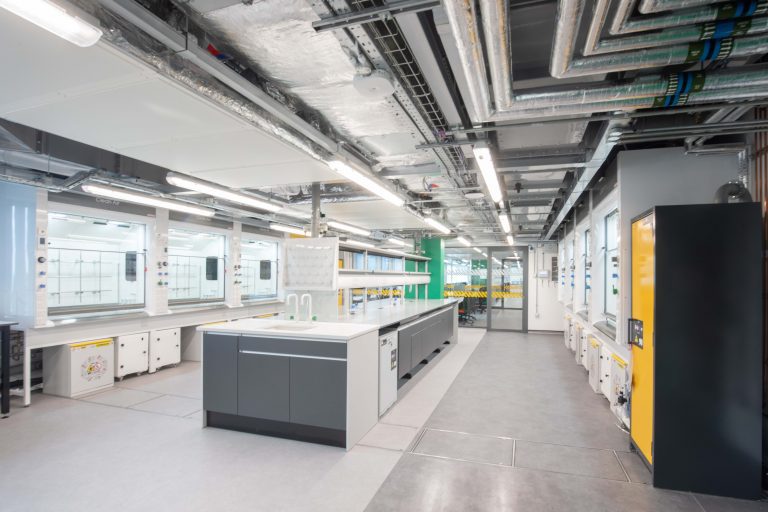
Contractor Henry Brothers Construction has delivered a £12m refurbishment scheme for The University of Manchester. The project involved the complete refurbishment of floors four and five of the Chemistry Building, along with work to the level eight plantroom, roof and external ductwork and services. It included reorganising the layout of the two floors to create flexible lab space to feature new fume cupboards and fixed benching, dedicated write-up spaces with glazed screens for visibility throughout the lab, modern offices, and attractive break-out areas. One of the key features of the project was the external ventilation ducts running up the side of the building which feed into floors four and five (and the other floors in future refurbishment phases). These ducts were connected to the existing fans in the 1960s-built, seven-storey building, which houses one of the largest Chemistry departments in the UK. Managing Director of Henry Brothers Construction Ian Taylor said: “We were delighted to have been appointed on our first contract at The University of Manchester, which represented an expansion for Henry Brothers into the North West. “The result of this refurbishment scheme on floors four and five of the Chemistry Building, along with work to the level eight plantroom and services, is first class. Researchers will now be working in and enjoying modern laboratories, offices, and break-out areas. These upgraded new facilities give researchers access to some of the most up-to-date amenities, helping the University to retain its position as one of the best places to study Chemistry.” The project was the latest in a number of schemes that Henry Brothers has delivered at UK universities and followed a £30m refurbishment scheme at the W and S Buildings at Loughborough University. Procured through the Crown Commercial Services Framework, The University of Manchester contract marked Henry Brothers’ expansion into the North West last year following sustained growth across the Midlands.The design team for the refurb included Gardiner and Theobold as NEC project manager, RLB as quantity surveyor, Halliday Meecham Architects, structural engineers Curtins and EDPI for M&E services, with sub-contractors William Bailey and Electract providing mechanical and electrical services for Henry Brothers. Henry Brothers Construction is part of The Henry Group, which comprises a number of manufacturing and construction sector companies, ranging from external construction through to interiors fit-out. In partnership with clients, it has a proven track record in education, defence, accommodation, commercial, industrial, transport and healthcare sectors. For more information, visit www.henrybrothers.co.uk Building, Design & Construction Magazine | The Choice of Industry Professionals 

Read More »
Groundforce Shorco delivers support for second Tideway ATU

Groundforce Shorco delivers support for second Tideway ATU

A complex shoring solution supplied by Groundforce Shorco for another Tideway excavation. Groundforce Shorco has provided specialist equipment to support a second Air Treatment Unit (ATU) excavation on the Thames Tideway Tunnel, London’s Super Sewer project. The project requires a number of ATUs to be installed along the route of the 25km tunnel, to treat exhausted air from the super-sewer. Last year, Groundforce provided Costain, Vinci Construction Grands Projects and Bachy Soletanche Joint Venture on the Eastern section with sheet piles and a range of medium and heavy-duty bracing frames for the ATU excavation in the Deptford Church Street site. Now, Groundforce Shorco is supporting another Tideway ATU excavation, this time at their Greenwich Pumping Station site. This ATU excavation is especially challenging as it is in a very confined location, bounded on one side by Greenwich Pumping Station, a listed building, and on an adjacent side by an acoustic enclosure used by the JV to receive precast concrete tunnel sections for the Greenwich connection tunnel. “Although the ATU is only about 8m x 8m in plan, a sheet piled structure of 13m x 15m was designed to enable adjacent ventilation pipework and ducting to be installed simultaneously,” says Civils Senior Engineer Andrew Bellamy. “Stringent limits on the deflection of the sheet were set due to the proximity of the excavation to the acoustic enclosure foundations, which includes a gantry crane, working continuously to supply the secondary lining works. The excavation was sheet piled on three sides, the fourth being the Grade 2 listed Thames Water pumping station.” Access to the acoustic enclosure needed to be maintained throughout the works, adding further restrictions to the already confined working area. The solution was to create a chamfer to one corner of the 14m x 13m x 5m deep excavation. This chamfer allowed articulated lorries to continue delivering materials. “Due to the orientation of the site access gate it was physically impossible to move the vehicle route away from the ATU and without the chamfered corner vehicle access would have been completely impossible for HGVs,” says Mr Bellamy. “There are two excavators on site, including one 45-tonner, and three lorry deliveries per shift bringing tunnel segments for the tunnel boring machine which meant that our design had to accommodate an increased surcharge of 15kN/m2,” explains Groundforce Shorco Area Manager Arpad Nagy. The excavation is lined with 6m-long GU13N steel sheet piles and braced with three levels of Groundforce’s hydraulic Mega Brace frames. Four MP150 modular hydraulic props were installed as knee-braces (ie spanning the corners of the excavation) at all three levels within the excavation – a total of 12 props. The MP150s are attached to brackets welded to the waling beams. “These act as shear-stoppers to prevent the props sliding along the beams,” explains Arpad. One side of the excavation runs along the top of the pumping station’s 10m-deep foundations. “The JV had to drill into the foundation of the Grade 2 listed Thames Water pumping station in order to facilitate the installation of gallows brackets required to support the temporary frames,” explains Arpad. The support structure is designed to limit deflections in the sheet piles to within 10mm. Designing the support system was complicated by the need to chamfer the corner of the excavation, says Arpad: “Once you lose that corner you need to recalculate the loadings and reposition the knee braces.” With the bracing installed, the 800mm-thick base slab was cast. When this had reached full strength, the two bottom levels of bracing could be removed to allow formwork to be assembled for the concrete wall lining. The top level of bracing is due to be removed when the lining walls have reached 1m below ground level. Despite the complexity of the job, design and installation of the support system has gone very smoothly. “Groundforce have served us well on the ATU package, engaging at the design stage, attending site to deliver toolbox talks on the EMV, and generally with how the works were progressing,” says Mr Bellamy. Building, Design & Construction Magazine | The Choice of Industry Professionals 

Read More »