BDC News Team
Green Homes Finance Accelerator Bid Gets Green Light

Green Homes Finance Accelerator Bid Gets Green Light

Leeds City Council, Lloyds Banking Group and Arup have been successful in their Green Homes Finance Accelerator Bid, to test and develop financial products for homeowners which enables building retrofit, and improve energy efficiency and comfort for residents. The new funding awarded through the Net Zero Innovation Portfolio (NZIP) by

Read More »
Balfour Beatty welcomes Jacobs to its Strategic Design Partnership

Balfour Beatty welcomes Jacobs to its Strategic Design Partnership

Balfour Beatty today announces Jacobs as the new partner for its Strategic Design Partnership. The leading design, engineering and project management consultant joins Atkins and Mott MacDonald as one of Balfour Beatty’s three pre-appointed design consultants, bringing together the best design and engineering capabilities in the industry. Formed in 2017,

Read More »
Fortis Vision sustains mark of quality with three successful ISO recertifications

Fortis Vision sustains mark of quality with three successful ISO recertifications

Nationwide refurbishment contractor, Fortis Vision, has announced that it has been recertified with its three ISO accreditations following a five-day audit. The accreditations are for ISO 9001:2015 quality management system (QMS) – a recognised world leading standard, ISO 14001:2015 – the international standard for environmental management systems (EMS) and the

Read More »
Call for wider support to solve housing crisis

Call for wider support to solve housing crisis

Homes for Scotland (HFS), the leading representative body for the Scottish home building sector, is calling for a rethink across government and wider society on how to address the spiralling housing crisis. Launching its new five-year strategy ‘Home building as a force for good’ today (Friday) and in the context

Read More »
Latest Issue
Issue 339 : Apr 2026

BDC News Team

Signify supports Dublin Port Tunnel with a fast route to energy efficiency

Signify supports Dublin Port Tunnel with a fast route to energy efficiency

Signify, the world leader in lighting, has equipped Dublin Port Tunnel in Ireland, an iconic infrastructure spanning 9km, with energy-efficient LED lighting for all its 1800 light points in the tunnel. The upgraded lighting has achieved up to 60% reduction in electricity use (based on 2022 rates), or the equivalent of the electricity consumed by up to 300 Irish households1.The upgrade hasenabled the tunnel to operate with reduced costs, lower emissions, and a reduced impact on grid congestion.  The project is expected to save upwards of €4 million (£3.3 million) in electricity costs including VAT over the coming five years. The installation includes reusing the existing fittings for all light points. So, the project contributes to a more circular economy, saving an estimated €3 million (£2.6 million) as opposed to opting for a new LED infrastructural installation. Since the end of 2006, Dublin Port Tunnel has provided a link to the wider motorway network between Dublin Port and the M50, routing heavy goods transport quickly, quietly, and safely away from city and residential areas. Tunnel maintenance operator ERTO was instructed by Transport Infrastructure Ireland (TII) to find a solution that would reduce energy costs and improve the quality of light in the tunnel. Signify’s LED retrofit solution was selected for its ease of replacement and impressive cost savings, which are especially significant in the context of the current energy crisis. Also, given that the tunnel is a dedicated route for Heavy Goods Vehicles between the Port, located in the heart of the city and the greater road network via the Coolock Lane Interchange (M50), the LED lighting project also aims to improve visibility in the tunnel. The project is part of the Irish government’s energy efficiency plans and was partially funded through the European Green Deal. Replacing the existing over 17 year installed Philips WRTL SON-T lighting with LED lights from Signify dramatically reduces the energy needed to keep the lights on, as well as providing a clear, high-quality light source that offers drivers and CCTV operators excellent visibility of road conditions. Installers made use of the existing high-quality housings, which were all retested, and CE marked to current standards and fitted with Philips METIS 2816 LED insert trays. By reusing the existing fittings, the project was achieved with minimal material waste, contributing to a more circular economy. As the new lights were made to perfectly fit the existing fittings, installation could be completed with minimal disruption to road users. Installers worked during late night and early morning hours over five weeks, with each lantern taking just five minutes to strip out and replace. Reusing materials also kept the project’s capital expense to a minimum, saving an estimated €3 million (£2.6 million) compared to a new installation. Patrick O’Hanlon, Senior Engineer at TII, said “We are delighted to have worked with Signify on this project. The replacement of the original SON lamps with LED inserts is a huge step towards reducing the carbon emissions, energy consumption and future maintenance of the Dublin Port Tunnel, while also improving overall lighting and power quality.” Sean Campbell, Key Account Manager – Road Lighting, Signify Ireland, “Dublin Port Tunnel is unique in Ireland and high traffic flows from the port of Dublin.  Working with the customer and assessing the balance of maintenance costing along with energy prices on the rise, our R&D team successfully developed and tested a product that was cost effective and energy efficient.  Collaborating with the customer who trusts Signify to deliver on a circular economy project that reduces energy consumption while increasing the power factor has been a real pleasure.’’ Dermot Deely, Managing Director, Signify Ireland, said “With public lighting accounting for 24% of Dublin Council’s energy expenditure, energy efficiency projects like this one can make an enormous positive impact. Through a relatively simple upgrade, we’ve been able to improve light quality, cost, maintenance, and sustainability for Dublin Port Tunnel. We are particularly proud to have supported these environmental goals while giving a second life to many of the materials that were already in place.”Learn more about the impact of switching to LED on Signify’s website. Building, Design & Construction Magazine | The Choice of Industry Professionals 

Read More »
ONE BioHub launches a new life sciences research commercialisation and economic diversification

ONE BioHub launches a new life sciences research commercialisation and economic diversification

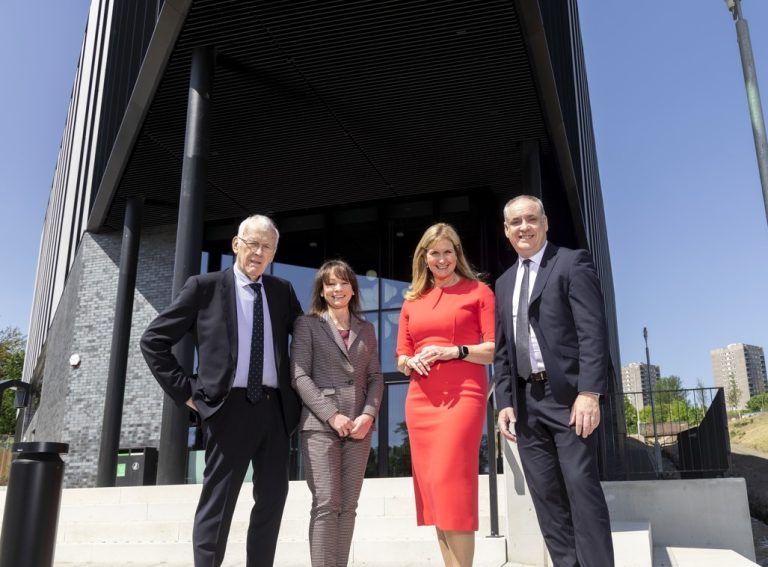
The £40 million ONE BioHub is the iconic new location for life sciences in Aberdeen. Inspiring ambition, giving scientists and innovators skills and knowledge to turn research and innovation into businesses, and supporting them on the entrepreneurial journey. ONE BioHub will provide start-up, spinout and scaling life sciences businesses, tackling modern health challenges with incubator laboratories and offices, fully customisable grow-on space, commercialisation and growth programmes, and access to mentors, expert networks and investors. The new-build industry innovation hub is a focal point for action and investment to diversify the economy and maximise the impact of science and technology from within life sciences companies, the University of Aberdeen, Robert Gordon University and NHS Grampian. It will accommodate up to 400 bio-entrepreneurs at full occupancy. An Aberdeen City Region Deal innovation project, ONE BioHub is led and co-funded by Opportunity North East (ONE) with funding from the UK Government, Scottish Government and Scottish Enterprise. The University of Aberdeen and NHS Grampian are strategic partners and have provided the site for ONE BioHub, in the heart of Aberdeen’s Foresterhill Health Campus. Sir Ian Wood KT GBE, chair of ONE, said: “ONE BioHub will be the transformational place in the North East of Scotland for the entrepreneurial life sciences community and growth sector to meet, share, learn, start up, innovate and grow. It will be a new game-changing technology and business cluster in Aberdeen, accelerating life sciences commercialisation, translating research into solutions in the market, improving health and wellbeing, creating high-growth businesses and high-value jobs, and harnessing the potential of science, technology and innovation to diversify the economy. This adds an exciting new business dimension to our economy.” Deborah O’Neil, OBE FRSE, chairs the life sciences board at ONE and ONE BioHub and is CEO of Aberdeen biotech company NovaBiotics said: “North east Scotland is serious about its life sciences opportunity. The region is home to world-class research and innovation in the University of Aberdeen, Robert Gordon University and NHs Grampian, a thriving community of 2,500 life scientists and a cluster of dynamic biotech, medtech and healthtech businesses. ONE BioHub will make more of all these strengths, assets and talented people. It will inspire the next generation of bio-entrepreneurs to commercialise innovation in the city, solve health challenges and create lasting economic value.” Formally launching ONE BioHub to the life sciences community, partners and stakeholders this morning, Scottish Government Innovation Minister Richard Lochhead said: “ONE BioHub will be a tremendous asset for the North East and the whole of Scotland. It will allow the already thriving life sciences cluster in the region to continue growing, innovating and succeeding. This includes important work in developing innovative treatments for conditions like Alzheimer’s Disease and cancer.” “This reflects the key role that life sciences have in our National Strategy for Economic Transformation and forthcoming National Innovation Strategy. And the partnership working that has made ONE BioHub possible exemplifies what is needed for the successful transformation of our economy.” “That is why the Scottish Government has invested £10 million in BioHub through the Aberdeen City Region Deal.” UK Government Minister for Scotland, Malcolm Offord, said: “This fantastic ONE BioHub facility is an important new platform for the region’s life sciences industries, and I have no doubt that it will rapidly forge an international reputation for excellence.” “The products developed here will improve lives, and reduce pain and suffering worldwide, while the companies based here will bring high quality jobs and investment to the local community.” “The UK Government has invested £10 million in the BioHub, part of our £2.3 billion support for levelling up right across Scotland.” Neil Francis is Scottish Enterprise’s Managing Director for Major Projects said: “I visited ONE BioHub during its construction phase to announce the £2 million contribution from Scottish Enterprise and it is a real honour to be here now and see the iconic building it has become. “Projects such as the ONE BioHub, bringing together our innovators, entrepreneurs and big thinkers in one place, are crucial to the success of Scotland’s future economy. “As Aberdeen transitions to the growth sectors of the future, ONE BioHub will be at the heart of its ambitions to become a leading life sciences destination.” Professor George Boyne, Principal and Vice-Chancellor of the University of Aberdeen, said: “ONE Biohub recognises the leading life sciences research expertise we have here at the University of Aberdeen and across the region and will help nurture that expertise and take it closer to market which in turn will contribute to health, wellbeing and prosperity. The University of Aberdeen is enhancing its support for commercialisation of research and we are excited by the role that ONE Biohub can play in accelerating our impact on the life sciences sector.” Alison Evison, Chair of NHS Grampian, said: “We are delighted that our partners in innovation will be here on the Foresterhill Campus. This cements our commitment to exploring new and innovative ideas with industry and life sciences within our healthcare systems.” Robertson Construction was the main contractor for ONE BioHub and the building was designed by BDP. Elliot Robertson , Chief Executive Officer, Robertson Group, said: “ONE BioHub is one of many projects being delivered by Opportunity North East (ONE) that not only lead to economic diversification in the region, but put it firmly on the global stage through its commitment to assisting the life sciences through innovation and commercialisation.  As the delivery partner of choice for ONE BioHub, we have been working with the local community throughout the build, supporting construction apprenticeships and careers and skills sessions with school pupils. ONE BioHub has been used to inspire and expand knowledge since its inception and will continue to be a place of collaboration with the potential to address global health challenges, whilst creating employment and opportunity.” Christoph Ackermann, Principal, BDP (Building Design Partnership Ltd) commented: “The Opportunities North East (ONE) team is very visionary in its leadership, particularly around economic development and innovation and this is a great example of their commitment


Read More »
Ekkist launches the Healthy Homes Checklist - Quintain and FORE Partnership first to trial

Ekkist launches the Healthy Homes Checklist – Quintain and FORE Partnership first to trial

Quintain and FORE Partnership among the first to trial new Healthy Homes tool in residential development Ekkist, specialist wellbeing consultancy for the built environment, has today launched the Healthy Homes Checklist, a comprehensive tool which supports developers and designers in examining every aspect of home design. The Checklist compiles science-backed best practice to measure the health credentials of new homes and identify areas for improvement in design and construction.  Leading developers Quintain and FORE Partnership are among the industry’s first to commit to using the newly launched tool, which will be adopted with Ekkist’s guidance to measure and improve the health and well-being potential of their new residential projects. The Healthy Homes Checklist comprises more than 130 practical steps across 12 categories that architects, developers and housebuilders can integrate from design stage to construction and through to post-occupancy, to ensure that homes genuinely support the physical and mental health of those living in them. Improving the quality of homes in the UK has never been more important. Latest figures show that 6.5 million people are living in damp, draughty and cramped homes that are harming their physical and mental health. Studies have also shown that indoor air quality is often a great deal poorer than outdoor air quality, which poses a particular risk to those with respiratory conditions (5.4 million people in the UK live with asthma, one in five will have a lung condition in their lifetime) but is a driver of health issues in all individuals. Air quality is just one of many indoor environmental factors that are contributing to chronic health conditions. Tackling the quality of our homes is a crucial aspect of a preventative approach to health that will reduce the burden on the National Health Service in the years to come. The comprehensive category list ranges from external and internal layouts, to design details (architecture and landscaping), through to toxicity of materials, furnishings and air quality; and feelings of community, comfort and happiness. In creating the checklist, the Ekkist team reviewed major health-focussed building standards, frameworks, guidance documents and scientific research papers relating to health and housing design. After pooling this research, it was reviewed with key industry experts and stakeholders, including Michael Chang from the Office for Health Improvement and Disparities, Spire Building Services, Chapman BDSP, GIA and Sandy Brown. This is believed to be the first time such a breadth of categorisation has been brought together in a readily applicable format, that enables developers to assess the cumulative impact that housing design will have on long-term physical and mental health. Current British minimum standards fall far short of ensuring optimal healthy homes, while most voluntary commercial accreditations have broader remits. The Healthy Homes Checklist may be used as a precursor to building certifications such as WELL or the HQM, or to form the basis of design briefs and ESG strategies, or to identify health-focused USPs for new developments. Ekkist co-founder Olga Turner Baker believes that the Checklist will be popular among developers looking to add value: “Not only do healthier homes have the potential to improve the lives of the public and reduce burdens on the NHS, but we are also seeing them be more popular with buyers. We see healthy homes as a ‘triple win’ – a win for consumers, a win for housing providers, and ultimately a win for society as a whole.” Ekkist Director Ben Channon – an experienced architect of residential buildings and specialist in healthy design – co-created the Checklist, and believes that it could have a huge impact on the quality of both existing and future British housing stock: “The sad truth is that lots of homes across the UK still negatively affect the physical and mental health of the people who live in them. This Checklist will make it easier to design new healthy homes and retrofit existing houses to improve health outcomes for all – so that we can provide new homes in both the quantity and quality at which they are required.” Aurélien Collignon of B-Corp FORE Partnership, who will be adopting the Healthy Homes Checklist, feels that there is a strong alignment with their company ethos and business aims. “A number of intersecting societal shifts are dramatically transforming what the buildings of tomorrow will look like: an increasing focus on well-being, the blurring of personal and professional lives, an aging population and an epidemic of loneliness – all combined with the urgency to move to a low carbon economy. We are committed to creating places that produce positive outcomes for residents in terms of health, well-being, and quality of life, while also being good for their local community and the planet. We share Ekkist’s passion for health in the built environment, and we firmly believe that buildings that prioritise the well-being of people and the environment will also be assets that generate healthy returns too.” Clare Masters, Head of Sustainability at Quintain, who will be trialling the checklist across more than 1,000 homes at Wembley Park, adds:  “It’s really important to us to ensure we continue building positive, healthy homes for our residents. We believe that the Healthy Homes Checklist will be a useful tool in helping us achieve this, which is why we’re trialling it across more than 1,000 apartments for rent at Wembley Park, using it to assess the health and well-being credentials of the newly launched Repton Gardens building as well as two further plots that are currently under construction. We believe that building healthy homes is vital to creating places to live that are fit for the future and we are pleased to be partnering with Ekkist to do so.”  If you are interested in applying the Ekkist Healthy Homes Checklist in your development, or simply finding out more, get it touch at ask@ekkist.co. Building, Design & Construction Magazine | The Choice of Industry Professionals 

Read More »
Green Homes Finance Accelerator Bid Gets Green Light

Green Homes Finance Accelerator Bid Gets Green Light

Leeds City Council, Lloyds Banking Group and Arup have been successful in their Green Homes Finance Accelerator Bid, to test and develop financial products for homeowners which enables building retrofit, and improve energy efficiency and comfort for residents. The new funding awarded through the Net Zero Innovation Portfolio (NZIP) by The Department for Energy Security & Net Zero, will support the delivery of the council’s commitments in the Net Zero Homes Plan, which includes establishing a simple one-stop-shop with trusted advice and available finance as a key commitment. Retrofitting homes, the process of making changes to existing buildings so that energy consumption and emissions are reduced, is a key solution in simultaneously tackling climate change and the cost-of-living crisis. Devising a solution that makes the process more straightforward and cost-effective will help homeowners and tenants reap the financial and environmental benefits of a more energy efficient home. Leeds City Council, Lloyds Bank Group and Arup, along with a number of local West Yorkshire organisations, are collaborating to lead the way in how building and energy efficiency improvements and retrofit can be delivered to homes across Leeds. With their Green Home Finance Accelerator (GHFA) grant, the consortium is actively exploring how to make retrofit more straightforward and financially attractive to homeowners. The project is initially looking to support around 1,000 households become more energy efficient and help residents save money through innovative, scalable and replicable energy efficiency, retrofit and finance products. The purpose of this scheme is to create a prototype One-Stop Shop (OSS) solution that can be replicated and scaled to allow rapid adoption across the UK. The OSS aims to provide a seamless journey for customers to find the best solutions for their home, options for installation and provide finance. Current challenges for homeowners include high cost, complexity and difficulty finding suppliers. To respond to these challenges, the consortium has identified a set of priorities which underpin the concept. These include improving the customer process; offering a targeted range of retrofit options; and financial options to pay for retrofit solutions. GHFA funding will be used to design and test a potential Property Linked Finance offer and a smart tariff technology package as part of the wider OSS retrofit project. The OSS concept aims to support customers on a whole house retrofit journey, tailored to the requirements of the property and the customer’s timescale and budget. This can be individual upgrades or whole packages. Councillor Helen Hayden, Executive Member for Infrastructure and Climate, said:  “Helping homeowners to access and afford energy-saving green upgrades for their own properties is a big piece of the puzzle when it comes to ending Leeds’ contribution to climate change.  “That’s why developing innovative solutions which make that possible was a key commitment of the Net Zero Homes Plan that we announced earlier this year.  “I am therefore delighted that the council, in collaboration with our private sector partners, has now been awarded additional funding to turn even more of our ambitious plans into reality”. Stephen Cook, Urban Energy Leader and Director from Arup, said: “We have worked closely with our partners to conduct in-depth user research which identifies what the priorities are for a project of this type. Retrofitting homes is critical at the moment as we tackle both climate change and the cost of living. “By devising a solution that makes the process more straightforward, adaptable and cost-effective, it will help encourage more homeowners and tenants reap the multiple benefits of a more efficient home”. About Department for Energy Security and Net Zero The Department for Energy Security and Net Zero provides dedicated leadership focused on delivering security of energy supply, ensuring properly functioning markets, greater energy efficiency and seizing the opportunities of net zero to lead the world in new green industries. The funding from the Green Home Finance Accelerator comes from the department’s £1billion Net Zero Innovation Portfolio which provides funding for low-carbon technologies and systems and aims to decrease the costs of decarbonisation helping enable the UK to end its contribution to climate change.  Building, Design & Construction Magazine | The Choice of Industry Professionals 

Read More »
Balfour Beatty welcomes Jacobs to its Strategic Design Partnership

Balfour Beatty welcomes Jacobs to its Strategic Design Partnership

Balfour Beatty today announces Jacobs as the new partner for its Strategic Design Partnership. The leading design, engineering and project management consultant joins Atkins and Mott MacDonald as one of Balfour Beatty’s three pre-appointed design consultants, bringing together the best design and engineering capabilities in the industry. Formed in 2017, the Strategic Design Partnership aims to re-frame the designer-contractor relationship, providing Balfour Beatty’s customers with earlier access to a co-ordinated and collaborative design and construction team with a shared vision on delivering best value solutions. The strategic partnership aims to do this through collaboration, designing solutions for complex construction and infrastructure projects in key areas such as health and safety, sustainability, social value, and Modern Methods of Construction. The announcement today builds on the success of the Strategic Design Partnership which secured the IS044001 accreditation for collaboration in 2018. Stephen Tarr, Balfour Beatty Chief Executive Officer for Major Projects Transport, Energy and Power at Balfour Beatty, said: “We are delighted to welcome Jacobs to our Strategic Design Partnership, joining together with Atkins and Mott MacDonald as we continue to re-frame the designer-contractor relationship and drive enhanced collaboration and innovation across the construction and infrastructure industry. “At Balfour Beatty, we truly believe that collaborative partnerships such as the Strategic Design Partnership have the opportunity to revolutionise our industry and must be considered as the vehicle of choice to ensure that projects are procured, designed and delivered safer, faster, better and greener.” Bruce Chalmers, Jacobs People & Places Solutions Vice President and Executive Sponsor said: “The Strategic Design Partnership enables closer integration of our collective expertise to drive efficiencies and co-create value-focused solutions for long-term transformation. “This is an exciting opportunity to help shape the future of UK infrastructure delivery, putting sustainability and different ways of working at the heart to build better outcomes for society and the environment.” Building, Design & Construction Magazine | The Choice of Industry Professionals 

Read More »
Fortis Vision sustains mark of quality with three successful ISO recertifications

Fortis Vision sustains mark of quality with three successful ISO recertifications

Nationwide refurbishment contractor, Fortis Vision, has announced that it has been recertified with its three ISO accreditations following a five-day audit. The accreditations are for ISO 9001:2015 quality management system (QMS) – a recognised world leading standard, ISO 14001:2015 – the international standard for environmental management systems (EMS) and the most widely used EMS in the world, and ISO 45001:2018 – an international standard that specifies requirements for an occupational health and safety (OH&S) management system. Obtaining these recertifications involved significant effort from the Fortis Vision team and included a – a site audit, a remote audit and three days at the office and warehouse. The team worked collaboratively to ensure management systems conformed to the requirements of the audit standard, providing procedure and policy documentations, as well as statutory, regulatory, and contractual requirements. Organisation was also key to the effective implementation of the planned management system and making sure the system was meeting its specified objectives. The recertifications are every three years and verify the quality of work as well as the financial, administrative, operational and health and safety practices carried out by the company. David Borthwick, managing director at Fortis Vision, said: “This a huge achievement for Fortis Vision and our three ISO Certifications place us in a very select group of companies that prioritise best practice. “Quality and assurance have always played a vital part in the delivery of our work, which is all about continual improvement and driving innovation. Not only do these awards showcase the hard work of our team and our quality and sound practices, but they can inspire confidence in our existing and new clients as we continue to grow.” To find out more about Fortis Vision and its projects, please visit: www.fortisvision.com.

Read More »

The future is green – and how the construction sector must support this vision.

By Cécile Fages, Chief Sustainability & Communications Officer at Xella International GmbH The desire to live in a comfortable home or work in an inspiring office environment is an old one – but it’s been given new impetus since the COVID-19 pandemic. This is not to mention the mas- sive increase in the popularity of home office and new trends like the concept of “workation”. Workplaces can no longer rely on the “9-to-5” to get their employees into the office. Instead, they must adjust to the “new normal”. Rising energy prices caused by recent geopolitical challenges have also prompted people to think more critically about the sustainability of their homes, the efficiency of their heating systems and their own mobility. At the same time the need to reduce the CO2 footprint has never been higher. The UN Climate Change Conference has called to limit the global temperature increase to 1.5 °C (Paris Agreement), and climate change is increasingly prominent in political and media debates. The ideal, it seems, is obvious: the demand for sustainable but affordable buildings in cities, where citizens, productivity, community, environment, nature and culture can all come together equitably. But how we do get there? At Xella, we work hard to make sure that the dream of comfortable, sustainable places to live and work can come true for as many people as possible. However, our ambition goes even further. Indeed, our vision states that “We are building a SUSTAINABLE world”. The political framework for a more sustainable world is already set. The European Commission presented its European Green Deal (EGD) for the European Union (EU) and its citizens in December 2019. The goal is to transform the EU into a prosperous society with a modern, resource-efficient and competitive economy, where there are no net greenhouse gas emissions from 2050 onwards and where economic growth is decoupled from resource use. Over three years later, the urgency of acting on the climate crisis has not decreased. Our industry, the construction sector, can and must play a key role in achieving these goals. Now is the time to act. The current global economic context is already impacting the construction industry. Sales are decreasing, stockpiles are increasing, and almost all companies in the construction industry are reporting a slowdown of activity across Europe. Interest rates and inflation are very high, private households and professional investors become more cautious to invest in new housing or commercial buildings. This poses an additional challenge for the construction industry. According to the European Commission, greenhouse gas emissions from material extraction, manufacturing of construction products, as well as construction and renovation of buildings are estimated at 5-12 percent of total national greenhouse gas emissions. Hence, the construction industry must become more sustainable if it wants to continue as a viable industry. Companies who take the strategic decision to invest in high-quality and durable products based on mineral raw materials will have a competitive advantage in the long term, as they make an important contribution to sustainable construction. An increasing number of customers already today, and for sure even more so in the future, are asking for building material that is sustainable, efficient and affordable. The same is true for investors: they are becoming more eager to identify opportunities to invest in green projects and companies that can lead the way to more sustainability in our sector. Especially, as it has recently been criticized by the World Economic Forum in being “a latecomer*” with regards to decarbonization. Those investors will value companies who demonstrate their responsibility and commit themselves to science-based CO2 emissions reduction targets as part of their sustainability reports. Both developments will have a positive impact on the profits of those companies that have set the right course early on. How can the construction industry reduce its CO2 footprint? return material from production, and ultimately introduce waste coming from demolition on their products’ recipes. I am confident that we can find the right solutions together. But I am also certain that companies who have not seen the writing on the wall and are not acting now will sooner or later disappear from the market. Sources: https://www.handelsblatt.com/downloads/28946720/1/hb-business-briefing-investments_02_23.pdf https://single-market-economy.ec.europa.eu/industry/sustainability/buildings-and-construction_en#:~:text=Greenhouse%20gas%20emissions%20from%20material,save%2080%25%20of%20those%20emissions

Read More »
Salboy bolsters senior Sales and Marketing management team with first global sales lead appointment

Salboy bolsters senior Sales and Marketing management team with first global sales lead appointment

Salboy Group, the nationwide property development and funding company, has named Carmen Ching as the Group’s first Head of Sales. Carmen, a senior director at Salboy since 2020, becomes the first person to be handed a global remit to lead Salboy’s international sales strategy.  For the last three years, Carmen has been Salboy’s Head of Asia Pacific based in Hong Kong. Following her promotion and reporting to Simon Ismail, Co-Founder & Managing Director of Salboy Group, Carmen will continue to lead Sales in Asia from Hong Kong while directing a global sales strategy that is implemented across the world in Manchester, London, Hong Kong, Beijing, Shanghai and the Middle East.  With 16 years’ experience in international residential property including leading the international residential team at Colliers, Carmen has developed a strong and vast client base across South-East and North-East Asia. Her experience of Western and Eastern working cultures, her expertise in investment advisory, and her multiple past successes in managing investor portfolios including block deals are all highly beneficial to international investors in UK property. Bringing her vast industry knowledge and wide-ranging skill set to her global strategic role, Carmen will be responsible for the success of the sales and marketing teams she leads not only across Asia but throughout the world where Salboy has a presence.  Simon Ismail, Co-Founder & Managing Director of Salboy, comments: “Since we were lucky enough to welcome Carmen to the Salboy team in 2020, she has been instrumental in maturing our sales strategies, nurturing our teams and ultimately driving our growth across Asia. We are hugely excited that Carmen has accepted our proposal to lead our sales strategy on a global basis in the future and we look forward to seeing the impact she has on all our talented sales teams wherever they are in the world. “Ensuring that our sales process reflects how borderless the UK property market has become is essential. Our client base is hugely international in its reach as more international clients buy UK property not just for investment but as homes for their children while studying at first-class UK universities or as homes-from-home during extended business travel. A globalised, coordinated approach will help ensure our discerning clients experience a better, easier and faster service from us.” Carmen is supported by Salboy’s experienced senior management team, including Zann Quek and Benjamin Ashcroft. Zann brings 14 years’ experience as a UK and international property professional to her role as Head of Greater China and Regional Director following previous directorships at JLL, Knight Frank and Colliers. Benjamin joined Salboy in 2019 as Head of Marketing and has 17 years’ extensive experience in project marketing and branding in the UK, Asia and Middle East. Carmen Ching, Head of Sales at Salboy Group, adds: “Collaboration will be key to achieving our ambitious growth goals over the next five years. Salboy has over £1 billion worth of property currently in development in London, Cornwall and Manchester – all parts of the UK where the demand for high quality housing continues to outstrip supply. We need to continually expand our sales presence globally to ensure that buyers throughout the world have the opportunity to access Salboy property built where it is most needed. Working with Zann, Benjamin and the rest of our global sales and marketing team, I look forward to rolling out a strategy that brings together our collective knowledge and expertise to help us maximise the potential ahead of us.”

Read More »
Land & Water helps return historic lake back to its former glory at Boughton House

Land & Water helps return historic lake back to its former glory at Boughton House

Working at historical British landmarks is nothing new for leading wet civil engineering firm Land & Water as it announces the commencement of works at Boughton House, having been engaged by Buccleuch, to return Star Pond, which dates back to the 1700s, to its original shape. Situated in Northamptonshire, Boughton House dates back to 1528 when it was once the home of the Montagu family who took style inspiration from the French, leading to the House being coined the ‘English Versailles’. In the 20th century it became home to the Duke of Buccleuch and Queensberry who wished to preserve this national treasure. Over the last three decades, Buccleuch has been working to uncover long lost waterways and lakes dating back over 300 years. As part of this, Land & Water will be restoring Star Pond which earnt its name through its original star shape. Having become built up with silt, the wet civil engineering firm will be carrying out dredging works as well as ensuring the pond cascades back to link with other estate waterways and the River Ise. Roger Baines, Contracts Manager at Land & Water, said: “We are delighted to be working at another historical landscape and preserving the future of the waterways at Boughton House. “As well as the works to return Star Pond to its former glory, we will also be installing an aquatic channel to enable fish and other aquatic life to easily travel down to the River Ise, as well as to support flood protection. “The environment is front and centre of all that we do at Land & Water and as part of this we want to ensure that we are supporting the creation of habitats to increase biodiversity.” David Cullum, Parks and Gardens Manager at Boughton Estate says: “In their heyday, the gardens were considered to be among the largest and finest in the country and in the last 30 years, considerable work has taken place to restore various features. It is an absolute privilege to be involved in this next exciting step of this journey and the restoration of Star Pond.” “Everything we do should have a positive impact on the environment, whether that be designed or natural. We are excited to be able to do both with the restoration of Star Pond.” Land & Water is due to be working at Boughton House until the end of summer. This coincides with another historical project at World Heritage Site, Blenheim Palace, to remove 300,000m3 of silt from Queen Pool to preserve the legacy of the waterway for years to come.

Read More »
Call for wider support to solve housing crisis

Call for wider support to solve housing crisis

Homes for Scotland (HFS), the leading representative body for the Scottish home building sector, is calling for a rethink across government and wider society on how to address the spiralling housing crisis. Launching its new five-year strategy ‘Home building as a force for good’ today (Friday) and in the context of a 110,000 homes shortfall with a worrying downward trend in the number of new homes being started, theorganisation wants better local and national government collaboration and the voices of the silent majority heard in order to tackle Scotland’s chronic undersupply of housing across all tenures.  In addition to the 110,000 homes shortfall which has accumulated since 2008, latest Scottish Government figures show a decline of 12% in home building starts overall and a 27% reduction in social housing approvals.  Chief Executive Jane Wood said: “Having accumulated a shortfall of 110,000 homes since 2008, Scotland’s housing crisis is well recognised. Just as this affects us all, so it is up to each and every one of us to take responsibility for ensuring that we have enough homes for those who need them now and for future generations. “From health and education to jobs and investment, housing impacts every area of our lives and is key to advancing social justice and tackling inequality, but we simply don’t have enough homes. “Unfortunately, home building is a hugely politicised and contentious issue and I’m calling on those of us who already have homes to be more supportive of those who don’t.   “Delivery challenges across the sector have never been greater, from rising costs and skills shortages to planning delays and changes to building standards as part of the transition to net zero. These barriers are now making it harder than ever to build new homes in Scotland. Our sector is not able to compete on a level playing field compared to elsewhere in the UK. “SME builders, in particular, are bearing the brunt with their numbers having already declined significantly and with the viability of many projects in doubt, some smaller home builders have abandoned home building plans altogether.    “The housing crisis has already had a drastic and far-reaching impact on Scotland’s economic and social development. If we don’t get this sorted, the consequences on the life chances of future generations will be even worse.” On average, major housing applications are taking 39 weeks to reach a decision from the time of registration. The national target for determining major housing applications is 16 weeks. As well as the barriers relating to planning and regulation, negative perceptions of home building also have far-reaching consequences, impacting the sector’s ability to get on with delivering more homes. Misinformation and opposition to new developments continues to have an effect but, in reality, only 2.1% of land in Scotland is built upon, the lowest level in the UK.  “I am asking us all to pause and reflect before condemning the building of new homes, recognising the urgent and critical need that exists right across the spectrum. It’s time to embrace the benefits new homes bring and for the voices of the silent majority to be heard by those who influence and direct local and national policy. “We need urgent action with better collaborative working between key players to solve what is a chronic issue and help stimulate growth.” New complex regulations like the National Planning Framework 4 as well as costly, time-consuming and difficult consent processes are all making it more difficult for developers to build new homes. HFS wants to facilitate joined-up and partnership approaches with the Scottish Government, local authorities and stakeholders to facilitate housing delivery and ensure policies and regulation are implemented appropriately, fairly and in support of much needed homes. Speaking ahead of the organisation’s strategy launch at the annual HFS awards today Jane Wood continued: “We must have a policy environment that supports development rather than frustrating it and one which attracts investment otherwise we will stymie our ambitions and damage the potential of our towns, cities and rural communities.  “Above all else, policy-making must be informed by contextual data and market insight to avoid unintended consequences across other National Outcomes.”  Accurate and current data from government and local authorities is crucial to creating a more authentic picture of the actual need for new homes in Scotland. However, this is very much a missing piece of the housing jigsaw, with its absence obscuring the true picture of housing need.  HFS plans to work with the Scottish Government, local authorities and its members to create relevant data sets to ensure the homes that are needed are delivered on the ground, not just on paper.  The new HFS strategy highlights the organisation’s aim to lead the conversation on the move to net zero carbon housing through the development of a clear road map to support the transition, working with members to achieve targets on timescales that are commercially realistic through the creation of a Scottish Future Homes Hub.  Today’s Homes for Scotland’s awards support this with a focus on ‘People, Place, Planet’, highlighting the sector’s social, sustainable and environmental goals.  Jane Wood concludes: “Building the homes our country requires is undoubtedly a difficult and complex job, but the undisputed fact is that home builders of all tenures are committed to playing a critical part in what is the most basic of humanitarian activities. “That is why I am making it my mission to ensure this is an issue that we all own. How each of us reacts to the building of much-needed new homes is vital to not only end our housing crisis but also to help eradicate homelessness and child poverty, tackle climate change and promote inclusive growth. Only once everyone has a place to call home will these goals be achieved. Faisal Choudhry, Head of Savills Scotland Residential Research, said: “Homes for Scotland’s latest five-year strategy covers a wide range of issues facing the supply of new homes. Its launch comes amid an array of supply and production constraints facing the

Read More »