Kenneth Booth

£400m Woolwich Exchange plans submitted to Greenwich Council

Grade II-listed market building reimagined for community use as a cinema, restaurants and bars Proposals to transform the Grade II-listed Former Covered Market and surrounding land in Woolwich, SE18, into a sustainable new neighbourhood with an estimated GDV of £400 million have been submitted to the Royal Borough of Greenwich. 

Read More »

Improving safety for nighttime road construction workers

Nighttime road works and motorway improvements have increased in recent years with many road construction companies now choosing to undertake improvements overnight. While operating overnight provides clear benefits for those using the road network, minimising disruption and reducing diversions for commuters, there are serious implications for construction workers’ safety due

Read More »

Build back greener, not just better

Euramax demonstrates how modular construction can help the country build back greener Following UK Prime Minister Boris Johnson’s announcement of £350 million in funding to help cut carbon dioxide (CO2) emissions in industry, construction and transport, Yorkshire based windows and doors manufacturer Euramax explains how modular construction could help the

Read More »

East Midlands Gateway logistics park work underway for large DHL Shed

Parcel company takes 10 year lease on second warehouse at huge distribution park just north of East Midlands Airport Global logistics operator DHL has taken a second big unit at the vast SEGRO Logistics Park East Midlands Gateway being built on the Leicestershire/Derbyshire border. The parcel company has taken a

Read More »

IP INVESTMENT MANAGEMENT & MAVEN CAPITAL PARTNERS DELIVER NEWLY COMPLETED HAMPTON BY HILTON HOTEL

IP Investment Management (“IPIM”), a Hong Kong-based boutique real estate investment manager and Maven Capital Partners (“Maven”), a leading UK property and private equity manager, have partnered to build Manchester’s first Hampton by Hilton hotel. The venture is Maven’s first hotel collaboration with IPIM, having already worked together on eight

Read More »

The Future of Construction

 Four Tech trends transforming the way we work The COVID-19 pandemic has had a significant impact across UK business and industry and we’re already witnessing a rapid and forced evolution in the way we work. For UK the construction industry, this is as much on site as it is at

Read More »
Latest Issue
Issue 343 : Aug 2026

Kenneth Booth

CIOB REACTION TO HCLG REPORT ON PRE-LEGISLATIVE SCRUTINY OF BUILDING SAFETY BILL

The Chartered Institute of Building (CIOB) has responded to the Housing, Communities & Local Government Committee’s (HCLG) report released today (24 November 2020) on the pre-legislative scrutiny of the Building Safety Bill. The report states that “the Government must improve on the detail if it is to demonstrate that its new building safety proposals will drive much needed reform in the sector…and that in its current form, the draft legislation fails to provide sufficient protection against leaseholders paying the bill for work to remedy existing fire safety defects.” The CIOB formally responded to the call for evidence and are supportive of the Committee’s recommendations. It is particularly pleased to see the Committee call for more detail around the yet unpublished secondary legislation to remove any doubt on the scope of the legislation and the responsibilities on building operators. Additionally, it is positive that the Committee have acknowledged the importance of accreditation to ensure that stakeholders have the confidence in the competence of persons undertaking the new building safety manager role. We look forward to working with the Government to ensure the Bill drives forward reform and remedies the flaws in the existing system as identified in the Hackitt review. The Committee’s report can be accessed here: https://publications.parliament.uk/pa/cm5801/cmselect/cmcomloc/466/466.pdf

Read More »

A Lesson in Sustainable Construction: Former School in Gloucestershire to be Transformed into Energy-Efficient

Boutique property company MELT Homes is celebrating the official launch of Lime Grove; a stunning new development in Tuffley, Gloucestershire. Complying with current social distancing regulations, the MELT team is inviting interested buyers to visit the new show home to learn all about the developments’ 19 homes that are being built on the former premises of Tuffley Primary School. Alternatively, house hunters can carry out a virtual viewing. With prices starting from £210,000, all of the homes benefit from the stamp duty holiday and can be purchased using Help to Buy. Having stood empty since 2014, the dilapidated building, which also briefly housed the Tuffley Resource Centre, had been in dire need of a new purpose. MELT secured planning permission to create Lime Grove; a residential community that puts particular emphasis on sustainability. Already incorporating the government’s Future Homes Standard 2025, which asks for new homes to be built without gas boilers, Lime Grove will be a completely gas-free development. In addition, all properties will utilise Ground Source Heat Pumps, a highly efficient, renewable energy source that has a low environmental impact and reduces carbon output by as much as 70%. Evan Maindonald, CEO and Founder at MELT comments: “Integrating a new residential community into an existing neighbourhood is a delicate matter. We wanted to ensure that Lime Grove’s design combines technical innovation with timeless exteriors that reflect Tuffley’s surroundings. We are delighted that the feedback during our show home launch has been extremely positive and are looking forward to welcoming our first residents in the near future.” …/ MELT’s forward-thinking and sustainable approach hasn’t gone unnoticed. Most recently, Lime Grove scooped up three awards at this year’s UK Property Awards, including recognition for its architectural design and layout. Maindonald adds: “The existing structure of the school building is being protected and preserved but will benefit from a 21st century makeover to feature seven stunning two- and three-bedroom apartments. Naturally, we have named these ‘Schoolhouse Apartments’ to pay tribute to the building’s history. In addition to the apartments, we are creating 12 new family homes, using timber frames; one of the most sustainable building materials available.” Located on the surrounding grounds of the apartment building, the houses are part of either ‘The Oak’, ‘The Lime’ or ‘The London’ collection. The latter differentiates itself by consisting of four semi-detached four-bedroom houses, whereas ‘The Oak’ and ‘The Lime’ properties are detached and feature either five or four bedrooms. All family homes boast private gardens and the apartments benefit from their own outside space as well. To celebrate the school’s Victorian architecture and design, the exterior of the newly-built homes will feature a colour scheme that mirrors that of the existing building. Equal attention to detail is being paid to the properties’ interiors, which flawlessly connect each room to create a homely feel. Whilst the Schoolhouse Apartments measure between 595 to 959 sq. ft. and embrace the building’s Victorian architecture with high ceilings and spacious layouts, the family homes are spread across three storeys, ranging from 1,270 to 1,935 sq. ft. in size. Branded fixtures contribute to the residences’ high-quality feel and include stylish Paula Rosa kitchens with Siemens and Neff appliances as well as bathrooms that are embellished with elegant Villeroy & Boch suites. With the first of Lime Grove’s three building phases due to complete this winter, interested buyers are invited to visit the newly opened show home located at Grange Road, Tuffley, Gloucester, GL4 0DJ. Opening hours are from 10am to 4pm, Friday to Monday and due to COVID restrictions by appointment only. To book your time slot, please contact MELT’s friendly team on 01452 346 174, email sales@limegrovegloucester.co.uk or visit www.limegrovegloucester.co.uk

Read More »

£400m Woolwich Exchange plans submitted to Greenwich Council

Grade II-listed market building reimagined for community use as a cinema, restaurants and bars Proposals to transform the Grade II-listed Former Covered Market and surrounding land in Woolwich, SE18, into a sustainable new neighbourhood with an estimated GDV of £400 million have been submitted to the Royal Borough of Greenwich.  Preserving Woolwich’s heritage The proposals for Woolwich Exchange retain the historic Former Covered Market building on Plumstead Road.  The building will become home to a new five-screen Picturehouse cinema, cafés, bars and restaurants allowing visitors to experience the expansive Lamella roof structure which was the main focus of the decision to list the building in 2018.  Picturehouse, which has confirmed its commitment to the scheme despite the current challenges facing the cinema industry in the wake of the Covid-19 pandemic, will open Woolwich’s first cinema in a generation following the closure of the Coronet in 1999. The Former Covered Market is currently closed to the public. The proposals reimagine the space and open it up for the whole community to enjoy. Extensive consultation with the Woolwich community has helped shape the plans and shown very high levels of support for the regeneration. The community requested historic elements of existing buildings were incorporated into the design, to help tie the new development’s identity to Woolwich’s heritage. As a result, several of the historic buildings on Woolwich New Road will be preserved and enhanced as part of the final plans. A sustainable development, built for the future Woolwich Exchange includes 801 homes, designed for flexible living, with space to live and work at home.  158 of the homes will be offered as affordable tenures and include a large number of much needed family-sized properties. The scheme will also provide a nursery, children’s play space, a gym and workspace.  The Energy Strategy across the whole development will see savings in CO2 emissions of over 50% compared to the requirements defined by building regulations.   The proposals feature new green, public spaces at the heart of the site, with extensive planting, benches and alfresco tables for cafés, bars and restaurants, offering a new, outdoor environment in the middle of Woolwich town centre, as well as promoting urban biodiversity. A well-connected site on the Elizabeth Line Woolwich Exchange is in TfL’s Zone 4 and sits between Berkeley’s Royal Arsenal Riverside development which includes the Elizabeth Line’s Woolwich Station (Crossrail), and the Woolwich Arsenal DLR and National Rail stations.  With numerous bus routes passing along the edge of the site, Woolwich Exchange is superbly located to attract new residents and visitors from all over London. New pedestrian and cycle routes across the car-free development will create pleasant connections to different parts of the town centre. Creating jobs and boosting the local economy The regeneration will trigger a major boost to Woolwich’s daytime and evening economy, generating over 600 temporary jobs during the construction phase and nearly 200 permanent jobs in the retail, leisure and employment spaces that will be created. Plans for the site represent a major investment and commitment in the future of Woolwich, with the development estimated to add £60 million per year to the local economy during construction, and £10 million a year once complete. The plans have been developed by a joint venture partnership between developer St. Modwen and housing association Notting Hill Genesis, which was appointed by the Royal Borough of Greenwich to deliver the scheme.  Although we’ve been working on these plans over a number of years, the changes in the way people work and spend their leisure time as a result of the Covid-19 pandemic have confirmed our desire to create a neighbourhood that offers it all: space to live, work, socialise and enjoy – both indoors and outdoors. Woolwich Exchange will be a place for everyone, existing residents as well as newcomers, which is why we have designed our proposals to encourage visitors and passers-by into the area. Our plans will create new connections, boost the local economy and generate new jobs, and we look forward to continuing our work with the Royal Borough of Greenwich and the local community to deliver them.” Gary Morris, Senior Development Manager at St. Modwen From the outset, we’ve been focused on delivering high quality and energy efficient affordable homes and facilities for the community at Woolwich Exchange.  It has been great to see the positive feedback we’ve received from the community and see this shape the final plans. We believe we’ve retained and reflected the unique identity of Woolwich in this new scheme, while creating a well-designed, sustainable development that offers something for everyone.” John Hughes, Group Director of Development at Notting Hill Genesis Designed by award-winning architects Panter Hudspith and Glenn Howells, with landscape design delivered by HTA, construction could begin in 2023 if the plans are approved by the Royal Borough of Greenwich and the GLA next year. For more information or to sign up for updates, visit woolwichexchange.co.uk The development team can be contacted on 020 7323 3544 or info@woolwichexchange.co.uk

Read More »

Muse chooses GMI to build new purpose-built job centre for the Department for Work and Pensions

New 12,000 sq. ft. office building to be built in South Shields will become the towns new relocated Jobcentre Plus. GMI Construction Group has announced that it has been awarded a contract by long-time customer and urban regeneration specialist Muse Developments to construct a new 12,000 sq. ft. office for the Department for Work and Pensions in South Shields. The contract will see construction of a new purpose-built BREEAM ‘Very good’ rated building which will serve as the town’s new relocated Jobcentre Plus. Approved by South Tyneside Council It will feature as part of the wider repurposing of South Shields town centre.  The scheme will see the current branch in Barrington Street moved to the new purpose-built facility on Mile End Road. Talking about the instruction Lee Powell GMI Divisional Managing Director said: “We are pleased to have been awarded this important new build contract by Muse Developments and to continue GMI’s successful partnership and affinity with them.  We are also pleased to be working with the DWP for the first time and to be delivering for South Tyneside Council.  This project compliments  our portfolio of completed public sector office buildings   including the successful delivery of Rotherham Metropolitan Borough  Council’s  200,000 sq ft state of the art civic centre and offices, as well as the award winning 33 Wellington Street office building in Leeds for our client Lancashire County Council, a building that is more noticeable as law firm Walker Morris’ headquarters. We look forward to delivering the project on time and on budget and working with the full project team.” Muse – one of the UK’s best at delivering transformational town and city centre regeneration – has been working with South Tyneside Council to deliver the council’s 365 Regeneration masterplan, which has brought forward two statement schemes; the South Shields Interchange, and the National Centre for the Written Word – The Word. David Wells, regional director at Muse Developments, said: “Everyone involved with the South Shields scheme has been working tirelessly to make sure the scheme delivers for our partners at the council and the DWP and we’re delighted to get approval for the new facilities. “This building is key to our collective ambition to deliver a new repurposed town centre. Working collaboratively with South Tyneside Council, we’ll continue to transform the town centre, driving both economic and social prosperity for all and importantly bringing a new vibrancy to South Shields. We look forward to once again working with our trusted partner GMI” The scheme is anticipated to start on site later in the year, with a 12-month build programme.

Read More »

Improving safety for nighttime road construction workers

Nighttime road works and motorway improvements have increased in recent years with many road construction companies now choosing to undertake improvements overnight. While operating overnight provides clear benefits for those using the road network, minimising disruption and reducing diversions for commuters, there are serious implications for construction workers’ safety due to poor visibility and worker fatigue. Construction is a hazardous occupation and road construction is ranked as one of the most dangerous occupations in the world. Research has shown that 55% of incidents occur within the work zone itself, with the majority of worker deaths and injuries involving a moving vehicle. Blind spots on vehicles are a major contributing factor to collisions and are often the main reason ground workers are killed or injured. Poor visibility, due to working overnight, dusty worksites and difficult weather conditions, all exacerbate this issue. Meanwhile, ground workers who are required to wear ear defenders cannot always hear a vehicle approaching. Vehicle safety systems are helping to address this issue. While passive systems, such as mirrors and cameras, will help assist a driver to spot objects in a vehicle’s blind spot, active systems, including operator alerts and reversing alarms, ensure that drivers receive an immediate warning that an object is present and pedestrians are aware instantly that a vehicle is nearby. Emily Hardy of Brigade Electronics, a global leader in vehicle safety systems, explains the importance of active systems for nighttime working. “Work sites present a number of challenges when it comes to visibility. Not only are they dusty and dirty places to be, but when this is combined with nighttime hours or difficult weather conditions, it can become increasingly dangerous for ground workers to be spotted by those operating moving vehicles. Active safety systems are therefore crucial to assisting drivers and enhancing safety for workers operating in these conditions. This is why we always recommend that a combination of both passive and active systems, such as cameras and alarms, are fitted to vehicles for the ultimate safety solution.” These include Brigade’s award-winning Backeye®360, which provides the driver with a complete surround view of the vehicle in real time in a single image. The system combines images from ultra-wide angle cameras, resulting in a ‘bird’s-eye view’ of the vehicle and surrounding area in real time, meaning drivers can clearly see people and objects as they manoeuvre their vehicles. Active technology like radar obstacle detection can detect stationary and moving objects even in the harshest of environments, including in darkness, giving the driver an audible and visible warning when objects are within a certain distance. Heavy duty radar systems, which are waterproof and smoke resistant, can even operate in high or low temperatures, and can easily be heard in noisy environments, making them ideal for construction sites. One construction company which has benefited from installing safety technology on its vehicles is UK-based business Day Aggregates. It fitted Brigade’s Backsense heavy duty radar sensor system onto its fleet of shovel loaders, tele-handlers and trucks. In the last few years of recording incidents, which are split by ‘damage’ and ‘near miss’, the company has reported that this technology has been key to reducing incidents and improving safety. Operator Darren Harfield agrees. He said: “It (the radar) is an extra back up when looking in numerous mirrors and using reversing aids. If you’re distracted, for example because someone suddenly asks you a question on the radio, you can be trying to take in too much at one time. The radar system prevents this. There’s an in-cab display that presents different colours and beeps when anything comes within a certain distance of the vehicle, so it’s not just visual prompts, but audible alerts too.” 

Read More »

TODD Architects led Nightingale project opens at Whiteabbey Hospital, Newtownabbey

Northern Ireland Health Minister Robin Swann has officially opened Northern Ireland’s second Nightingale Hospital in County Antrim. The new facility at Whiteabbey Hospital will ultimately have up to 100 beds available to ease pressure on the region’s Covid-19 wards in the event of further surges in cases over the winter period.  TODD Architects was appointed as architect and lead consultant to the project, working alongside Beattie Flanigan, Doran Consulting and Currie & Brown as an integrated design team. The creation of this vital enhanced rehabilitation facility was only announced in September and had the dual challenge of being delivered within a tight programme and on the site of a working hospital. Drawing on its extensive and award-winning healthcare design experience from across the UK, the healthcare team at TODD Architects oversaw the process of delivering the 100-bed scheme at Newtownabbey safely and at speed, whilst also ensuring the facilities met the strict healthcare requirements of the Northern Health and Social Care Trust. The new Nightingale will generally cater for low acuity/step-down patients who are well enough to leave an acute hospital but who would benefit from a period of intensive rehabilitation. However, the scheme has been designed and delivered to provide some flexibility to step-up care when and if required. In the immediate term, it will be managed as a regional resource to support the response to Covid-19, but in choosing to remodel an existing hospital facility it also provides a valuable longer-term asset for the provision of healthcare in the region. Andrew Murray Director at TODD Architects said: “The successful delivery of this vital healthcare facility was the product of an incredible collaboration between the Design team, Main Contractor Dowds Group, the Northern Trust and CPD Health Projects on a ‘live’ hospital site. This monumental team effort has achieved the highest possible standard of healthcare services within a tight timeframe. It has been amazing to witness the whole construction industry come together with purpose to support the tireless work of the NHS in this time of crisis.” Nicholas McKee, Build Manager at Dowds Group added: “We were delighted to once again partner TODD Architects on another landmark hospital project. The works necessitated completion to an exceptionally high quality and one of the tightest build programmes we’ve faced. We are very proud of the extended site team who went over and above to do their part to contribute to Northern Ireland’s fight against Covid-19.”

Read More »

Build back greener, not just better

Euramax demonstrates how modular construction can help the country build back greener Following UK Prime Minister Boris Johnson’s announcement of £350 million in funding to help cut carbon dioxide (CO2) emissions in industry, construction and transport, Yorkshire based windows and doors manufacturer Euramax explains how modular construction could help the country build back greener, as well as better. The funding, part of the “Build Back Better” campaign, is designed to help combat CO2 emissions and restore the economy’s position following the COVID-19 pandemic. Investments include support for materials innovation, including research into steel sustainability, and £26 million to support advanced building techniques. As well as boosting the construction industry’s productivity, it’s vital that the government’s funding positively impacts its environmental status. Currently, 39 per cent of global CO2 emissions are attributed to building and construction. Broken down, 28 per cent comes from the energy used to heat, cool and light buildings, while the remaining eleven per cent is from the materials and construction processes used. Just under half of the £350 million investment is being used to fund the use of innovative materials to cut emissions in the sector. Modular construction, the process of manufacturing parts of a building, known as modules, offsite and transporting them to site for assembly will significantly support all of the environmental focuses outlined by the government. “Apart from being cheaper and quicker to build, modular construction methods also have less environmental impact compared to traditionally constructed buildings”, said Nick Cowley, managing director at Euramax. “As modular builds can be completed 50 per cent faster, fewer resources are required, which also produces 90 per cent less waste. “Although glass, steel and concrete are fundamental materials in building and construction, their production is highly energy intensive, whereas 94 per cent of the materials used to construct a modular build are recyclable. All of these benefits point to a solution that is less harmful to the environment, further supporting the reduction of emissions across the sector”, added Cowley. Euramax, which supplies its windows and doors to a number of modular construction projects, has formed close relationships with modular home manufacturers Ilke Homes, for which Euramax is supplying the windows and doors for over 2,000 of its modular homes. “Modular builds are also environmentally friendlier to run because they are incredibly airtight. Energy efficiency is crucial in modular builds, and our products, which are rated A for their energy efficiency by the British Fenestration Ratings Council (BFRC), are perfect modular components. Higher energy efficiency means less power is required to heat a build, which could reduce overall emissions of the built environment.” “To “build back better”, we must actively do as much to build back greener, and investing in modular construction for this purpose is certainly a step in the right direction”. For more information about how Euramax supports modular construction go to www.euramaxuk.com.

Read More »

East Midlands Gateway logistics park work underway for large DHL Shed

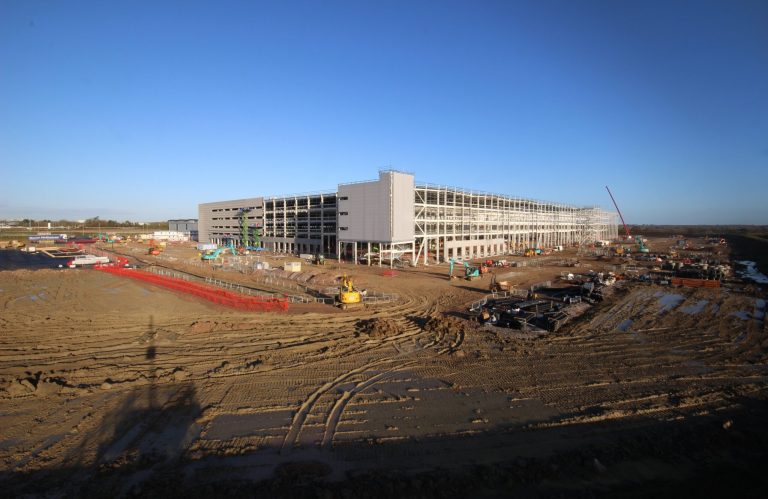
Parcel company takes 10 year lease on second warehouse at huge distribution park just north of East Midlands Airport Global logistics operator DHL has taken a second big unit at the vast SEGRO Logistics Park East Midlands Gateway being built on the Leicestershire/Derbyshire border. The parcel company has taken a 10 year lease on a 192,000 sq ft facility at the huge distribution park next to the M1, just north of East Midlands Airport. It takes the total space pre-let to DHL there close to 900,000 sq ft. Back in August, planning permission was granted for a 670,000 sq ft building for DHL on the warehouse park – covering an area the size of about 80 football pitches and likely to provide employment space for hundreds of people. East Midlands Gateway – which is served by its own rail freight interchange – is already home to a number of big warehouse buildings occupied by Amazon, Very, XPO Logistics and Kuehne and Nagel. Once complete, it will provide six million sq ft of space and create an estimated 7,000 jobs. DHL also has a significant base at the nearby airport. BusinessLive recently revealed how East Midlands Airport’s freight operations and the logistics firms around it were creating more new jobs right now than any other part of the region. The airport has seen a 20 per cent growth in the amount of freight going through it, after increasing demand for dedicated express freight operators such as DHL, UPS and FedEx and an increase in people shopping more online. Andrew Pilsworth, SEGRO’s business unit director for national logistics, said: “The latest addition with DHL at SEGRO Logistics Park East Midlands Gateway continues to highlight the demand for modern, sustainable space that is supremely well located. “We have now contracted over half the available space, securing inward investment and creating jobs across the region. “There’s a vibrant atmosphere on site and it’s good to see the high levels of activity of our customers during these uncertain times.” He said the on-site rail terminal, operated by Maritime, was now operational with trains transporting goods across the UK linking other strategic rail freight interchanges and ports such as Southampton, Felixstowe, London Gateway and the Channel Tunnel. Mr Pilsworth said that since construction began on site in 2017, SEGRO had spent £100 million on earthworks, upgrading transport and road infrastructure, including building a new by-pass around the village of Kegworth. The site is seen as geographically significant because of its central England location, and proximity to the cities of Nottingham, Leicester and Derby.

Read More »

IP INVESTMENT MANAGEMENT & MAVEN CAPITAL PARTNERS DELIVER NEWLY COMPLETED HAMPTON BY HILTON HOTEL

IP Investment Management (“IPIM”), a Hong Kong-based boutique real estate investment manager and Maven Capital Partners (“Maven”), a leading UK property and private equity manager, have partnered to build Manchester’s first Hampton by Hilton hotel. The venture is Maven’s first hotel collaboration with IPIM, having already worked together on eight purpose-built UK student accommodation (“PBSA”) developments. Hampton by Hilton, Manchester, is Maven’s eighth UK hotel development and expands a hotel portfolio which includes brands such as hotel Indigo, Ibis Styles and Travelodge. The £24.6 million newly built hotel was designed by Tim Groom Architects, with Create Construction as the main contractor, alongside its sister company Create Developments, both part of north-west development experts, Create Group. The 221-room, nine storey hotel is the latest to join Hampton by Hilton’s growing portfolio, which includes 31 existing properties in the UK. Hampton by Hilton is one of the fastest growing global hotel brands, offering a consistent hotel experience at a competitive price point to business and leisure travellers alike.  There are over 2,500 Hampton by Hilton hotels in 29 countries worldwide. The hotel is operating under a Franchise Agreement with Hilton, one of the largest hotel companies in the world with nearly one million rooms in 6,300 hotels worldwide, and a Hotel Management Agreement with RBH, a leading independent hotel management and services company operating a diverse collection of branded and private label hotel properties across the UK.  RBH currently manages more than 45 hotels across the UK, including three on behalf of Maven.  Located at 41 Rochdale Road, the property is well-situated to serve business and leisure travellers staying in Manchester’s vibrant Northern Quarter, which features colourful street art, independent record shops and some of the city’s most iconic cultural venues. Manchester’s popular Arndale Shopping Centre is a seven-minute walk away. The AO Arena (formerly The Manchester Arena) is a 12-minute walk from the hotel, which has the highest seating capacity of any indoor venue in the UK.  Furthermore, the National Football Museum is located nearby, the Etihad Stadium is located 1.5 miles to the east and Manchester United Football Club is located 3.5 miles to the southwest. The Printworks, which is home to restaurants, bars, nightclubs, a cinema and a gym, are located 0.5 miles to the south. Colin Anderson, Partner at Maven, said: “We are delighted to continue our partnership with IPIM and are thrilled to add Hilton to our brand stable for what is our first development in Manchester. The new Hampton by Hilton is situated in a superb location with a host of attractions close by, and it will cater for the rising number of visitors coming to the area for leisure and business, as well as assist with the further enhancement of the city’s vibrant Northern Quarter.” Selina Williams, Executive Director, IP Investment Management, added: “I am very pleased to be furthering our relationship with Maven by partnering with them on our first hotel development. Despite opening in the midst of what is one of the most challenging years on record for the hospitality sector, we are optimistic about the future. Manchester is undoubtedly the UK’s second city with a bright future as part of the UKs northern powerhouse.” Graham Dodd, Managing Director of UK and Ireland Development at Hilton said: “It is a pleasure to see Manchester’s first Hampton by Hilton property completed and one step closer to welcoming its first guests. The city’s Northern Quarter is thriving and the addition of this hotel will further boost the area’s growing economy. We’re confident the high-quality accommodation, value-added amenities and thoughtful service the Hampton brand is known for will prove popular with locals and visitors alike.” Adrian Tottey, Managing Director of Create Construction commented: “Congratulations to all involved for completing this outstanding hotel project. The Covid-19 pandemic created a challenging environment during the build and it is a credit to the professionalism and expertise of the team that the hotel has been finished to such a high standard.”

Read More »

The Future of Construction

 Four Tech trends transforming the way we work The COVID-19 pandemic has had a significant impact across UK business and industry and we’re already witnessing a rapid and forced evolution in the way we work. For UK the construction industry, this is as much on site as it is at head office. Now, more than ever, it’s crucial for contractors to ‘Get Digital’, adopting game-changing new tech-backed systems and products to help improve the way work is delivered. So, what are the emerging and existing innovations to watch out for over the remainder of the year and beyond? With so many to choose from, it can all become a bit confusing. For this article, I will focus my attention on four technologies which I believe will help improve processes and procedure in construction, encouraging it to become more efficient, more productive and safer. Think big Big data is a term used to describe extremely large data sets, used to uncover hidden trends, patterns in behaviour and highlight unknown correlations to make more informed business decisions and serve as the basis for artificial intelligence and automation systems. Big data can be used in a number of ways. One important example is historic data, which can be analysed to pick out past risks and errors, identifying corrections and informing future decisions, to avoid potential pitfalls. This can also apply to weather, traffic, community and business activities to determine optimal phasing of construction activity. The design process is already seeing huge benefits from the power of big data, especially when it comes to planning and modelling. Collected data can be fed back into BIM systems at every stage of the construction journey to schedule future maintenance activity, a vital process as we aim for the elusive ‘Golden Thread of Information’. Hi Robot! It’s no secret construction is one of the least automated industries, where intensive, manual labour remains the norm. Currently, a key obstacle to AI playing a more significant role on construction sites is that robots require a controlled environment. Tasks need to be repetitive and non-variable. However, as we are now seeing modern construction methods increasingly using standardised designs and components, there is more potential to introduce AI-backed solutions to carry out certain tasks. It’s hugely advantageous to site managers who can gain efficiencies and save money through the delegate of repetitive tasks to this digital workforce. For example, robots could be employed to undertake activities such as pouring concrete, brick laying or welding, freeing up workers to concentrate on more complex aspects of the build. Taking over these highly repetitive tasks could significantly improve productivity and increase safety, whilst addressing the industry’s shortfall of labour. Furthermore, Machine Learning (ML) presents the opportunity to explore different variations of a solution and create design alternatives, taking into consideration the mechanical, electrical and plumbing systems (MEP) and ensuring the routes for MEP systems do not clash with the building architecture.  Drone On The use of drones is becoming more commonplace within construction. This technology is instrumental in helping to survey site suitability and monitoring progress of the build. They can also help observe or access hard to reach or elevated areas. This is particularly useful when surveying HVAC and wiring in plant construction as well as many other civil engineering tasks. The technology in this field is developing fast, no doubt, it won’t be long before we see the drones conducting precision-heavy repairs by remote control. Drones can also be used to improve safety, monitoring the site and, with the use of cameras, identify any danger areas. This gives the construction manager a quick view of the location without him having to physically survey it. The logistical potential of drones has already been well explored, especially by organisations like Amazon. It’s no different for construction and there are plenty of opportunities for drones to deliver materials to site, particularly to make up any shortfall of smaller components needed urgently. This will reduce the number of vehicles required on site, improving the carbon footprint. 5G to support tech delivery To ensure all this exciting technology can be supported, 5G will be vital. Fundamentally, it will provide the strong, reliable connectivity required to effectively operate these high-tech systems, especially with the increasing reliance on big data. Significantly, 5G will boast faster speeds, better traffic handling and less network congestion. When used in conjunction with Wi-Fi 6, the newest standard in Wi-Fi technology, 5G will enable users to communicate faster and more effectively, share large scale drawings, and run resource heavy applications without compromising on speed and performance. Importantly, it will allow devices to perform faster data modelling and will allow faster computing on the cloud edge, delivering significant efficiencies during the construction journey. It’s a game changer and will, no doubt, accelerate digital adoption within the construction sector. However, there’s still some way to go and a certain degree of apprehension exists. What’s key is that we encourage the sector to make the investment now to secure the long term interests of the industry. It might seem like a large upfront cost, but it will be worth the effort when we deliver a more efficient, smarter and safer construction landscape.  PJ Farr, Managing Director, UK Connect Ltd

Read More »