


Novus and The Guinness Partnership – delivering for communities across the South West
National maintenance, refurbishment and fit-out contractor Novus Property Solutions has secured a new 15-year planned improvement and major works contract with The Guinness Partnership in the South West, reinforcing a 14-year strong relationship of trusted delivery and shared purpose. Valued at £11 million per year, the contract will see Novus deliver a comprehensive programme of planned maintenance works, including kitchen and bathroom replacements, electrical heating upgrades, external works and window and door installations. Ensuring homes remain safe, comfortable and fit for modern living, the scope also includes addressing any defects classified as a significant hazard under the terms of Awaab’s Law which came into force in October 2025. The Guinness Partnership is one of the largest affordable housing providers in England, with more than 160,000 residents living in more than 70,000 homes. Committed to providing high quality homes, the framework with Novus directly supports operational delivery alongside social value to ensure meaningful impact in homes and their communities. Steve Gayter, Executive Director of Operations at Novus Property Solutions, said: “Over the past 14 years, we have developed a way of working with The Guinness Partnership that prioritises quality, responsiveness and a positive experience for every resident. Being awarded this 15-year framework for the South West region is a reflection of our ability to deliver at scale and to the highest standards while remaining focussed on the individual needs of the communities we serve.” Catriona Simons, Group Chief Executive at The Guinness Partnership said: “We’re delighted to welcome Novus Property Solutions as one of our five new long-term partners, and for them to have formally signed our Planned Investment and Major Works contract. These partnerships demonstrate our shared commitment to investing in and improving residents’ homes and marks the beginning of a relationship we expect to grow and strengthen in the years ahead, as we work together to deliver lasting benefits for our residents. “Residents are central to this partnership. When selecting our partners, we placed residents’ priorities at the front of the process. Their feedback – ranging from the importance of clear communication to consistently high‑quality works – directly shaped our decisions and will continue to guide how these partnerships operate day to day. “We look forward to working closely with Novus Property Solutions in the years ahead, as we focus on improving residents’ homes.” Novus Property Solutions has supported The Guinness Partnership since 2012, delivering more than 2,400 component upgrades as part of its planned maintenance programme. Work has included carrying out upgrades under the SHDF Wave 2 retrofit covering EWI, windows and doors, roofing, and ventilation to 50 properties in Crewe which was completed ahead of schedule. The team also successfully undertook a heritage refurbishment project including roofing works, fire safety upgrades and conservation-compliant finishes for 117 apartments housed within Grade II buildings at Lansdown Crescent in Cheltenham. To find out more about Novus Property Solutions please visit https://www.novussolutions.co.uk/. Building, Design & Construction Magazine | The Choice of Industry Professionals
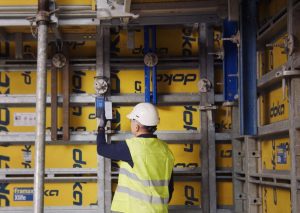
Doka Intelligent Heated Formwork to make its UK debut at the UK Concrete Show
The stage is set for Doka to showcase its Intelligent Heated Formwork prototype at this year’s UK Concrete Show. The formwork and scaffolding specialist’s next-generation system sets a new standard in automated formwork, enabling safe, efficient use of CO2reduced concrete all-year-round. The two-day UK Concrete Show (25-26 March) at NEC Birmingham provides the Intelligent Heated Formwork with its first UK demonstration, following its successful unveiling at last year’s Bauma international construction trade fair. Using targeted electrical heating, the intelligent formwork accelerates low-carbon concrete curing in walls and slabs. This supports greater building schedule certainty and leads to potential CO2 savings of circa one-third compared to a standard concrete mix. Robert Hauser, Doka CEO, said: “CO2-reduced concrete is a key driver of change, and Doka is committed to supporting a lower carbon construction future. This aligns with our own ambitious goal of achieving net zero by 2040.” Concrete and cement are significant contributors to construction’s global CO2 impact. The development of low-carbon concrete mixes helps to reduce carbon emissions, but their potentially lengthy setting time – particularly in cold weather – negates some of their sustainable value. Doka’s Intelligent Heated Formwork, which has been successfully trialled in research projects and on live construction sites, addresses that issue. The system maintains a moderate temperature to protect concrete from changes in weather and temperature. Therefore, even in winter, setting times continue unaffected, saving costly building delays and increasing project sustainability. Alongside the Intelligent Heated Formwork prototype, Doka will also showcase its proven digital solutions, Concremote and DokaXact, which are already delivering value on construction sites worldwide. These sensor-based technologies provide real-time data on concrete temperature, strength development, and formwork pressure, enabling contractors to make informed decisions throughout the pouring and curing process. By improving visibility over key performance indicators, they support safer operations, optimise stripping times, and help maintain project schedules. In the context of low-carbon concrete, where slower strength development and increased sensitivity to environmental conditions present new challenges, digital monitoring becomes increasingly critical. Concremote and DokaXact allow teams to accurately track in-situ behaviour, reducing uncertainty and mitigating risks associated with extended curing times or fluctuating temperatures. Together with Intelligent Heated Formwork, these solutions form part of a comprehensive approach to enabling the safe, efficient, and scalable use of CO2-reduced concrete in real-world conditions. James Hurst, Product & Marketing Director UK, added: “The UK Concrete Show is the ideal platform to bring this technology in front of the people who will shape the next generation of construction in Britain. Intelligent Heated Formwork represents a real step forward — not just for how we build, but for how responsibly we build. We look forward to welcoming visitors to stand B50 and showing what the future of low-carbon concrete construction looks like in practice.” Doka will be exhibiting its Intelligent Heated Formwork prototype on stand B50 at the UK Concrete Show on Wednesday 25th and Thursday 26th March 2026 at the NEC Birmingham. Building, Design & Construction Magazine | The Choice of Industry Professionals

TOPDON brings dual-lens thermal imaging to HVAC engineers
Global thermal imaging manufacturer TOPDON has launched the TC001 Max, a dual-lens smartphone-connected thermal camera aimed at HVAC engineers, electrical contractors and building services technicians. The camera combines an infrared sensor with a built-in visible light camera, fusing the two images together to give engineers precise, on-screen fault location across heating, ventilation, air conditioning refrigeration systems and electrical wiring. Fault-finding is the most time-intensive part of any HVAC call-out, and the most commercially sensitive. Whether it’s a refrigerant leak that has partially migrated, an underperforming heat exchanger, a poorly balanced duct system or a faulty contactor running hot inside a panel, the challenge is always the same: identifying the precise source quickly, without unnecessary dismantling, and with enough evidence to justify the repair to the customer. Traditional fault-finding methods like feeling pipework by hand, checking pressures at service ports, or isolating circuits one by one, are slow, often inconclusive, and leave the engineer with limited visual evidence to share with the customer or building manager. An experienced engineer working through an intermittent fault on a multi-zone system can lose an hour to tracing work that a thermal scan would resolve in minutes. The TC001 Max solves this by rendering heat distribution across any system as a live visual image, without contact. Blocked heat exchangers, poorly insulated pipework, overheating electrical contactors and air infiltration points in building fabric all produce distinct thermal signatures that become immediately visible on screen. Until recently, equipment capable of this level of sensitivity in a field environment cost several thousand pounds and was largely confined to specialist thermographic survey contractors. TOPDON has deliberately priced the TC001 Max to make thermal imaging a practical day-to-day tool rather than a specialist hire item. It connects directly to iOS, Android or Windows devices, using the engineer’s existing smartphone or tablet as its display, interface and storage platform. This removes the need for a dedicated screen and battery pack, which account for a significant portion of the cost of conventional handheld thermal cameras. The camera’s 256 × 192 infrared sensor is upscaled to 512 × 384 pixels through TOPDON’s TISR processing, giving resolution sufficient to distinguish temperature variation across individual components rather than broad surface areas. Thermal sensitivity of ≤40mK (NETD) means the camera picks up the small differentials that matter in HVAC and electrical diagnosis – a slightly cool section of refrigerant pipework, a marginally warm return air grille, or early-stage bearing heat in fan motor assemblies. A 25Hz refresh rate keeps the image fluid during live scanning. The key differentiator is the TC001 Max’s dual-lens design. Unlike single-sensor thermal cameras that produce a thermal-only image, the TC001 Max pairs its infrared sensor with a built-in visible light camera and electronically fuses the two into a single blended image. Five selectable fusion modes let the engineer dial between full thermal and full visible, with blended options in between, so component outlines remain sharp and identifiable even when scanning a densely packed plant room or electrical panel. In practice, this means an engineer can see exactly which valve body, terminal block or pipe joint is the source of a thermal anomaly. For building envelope surveys, where identifying the precise location of insulation voids or air infiltration paths is critical to a useful report, the fused image is particularly valuable. “HVAC engineers are under constant pressure to diagnose faster and document better,” said Oscar Diaz, CEO of TOPDON Europe. “The TC001 Max gives them a tool that does both. The fused imaging puts the fault location in the image itself, which speeds up the diagnosis and gives the engineer something concrete to show the customer.” The TC001 Max works with TOPDON’s TopInfrared (Mobile) and TopView (PC) applications across iOS, Android, and Windows, supporting thermal image capture, spot and area temperature measurement, isotherm analysis, and structured PDF report creation – including client-ready reports with annotated images and temperature readings suitable for handover to building managers or FM teams. When used alongside TOPDON’s TopFix AI, thermal findings can be cross-referenced against fault data to accelerate diagnosis and inform repair recommendations. Building, Design & Construction Magazine | The Choice of Industry Professionals

Sunshine savings: Lidl brings plug-in solar panels to the high street
The middle aisles of discount supermarkets can be a treasure trove of unexpected bargains, from bagpipes to wetsuits – and now solar panels may soon join the list. German supermarket giant Lidl is among the organisations working with the government to support the roll-out of plug-in solar panels. Within the next few months, shoppers could find low-cost solar kits in Lidl stores that can be set up on balconies or in outdoor spaces, helping households start saving on their energy bills. Lidl GB’s corporate affairs director, Georgina Hall, said the move reflects the retailer’s commitment to making sustainable living more affordable. She welcomed efforts to modernise UK regulations, describing the changes as an important step in enabling households to take control of their energy use while supporting the country’s net zero ambitions. Plug-in solar technology is already widely used across Europe. In Germany alone, around half a million units are installed each year. These systems allow users to generate free solar power and feed it directly into their home via a standard mains socket, avoiding installation costs. As a result, households can reduce their reliance on grid electricity and lower their bills. The government believes this simple, accessible technology could help many households cut energy costs while reducing the UK’s dependence on global fossil fuel markets. The push for solar has been accelerated by rising energy prices linked to ongoing conflict in the Middle East. Alongside this, the government has published its long-awaited Future Homes Standard. While largely in line with previous expectations, it includes a stronger emphasis on solar panel installation in new homes. Under the updated Building Regulations, most new properties – with some exceptions such as high-rise buildings – will be required to include on-site renewable electricity generation, most commonly through solar panels. The standard also mandates low-carbon heating systems, such as heat pumps and heat networks, in all new homes. Energy Secretary Ed Miliband said the government is focused on supporting households through rising energy costs while strengthening the UK’s energy security. He emphasised that expanding access to clean energy, whether through solar panels on new homes or plug-in systems available in shops, is key to reducing reliance on volatile fossil fuel markets. Greg Jackson, founder and chief executive of Octopus Energy, said public interest in clean technologies has surged in response to global instability. He noted that demand for solar panels has risen sharply, alongside growing uptake of heat pumps and electric vehicles. He added that generating electricity at home allows households not only to cut bills but also to sell excess energy back to suppliers. Combined with technologies such as heat pumps and electric cars, this can significantly reduce the cost of heating and transport in ways that traditional gas and petrol cannot. Building, Design & Construction Magazine | The Choice of Industry Professionals

NFRC Celebrates Government’s Move to Ban Retentions and Overhaul Payment Law
NFRC (National Federation of Roofing Contractors) welcomes a landmark government announcement that will prohibit the use of retentions in construction contracts and deliver sweeping reforms to payment legislation. The announcement represents the most significant overhaul of the UK’s payment regime in over 25 years and will help to address the cash flow crisis that has long crippled NFRC members and other specialist contractors across the construction industry. NFRC Group CEO James Talman said, “This outcome is one our industry has been campaigning for years to achieve. “ “For too long, specialist contractors have been forced to operate under a system that allowed larger firms to withhold their money, delay payment, and use their cash as free working capital. “Today, the Government has shown that it has listened, and we could not be more pleased.” The measures will be subject to a two-year implementation period, and dependent on the parliamentary timetable. This gives industry time to prepare, while providing a clear and firm direction of travel. NFRC will work with our Members and government during this transition period to ensure the incoming legislation is appropriate and effective. We will also continue to advocate on behalf of Members who are exploited by the current laws, which are now conclusively recognised to be unfair. YEARS OF WORK, FINALLY REWARDED NFRC has been advocating for reform of payment practices and the abolition of retentions for nearly a decade. In 2021, NFRC estimated that £300 million of roofing and cladding subcontractors’ cash was held in retention at any one time. In 2023, 86% of NFRC Members reported difficulties recovering retention payments on local authority contracts. And in 2025, 80% of contractor Members said retentions were still affecting their business. NFRC has taken every opportunity possible to advertise these facts and advocate for reform. “Our Members are passionate about this issue, not just because it affects their bottom line, but because it affects their people, their livelihoods, and their ability to grow and deliver for the UK,” said Talman. “The hours our team and our Members have put into this consultation speak for themselves.” The UK has a critical need for housebuilding, retrofit, clean energy infrastructure, and public sector construction. None of these issues will be adequately tackled if the specialist contractors at the coal face are being strangled by cash flow problems. CREDIT WHERE DUE NFRC wishes to acknowledge the Department for Business and Trade for bringing these proposals forward with seriousness and urgency. The consultation process was well-designed, accessible, and genuinely engaged with industry. The government has listened to the evidence industry presented and acted on it. “We are grateful to the Department for Business and Trade for the rigour and openness they have brought to this process,” said Talman. “Good consultation deserves recognition, and today’s announcement is evidence of what happens when industry engages and government listens. “We also want to acknowledge the many industry partners, trade bodies, and our own Members who contributed to this collective effort. Special thanks to the CLC taskforce on this important topic headed by Steve Bratt.” The government has confirmed it will proceed with many of the measures proposed in the consultation, including: – Removing the ability to contract out of the statutory charge of 8% interest on late payment. – Boards or audit committees of persistently late-paying large companies will be required to publish explanations for poor payment performance and the actions they are taking to address it. – Banning retention clauses. Building, Design & Construction Magazine | The Choice of Industry Professionals

Ravenscraig Enterprise Park set to boost industrial growth in North Lanarkshire
A major new industrial development has been launched in North Lanarkshire, with Ravenscraig Enterprise Park officially brought to market by global real estate adviser CBRE on behalf of Fusion Assets Ltd. The first phase of the scheme will deliver 29,400 sq ft of industrial, business and storage space, addressing a long-standing imbalance where demand has continued to outstrip supply across the region. Craig Semple, director at CBRE Scotland, described the launch as a significant milestone for central Scotland. He noted that businesses have faced a persistent shortage of modern, high-quality premises, particularly those seeking well-located space to support growth. He explained that the development will not only help meet this demand, but also reflects growing confidence in the strength of the regional market. With strong infrastructure, excellent motorway connections and the flexibility to support a range of uses, the site is expected to attract interest from both regional and national occupiers. He added that construction is due to begin in March 2026, with the first units ready for occupation in the final quarter of the year. In total, the development will provide 62,400 sq ft across eight units, delivered over two phases, bringing much-needed new stock to the central Scotland industrial market. The project is being led by Fusion Assets Ltd, the property development and regeneration arm of North Lanarkshire Council. It is supported by £4.4 million in public funding from the Glasgow City Region City Deal and the Scottish Government’s Vacant and Derelict Land Fund. A further £6.8 million of City Deal funding has been allocated to support future commercial development at Ravenscraig and other sites across North Lanarkshire. Murray Collins, managing director of Fusion Assets Ltd, said the development builds on significant investment already made across the wider Ravenscraig site. He highlighted the company’s commitment to transforming brownfield land into high-quality commercial space that can support job creation and long-term economic growth. He also pointed to strong demand for modern industrial and commercial premises, underlining the importance of delivering new space quickly, with Ravenscraig playing a central role in those plans. Strategically located with direct access to the M74 and M8 motorways, the site offers excellent connectivity to key markets, labour pools and national transport networks, making it an attractive proposition for a wide range of businesses. CBRE anticipates strong interest from occupiers across both regional and national markets. Building, Design & Construction Magazine | The Choice of Industry Professionals