Kenneth Booth

Winvic developing first embodied carbon analytics AI system

‘AI System for Predicting Embodied Carbon in Construction’ (ASPEC) Winvic Construction Ltd, a leading main contractor that specialises in the design and delivery of multi-sector construction and civil engineering projects, has once again secured Innovate UK funding as part of a cross-sector multidisciplinary research group. Winvic, University of the West

Read More »

SELECT welcomes second consultation on regulation of the electrical industry

Scotland’s largest construction trade association, SELECT, has welcomed a second consultation on regulation of the electrical industry which has been launched by the Scottish Government. The consultation, lodged by Jamie Hepburn, the Minister for Business, Fair Work and Skills, is seeking views on “whether regulatory measures are required to give

Read More »

History of the Heavy Equipment Industry

Heavy equipment has laid the foundation of great civilizations and modern communities. From the Great Pyramids to the 35-year construction of the Interstate Highway and high-rise buildings, these construction tools dug earth and moved stones to make way for impressive engineering and architectural feats both ancient and modern. Their history

Read More »

4 ways to organise your office for improved productivity

Productivity at work is always going to be a hot topic because there are continually so many emerging techniques that are supposed to help employees and employers get the most out of every working day. Often, these techniques are ones that are centred around an individual and while that is

Read More »

Kingspan embarks on transition to Electric Vehicle fleet

Recent delivery of three Electric Vehicles (EVs) takes global EV fleet to 69 Kingspan to install Electric Vehicle charging station at IKON innovation centre  Company aims to only acquire zero emission company cars by 2025 Transport targets part of wider Planet Passionate commitment ​Kingspan, the maker of high-performance insulation and

Read More »

Willmott Dixon secures second phase of Oaklands College redevelopment

Pagabo announce that Willmott Dixon has been awarded a £13.4m contract for the second phase of the £62m redevelopment at Oaklands College in St Albans. It comes after they successfully handed over the first phase in the summer, the Homestead building, which provides residential accommodation for up to 80 students

Read More »

Works begin on pivotal build of West Midlands SEND school

Midlands contractor G F Tomlinson has been selected by the Department for Education (DfE) to design and build a brand-new facility for the modernisation of Oscott Manor School in Birmingham, as part of the DfE’s Priority School Building Programme. Oscott Manor School, located in Old Oscott Hill, Birmingham, is a

Read More »
Latest Issue
Issue 344 : Sep 2026

Kenneth Booth

Winvic developing first embodied carbon analytics AI system

‘AI System for Predicting Embodied Carbon in Construction’ (ASPEC) Winvic Construction Ltd, a leading main contractor that specialises in the design and delivery of multi-sector construction and civil engineering projects, has once again secured Innovate UK funding as part of a cross-sector multidisciplinary research group. Winvic, University of the West of England (UWE Bristol), Edgetrix Ltd and Costain make up the consortium that will use the £800,000 funding to develop the first embodied carbon analytics AI system of its kind over the next two years. The project entitled ‘AI System for Predicting Embodied Carbon in Construction’ (ASPEC) will predict the carbon output on building and infrastructure projects based on BIM designs, materials carbon data and lessons learnt on past projects. Its aim is in line with article eight – Carbon Capture – on the government’s 10 Point Plan for a green industrial revolution, which was launched last week. While construction organisations continue to make advances in how they address both embodied and operational carbon emissions, current calculation methods for the former are onerous; with no design support calculation solution, there is no efficient way for design teams to proactively drive down the embodied carbon and carbon footprint of projects. The revolutionary technology will therefore be crucial in propelling constructors and material manufacturing firms to meet the UK government target removing 10MT of carbon dioxide by 2030. Furthermore, a 50 per cent reduction in carbon emissions has been set through the Construction 2025 strategy and the target for 2050 is to bring all greenhouse gas emissions to net zero. In the UK alone, building stocks are responsible for 40 per cent of the UK’s total greenhouse gas emissions (UKGBC, 2020) Buildings and construction together account for 36 per cent of global final energy use and 39 per cent of energy-related carbon dioxide (CO2) emissions (UNEP, 2018) The proposed ASPEC therefore has three components, to meet the tangible needs of the industry: AI-based Embodied Carbon Calculator (ECC) – This system will predict the embodied carbon cost of any project from a scheme’s BIM model. It will use historic embodied carbon data from previous construction projects and accurate ‘carbon factors’ to develop machine learning models. The creation of the ECC will lead to a dramatic reduction in the time it takes to calculate embodied carbon, bringing the process down from potentially days and weeks of data collection and calculation to a matter of a few hours. Embodied Carbon Analytics and Simulation Platform (ECAS) – This cloud-platform will undertake what-if analyses of the embodied carbon of schemes during the design phase. The tool will use advanced big data analytics to identify alternative design specifications that would reduce the embodied carbon of a project. A user of ECAS will be able to simply change the selection of a building material and obtain an instantaneous embodied carbon figure. BIM-based Design Support Tool for Embodied Carbon Analytics (B-DST) – This solution will also support design teams during the design stages of construction projects. It will integrate with existing BIM development software via an Application Programming Interface (API). Tim Reeve, Winvic’s Technical Director and project lead, commented: “Following the announcement of government targets paired with BREEAM sustainability requirements, construction organisations and clients have worked hard to reduce emissions, but the task certainly isn’t simple. That’s why we believe that utilising the most up-to-date AI and advanced big data analytics techniques in a way that has never been done before will be transformational for Winvic’s green agenda and pave the way for significant changes across the whole industry. Having the ability to optimise schemes and see embodied carbon costs as real-time design and material changes are applied will naturally lead to quantifiable reductions in greenhouse gas emissions, and having technology that automatically estimates the embodied carbon cost of any digitally designed project will make the delivery of many project tasks much faster. It’s very exciting to be working on ASPEC – our third Innovate UK funded initiative – with Costain, UWE and Edgetrix and together we aim to deliver these two primary benefits of the project to the industry as early as Autumn 2022.” Dr Lukman Akanbi, Associate Professor at UWE Bristol, said: “Through the ASPEC project, we as academics hope to contribute our technical know-how and expertise in Big Data Analytics and Artificial Intelligence to help move the UK one-step closer towards the realisation of her clean growth strategy and 2050 net-zero carbon target. In addition, UWE Bristol is a university that’s environmentally aware and is aiming to be carbon neutral by 2030, so it’s great that we are taking a lead in a project that is looking to help achieve these aims.” Muktar Tijani at Edgetrix, commented: “This ASPEC project provides a simpler, more accurate and innovative approach to predicting embodied carbon in construction projects. As a rapidly growing construction tech-company, Edgetrix is delighted to be part of this project and are committed to helping organisations commence their Net-Zero journey through our expertise in carbon-cutting and modern tech-solutions”. Crucially, Winvic and its project partners will develop a Common Data Environment (CDE) to eradicate the challenges that arise from having multiple, siloed datasets. The huge amounts of data that are generated from different phases of construction projects will be documented and stored in one system; it is this data nucleus that will facilitate the machine learning technologies, providing industry professionals with the insights to make more eco-friendly decisions on materials used. For more information on Winvic, the company’s latest project news and job vacancies please visit www.winvic.co.uk. Join Winvic on social media – visit Twitter @WinvicLtd – and LinkedIn.  

Read More »

Together Housing and Kensa Contracting gain international acclaim for regional GSHP retrofit programme

A collaboration between Together Housing and Kensa Contracting, resulting in sustainable ground source heat pumps being retrofitted into over 770 homes in the North of England, has won the ‘Heat Pump City of the Year’ category at the international European Heat Pump Awards (EHPA). The government recently set out aspirations for 600,000 electrically-powered heat pumps per year to be installed into homes by 2028, as part of a 10-point plan for a ‘green industrial revolution’. This recent award win demonstrates that the UK is already leading the way on the European stage in reducing carbon emissions to meet its 2050 net-zero target, and is committed to tackling climate change ahead of the COP26 summit, which is being hosted in Glasgow in November 2021. The Heat Pump City of the Year (HPCY) award commends local regions which have put in place large scale exemplary energy-efficient heat pump projects. Together Housing and Kensa Contracting’s continuing programme of retrofit ground source heat pump installations, which has increased comfort levels and lowered heating costs for hundreds of residents across multiple sites in Yorkshire and Lancashire, fought off competition from projects in 110 cities across 27 countries around the world to take the title. Cutting carbon emissions and confronting fuel poverty Following a successful pilot scheme in 2018, Kensa Contracting and Together Housing have been on a mission to tackle fuel poverty and reduce the carbon footprint of the social landlord’s existing housing stock. By replacing a mixture of old gas boilers and inefficient electric storage heaters with Kensa’s highly efficient and low carbon ground source heat pumps over the last three years, more than 700 households have seen savings of up to 45% on their heating and hot water bills. A tenant fed back: “The new heating system is amazing; before it was so difficult to heat up more than one room in my home, but now I don’t have to worry about that.” Using the current SAP methodology, the lifetime carbon savings have been calculated as 44,858tCO2. As the grid further decarbonises with the increased levels of renewable capacity, the carbon impact of heating will be further reduced. The scheme was procured using the ProcurePlus framework, the first domestic ground source heat pump replacement program procured via a framework in this way. Together Housing has made a significant commitment to renewable heat they are leading the way in rolling out large scale deployment of renewable heat technology. Patrick Berry, Managing Director of Together Energy Services, commented: “We are delighted to receive this award from the European Heat Pump Association. This has been Together Housing’s first major commitment to heat pump technology and it will make a great difference to our tenants’ carbon impact. The project paves the way for a much wider application of heat pumps as we move away from fossil fuels in our properties.” David Broom, Commercial Director of Kensa Contracting, said: “Kensa Contracting has pioneered the use of ground source heat pumps in social housing, developing the capability to deliver increasingly ambitious market-leading projects; our work with Together Housing is the largest of its kind delivered to date. This scheme has been a true partnership of client and contractor working to achieve a shared goal of decarbonisation, reducing fuel poverty and providing affordable comfortable homes, through the adoption of British-manufactured renewable technology.” Shared ground loop array infrastructure provides a blueprint After the incumbent heating systems have been decommissioned in each individual property, they are replaced by a quiet and highly efficient Kensa Shoebox ground source heat pump. The Shoebox heat pumps are then linked to arrays of shared ground loop boreholes drilled under the green spaces and car parks adjacent to the tower blocks. The system design is very efficient, as the energy collected from the underlying rock is distributed at an ambient temperature to the individual heat pumps, which then upgrade this to a higher temperature at the point of use and only when required. This is an alternative system architecture to traditional district heating, where heat is generated in a central plant and then continually circulated through the system, which leads to significant heat losses and potential overheating in risers and communal areas. The use of distributed heat pumps also removes the need for a plant room, complex metering and billing arrangements, and restrictive energy supplier contracts, mimicking traditional gas network infrastructure. Ground source heat pump technology is vastly underused within the UK, despite the system efficiencies being some of the best of any other heating technology available, offering the lowest carbon output and running costs. Shared ground loop array schemes are eligible for government funding, and Kensa believes that this accessible and innovative system architecture is the key to increasing the national deployment of the technology.

Read More »

Stephen George + Partners’ £7million Norwich Airport project reaches practical completion

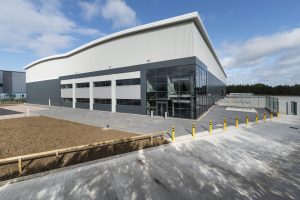
Stephen George + Partners (SGP) is pleased to announce the completion of a £7million, 54,000 sq ft hangar and associated 15,500 sq ft workshop at Norwich International Airport for Rigby Group plc, owners of Regional City Airports. Ian Yallop, Chairman of SGP says: “Despite these being incredibly difficult times for aviation, project completions such as this showcase the strength and diversity of regional airports. These flexible spaces will meet current and future engineering needs as well as supporting Norwich Airport’s masterplan to maintain its position as a leader in aircraft maintenance, repair and overhaul.” The buildings will accommodate the expansion of KLM UK engineering group, with the double bay hangar designed to service two Airbus A320 aircraft. The workshop is 7.5m to its haunch and the hangar 13.1m haunch, constructed using a Twin-Therm wall system and Euroclad cladding in standard goosewing grey, profiled to break up any interference with the ground radar system. Ian states: “This is an important milestone for SGP. Although we have worked on several masterplans and designs for other regional and national airports, this is the first building to reach completion. In these tough times, we remain committed to using our technical knowledge and expertise in this sector to support the sustained recovery of the aviation industry in the months and years to come.”

Read More »

SELECT welcomes second consultation on regulation of the electrical industry

Scotland’s largest construction trade association, SELECT, has welcomed a second consultation on regulation of the electrical industry which has been launched by the Scottish Government. The consultation, lodged by Jamie Hepburn, the Minister for Business, Fair Work and Skills, is seeking views on “whether regulatory measures are required to give greater protection to the public and reduce the level of poor electrical workmanship by a persistent rogue trader element”. SELECT Managing Director Alan Wilson said: “This is another great opportunity for the industry to take part and shape the future. “It’s heartening to see that the Scottish Government believes that regulation of the sector is so important that it merits this further consultation. “It’s an excellent chance for Scotland to lead the way and demonstrate that we are committed to safer and brighter future for the industry.” The latest move follows a consultation by Conservative MSP Jamie Halcro Johnston, which was issued in August and closed on 10 November. Mr Halcro Johnston hopes his consultation will lead to a Member’s Bill ensuring that only properly qualified and experienced professionals can call themselves an electrician. SELECT and the Scottish Joint Industry Board (SJIB) were among those who responded to the consultation, which received more than 140 submissions. In her response, Fiona Harper, The Secretary of the SJIB, said: “Electricians frequently voice their concerns and frustration that individuals who have not met the established national and industry standards and are not qualified electricians are able to use the title of electrician. “In what is such a highly-skilled and safety-critical occupation, this situation should be rectified and the title of electrician should be protected.” In the SELECT submission, Mr Wilson said: “Our research suggests net benefits to Scotland from proper regulation of electricians of around £58million, including the benefits of higher electrical standards, such as fewer injuries and deaths, better functioning installations, less need for call backs or for poor/unsafe work to be repaired, leading to improved customer satisfaction.” SELECT has been leading a long-running campaign with other leading industry bodies to make sure that those who work in the industry do so in a safe and competent manner. The groundswell of support on its Wall of Support has seen more than 100 prominent parliamentarians, industry figures and representatives of trade associations and professional services bodies pledging their commitment. The latest consultation can be completed here and closes on 12 February 2021.

Read More »

History of the Heavy Equipment Industry

Heavy equipment has laid the foundation of great civilizations and modern communities. From the Great Pyramids to the 35-year construction of the Interstate Highway and high-rise buildings, these construction tools dug earth and moved stones to make way for impressive engineering and architectural feats both ancient and modern. Their history is intertwined with the rise of equipment technology, and promises a bright future for the industry – as can be seen in well-established companies such as Fortis Heavy Duty. Muscle Power in Ancient Times  The Egyptian civilization was the first ever to use heavy equipment in terms of manual and animal labor to operate simple levers, pulleys and cranes. In 2500 BCE Imhotep, an Egyptian chancellor regarded as the world’s first architect orchestrated the building of the Great Pyramids using a system of rollers, ramps and ropes. The Romans also used this system. Moving huge slabs of stone was done using smooth ramps and rolling pins. Cranes were used to create the Roman arch, and other structures. Vitruvius, a Roman engineer, described early heavy equipment in his treatise known as De Architectura. These were made of wood, and used treadwheel for power. 1800s: Steam, Traction and Hydraulics Much of what the ancient civilizations used was still in operation until the 1800s, primarily for agricultural purposes – far from super-mechanized engines and heavy equipment undercarriage parts. In 1886, American inventor Benjamin Leroy Holt created a combine steam harvester. Two years later, John Froelich created a gasoline-powered tractor with forward and reverse gears. In 1890 Holt once again produced a steam-powered tractor. These inventions proved beneficial to the agricultural industry as it allowed the transition from animal-power to more powerful steam engines. Apart from the tractor, steam engines also fueled dredgers and steam excavators.  Thomas Aveling also created the traction engine in the mid-1800s and is known as “The Father of the Traction Engine.” His invention has made a lasting impact in the development of succeeding heavy equipment. 1900s: Rise of Heavy Equipment Vehicles By the 1900s, the second phase of The Industrial revolution was well underway and created a huge demand for heavy equipment in various industries. Track vehicles emerged at this time, with the first successful patent made by Alvin Orlando Lombard in 1901. In later years he would invent the first commercial tractor crawler, the forerunner of today’s tracked construction vehicles. Heavy equipment was also introduced to the construction industry in the early 1900s. In 1907, the Galion Works built motor and pull graders, steam and internal combustion rollers, wheeled scrapers and hydraulic cranes. Adaptations were made on these vehicles to suit the demands of construction. The bull graders were introduced in 1920s. It quickly grew in popularity, and in the 1930s it was renamed the bulldozer. This vehicle has since evolved into the bulldozer we know today, hauling boulders and tree stumps from the earth. Bucket-wheeled excavators also began in the 1920s, as digging machines for the mining industry. They have proved beneficial to surface mining operations over the years. Dump Trucks were also introduced at this time, also known as tipper or dumper trucks. 1930-1960: Tough Times and Tough Builds This 30-year period is marked with tough times, from the Great Depression to WWII. There was also notable construction taking place, including the San Francisco Golden Gate Bridge and the beginning of the Interstate Highway. This is often considered as the boom of the heavy equipment industry, as vehicles became monster-sized to address the demands of the massive interstate construction. The world’s biggest dragline, shovel and 360-ton truck emerged.  1970-1980: Embargo and Recession Demand for machinery continued to increase during this period, and equipment became more sophisticated. The Arab embargo of 1973 also caused greater demand. It is at this time that safety measures were given for heavy equipment. 1990-2010: Compact and Efficient Vehicles Machinery now utilized diesel engines, and while this shift improved efficiency, it had negative effects to the environment. Environmental compliance demanded that manufacturers build cleaner and more efficient engines. The economic recession: the third to hit the heavy equipment industry, has created a trend favoring rent rather than purchase of heavy equipment. Manufacturers are compelled to comply with the specifications rental companies for durability and efficiency, as well to ensure compliance with continuous emission-phase testing from 2001-2008.  2010-2019 The heavy equipment industry is one again seeing growth. Advances in construction equipment came in the form of telematics, electromobility and autonomous machinery. IoT, or the Internet of Things is also employed to increase machine life cycles. 

Read More »

4 ways to organise your office for improved productivity

Productivity at work is always going to be a hot topic because there are continually so many emerging techniques that are supposed to help employees and employers get the most out of every working day. Often, these techniques are ones that are centred around an individual and while that is a fundamental starting point, people usually forget to assess the environment they’re working in – the office itself. There are many simple ways to organise your office to help improve productivity and we’ve listed some below. Office equipment It sounds obvious, but it’s important that you have the right equipment in order to work effectively. If you are doing lots of tasks on a computer then a second screen can really improve productivity and efficiencies. If you are using a second screen or laptop screen then these need to be at eye level to reduce eye strain and back and neck injury. Screen levels can be adjusted with risers if needs be. As well as any technical requirements, making sure you have adequate desk space and a comfortable chair in good working order are essential. If these items are old and broken then they can also lead to counterproductivity. You can buy replacements for fittings such as castors online so you often won’t have to replace whole units if they need fixing. 2. Office lighting Artificial lighting can strain your eyes and lead to headaches and tiredness which will hinder productivity. If you can, use natural light from outside to brighten your office and provide natural views to help keep you stimulated. There are LED office lights that can emulate natural light so if it isn’t possible to get it from outside, consider how these can be used to help. 3. Colour Colours stimulate different emotions and can improve productivity. If you work in an office that needs to be creative, then yellow is a colour that can help boost this alongside optimism and confidence. If you’re in an office that needs a lot of focus and concentration, then blue is an ideal colour. You can always use colours to break up different areas of the office to create different moods and feelings so that you can be productive however you need to. 4. Clutter and cleanliness By being surrounded by clutter in an unclean environment, you can easily get distracted and lose focus. It’s easy to let clutter build-up, especially if you have lots of important documents and files to sort through. Try to make it a weekly habit of cleaning up your desk area. A good day to do this is on a Friday because it means that when you come back on Monday, you’re ready to start the working week in a productive environment. By following these steps and making changes to the space around you, it will be much easier to improve your productivity in the office.

Read More »

Chancerygate secures planning for Warrington and Sutton Coldfield sites totalling 191,680 sq ft

Chancerygate has secured planning for two multi-unit schemes at Gemini8 in Warrington and Forge Industrial Park in Sutton Coldfield. The development at Gemini8 will see Chancerygate speculatively develop 119,675 sq ft of industrial and warehousing space as part of a joint venture (JV) with Hines, the international real estate firm. Comprising 5.1 acres in total, the scheme will provide 18 freehold and leasehold units ranging from 3,900 sq ft to 16,500 sq ft and is strategically located with direct access to the M62. Planning consent comes after Chancerygate and Hines acquired the site in January this year. The development at Forge Industrial Park in Sutton Coldfield will see Chancerygate deliver a 72,007 sq ft freehold light industrial and warehousing scheme featuring 11 units ranging from 4,467 sq ft to 24,003 sq ft. Chancerygate purchased the 3.1-acre site last August and work to demolish an existing 69,000 sq ft industrial building on the site is due to begin in November. Located next to Minworth Trade Park, Forge Industrial Park is located 2.2 miles from junction 5 of the M6, three miles from junction 9 of the M42 and seven miles north east of Birmingham city centre. Alastair King, head of development at Chancerygate, said: “We are seeing growing demand for high-quality industrial developments across the UK. This is being driven in part by increasing demand from retailers and institutional investors, both of which regard strategically located industrial space as a key asset. “Our scheme at Gemini8 is a great example of this. Historically, there has been a shortage of warehousing space in Warrington and there has not been a multi-unit development in the area for more than a decade. Now, we are seeing demand rise significantly and that is why we are best placed to invest in the area to speculatively develop 119,675 sq ft of industrial and warehousing space. “Rising demand is also a key driver behind our development at Forge Industrial Park. It is a well-established industrial area and is ideally located for retailers and funds looking to invest in warehousing and logistics to meet growing consumer demand for ecommerce and home delivery models.” Commenting on the scheme at Gemini8 in Warrington, Greg Cooper, Hines UK director of industrial and logistics, said: “This is an important next step in continuing to grow our portfolio with Chancerygate and deliver high-quality industrial schemes across the UK. The partnership to date has been highly successful at identifying modern industrial and logistics space in strategic locations across the UK and we welcome the momentum behind these quick transactions that allow us to deliver schemes at pace.” Joint agents on the Gemini8 scheme are CBRE and Davies Harrison. Joint agents on the Forge Park Industrial scheme are Knight Frank and Gerald Eve.

Read More »

Kingspan embarks on transition to Electric Vehicle fleet

Recent delivery of three Electric Vehicles (EVs) takes global EV fleet to 69 Kingspan to install Electric Vehicle charging station at IKON innovation centre  Company aims to only acquire zero emission company cars by 2025 Transport targets part of wider Planet Passionate commitment ​Kingspan, the maker of high-performance insulation and building envelope solutions, is transitioning its entire company fleet to electric vehicles, targeting to only acquire zero emissions cars by 2025. The company has recently taken delivery of three Tesla EV vehicles, taking its global EV fleet to 69.  Kingspan is also installing a new six-bay Electric Vehicle (EV) charging station at its recently opened IKON global innovation centre in Kingscourt, Cavan, which will help ensure that each car’s charge can be derived from 100% renewable energy.  The EVs will replace older, petrol and diesel models, and will be used by the company for visits to clients, contractors, architects, and sites. The push towards zero emission cars is part of Kingspan’s Planet Passionate programme, an ambitious 10-year global sustainability strategy that aims to impact on three big global issues: climate change, circularity and protection of our natural world. Specific commitments the company strives to reach by 2030 as part of its Planet Passionate Programme include: Energy: powering 60% of all Kingspan operations directly from renewable energy while generating the equivalent of 20% of its energy demand on manufacturing sites Carbon: achieving net zero carbon manufacturing and a 50% reduction in product C02 intensity from primary supply partners Circularity: upcycling of 1 billion PET bottles per annum into insulation products plus zero company waste to landfill across all sites Water: harvesting 100 million litres of Kingspan’s water usage from rainwater Bianca Wong, Global Head of Sustainability at Kingspan, commented: “As a company, we have committed to reduce significantly our carbon footprint across our value chain by 2030. The acquisition of these state-of-the-art vehicles and installation of the charging station supports our broader Planet Passionate vision and our target to acquire only zero emission company cars by 2025. By leveraging the latest in innovation in the motor industry and striving to be Planet Passionate in everything we do, we are confident we can achieve the goals we have set our business.” Marci Bonham, Managing Director of Kingspan Insulated Panels in Ireland and Kingspan Energy, commented: “Implementing our mission to reduce our impact on the planet is progressing rapidly. This latest delivery brings the total number of electric vehicles in our global fleet to 69, and our Irish teams are pleased to be among the first in the company to make this move to zero emissions cars. There is a strong commitment by Kingspan to incorporate carbon reductions into all areas of the business. This is one more step towards our net zero targets.”

Read More »

Willmott Dixon secures second phase of Oaklands College redevelopment

Pagabo announce that Willmott Dixon has been awarded a £13.4m contract for the second phase of the £62m redevelopment at Oaklands College in St Albans. It comes after they successfully handed over the first phase in the summer, the Homestead building, which provides residential accommodation for up to 80 students as well as two on-site wardens. Phase two was again procured through our Major Works Framework and will be known as The Evolution Centre to represent the importance it will have in the development of the College’s staff and students.  The new facility will be the core learning building on campus and contains a mix of classrooms and support spaces for teaching staff, with seven classrooms forming a dedicated wing for Oaklands College’s Pathway 4 special needs provision. A sustainable build: Now or Never  To support Willmott Dixon’s ambition to be net zero carbon by 2030, the site team have created early electrical connections to the grid so that the tower crane, site and welfare facilities do not need diesel generators. The project is also utilising the local St Albans based community wood recycling to ensure that all timber not required is reused rather than sent away as waste. Chris Tredget, managing director at Willmott Dixon in London and East, said: “After delivering the Homestead Building, the team is delighted to be back on site with the Evolution Centre and look forward to creating a new teaching space that will benefit the college and students for years to come.” Zoe Hancock, principal of Oaklands College said: “The Evolution Centre will house 49 classrooms and will be a centre for technical, academic and vocational education. It will transform the learning experience for our students, and we are really looking forward to its completion in Autumn 2021.” Jonathan Parker, national framework manager at Pagabo, said:  “We’re delighted to be continuing our close working relationship with Willmott Dixon, and are really pleased to see the second phase of work in motion at Oaklands College following the handover of the first phase earlier this year. This next phase of work, which was awarded via a single stage procurement process through a programme of works, made it quicker and simpler to get work underway on delivering teaching facilities and a dedicated wing for special needs provision that are set to have a hugely positive impact on both the college and the wider community.” After the successful handover of the first phase, we’re all delighted to see phase two in motion and wish Willmott Dixon the best of luck in delivering this fantastic scheme.

Read More »

Works begin on pivotal build of West Midlands SEND school

Midlands contractor G F Tomlinson has been selected by the Department for Education (DfE) to design and build a brand-new facility for the modernisation of Oscott Manor School in Birmingham, as part of the DfE’s Priority School Building Programme. Oscott Manor School, located in Old Oscott Hill, Birmingham, is a SEND (Special Educational Needs & Disability) secondary school supporting pupils with autism. Rated ‘Good’ in the most recent Ofsted inspection, the school has outgrown its current building following an increase in the demand for places, and due to site constraints which has meant the current site is too small to develop. This has resulted in the relocation and the construction of a new school at nearby Reservoir Road in Erdington, Birmingham. Due for completion in winter 2021, the new educational facility will be a community school for 120 young people aged 11-19, with autism as their primary diagnosis. The school will provide educational, health and care plans for each student. Construction works will involve the demolition of existing buildings at the 2.8 acre Reservoir Road site; the former Bridge SEND School, Fairfield Children’s Home and the Children’s Bungalow, followed by the construction of the new 29,923 sq. ft two-storey modern educational facility with a range of versatile teaching spaces for ICT, design and technology, science and music, as well as general staff facilities, external play areas and associated access roads. It will also include a multi-use games area (MUGA), a forest school with associated lighting and secure boundaries, staff parking and safe drop off and pick up areas for pupils. As you enter the site, the school is adjacent to the Elwood Day Centre which will remain open throughout the works, and G F Tomlinson has worked closely with the centre to ensure access will be maintained at all times and there is minimum disruption to service users. Network Rail is situated on the left and residential properties are located to the right and to the rear. This project will mark the 13th scheme delivered by G F Tomlinson under the DfE framework since 2014 and in line with the organisation’s commitment to social value, the scheme will maximise opportunities for work experience and employment, partnering with local schools, colleges, universities and unemployed residents, through an Employment and Skills Plan, developed in consultation with Birmingham City Council. Chris Flint, director of G F Tomlinson, said: “We are delighted to be managing the design and build of the new Oscott Manor SEND School, under the DfE framework. “The building replacement is part of the DfE’s Priority School Building Programme (PSBP) that considers applications from Local Authorities and other agencies to rebuild and refurbish school buildings in the greatest need of repair across the country, and the new building will be constructed by the DfE’s Capital team, which includes G F Tomlinson. “This scheme adds to our strategic portfolio of projects in the education sector throughout the West Midlands region where we have an established reputation for delivering high quality SEND schools, providing safe and inspiring places for young people to learn and thrive. “As always, we have focused on the social value of this project, ensuring our dedicated Employment and Skills Plan provides tangible benefits to the community of Erdington and the surrounding areas.” Head teacher of Oscott Manor School, Victoria Miller, said: “The completion of this carefully designed project will provide a wealth of opportunities for our pupils and enhance their curriculum access, community connections and ability to develop the independent skills that will prepare them for adulthood. We are delighted to be working so closely with the DfE, Bond Bryan Architects and G F Tomlinson to ensure that this project meets the needs of our cohort.” G F Tomlinson’s design team include Bond Bryan Architects, BSP Consulting for structural and civil engineering services and Anderson Green for mechanical and electrical services.

Read More »