Trades & Services : Property & Facilities Management News

Owen Pugh to Work with Gentoo for First Time

It has been announced that Owen Pugh GDC, a leading northeastern civil engineering practice has been successful in earning a £1.1m project for infrastructure works in line with a leading Newcastle-upon-Tyne housing scheme. The contract, to see Owen Push complete a series of works, such as the installation of roads,

Read More »

BIM and Infrastructure: Meeting the Challenge

In the infrastructure sector, BIM is changing the way that clients, designers and contractors approach projects.  However BIM Level 2 is a major challenge for 2016, with many uncertainties still apparent as to how it will be successfully and consistently implemented, so that it delivers the excellence in project delivery

Read More »

New Renewables Supply Scheme Launched

Through support offered from the new SmartestEnergy initiative, it has been announced that those businesses aiming to display role model conduct in responsible practice, will in turn be able to enjoy an increased level of confidence in the responsible nature of renewables procured. As the UK’s largest procurer of renewables

Read More »

Concerns over Shortening Supply of Grade A Property Space

It has been recently reported that Grade A property supply in the North West industrial industry is to hit a rate of concerning shortage by the end of the year. Highlighted Savills, figures have shown that, although some 2.2m square feet of space is to be provided over 11 different

Read More »

Working At Height, Don’t be Fooled by Myths

Working at height has been a popular topic of discussion for some time, and while there are clear best practice techniques outlined by the HSE, there are also a multitude of key myths abound which may yet confuse the issues and challenges faced when working at height. As such, a

Read More »

Dulux Academy Launched by AzkoNobel

AzkoNobel has announced the launch of the very first UK-based academy for industry professionals in the painting, decorating and architecture industries, the Dulux Academy. Set to provide over 4,000 industry professionals with the opportunity to pursue further training and development with new practices, methodologies and also through professional advice on

Read More »

The Launch of Cromford Creative: Restoring the Mills

For the opening of the Cromford Creative managed workspace scheme, held at Derwent Valley Mills World Heritage site, circa 150 dignitaries and their extras attended to both inspect and celebrate the work undertaken on the scheme, effectively bringing the historic, Grade I building back into use for the public. The

Read More »

Shedmasters Highlights the Incredible Take-Up of UK Warehousing

Playing host to some 300 guests from areas all the way across those industries relative to the logistics and industrial sectors were in attendance at this year’s Shedmasters event, held in Cannes. Savills announced that, to date, the total amount of take-up reported of UK warehouse space reached a notable

Read More »
Latest Issue
Issue 336 : Jan 2026

Trades : Property & Facilities Management News

Owen Pugh to Work with Gentoo for First Time

It has been announced that Owen Pugh GDC, a leading northeastern civil engineering practice has been successful in earning a £1.1m project for infrastructure works in line with a leading Newcastle-upon-Tyne housing scheme. The contract, to see Owen Push complete a series of works, such as the installation of roads, sewers and complete plot works, exists to support the some 37 affordable new homes in Fenham. It is estimated at present that the project will take approximately a year for Owen Pugh to complete and will also include complementary works to the main project ambitions, such as hardscaping, paving and road surfacing; effectively taking the organisation closer to offer a complete infrastructure package for the scheme. Also heralding the first time with the Owen Pugh has worked with the development company, Gentoo Homes, expectations are assuredly high and only time will tell as to how Owen Pugh impresses on the project. Owen Pugh GDC’s Business Development Manager, Steve Hamilton expressed his delight in being awarded the project, and the ability to deliver the much-needed infrastructure for the area, then adding: “It’s real coup to have been recognised as a preferred supplier. This is a significant piece of work for the GDC team and one which we are well placed to deliver.” As such, optimism is rife, from Owen Pugh, the Gentoo Group and also from the locality, with the prospectus of delivering a project which will benefit the area together. The development at which the project is to be undertaken, called the Calderstone development, is situated some 2.5 miles west of the Newcastle city centre, and includes a combination of two, three and four-bedroom residential properties for those looking to get onto the property ladder, as well as those looking for affordable residential family housing; as such, the properties are starting at prices of just £155,950, a very manageable sum in comparison to present average property prices.

Read More »

How Smart Thermostats Enable the Internet of Things (IoT): Three Key Developments of the Smart Home

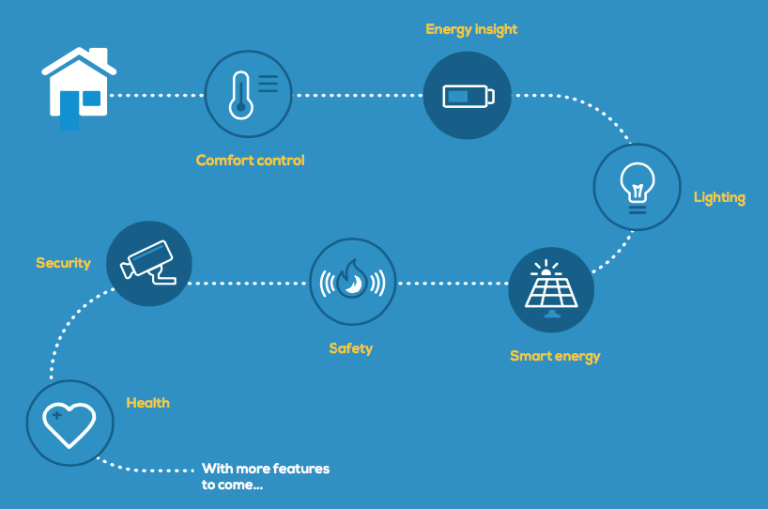
Do people want a smart box that can physically control everything in their homes? We posed this question to consumers for the first time, back in 2004. Being a home automation company in the Netherlands and coming from a background of technology development and IoT enthusiasm, we pioneered remote controlling devices, smart lighting and assisted living, even back then. Now remember, this was years before the iPhone was introduced. Touchscreens had only just started popping up. Even though all of these things were already possible, our ambitious plan to “conquer the world” didn’t quite take off in the way we had expected. Why? It turns out that people didn’t want a mysterious box with the potential to control fully their home. They simply weren’t ready for that concept because they didn’t understand it. Years later, in 2012, the realization of what people actually wanted came when we partnered with a forward-thinking and leading Dutch energy company, Eneco. They realized that the energy world is changing and that we have to transition from a central to a decentralized system. From a world with central energy production and delivery over a grid to people’s homes, to a reality where people are generating their own, sustainable energy and using a smart grid. In this new world, they needed a new business model. They wanted to shift from a traditional supply of energy to a new service model, one that could help them connect with their customers and drastically reduce churn. The smart thermostat we were developing provided just that. From a smart box concept in 2004, it developed into a new self-learning smart thermostat that incorporated all the features of the original product, but added one big new advantage: an attractive smart energy display. This suddenly provided a new foothold into the smart home market, allowing multiple features to be introduced to the screen. It helped to transform the concept of a smart thermostat intended for a niche and ‘geeky’ audience into a mass energy-saving solution. Now, over 200,000 people have embraced this smart home proposition branded as ‘Toon’ by Eneco in their homes in the Netherlands, putting our product in the top three smart thermostats in Europe. The case for smart thermostats to provide a platform to the smart home became apparent, as sales continued to grow and we decided to build new features and services on top of our platform quickly after that. For instance, we connected smart plugs to our smart thermostat, so that consumers can control their lighting and devices and gain unique insights into their usage on a device level. We also introduced a smoke detection feature that builds on a wireless smoke detector and alerts Eneco’s customers when there is a fire in their homes. These are just a few of the many examples and opportunities that the platform offers. But there are more. Indeed, Quby sees the potential for many features to come: Smarter energy with storage and boiler management Eneco recently partnered with Tesla to sell their home energy storage solution called the “Powerwall”. We are currently developing new insight features for their solution on our smart thermostat. But not long before that, their user base was delighted to see a solar monitoring feature. This allows them to see how much energy they are generating, consuming and delivering back to the grid. The consumer thereby gains insight if they are on track to generate returns on their investment. Another recent introduction was a new boiler management service, allowing for maintenance of the boiler based on predictive analysis that shows the decreased performance of the boiler before it breaks down. These are just a few examples of the smart energy solutions that enable people worldwide to play an active role in the energy transition. Instead of shying away from these concepts because it threatens the traditional energy company’s position, Eneco decided to build their business around it. Insight into energy consumption and appliances The visual display of our device presents insightful details of the energy consumption of the user, showing hourly, daily, weekly and monthly usage of gas and electricity. This even allows for benchmarking with neighbours and friends. Additional features coach the user into understanding what’s happening in their home and to see where they can reduce both their usage and cut their bill. With the extension of a smart plug, they can now see how much energy usage individual appliances account for, and easily spot ‘energy hogs’ in their home. Beyond these features, our research and development team are also exploring ‘home health’ uses by adding sensors for air quality and other detection that will offer people even more insight. Leveraging third party creativity with API’s Because our platform offers open API’s, it opens up a world of opportunities by leveraging creativity from third party developers who are able to develop new consumer services and even connect new hardware from third parties. A possible area of innovation could relate to people’s health and assisted living services could become a logical next step. This means helping the elderly lead fulfilling and active lives, while their loved ones are in the loop and able to remotely monitor their safety. Privacy and safety In all this, there is the question of privacy and safety, which we take extremely seriously. We have the infrastructure and policies to match this. The data of the end-user is stored on the device and it only leaves the thermostat if the end-user says so. As you can see in Quby’s roadmap of new features, the possibilities are endless and we are continuously building towards the connected home of the future. We’ve learnt that these concepts simply cannot be introduced all at once, especially when developing products and services for a mass market. They have to be introduced gradually as an extension to a service that people are familiar with and understand, and in a way that makes sense to them. That can only be done if you start from a position

Read More »

BIM and Infrastructure: Meeting the Challenge

In the infrastructure sector, BIM is changing the way that clients, designers and contractors approach projects.  However BIM Level 2 is a major challenge for 2016, with many uncertainties still apparent as to how it will be successfully and consistently implemented, so that it delivers the excellence in project delivery that we all aspire to. We have seen excellent 3D modelling in the last few years in highways and associated structures, for example at Ramboll we have taken laser scans of complex structures such as the Hammersmith Flyover and integrated design of strengthening elements into the geometrical model, before passing this model onto the contractor to use during construction.  Clash detection and resolution has taken place and significant effort has gone into translating 3D model data into 2D drawings and specifications. Yet BIM Level 2 is about far more than this – it is not just a geometrical model.  We need to see information managed well throughout the project lifecycle and there remain a number of challenges to expand the use of BIM Level 2 through the infrastructure sector in the UK: Improving consistency of Employer’s Information Requirements Addressing issues specific to the infrastructure sector – many of the requirements of the 8 pillars of BIM required for BIM Level 2 are not developed fully for infrastructure projects.  COBie is still not developed for many asset types, such as underground drainage systems. Integration with asset management systems.  In many cases the sector’s contractual arrangements will not help with implementing the ‘Government Soft Landings’ process, improving handover of a new asset to its future maintainers. At the moment, BIM is seen as added cost, and another item which complicates contractual arrangements.  It needs to be seen by all parties as a process which adds value. Integration of BIM processes with the essential assurance processes required for infrastructure projects, such as Highway Structure Technical Approval Expanding the levels and confidence with BIM from a small group of ‘BIM professionals and experts’ to the wider engineering community. Yet despite these challenges, as an industry we need to push for progress.   We have the potential to improve clarity of deliverables through the construction process.  By integrating the use of smart sensors in infrastructure assets with a fully compliant BIM level 2 process, there are excellent opportunities to improve future maintenance of structures, and to improve satisfaction levels for both clients and end users.  We need to work BIM processes in parallel with parametric design, and the use of modular construction techniques. Above all we need to continue the culture of change in the industry, using BIM to improve collaboration, and increase the involvement of asset maintainers and users in the design process. We are striving for this at Ramboll by training more of our staff in the use of BIM and by the end of this year we will see all our technical staff trained in the full understanding of BIM’s processes, requirements and benefits.  The particular challenges around BIM for infrastructure need to be acknowledged, but then clients, contractors, consultants and engineering institutions will need to work closely together to identify excellent solutions that add value to our projects. By John Armitage, Technical Director, Ramboll

Read More »

Featuring Loughton Contracts: Interview with Tony Mills, Director of Operations

Aesthetics is everything and good interior design has the ability to transform a building, mark its entry into the modern-day, and is key to creating something which is more than purely functional. Acknowledging the imperative of flooring as a key component of an aesthetic structure, and doing so in a manner that affords certainty in both quality and safety, Loughton Contracts has established a mode of practice whereby nothing is left to chance. Over the past thirty years, the company has grown exponentially, rapidly becoming the UK’s leading flooring contractor, successfully entering the commercial market and regularly working on high profile projects across the UK. Despite phenomenal expansion, the ambition of Loughton Contracts remains the same: to be the best flooring installer out there, and the company’s health and safety ethic – amongst its quality and professionalism – differentiates it from many like competitors. Refusing to be ordinary, the company is determined to do things differently, as Tony Mills, Director of Operations at Loughton Contracts asserts: “Within the construction industry, companies tend be reactive, rather than proactive. More often than not, health and safety becomes a box-ticking exercise and that’s not what we’re about. We want to be proactive. We want to find what’s best for our operatives and work hard to protect our staff.” Keen to prevent not just discrete injuries and loss time accidents but long-term health complaints too, the company takes a holistic view of health and safety well beyond either legal compliance or accreditation. In many ways, Loughton Contracts can be defined by being two steps ahead of the pack. The company insists on a 5 Point PPE policy, as well as enforcing any other kit required for each, individual job. Supplying and installing many different materials and in various dimensions, Loughton Contracts is adaptive and able to make subtle changes to working procedure across projects – utilising face-fitting masks for cutting timber and knee-pads for the hard-flooring team being just two examples. Having worked on a number projects, including prestigious universities and major blue chip organisations, during the course of 2015 Loughton Contracts installed flooring on a phenomenal scale at the new Tate Modern extension. It saw the company win Health and Safety Contractor of the Month multiple times over a twelve month period, pitching above around 30 other sub-contractors on site. The accolade came as a result of the combined efforts of management and operatives, each exuding responsibility for the team and business as a whole. The company’s specialist workforce is, in part, indebted to Loughton Contracts’ prolonged investment in training and development; the company recognises the importance of regular and progressive development. It’s with the introduction of a training matrix, listing both administrative and operations staff, that the contractor is able to instantly identify when employees are due for renewal as well as capitalise on upcoming opportunities with external providers. “I’ve done the budgets for this year and, with a quick scan of the matrix, know that 7 people need a CSCS card, four need to renew their SSSTS training, two need to do the SMTS course and, on top of that, we’re looking at promoting asbestos awareness and providing further training where we can.” With such attention paid to staff training and a united code of practice, it comes as no surprise that the company incurred zero accidents last year despite laying over a million square metres of flooring across 700 different projects. Not complacent however, with the log of one accident this January, a minor cut, Loughton Contracts has already launched an investigation as to why it happened in order to prevent it from happening again. As a result of its preliminary findings, the company has already enacted various changes to working practice: for instance, introducing retractable knives for the removal of packaging. Indeed, Loughton Contracts’ keen health and safety practice is set to tighten and advance further with this year seeing the introduction of an intranet system capable of hosting risk assessments, accident reports, toolbox talks and method statements and all other documentation relevant to the job. Tony Mills provides further detail: “Not only does this work alongside our database and is helping us to create a more paperless environment, the intranet allows us greater efficiency with respect to getting the message out there. When out on site, our operatives can go straight to the most up to date forms and processes and go into a job with all the information they need to carry out work to the standard we expect. By the end of this year, the extranet system will be online and will allow greater interaction with the documentation in cases where things need to be amended, adapted or sent out.” Embedded within the company’s core and informing its future development, health and safety is something on which Loughton Contracts is simply unwilling to compromise. As their flooring work on one of the largest construction project in Europe, Battersea Power Station, gets underway, the company’s dedicated ethic and unique industry profile remains unshakeable and will no doubt continue to see Loughton Contracts foster the respect of clients and competitors alike.

Read More »

New Renewables Supply Scheme Launched

Through support offered from the new SmartestEnergy initiative, it has been announced that those businesses aiming to display role model conduct in responsible practice, will in turn be able to enjoy an increased level of confidence in the responsible nature of renewables procured. As the UK’s largest procurer of renewables in the independent generation sector, SmartestEnergy maintains an enviable industry position. Yet, utilising this position in a positive manner, the SmartestEnergy Tariff Emission Factor Model has been established, in association with the Carbon Trust, to enable the organisation to distribute renewable certificates for pinpointed tariffs and customers, allowing for a more effective supply-to-source link between the generation of the energy and the customer. How this will be perceived is far less complicated however, as labels are to be created so that each individual customer can see the relative source of their energy, as well as the associated carbon emissions from such generation. Further to this, those customers looking to utilise the facility to exert greater control over the energy they purchase will be able to select the renewable technology they would like their electricity to be generated from. Though renewables as a whole have already been heralded as the future for the energy generation sector, the initiative effectively puts a degree of control in the hands of the customer, but most importantly informs and equips people with the information they need to assess their preferences on the renewable technology medium they support most. Of course, not only will this allow for improved awareness of environmental impacts associated with energy generation, but will also allow for increased differentiation between differing renewable technologies; indeed, not all renewables are the same. Robert Groves, Chief Executive Officer of SmartestEnergy commented on the new label, and system, saying: “We recognise some organisations will want to go further and specify the types of renewable electricity they buy – whether that be just from natural sources or from a particular technology or project – and we can also support that.”

Read More »

Concerns over Shortening Supply of Grade A Property Space

It has been recently reported that Grade A property supply in the North West industrial industry is to hit a rate of concerning shortage by the end of the year. Highlighted Savills, figures have shown that, although some 2.2m square feet of space is to be provided over 11 different schemes this year, the demand and take-up of such space is at a level far outstripping that of the supply. Shockingly, the North West has actually been highlighted to represent one of the most considerable (the second most) pipelines for development in the entirety of the UK, it is still yet unable to compete with average annual take up values of approximately 3.44m square feet, leading sceptics to fret over a growing reduction in space actually available for further take up. The predicted figures effectively follow from last year’s record setting take up values, where the North West alone achieved a considerable 4.56m square feet of take up over the course of the year. And while Savills does indeed nod towards the great work being undertaken on the development front, which will no doubt provide much-needed space for further take-up, yet simultaneously Stuart Murray, Savills’ Industrial Director outlines the growing need for further development pipeline and opportunities to develop. With the market almost wholly-dependent on the provision of further stock to continue performing out of the recessionary periods, the importance of further development is absolute, with Murray commenting: “The big questions now are where will the second tranche of new stock come from and who will the developers be?” Of course, whilst there is a reportedly considerable amount of industrial stock presently available in the North West, sitting at some 5.71m, some 81% of this is regarded as Grade C or B stock, with many of the Grade C stock actually not being fit for occupation. This, of course highlights an already shortened supply of Grade A stock, with an ever-increasing reason for developers to move.

Read More »

Working At Height, Don’t be Fooled by Myths

Working at height has been a popular topic of discussion for some time, and while there are clear best practice techniques outlined by the HSE, there are also a multitude of key myths abound which may yet confuse the issues and challenges faced when working at height. As such, a little clarity can go a long way in helping to understand the safety implications of working at height. Of course, with the HSE regarding working at heights to be one of the most common causes of industrial injuries and accidental death, both employers and their operatives are required to take all manner of precautionary care to ensure that they are protected above and beyond traditional safety standards in ground-based roles. Of course, the key way in which legal requirements can be met is quite simple, by not working at heights at all, yet, if this proves impossible, methodologies must be pursued to best ensure the safety of those working in such environments. Yet, while there are some clear ways through which employers and employees can ensure a level of safety which is compliant, there are a number of less-founded ways of doing so, with some even making the situation worse; the myths that detract from the key issues and challenges of working at heights Of these myths, one of the most predominant is that of CE markings – the belief that CE marking and safety are synonymous. Yet, while CE marked products can indeed be a positive step forward, the very notion that CE marking alone makes products safe for use is a myth which can lead employers and employees into believing that they are using safe products, when this may not always be the case. Key considerations which must be taken into account include the very nature of the task at hand, of course, and while certain products may be suitable for one task, the reliability and safety of the same product in an entirely alternate scenario is one which employers should, and to a degree, must look into individually.

Read More »

Dulux Academy Launched by AzkoNobel

AzkoNobel has announced the launch of the very first UK-based academy for industry professionals in the painting, decorating and architecture industries, the Dulux Academy. Set to provide over 4,000 industry professionals with the opportunity to pursue further training and development with new practices, methodologies and also through professional advice on the application of paints and coverings. Not built solely for those performing at the top of the industry, or solely those working their way upwards, the academy will exist to support the professional development of individuals at all levels of the career cycle, equipping them with the skills to build, run and promote a successful business. To support this further, as well as key industry skills, courses will also be provided from a marketing perspective, giving people the tools to put their best foot forward. Also looking to maximise the benefit that the academy will bring to the sector, it has also been decided that the academy will also provide training for those looking to break into the painting and decorating industry, providing a clear training path into the industry and reducing barriers to entry. Given the present state of skill shortages in the wider industry, the news is naturally well received, providing much-needed support for would-be painters and decorators, as well as providing access to a stream of high-quality industry professionals. Then looking to partner with existing colleges across the UK, the Dulux Academy will also see to the provision of circa 350 workplace opportunities for performing students. This will be further supported through the communication of knowledge on the latest products, methodologies and design technologies to teachers at such institutions, who will then be communicating the same, cutting edge knowledge to their students. Priti Patel, Minister of State for Employment formally signalled the opening of the venue at the official opening ceremony, and passed comment, saying: “With its fantastic new training academy and City & Guilds Level 3 Certificate, employers like Dulux are leading the way. We are committed to working hand-in-hand with industry to boost the number of apprenticeships our economy needs.”

Read More »

The Launch of Cromford Creative: Restoring the Mills

For the opening of the Cromford Creative managed workspace scheme, held at Derwent Valley Mills World Heritage site, circa 150 dignitaries and their extras attended to both inspect and celebrate the work undertaken on the scheme, effectively bringing the historic, Grade I building back into use for the public. The event effectively also signalled the official opening of a brand new gateway to the heritage site, with a new state of the art gateway information hub located on the building’s ground floor. Serving as the completion of a £6.7m project, guests were able to look over the incredible work done on the venue to restore it into a condition whereby it can then add value back to the community and find effective use. The project itself, however, was only possible through funds raised by the Arkwright Society, one of Cromford’s leading charities for the restoration of historic structures and their reuse. As of present, the structure now incorporates approximately 8,000 square feet of managed workspace in the upper floors of the formerly known as, “Building 17”. The space is then split into 17 different individual workspaces, varying in size and available in single or multi-let packages, or even as a whole floor should potential occupiers truly see the value of the venue. Of course, beyond the bare bricks and mortar, the venue also offers a great deal of connectivity into other associated facilities at the mills, which includes an offering of conferencing and meeting rooms, a café and even a restaurant. “Building 17 is one of the most important heritage assets on the whole of the Cromford Mills site and we are delighted that it has been restored to its former glory,” explained Sarah McLeod, the Arkwright Society’s Chief executive. And, as such, the completion of the building’s regeneration is seen as a great step forward in enabling a useful, sustainable future for the entire site at Cromford Mills.

Read More »

Shedmasters Highlights the Incredible Take-Up of UK Warehousing

Playing host to some 300 guests from areas all the way across those industries relative to the logistics and industrial sectors were in attendance at this year’s Shedmasters event, held in Cannes. Savills announced that, to date, the total amount of take-up reported of UK warehouse space reached a notable high of some 5m square feet, not yet including the 1.9m square feet still under offer; these figured effective highlighting a colossal increase of 85% on the 2015 figure of 2.7m square feet. In fact, it has been estimated by Savills that the total take-up is expected to actually tip over the long-term Q1 average of 5.4m square feet, which could clock in at a value near to 7m square feet in total for the start of Q2. Playing as key drivers to these figures has proven to be the reported mega-shed deals, which incorporates the 1.2m square feet facility for The Range in Bistol, as well as the 1m square feet centre for distribution of Amazon’s in the Midlands. Highlighting the figures as a wonderful start to 2016, Savills’ National Head of Industrial and Logistics, Richard Sullivan nodded towards the potential for record-breaking levels of take-up for Q1, with occupier demands sustained at high levels . Much of the interest, of course, has come from manufacturers and retailers operating online, with businesses achieving great success in their dominance in the wider market. Richard Sullivan also went on concerns as to the present state of a sparsity of fit-for-purpose warehouse space presently on the market, yet added: “However with 39 speculative schemes currently in the pipeline, this will help to address the issue over the next 12 months.” Of course, with the growing success of certain organisations in the online retail sector, as well as that of key manufacturers, the demand for warehousing space is expected to only grow yet further, with the view of this then reaching a value of up to 160% for 2016. And with some 8.8m square feet of prospective development planned for release over the course of 2016, it is, at the very least hoped that the supply for quality warehousing space will be able to challenge levels of demand somewhat.

Read More »