


Solar Battery Storage: Disadvantages, Safety Features and Trade-Offs
A battery can reduce evening electricity purchases without making a house independent of the grid. It can also provide backup, but only through the right equipment and installation. Understanding those limits is part of choosing well, not a reason to dismiss storage. For UK households, solar battery storage involves an upfront cost, conversion losses and decisions about where equipment belongs. A useful home battery storage assessment weighs those drawbacks against measurable benefits, with safety features examined as part of the complete installation rather than as isolated claims. Put the drawbacks beside the intended benefit The value of solar battery storage depends on what the household needs to shift from one time of day to another. If little surplus is available, or most electricity is already used during solar hours, the battery may have less useful work to do. Upfront expenditure The Energy Saving Trust describes battery costs as dependent on type and size, with a broad range from £1,500 to £10,000. That range is context, not an OCEAN 2 Plus quotation. Obtain a property-specific installed price and compare identical scopes. Losses during operation Charging and discharging do not return every unit of input energy to appliances. The financial calculation should include those losses, plus any export income given up when solar is stored. Otherwise, the model exaggerates the value of each unit moved into the evening. A finite energy budget Storage shifts energy; it does not create it. A battery that empties on a dark winter evening needs another charging opportunity. Increasing capacity alone cannot compensate for a persistent shortage of solar input or an operating plan that leaves no suitable charging period. Examine the protection around the battery EcoFlow’s home battery storage product page describes ten protection layers for OCEAN 2 Plus, divided into six passive and four active layers. Read that alongside the operating instructions. A protection architecture is useful evidence about design, but it does not make every installation location appropriate. Cell chemistry The product uses lithium iron phosphate, commonly abbreviated LFP. Chemistry is one part of the safety design, alongside monitoring, protective devices and installation. Avoid describing any rechargeable battery as risk-free merely because its cell chemistry differs from that of another product. Fire detection and alarms PAS 63100:2024 includes fire-detection provisions for certain indoor battery locations, including requirements that may apply to infrequently visited areas such as store cupboards. Battery-app alerts should not be treated as a substitute for any fire detection or alarm measures required by the applicable design. The installer should confirm the requirements for the proposed location. Siting and fire separation Within its scope, PAS 63100:2024 gives preference to outdoor installation where reasonably practicable and places restrictions on certain indoor locations, including areas associated with sleeping accommodation and escape routes. Indoor installations may require additional assessment and protective measures depending on the proposed location. It is a technical specification, not a substitute for applicable law; verify its scope and the project’s design basis. Environmental protection EcoFlow specifies IP66 protection and indoor or outdoor options. Those statements do not remove temperature, access or siting requirements. The bottom-module immersion claim also has specified test conditions; it should not be interpreted as permission to install the whole system in a flood-prone position. Understand what backup does and does not promise For home battery storage, backup requires an agreed circuit arrangement and sufficient output. EcoFlow describes integrated backup and conditional 0 ms load-side switching under specified operating conditions. Those conditions and the applicable backup output limits should remain alongside the claim when comparing backup performance. Transfer speed does not establish how long appliances will run. Duration depends on available energy and demand. Nor does a rapid transfer prove that every appliance can start together. Ask the installer to demonstrate the actual protected circuits rather than relying on a general whole-home description. Compare trade-offs with explicit assumptions Use a small decision table to separate different benefits. Financial savings, outage support and future flexibility answer different questions. Combining them into one percentage hides the compromises, particularly when the same stored energy is reserved for backup and also counted as daily bill reduction. Reserve versus everyday use A larger reserve can improve outage readiness while leaving less energy for normal evening demand. Choose the reserve deliberately. Ask the supplier to model the setting you intend to use, rather than assuming the entire usable capacity is discharged for savings every day. Choice Potential benefit Trade-off Larger reserve Outage readiness Less daily use More capacity Longer supply Higher cost More automation Better scheduling Setup and monitoring Capacity versus utilisation Solar battery storage should be sized around recurring demand and charging opportunity. A larger battery may support a future appliance, but unused capacity still costs money. Compare today’s design with a clearly defined future scenario instead of assuming every possible household change will occur. Modularity can make expansion possible, subject to the supported configuration. Obtain the applicable limits for the UK equipment. Expansion should be a documented option with compatibility conditions, not a vague assurance that any additional battery can be fitted whenever convenient. Match efficiency assumptions to the charging route With AC-coupled solar, panel DC becomes AC before conversion back to DC for battery charging, then AC again for household use. DC-coupled solar can avoid that intermediate AC stage, although DC conversion and battery losses remain. Count the actual energy path rather than assuming lossless solar charging. Price assumptions matter As an illustration, buying at 10p/kWh and delivering energy with 90% round-trip efficiency gives an input cost of about 11.1p per delivered kWh. Avoiding a 30p import would leave roughly 18.9p before other costs. These are assumed rates, not a tariff offer. Grid charging requires AC-to-DC conversion and subsequent DC-to-AC supply to household appliances, including in a hybrid system with DC-coupled solar. Coupling architecture alone therefore cannot establish grid-charging efficiency. Losses depend on equipment, load, temperature and standby consumption, rather than a universal figure above 10%. For home battery storage, use an efficiency figure whose measurement boundary matches the calculation:

McLaren Living Secures Green Light for £65m Hackney Co-Living Development
McLaren Living has secured planning permission for a £65 million co-living and affordable housing development at Fish Island in Hackney Wick, paving the way for 324 new homes in east London. The Wansbeck Road scheme will deliver 280 co-living studios alongside 44 affordable homes across two buildings rising to 10 and seven storeys. Occupying the final development plot within the wider Neptune Wharf masterplan, the project will complete a key part of the regeneration of Fish Island and establish a new residential gateway at the junction of Wansbeck Road and Monier Road. Designed by HTA Design, the development has been conceived as a residential-led community combining private accommodation with an extensive range of shared amenities. Residents of the co-living building will have access to a gym, library, cinema and creative studios, together with communal kitchens and dedicated dining and social spaces. At ground-floor level, plans also include a social co-working café and flexible pop-up event space, helping to create greater activity and interaction between the development and surrounding neighbourhood. A landscaped central courtyard will sit between the two buildings, providing shared outdoor space while creating new connections through the site. Sustainability has also been embedded within the design. The car-free development will provide extensive cycle facilities alongside rain gardens and sustainable drainage measures, while rooftop solar panels will contribute towards reducing operational energy requirements. The scheme is targeting a BREEAM Excellent rating, further strengthening its environmental credentials as McLaren Living looks to deliver a high-density residential development designed around sustainable urban living. The combination of co-living and affordable housing also reflects the increasing diversification of London’s residential market, with purpose-designed shared living emerging alongside more established housing models as developers respond to demand for well-connected homes with greater communal and amenity provision. Ed Court, divisional managing director at McLaren Living, said the developer was excited to progress its plans for Wansbeck Road and complete an important remaining part of the Neptune Wharf masterplan. He added that the location represented a significant co-living investment opportunity, supported by a diverse professional population and strong connections to employment, education and leisure destinations across the capital. With planning permission now secured, the £65 million development represents another significant addition to Hackney Wick’s evolving residential landscape and the continuing regeneration of Fish Island. Building, Design & Construction Magazine | The Choice of Industry Professionals
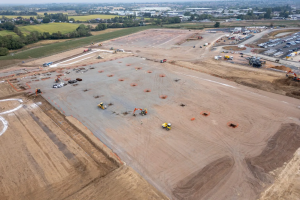
McCoy Lands Major Hinckley Park Groundworks Package as McLaren Pushes Ahead with Logistics Scheme
McCoy Contractors has secured a major earthworks and groundworks package from McLaren Construction for a new industrial and logistics development at Hinckley Park in Leicestershire. The 40-week programme will see the Midlands-based contractor undertake extensive cut-and-fill operations and soil modification before progressing to a comprehensive groundworks package incorporating drainage infrastructure, water tanks, foundations, a pump station and external concrete yard slabs. The contract continues a longstanding relationship between McCoy Contractors and McLaren Construction, with the two businesses having collaborated on a series of major industrial developments across the UK. Central to McCoy’s delivery strategy at Hinckley will be the installation of its own concrete batching plant on site. The approach has already been successfully deployed by the contractor at the circa one million sq ft TJ Morris Distribution Centre in Doncaster, where McCoy is delivering a £22 million groundworks package for McLaren. Producing concrete directly on site is designed to provide greater control over quality, programming and supply while reducing reliance on external ready-mix deliveries. Fewer concrete vehicle movements can also help reduce transport-related environmental impacts and alleviate logistical pressures surrounding major construction sites. The system provides additional flexibility when scheduling pours around changing weather and site conditions, while allowing the construction team to coordinate production more closely with the wider programme. McCoy’s appointment comes as investment continues across the wider Hinckley industrial and logistics market. McLaren Construction Midlands & North is also delivering a £48 million expansion at Mountpark Hinckley, comprising two high-specification warehouse and distribution buildings totalling approximately 772,000 sq ft. Hinckley Park itself has become an established logistics location close to Junction 1 of the M69, positioned between the East and West Midlands. Existing occupiers at the wider park include Amazon, DPD, Geosynthetics and Octopus Energy. Delivery of McCoy’s package will nevertheless involve several significant engineering and logistical challenges. Construction activity will need to be carefully coordinated around overhead power lines, an existing railway bridge and a high-pressure gas main, alongside areas of vegetation requiring management. The latest contract further expands McCoy’s portfolio of large-scale industrial and logistics infrastructure projects, while transferring construction methods proven on previous schemes to the Hinckley development. The use of on-site concrete production in particular demonstrates how contractors are increasingly looking beyond conventional supply arrangements to improve productivity, programme certainty and environmental performance on major warehouse and distribution projects. Building, Design & Construction Magazine | The Choice of Industry Professionals

Scotland Targets Private Investment to Unlock New Wave of BTR Development
Scotland is looking to attract greater levels of private investment into housing development, with Build to Rent identified as an important part of plans to accelerate the delivery of new homes across the country. The Scottish Government’s Programme for Government 2026–31 sets out plans for a new national housing agency, More Homes Scotland (MHS), which will bring together funding, expertise and delivery tools in an effort to remove barriers and get more housing projects moving. The agency is expected to be phased in from 1 April 2027. Central to the approach will be a strategic partnership between More Homes Scotland and the Scottish National Investment Bank (SNIB), designed to leverage additional private commercial capital for residential development. The partnership will look across different housing tenures, with Build to Rent specifically identified alongside affordable and social housing as an area capable of supporting increased delivery. The Government also wants the initiative to encourage new entrants into the market and support the growth of existing housing providers. For Scotland’s BTR sector, the announcement provides a potentially important new route for attracting institutional and private capital into projects at a time when the industry continues to face challenges around development viability, funding and the delivery of new housing at scale. More Homes Scotland will have a wider role in coordinating housing delivery and investment, strengthening regional collaboration and helping to align new development with economic growth priorities. The Government is also proposing further changes to the planning system aimed at speeding up development and helping projects progress from planning through to construction. The measures form part of a broader strategy to increase housing supply and improve investor confidence across Scotland. Alongside the increased focus on private capital, affordable housing remains a major part of Scotland’s housing programme. The Government has committed to delivering 111,000 affordable homes by 2032, with at least 70% intended for social rent. The establishment of MHS could therefore create a stronger link between public-sector housing priorities and institutional investment, opening opportunities for developers, investors, contractors and the wider construction supply chain. For Build to Rent in particular, the commitment is significant because it places the sector directly within the Government’s plans for increasing housing delivery rather than treating it solely as a specialist investment market. As More Homes Scotland begins to take shape ahead of its planned introduction from April 2027, attention will now turn to how its partnership with SNIB will translate private capital into viable development opportunities and, ultimately, new homes on the ground. Building, Design & Construction Magazine | The Choice of Industry Professionals

Willmott Dixon completes £100m student village for University of Staffordshire
Offsite light gauge steel frame took the superstructure of the £100m Stoke-on-Trent scheme from start to finish in 32 weeks NATIONAL tier one contractor Willmott Dixon has completed the new Student Village at the University of Staffordshire, a 1000-bed development in Stoke-on-Trent whose superstructure was delivered in 32 weeks using an offsite light gauge steel frame system. The £100 million scheme has been delivered under a Design, Build, Finance, Operate (DBFO) model by a consortium of Willmott Dixon, HOCHTIEF PPP Solutions UK and Ireland, Plenary and Pinnacle Group, working with the university. Project and industry partners were given a preview of the completed village ahead of the first residents moving in for the new academic year. The modern methods of construction (MMC) strategy centred on a fully integrated light gauge steel frame (LGSF) solution, manufactured offsite and assembled on site across six residential buildings. As well as compressing the superstructure programme to 32 weeks, the approach held manufacturing tolerances to 5mm across the development. At the centre of the site is a £12 million student hub, designed to be net zero carbon in operation. Across four levels it provides individual and group study areas, social and welfare facilities, a landscaped garden lounge and a double-height events hall. A new pedestrian bridge and boardwalk will link the village to the university’s wider Leek Road site, where demolition will make way for accessible parkland targeting a 12% biodiversity net gain. The 1000-bed development also included the refurbishment of 300 rooms at The Swan Building, upgrading the living space and installing low-energy systems to improve the block’s energy performance. The work was programmed over the summer months so that the university retained its accommodation capacity and avoided any loss of room income. The DBFO model allows the university to spread the cost over a 50-year period while retaining flexibility during construction. Early engagement between the consortium and the university meant the scheme was delivered for the same £100 million agreed at the outset, with the entry cost and the exit cost matching. The project has also delivered wider social value for the local area, including 1,000 students engaged through education programmes, 500 weeks of careers support, community volunteering and charity initiatives and mental health awareness campaigns with Lighthouse Charity. Dan Doyle, delivery director at Willmott Dixon, said: “The ambition here was never simply to build more accommodation. It was to create an inclusive student community, with sustainable, future-ready buildings on a campus that attracts and retains students, and to support the university’s long-term plans for sustainability, wellbeing and growth. “Getting the superstructure up in 32 weeks came from taking the offsite decision early and holding to it, and that same early engagement is why the university has paid what it expected to pay. Pace and cost certainty together are what universities are asking of us.” Steve Rimell, chief financial officer at the University of Staffordshire, said: “We are delighted with the outcome of the Student Village project, and as CFO I am particularly pleased that it was delivered on time and on budget. The student hub is going to be extremely impactful for student amenities and wellbeing, and as a way of connecting the accommodation with our main campus. “Our students were involved from the start, helping to shape the design from the early stages, allowing us to create a new space for them that prioritises community, inclusion and wellbeing.” Ian Prescott, managing director (UK) at HOCHTIEF PPP Solutions, said: “The opening of the Student Village is the culmination of a fantastic partnership and a shared ambition to create an outstanding place for students to live. “Together, we’ve delivered a sustainable, modern development that will enhance the student experience for years to come while creating a lasting asset for the University and the wider Stoke-on-Trent community.” Dan Doyle continued: “This scheme is a strong example of what is possible when universities, developers and delivery partners come together with a shared vision and a collaborative approach.” The Student Village adds to Willmott Dixon’s higher and further education portfolio, which includes two major projects for Queen Mary University of London, the £48.8m School of Business and Management and the retrofit and extension of its Information Teaching Laboratory, the £19.3m first phase of Coleg Gwent’s Crosskeys Campus redevelopment in Newport, and Bridgend College’s net zero in operation town centre campus. The student village will welcome its first residents in time for the new student intake in September 2026. Building, Design & Construction Magazine | The Choice of Industry Professionals

Falling pupil numbers prompt call for wider approach to school place planning
Developers expected to fund new school places across all nine English regions despite pupil numbers falling by 722,000 by 2030 Councils in England should assess demand for school places across local school networks rather than considering each housing development in isolation, according to new analysis by national planning and development consultancy Lichfields. Department for Education forecasts show that nursery and primary pupil numbers are expected to fall by 473,000 by 2030, alongside a reduction of 249,000 secondary pupils. The analysis found that places funded through Housing Developer Contributions are forecast to increase across all nine English regions over the same period. In the North East, for example, pupil numbers are projected to fall by 2.9% while developer-funded places rise by 300%. It recommends that councils consider existing capacity, access to schools and longer-term population changes before deciding whether new provision is required. This should take account of children who move locally but remain at their current school, as they would not create demand for an additional place. Mainstream schools could also introduce SEND units where appropriate, while developer contributions could fund improved walking and cycling routes, crossings or bus services. New schools would still be needed where local provision could not accommodate the number of pupils expected. The findings come as councils plan for further housing growth under the government’s target to deliver 1.5m homes by 2029. Large developments are often planned on the edges of towns and villages, where nearby schools might have spare capacity but are too far away or cannot be reached safely on foot. Councils estimate the number of school-age children a development is expected to generate. Where existing schools cannot accommodate them or are not accessible, developers can be required to contribute towards new provision. Assessing demand across the wider area would help councils provide schools for new communities while making better use of places already available. Housing growth could also support established schools in areas where pupil numbers are falling. Robert Curtis-Haigh, Planner at Lichfields and co-author of the analysis, said: “Our analysis highlights a growing contradiction when planning for housing and education. “The current system places significant emphasis on the pupil yield of individual developments, meaning new school places are often still being planned even as pupil numbers decline and existing schools face falling rolls. “The solution isn’t to stop building new schools or new homes, but to take a more strategic view of how the education system will function over the coming decades. “New schools will still be essential in some locations, particularly where major growth is planned. However, in many cases there may be opportunities to improve accessibility and make better use of existing school capacity, while also recognising that housing growth actually supports those schools that are facing declining pupil numbers.” Read the full analysis here: https://lichfields.uk/blog/2026/august/24/catchment-22-the-education-planning-paradox-nobody-is-talking-about Building, Design & Construction Magazine | The Choice of Industry Professionals