Off the gas grid: where LPG still earns its place on Irish building projects
Large parts of Ireland and Northern Ireland have no mains gas, and for decades heating oil filled the gap in rural homes, farms and commercial premises. That legacy stock is now a live issue for contractors, retrofit specialists, facilities managers and developers. Policy for new homes points firmly at heat pumps, but the existing off-grid building stock, construction sites and commercial kitchens still need a practical fuel. Liquefied petroleum gas (LPG) covers many of those cases.
The short answer
LPG is a portable gas fuel supplied in bulk tanks or cylinders, used where there's no mains connection. On Irish projects it's most relevant to three areas: converting oil-heated buildings, temporary heat and trades on site, and catering or process heat in commercial fit-outs. Calor Ireland has supplied LPG on the island for more than 85 years and serves around 50,000 customers across homes and businesses.
Retrofit: replacing oil in existing buildings
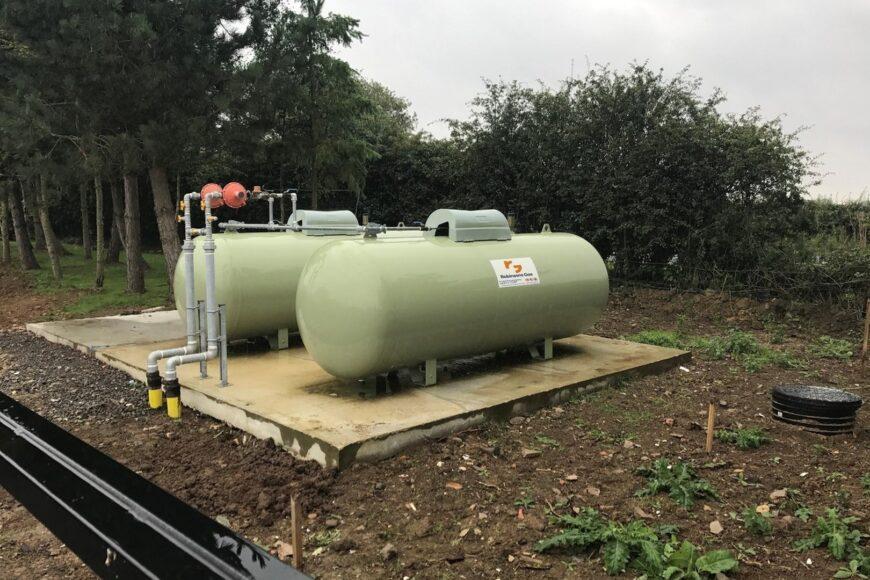
A typical oil-heated farmhouse or 1970s bungalow presents a familiar problem. A heat pump will only perform well after significant fabric upgrades, and the client may not have the budget or the appetite for that work yet. An oil-to-LPG conversion is a smaller intervention. The wet heating system usually stays, the boiler is replaced, the oil tank comes out and an LPG tank goes in.
Calor sets the process out in three stages. An enquiry is followed by a consultation call, a Calor specialist then produces an installation plan, and a registered gas installer chosen by the client carries out the work. The Calor team assesses demand, sites the tank and sets up the supply connection, and the first delivery normally arrives within a few days of installation. For contractors who want to brief clients, Calor's page on how to switch to lpg from oil covers the steps and links to grant information.
Two details matter for whole-life cost. Calor maintains and repairs its own tanks, so the building owner isn't carrying that liability. Tanks can also be fitted with telemetry that reports fill levels and triggers automatic top-ups, which removes a recurring headache for facilities teams managing scattered rural sites such as clinics, community halls or holiday lets.
On energy ratings, LPG burns more cleanly than heating oil, and Calor notes that upgrades such as smarter heating controls can improve a property's Building Energy Rating (BER). Grant eligibility for specific measures changes, so check the current SEAI position before including it in a client proposal.
Hybrid systems
For larger or older buildings, a hybrid arrangement is often the pragmatic answer: a heat pump carries the base load for most of the year, and an LPG boiler covers peak demand on the coldest days or tops up domestic hot water. This lets a client reduce fossil fuel use now without sizing a heat pump for a worst-case winter on a building whose fabric hasn't been upgraded. It also leaves room for further fabric work later, at which point the gas element can be reduced or removed.
On site: cylinders for temporary heat and trades
Most site managers already use LPG without thinking of it as a fuel decision. It runs space heaters in welfare cabins, roofing torches for felt work, cooking in canteens and forklift trucks in yards and warehouses.
A few points are worth repeating in site inductions. Direct-fired LPG heaters release water vapour as they burn, so they can slow down drying out of plaster and screed in a closed building. Indirect heaters, or ventilating well, give better results. LPG is heavier than air, so cylinders should be stored upright, in the open or a ventilated cage, and kept well away from drains, excavations and basements where leaked gas could collect. Secure cylinders against falling and keep them clear of hot work.
Supply is the other practical issue. In Northern Ireland, Calor Direct provides door-to-door cylinder delivery from local centres covering Belfast and Lisburn, Omagh, and Derry/Londonderry. Site and procurement teams can order gas cylinder online in northern ireland or phone the local centre, and delivery is same-day or next-day where available. Calor states there are no delivery charges. Payment is by card, by phone or to the driver, with no cash accepted. The range runs from 5kg to 47kg cylinders for heating, cooking and commercial use, and empties are collected when you note them on a reorder. Rural and remote addresses, including farms, are covered, which helps on one-off houses and agricultural projects far from a builders' merchant.
Commercial kitchens and hospitality fit-outs
For hotel, restaurant and food-production fit-outs off the gas grid, LPG is often the default for cooking because chefs want a responsive flame. Depending on demand, the supply can be a bulk tank or a manifolded bank of large cylinders. Early coordination matters here. Tank or cylinder compound location, delivery vehicle access and separation distances should be fixed at planning stage rather than discovered during fit-out, when the obvious spot has already gone to bin stores or plant.
Lower-carbon options
Clients with ESG targets increasingly ask what comes after conventional LPG. Calor offers BioLPG, which is made from renewable feedstocks and works in the same appliances as standard LPG. That gives building owners a route to reduce emissions without replacing equipment, and it's worth raising early with clients who report on Scope 1 emissions.
Specification checklist
Before committing to LPG on a project, confirm:
- Tank or cylinder location, with clear access for delivery vehicles
- That installation will be carried out by a registered installer (RGI in the Republic, Gas Safe in Northern Ireland)
- Carbon monoxide detection in rooms with gas appliances
- Ventilation and low-level hazards, given that LPG is heavier than air
- Whether telemetry and automatic top-up suit the client's maintenance regime
- Whether BioLPG supply fits the client's carbon reporting
Frequently asked questions
Can LPG be used in new-build homes in Ireland?
Energy performance rules for new dwellings in both jurisdictions favour heat pumps and renewables, so LPG on new residential schemes is usually limited to cooking or a supporting role. Check the current Part L (Republic) or Part F (Northern Ireland) requirements for each project.
Is converting from oil to LPG disruptive?
Usually less so than a full heat pump retrofit. The existing radiators normally stay, the boiler and tank are replaced, and the first gas delivery follows within a few days of installation.
Who maintains a bulk LPG tank?
Calor maintains and repairs its tanks, and telemetry can monitor levels and arrange automatic deliveries.
How quickly can gas cylinders reach a site in Northern Ireland?
Calor Direct offers same-day or next-day delivery where available from its Belfast and Lisburn, Omagh, and Derry/Londonderry centres, with no delivery charge.
Why should LPG cylinders be kept away from drains?
LPG is heavier than air. Leaked gas sinks and can collect in drains, trenches and basements, creating an ignition risk.