Heidelberg Materials supplies in-situ carbon negative concrete containing ACLA for the first time in the UK
- Heidelberg Materials UK has worked collaboratively with BAM UK & Ireland and the Environment Agency to deliver the UK’s first carbon-negative in-situ ready-mixed concrete containing ACLA.
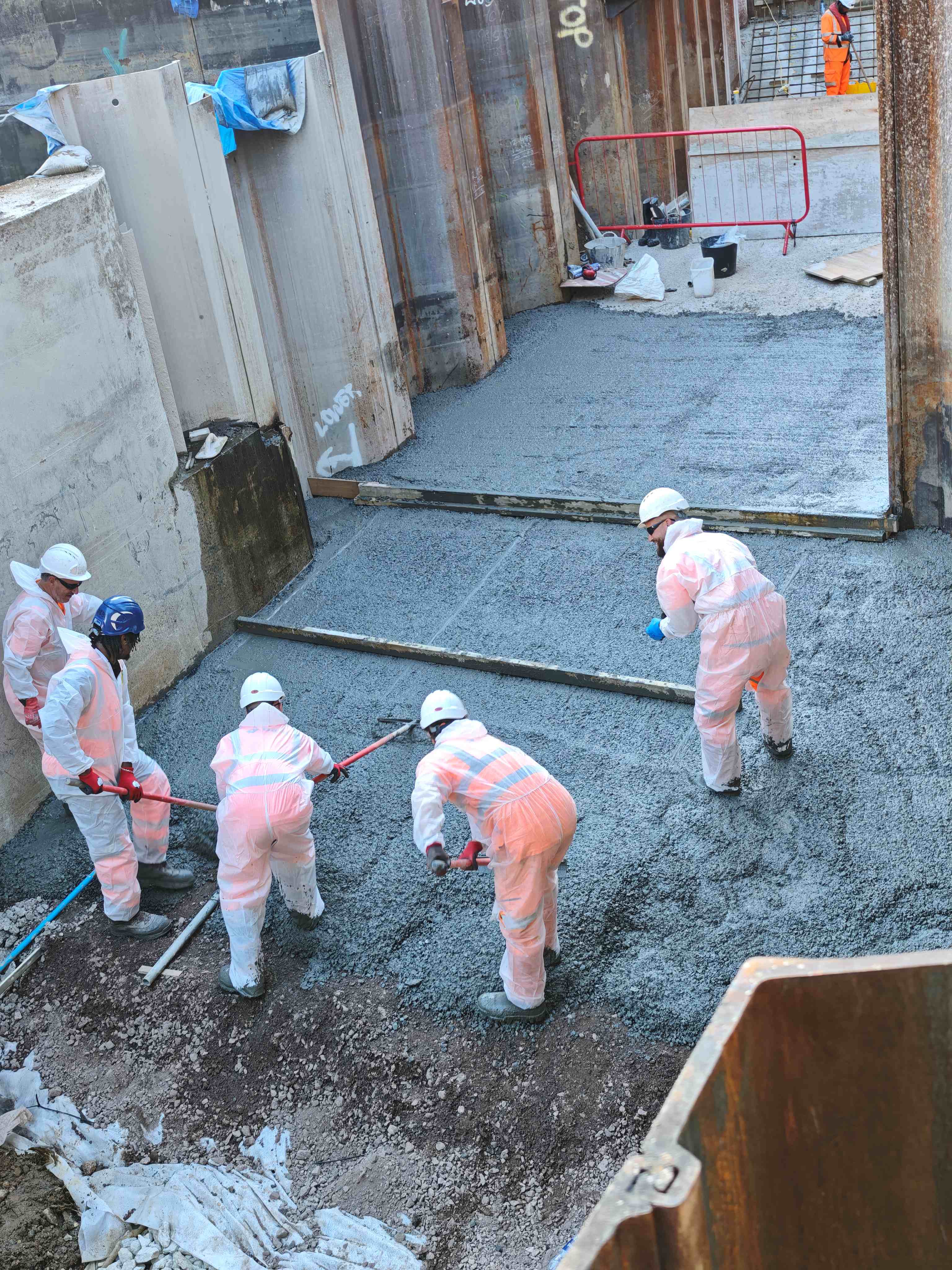
- The material was used as blinding concrete during construction of a multi species fish and eel pass at Bell Weir on the River Thames in Egham, Surrey.
- The concrete supplied has a A1-A3 GWP of -34kg CO₂e/m3, compared with around 150kg CO₂e/m3 for a standard concrete for this type of application.
- ACLA, supplied by Low Carbon Materials, is a carbon-negative aggregate-like biochar mineral matrix pellet that can be used as a lightweight replacement for the aggregate content in concrete.
Heidelberg Materials UK has worked collaboratively with BAM UK & Ireland and the Environment Agency to deliver the UK’s first carbon-negative in-situ ready-mixed concrete containing ACLA.
ACLA is a carbon-negative, aggregate-like, biochar mineral matrix pellet. It has been used in projects as a replacement for some of the aggregate content in order to decarbonise concrete and asphalt applications.
Working together, Heidelberg Materials and BAM UK & Ireland developed a blinding concrete used during construction of a multi species fish and eel pass at Bell Weir on the River Thames at Runnymede, Surrey. It formed part of refurbishment work being carried out with funding from the Environment Agency’s net zero carbon pilot programme.
Trials were carried out at Heidelberg Materials’ Greenwich evoHub laboratory and the finished concrete was supplied with an A1-A3 Global Warming Potential (GWP) of
-34kg CO₂e/m3. This compares with an equivalent GEN 31 concrete for this type of application which has a A1-A3 GWP of around 150kg CO₂e/m3.
The success of the project has resulted in a continuation of trials to evaluate different options for use in future BAM projects.
“This project is another example of our investment in innovation to minimise the carbon impact of our products,” said Daniel Clayton, Concrete Technical Director, Heidelberg Materials UK.
“The results are really exciting and demonstrate the potential for us to decarbonise the aggregate content of concrete as well as significantly reduce the carbon impact of the cement content through the use of supplementary cementitious materials and evoZero carbon-captured cement.”
Ian Hubbard, Managing Director of Social Infrastructure, Nuclear and Defence at BAM UK & Ireland, added: “The construction industry has made significant progress in reducing the embodied carbon of concrete, but reaching net zero requires us to continue exploring innovative solutions that challenge conventional practices.
“This trial at Bell Weir demonstrates how collaboration across the supply chain, supported by the Environment Agency, can help bring new technologies onto live projects and generate the evidence needed to accelerate their wider adoption.
“Trials like this play a vital role in our understanding of carbon-negative products, how they can be used in real-world applications and, most importantly, support the government’s drive towards net zero.”
ACLA is produced and supplied by Low Carbon Materials. It uses biochar which permanently ‘locks’ CO₂ into the concrete or asphalt, even when the material is recycled.
To find out more email: concrete.technical@heidelbergmaterials.com